

You bought a bottle of body oil for dry skin because your shins look flaky by lunch and your elbows feel rough against your sweater. You smooth it on after a shower, your skin feels soft for an hour, and then the tightness creeps back. That doesn't mean you chose badly or used it wrong every time. It often means you expected oil to do a job it was never built to do alone. Once you understand the one job oil does well, choosing a bottle and building a routine get much simpler.
What Body Oil Does and Does Not Do for Dry Skin
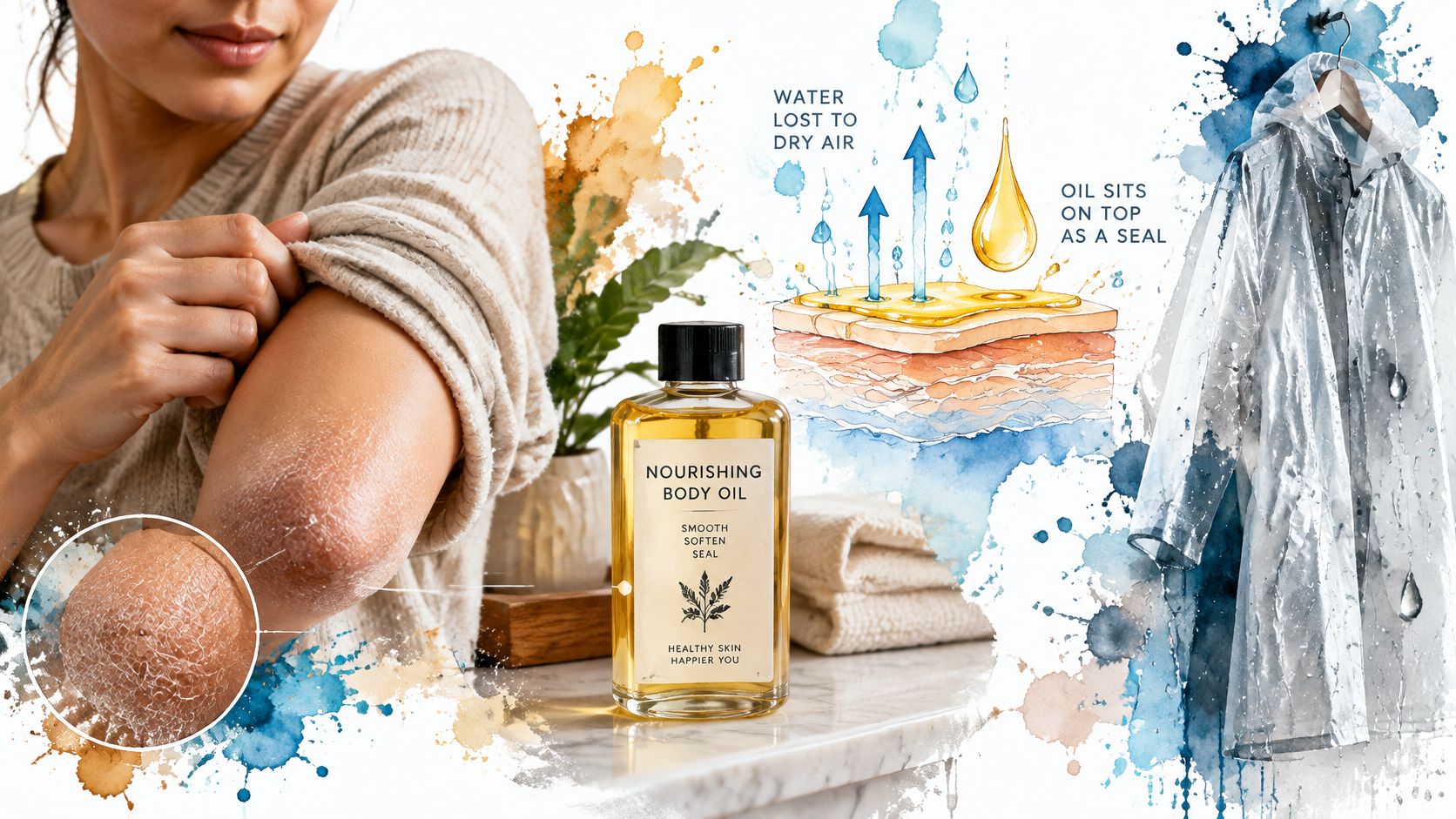
After a shower, skin still holds some water. A layer of oil can help slow its escape, which is why timing matters more than a rich feel or a glossy finish. To understand what oil can do, start with the skin's outer layer, the stratum corneum. It acts like a wall that helps keep water inside. Water naturally moves through this layer and evaporates, a process called transepidermal water loss.
Body oil forms a thin film over the surface. Like a light raincoat, it slows water loss and softens rough-feeling skin. It does not add water, so oil applied to already-dry skin has less moisture to hold in.
Two Different Jobs in a Routine
Oil and moisturizer can work together, but they do different jobs:
- Humectants hold water: Ingredients such as glycerin and hyaluronic acid attract water to the outer layer and help keep it there.
- Oils slow water loss: A plant oil spreads across the skin, softens rough patches, and reduces evaporation, especially when skin is still damp.
- Creams often combine both: A cream may provide humectants along with ingredients that soften or protect the skin. For very dry areas, using a body cream for dry skin can complement oil rather than compete with it.
People have long used oils to soften skin, while the science and terminology of moisturization have developed over time. A peer-reviewed review of moisturization history and occlusion discusses how different moisturizing ingredients work. One useful distinction is that petrolatum is far more occlusive than most plant oils, meaning it forms a stronger barrier to water loss.
A rich feel or glossy shine shows that oil is on your skin. It does not show how effectively it is slowing water loss.
That difference matters when dryness is severe. Plant-based body oil can soften skin and provide a partial barrier, and fatty acids such as linoleic acid may support the skin barrier in other ways. But a plant oil is generally less reliable than a strongly occlusive base when substantial water loss needs to be limited. Apply oil while skin is slightly damp, so the film helps hold onto water already present.
Body Oils Compared by Ingredient at a Glance
Common body oils by profile and feel
| Oil | Key lipid profile | Feel on skin | Occlusive strength | Best fit |
|---|---|---|---|---|
| Jojoba | Liquid wax esters, not a typical triglyceride oil | Light, silky, absorbs quickly | Light to moderate | Everyday dryness and a non-greasy feel |
| Argan | Oleic-leaning with a meaningful share of linoleic acid | Medium, smooth | Moderate | Elbows, legs and daily use after bathing |
| Squalane | Lightweight emollient, not a fatty acid | Very light, non-greasy | Light | Humid weather and layering under other products |
| Sunflower (high-linoleic) | Rich in linoleic acid | Light to medium | Moderate | Dry areas that need a linoleic-rich base |
| Safflower (high-linoleic) | Very high in linoleic acid | Light | Moderate | Lightweight oil with a linoleic-rich profile |
| Almond | Oleic-dominant with some linoleic acid | Light to medium | Moderate | Broad body use; check for nut allergy first |
| Coconut | Mostly saturated, with lauric acid | Rich, can firm up in cool rooms | High | Cold, dry seasons; tolerance varies |
| Olive | Oleic-dominant | Heavy, noticeable scent | High | Cooking more than skin; cautious on reactive skin |
The feel and occlusive strength above are general descriptions to help you compare, not measured values for any single product. Blends will fall somewhere between their ingredients, and how much you apply changes the feel a lot.
The Column That Changes Your Choice
Start with key lipid profile, because it explains why two clear oils in similar bottles can behave differently. Jojoba isn't a typical triglyceride oil at all. It's made of liquid wax esters, which is why it spreads thin, feels silky, and settles quickly. Squalane is different again. It's a lightweight emollient, not a fatty acid, so people often reach for it when they want slip without weight.
Sunflower and safflower need a second look at the label. The high-linoleic versions are rich in linoleic acid, while other versions of the same plant oils can lean the opposite way. Dermatology research summarized in a review of plant oils and barrier function indicates that oils with a higher linoleic-acid-to-oleic-acid ratio generally have stronger barrier-repair potential. High concentrations of oleic acid may disrupt how the outer layer is organized and increase irritation in susceptible skin.
That ratio helps you read the rest of the table. Argan and almond lean toward oleic acid but still contain linoleic acid, and many people use them comfortably for everyday dryness. Olive oil is also oleic-dominant, yet despite its natural reputation, it's been associated with barrier concerns and increased water loss in some studies. Coconut oil sits apart because it's mostly saturated. It feels richer and more protective in cold weather, though that same richness feels heavy to some people and doesn't suit every skin type.
Feel Is a Preference, Not a Ranking
Use the feel column to match your real life. If you get dressed quickly, a light oil you will use every day beats a heavy oil you skip. If your legs stay rough through winter, a moderate or richer option applied to damp skin may suit you better.
No row wins for everyone. Treat this as a first filter, then pay attention to how your own elbows, hands, and shins respond over the next couple of weeks.
How to Match an Oil to Your Skin and Read Its Label
Matching an oil to your skin situation
| Skin situation | What to look for | Caution |
|---|---|---|
| Everyday dryness on legs and arms | Light plant oil or squalane-based blend | Reapply after showers as needed |
| Rough patches on elbows, knees or heels | Richer oil, or oil layered with a cream or humectant product | Reassess after two weeks before changing again |
| Cold, low-humidity season | Richer oils such as coconut, or a blend with an occlusive base | Test a small area first if skin is sensitive |
| Warm, humid climate | Light, fast-absorbing oil or squalane | Heavier layers may feel uncomfortable |
| Reactive or sensitive skin | Short ingredient list, fragrance-free, familiar oil | Patch test before full-body use |
| Scent preference | Blend with essential oils or fragrance | Check the label; fragrance may appear as a single term |
| Severe dryness | Fragrance-free occlusive if a plant oil underperforms | Evidence broadly favors petroleum-derived occlusives for reliable barrier support |
When a Plant Oil Is Reasonable and When It May Fall Short
For mild, everyday dryness, a plant oil on damp skin is often a reasonable, pleasant choice. For severe dryness, be more demanding. A 2024 review found broad consensus that petroleum-derived oils generally provide stronger moisturization than botanical oils because they reduce water loss more reliably, as summarized in a 2024 review comparing petroleum-derived and botanical oils.
That doesn't make every plant oil weak. The same review notes a randomized double-blind study of 34 people with mild-to-moderate dryness where coconut oil performed comparably to mineral oil. Evening primrose oil has also been associated with improvements in moisturization, roughness, and water loss. The practical lesson is to judge by how your skin holds moisture, not by whether a bottle sounds natural or feels luxurious for five minutes.
A useful test: If your skin feels soft right after application but tight and flaky again within hours, day after day, the film may not be enough on its own. Add a humectant or cream layer, or switch to a stronger fragrance-free occlusive for those areas.
What Labels Can and Cannot Tell You
In the United States, retail cosmetics must carry an ingredient list, and most ingredients must be listed individually. Fragrance and flavor ingredients may generally appear under the single term Fragrance or Flavor, according to U.S. Food and Drug Administration guidance on fragrances in cosmetics. The FDA also notes that essential oils have no regulatory definition.
So words like natural, plant-based, or clean don't predict how well a formula will slow water loss. Read the actual list. Look for the base oil, notice where fragrance appears, and check whether aromatic plant extracts are present if scent bothers you. Choose by your skin situation first, then by scent and feel.
When Body Oil Needs Extra Caution
Natural doesn't automatically mean gentle for your skin. An oil can come from a plant and still sting, clog, or irritate you, especially when fragrance or essential oils are part of the blend. A few simple checks keep a body oil for dry skin in the realm of everyday self-care, where it belongs.
Checks to Do Before Full Use
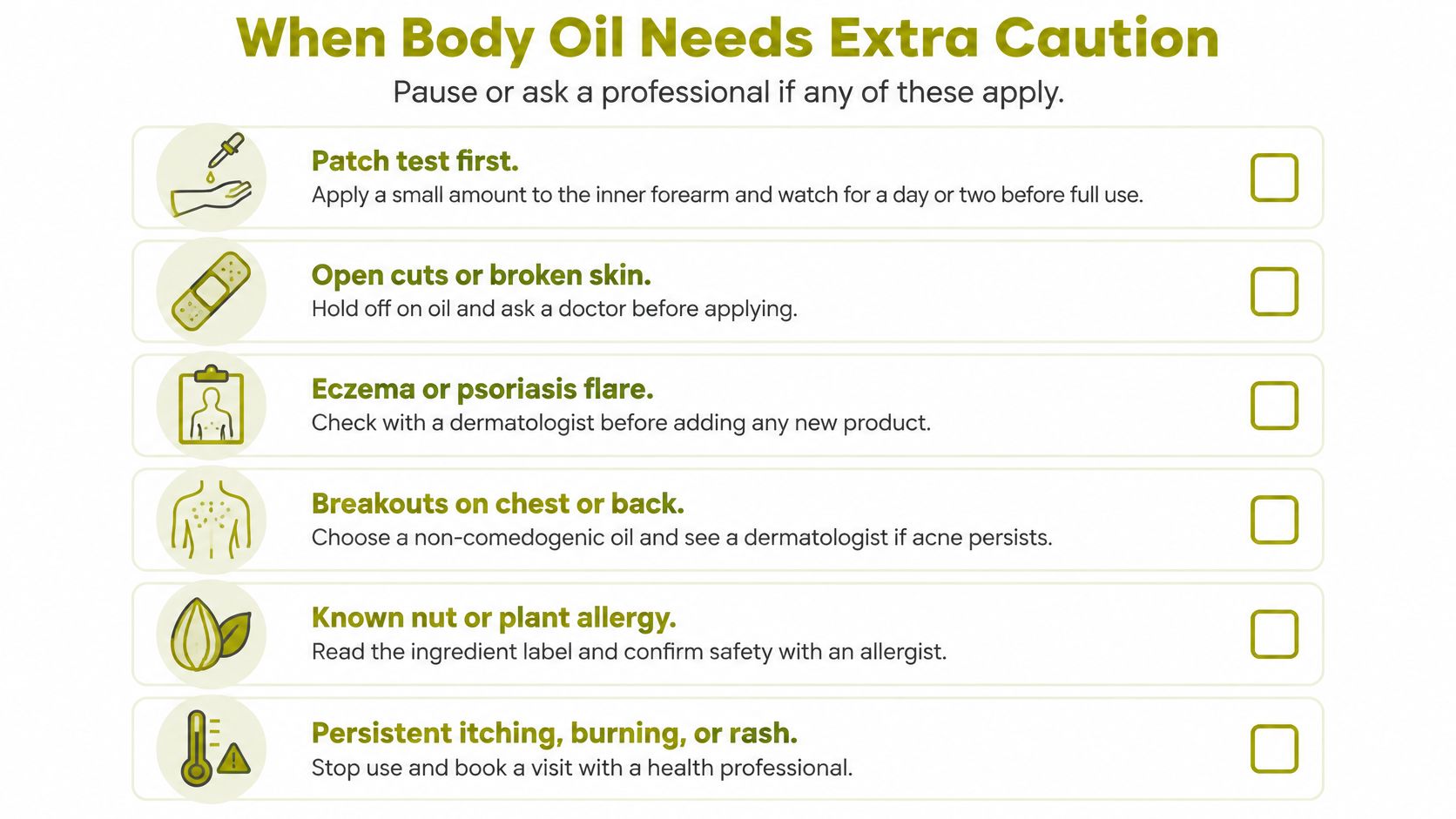
- Patch test first: Smooth a small amount on your inner forearm and watch the area for a day or two before using it across your body.
- Check for nut sources: Almond oil deserves extra care if you have a nut allergy. Read the label and ask your own clinician if you're unsure.
- Treat scent as an ingredient: Fragrance and essential oils are common sources of sensitivity. If your skin is reactive, start fragrance-free, and review guidance on how to use essential oils for skin before choosing a scented blend.
- Skip broken skin: Don't apply oil to broken, cracked, or inflamed areas without guidance from a healthcare professional.
- Watch the floor: Oil in a tub, shower, or on bathroom tile creates a real slip hazard. Apply it once you're out and standing on a dry surface.
Stop using a product if you notice stinging, burning, itching, or redness that doesn't settle quickly. That's information about fit, not a sign you should push through. Try a simpler, fragrance-free option only after your skin feels calm again, and patch test that one too.
Infants and young children need a different standard. Use only products their own healthcare provider recommends for them, rather than assuming an adult body oil is appropriate.
Signs to Get a Professional Opinion
Body oil supports softness and moisture retention. It isn't a treatment for any condition, and it shouldn't replace advice or prescribed care. Persistent scaling, fissures, inflammation, or suspected eczema are reasons to seek medical evaluation rather than trying another bottle.
The same applies when dryness keeps spreading, cracks bleed, or itching disrupts sleep. At that point, the helpful question is no longer which oil to buy. It's what is driving the barrier problem in the first place.
How to Apply Body Oil and Build a Simple Routine
Timing does more work than many people expect. The same oil can feel disappointing on completely dry skin at night and truly useful on damp skin after a shower, because only the second method gives it water to hold in.
A Calm Routine You Can Repeat
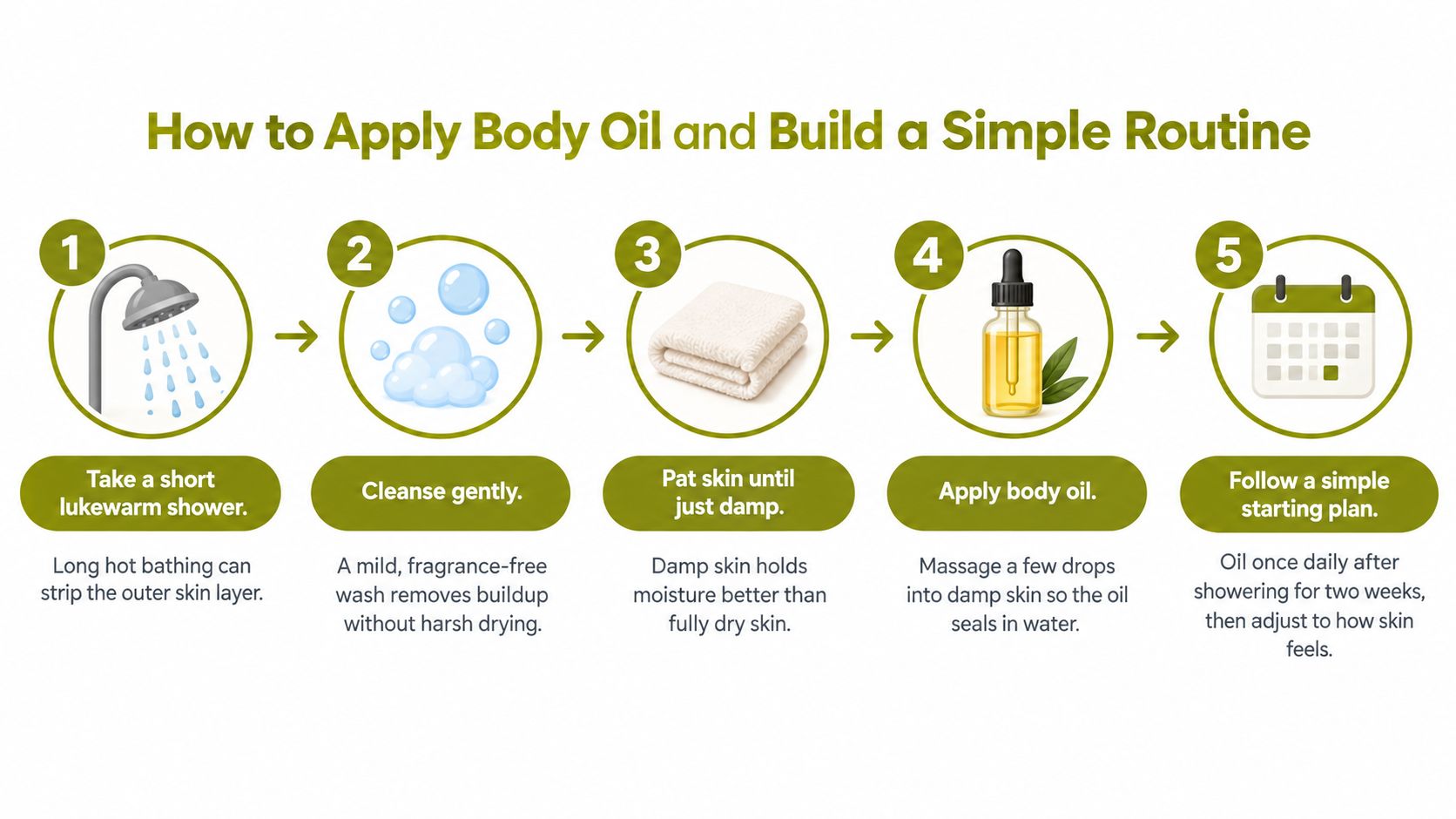
- Keep showers short and lukewarm. Long, hot bathing can strip the outer layer and leave you starting from behind.
- Cleanse gently. Use a mild wash where you need it and avoid vigorous rubbing with rough cloths.
- Pat, don't rub, and leave skin damp. The American Academy of Dermatology guidance on relieving dry skin recommends gently patting dry and applying a fragrance-free moisturizer while skin remains damp.
- Warm a small amount between your palms. Smooth it on in long strokes, starting with elbows, knees, hands, and legs. Add more gradually instead of starting heavy.
- Let it settle before dressing. A minute of patience keeps more oil on your skin and less on fabric.
- Layer when dryness is substantial. Smooth a fragrance-free cream or lotion over or under the oil on rough areas, since oil alone doesn't add water.
- Reapply lightly during the day. After handwashing and whenever skin feels tight, a small repeat application works better than relying on one heavy morning layer.
- Apply outside the tub or shower. A dry floor keeps the routine safe and makes dosing easier.
For portion awareness, the NHS guidance on emollients describes around one teaspoonful mixed with warm water in the palm for emollients used as a cleanser or soap substitute. Body oils vary, so treat that as a reminder to start small and adjust by feel, not as an exact dose.
The video below shows the basic application motion on damp skin if you prefer to watch the sequence once before trying it.
Run your patch test before the first full use, then keep the starting plan simple. Oil once daily after showering for two weeks, layer cream only on the roughest spots, and note what changes. If you want a plant-based option, ArtNaturals Lavender + Jasmine Face & Body Oil is one scented choice listed for dull and dry skin, and you can compare it with the broader steps in a dry skin care routine before deciding. Consistency will teach you more than switching bottles every few days.
How Long to Give Body Oil Before Judging Results
Evaluation timeline for a body oil routine
| Timeframe | What you may notice | What to do |
|---|---|---|
| Day 1 | Softer, smoother feel right after application that fades over hours | Apply to damp skin at the same time each day |
| Days 2 to 7 | Less tightness between applications; some people notice early flaking | Keep the routine consistent and note persistent dry areas |
| Week 1 | Measured water loss can rise briefly, as seen across moisturizers in a clinical study | Avoid judging the routine on the first week alone |
| Week 2 | Hydration improvements reported for several plant oils in a multicenter study | Compare with day one and adjust the oil's weight if needed |
| Weeks 3 to 4 | A clearer pattern of which areas improve and which stay rough | Decide to keep the oil, switch oils, or add a humectant or cream |
| Beyond four weeks | Persistent scaling, cracking or redness that does not improve | Seek guidance from a healthcare professional |
Why Two Weeks Is a Fairer Test
One application only tells you about feel. In a multicenter randomized study of adults with xerosis, almond, jojoba, and coconut oils produced statistically significant increases in skin hydration after 2 weeks and performed comparably to white petrolatum as daily moisturizers, as reported in the PubMed record for that multicenter study. The same study observed an initial week-1 increase in measured water loss across the tested moisturizers, followed by improved hydration.
That early rise is why a first-week verdict can mislead you. Give a body oil for dry skin at least two weeks of consistent, post-shower use before you decide it failed, unless you develop irritation. Irritation is always a reason to stop sooner.
Judge the routine by how your skin feels just before the next application, not by the shine right after you apply it.
A Simple Way to Track Change
Pick the same time of day and the same three areas, perhaps one shin, one elbow, and the backs of your hands. Write one short line about tightness, flaking, and comfort before application. After two weeks, compare those notes with day one.
Then make one change at a time. If most areas improve but heels stay rough, keep the oil and add a cream there. If everything feels slick but still tight, you may need a humectant layer or a stronger occlusive. If scaling, cracking, or redness persists beyond a few weeks of steady care, let a healthcare professional look at it rather than extending the experiment.
If you're building a gentler routine around damp-skin application and thoughtful layering, ArtNaturals offers plant-based body oils, moisturizers, and bath and body care you can compare by ingredient list and skin concern. Read each label carefully, start with a patch test, and choose the weight and scent you will use consistently after every shower.