

Your curls looked fine after wash day, then turned dull, heavy, and oddly sticky by the next morning. You add more conditioner, smooth on another cream, and still the strands feel coated rather than nourished. With high porosity hair, that experience can mean buildup, but it can also mean the cuticle is already too worn for a stronger cleanser.
That distinction matters. Clarifying shampoo for high porosity hair isn't just a more powerful version of your everyday wash. It's a chemistry decision: first identify what's sitting on the strand, then choose the mildest routine that removes it without taking away the moisture your hair struggles to retain.
What a Clarifying Shampoo Actually Does for Your Hair
Run your fingers through a curl that feels coated after washing. The strand may seem smooth at first, but it lacks bounce. When wet, it can feel tacky or waxy. Once dry, it may look dull, lose definition, or refuse to absorb the leave-in conditioner that normally works well.
That's where a clarifying shampoo can help. It's a deeper-cleaning cleanser designed to lift residue that regular shampoos may leave behind, including excess oil, dry shampoo, styling film, hard-water minerals, and environmental impurities. The purpose is to create a cleaner surface so your usual conditioner and styling products can behave more predictably. You can find a plain-language overview of this reset step in ArtNaturals' guide to clarifying shampoo.
Buildup has a recognizable feel
Buildup isn't always visible as a dramatic layer. It may show up as curls that feel heavy at the roots, ends that stay dull despite conditioning, or a strand that takes longer to become fully wet. Products can seem to sit on top instead of spreading through the hair.
Common sources include mousses, gels, hairsprays, oils, silicones, sweat, sebum, chlorine, pollution, and hard-water minerals such as calcium and magnesium. These deposits can collect unevenly, especially when the cuticle surface is raised.
A clarifying wash acts more like a reset than a normal appointment with shampoo. It isn't intended to replace your regular cleanser, and it shouldn't become a daily response to every dry or frizzy hair day.
Practical rule: Clarify when the hair feels coated or unusually resistant to products, not simply because it feels dry.
High porosity hair needs extra care because its outer cuticle is often more open or worn. A strong cleanse may remove the film you dislike, but it may also leave the strand more exposed. The right approach starts with understanding how that open structure behaves.
How High Porosity Hair Behaves Day to Day
Think of the cuticle as a roof made from overlapping shingles. On a well-sealed roof, the shingles lie close together and help keep the inside protected. On high porosity hair, some of those tiny shingles are lifted, chipped, or worn, so water and products can move in quickly, then escape almost as quickly.
That explains a familiar contradiction. Your hair absorbs water the moment you step into the shower, yet it feels dry soon after drying. A rich cream may seem to disappear into the curls, while a heavier oil can collect along uneven areas of the strand and leave a film.
Notice the pattern, not one isolated sign
High porosity hair often:
- Dries quickly: The strand takes in water readily, then releases moisture with similar speed.
- Loses definition: Curls can look shaped after washing but become fuzzy or stretched as the day continues.
- Feels rough or catches: Raised cuticle edges can create friction between neighboring strands.
- Needs richer support: Heavier moisturizers, masks, creams, and oils are often used to slow moisture loss, as described in Dyson's explanation of hair porosity.
A product that absorbs quickly isn't automatically helping. Sometimes it sinks into the irregular surface. Sometimes it leaves behind ingredients that attach to raised edges, especially when you layer several stylers without a thorough but gentle cleanse.
Why cleansing feels different
A low-porosity strand may resist water and product at first. High porosity hair usually doesn't have that problem. Its challenge is retention, not access. Cleansing therefore has to remove residue while preserving enough lubrication for detangling and enough flexibility for the cuticle to feel comfortable.
Heat styling, chemical processing, and environmental exposure can all contribute to a more lifted surface, although some people naturally have more porous hair. Day-to-day behavior offers more useful clues than a single at-home water test. Look for a repeating pattern of rapid wetting, rapid drying, frizz, tangling, and changing product response.
How Clarifying Shampoos Lift Buildup
A clarifying shampoo works through a cleansing system rather than water alone. Shampoos are commonly made up of 80% to 90% water, but the water mainly carries the formula across the hair and helps rinse it away. The lifting action comes from surfactants and, when mineral deposits are involved, chelating agents. This composition is discussed in Healthline's explanation of clarifying shampoo.
Surfactants act like tiny grease lifters
A surfactant has one part that interacts comfortably with water and another part that interacts with oils and residue. As you massage the shampoo through the hair, those oil-loving parts attach to sebum, styling film, and other deposits. Rinsing then carries the captured material away.
The process is similar to dish soap cutting through grease, although hair needs a much more careful balance. Everyday shampoos generally use cleansing systems designed for regular use. Clarifying shampoos often use stronger or more complete cleansing systems, which can be useful when the strand is coated but unpleasant when the hair is already dry.
Chelators target minerals
Hard water leaves a different kind of residue from gel or oil. Calcium and magnesium can cling to the strand and make hair feel stiff, dull, or resistant to conditioning. Chelating agents help by binding these minerals into water-soluble complexes, allowing them to rinse away more effectively.
That's why an effective formula may include both surfactants and chelators. The surfactants handle oils and product residue, while the chelators address mineral deposits. You can learn more about how acidic ingredients are used in scalp and hair formulas through ArtNaturals' discussion of glycolic acid for the scalp.
Strength becomes a question of dosage
High porosity hair can respond intensely to this lifting action. The open cuticle gives residue more uneven places to cling, but it also leaves the fiber more vulnerable to dryness after cleansing. A clarifier can rescue hair that feels sealed under product, yet the same product may make already rough hair feel harsher.
Look for a measured reset rather than a dramatic “squeaky clean” result. Hair should feel lighter and cleaner, not stripped of all slip. If the strand feels brittle immediately afterward, the formula or the timing may be too aggressive.
Buildup Symptoms vs Damage Symptoms
The most useful question isn't, “Does my hair feel dry?” Both buildup and damage can create dryness. Ask instead, does the hair feel coated, or does the fiber feel worn?
Buildup tends to appear as a change from your normal behavior. Your curls may suddenly look limp, feel waxy when wet, or resist products that used to absorb easily. You may notice white or grayish material that rinses away rather than crumbles like dry skin. Styling residue from gels, mousses, and hairsprays can create this type of surface problem.
Damage behaves differently. Frizz stays present even after a fresh wash, strands may feel rough or gummy, and split ends can catch during detangling. Knots that form along the mid-lengths, rather than mainly near the scalp, can point to a roughened cuticle surface.
Use a simple observation test
Wash one small section with your normal gentle cleanser and observe how it responds. If it feels coated, dull, and resistant to water or conditioner, buildup may be involved. If it feels rough, tangles immediately, or loses moisture almost as soon as it dries, a clarifier may not address the main concern.
Don't pull hard on a strand or treat a home test as a diagnosis. The purpose is to compare texture, wetting, slip, and behavior before changing your routine.
Buildup vs Damage at a Glance
| Clue | Likely Buildup | Likely Damage |
|---|---|---|
| Appearance | Sudden dullness or limp curls | Persistent frizz and a rough-looking surface |
| Wet feel | Waxy, tacky, or resistant to water | Gummy, coarse, or fragile |
| Rinse response | White or grayish residue rinses away | No clear improvement after cleansing |
| Styling response | Products sit on top or stop absorbing | Products absorb quickly but moisture doesn't last |
| Detangling | Hair feels coated near the surface | Split ends catch and tangles form through the mid-lengths |
High porosity hair can show both patterns at once. A clarifying wash may remove the film, but it won't rebuild a worn cuticle. When the clues point toward damage, prioritize conditioning, gentle handling, reduced heat, and an appropriate repair treatment instead of repeating the reset.
Ingredients to Prefer and Avoid
The label matters more than the word “clarifying” on the front. Two formulas can promise a deep cleanse while creating very different experiences for porous hair. Look for a combination that addresses residue and minerals without making the strand feel raw.
Gentle chelators, balanced surfactants, and supportive humectants can make a formula more comfortable. Ingredients such as sodium citrate and disodium EDTA help bind minerals, while sodium cocoyl isethionate and cocamidopropyl betaine can provide cleansing with a milder profile. Aloe, glycerin, and panthenol may add a more conditioned feel, although the full formula and your own response still matter.
Clarifying Shampoo Ingredients: Prefer vs Avoid
| Ingredient Type | Prefer | Avoid |
|---|---|---|
| Chelators | Sodium citrate, disodium EDTA, and other mineral-binding ingredients | A formula that relies on aggressive cleansing without mineral support |
| Surfactants | Sodium cocoyl isethionate, cocamidopropyl betaine, and balanced cleansing blends | High-strength sulfates such as sodium lauryl sulfate when your hair already feels dry |
| Moisture support | Aloe, glycerin, and panthenol | Strong drying alcohols high on the ingredient list |
| Silicones | Choose according to how your hair responds and how easily you can remove residue | Heavy dimethicone if your lifted cuticle accumulates film quickly |
| pH support | A slightly acidic formula and an acidic conditioner afterward | Highly alkaline products that can swell the hair shaft further |
A low pH matters because alkaline products can swell the hair shaft and open the cuticle more. Formulas around pH 4.5 to 5.5 are commonly cited as a useful slightly acidic range for high porosity hair in this pH-focused clarifying shampoo guide.
If sulfate-free cleansing is part of your routine, this guide to sulfate-free shampoo can help you understand how to read that label. Patch test a new product on a small area of skin, and test the shampoo on one section of hair before using it across your entire head.
How Often to Clarify and What to Do After
For many high porosity routines, every two to four weeks is a reasonable starting range, but your hair's feedback should set the pace. A swimmer, someone living with hard water, or a person who uses heavy stylers may need a more targeted mineral or residue reset. Someone with a minimal routine may need clarification less often.
A monthly approach is also commonly recommended for high porosity hair, while other guidance suggests avoiding traditional clarifiers when they feel too drying. That disagreement makes sense because porosity, styling habits, water quality, and formula strength differ from person to person.
Watch for signs that you're clarifying too much
Pause the reset and return to a mild cleanser if you notice:
- Squeaky dryness: The hair feels stripped rather than clean.
- More tangling: Detangling becomes harder after washing.
- A tight scalp feel: The scalp feels uncomfortable or unusually dry.
- Oil rebound: The scalp seems to become oily soon after cleansing.
These signals don't prove a particular ingredient is responsible, but they tell you the routine needs less cleansing intensity. The aim is a flexible strand, not a completely frictionless surface.
Restore the strand immediately
Use lukewarm water rather than hot water. After rinsing the clarifier, apply a pH-balanced conditioner with light proteins if your hair responds well to protein, then add a leave-in conditioner while the hair is still damp. Finish with a humectant-rich styler or a lightweight oil to slow moisture loss.
A deep-conditioning mask can be especially useful when the hair feels porous and thirsty after cleansing. The sequence matters: remove residue, add water and conditioning agents, then use a leave-in or sealant to help the hair hold onto that support.
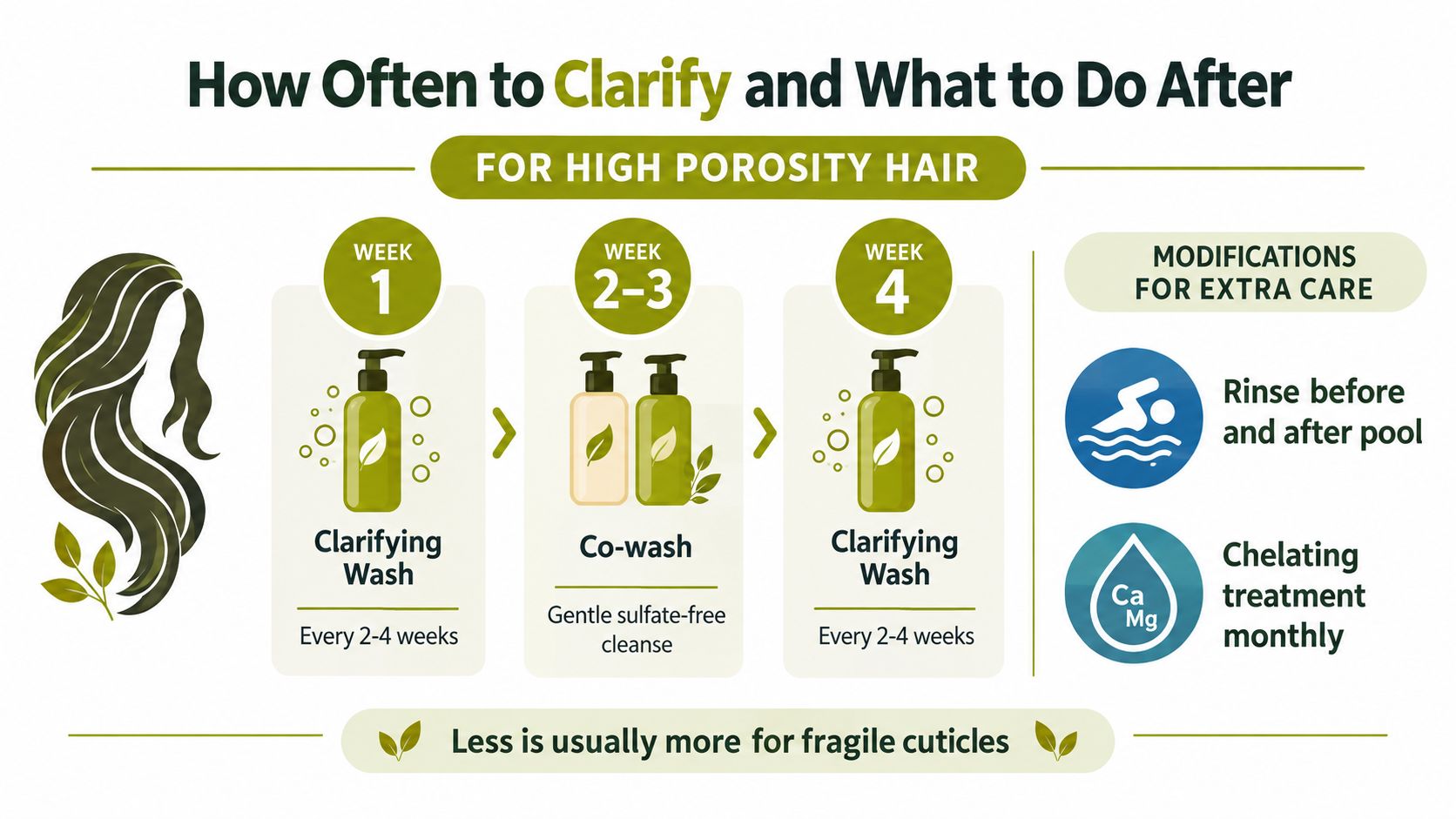
After-wash check: Your hair should feel clean, soft, and flexible. Bone-dry hair is asking for a gentler formula, more conditioning, or a longer gap between resets.
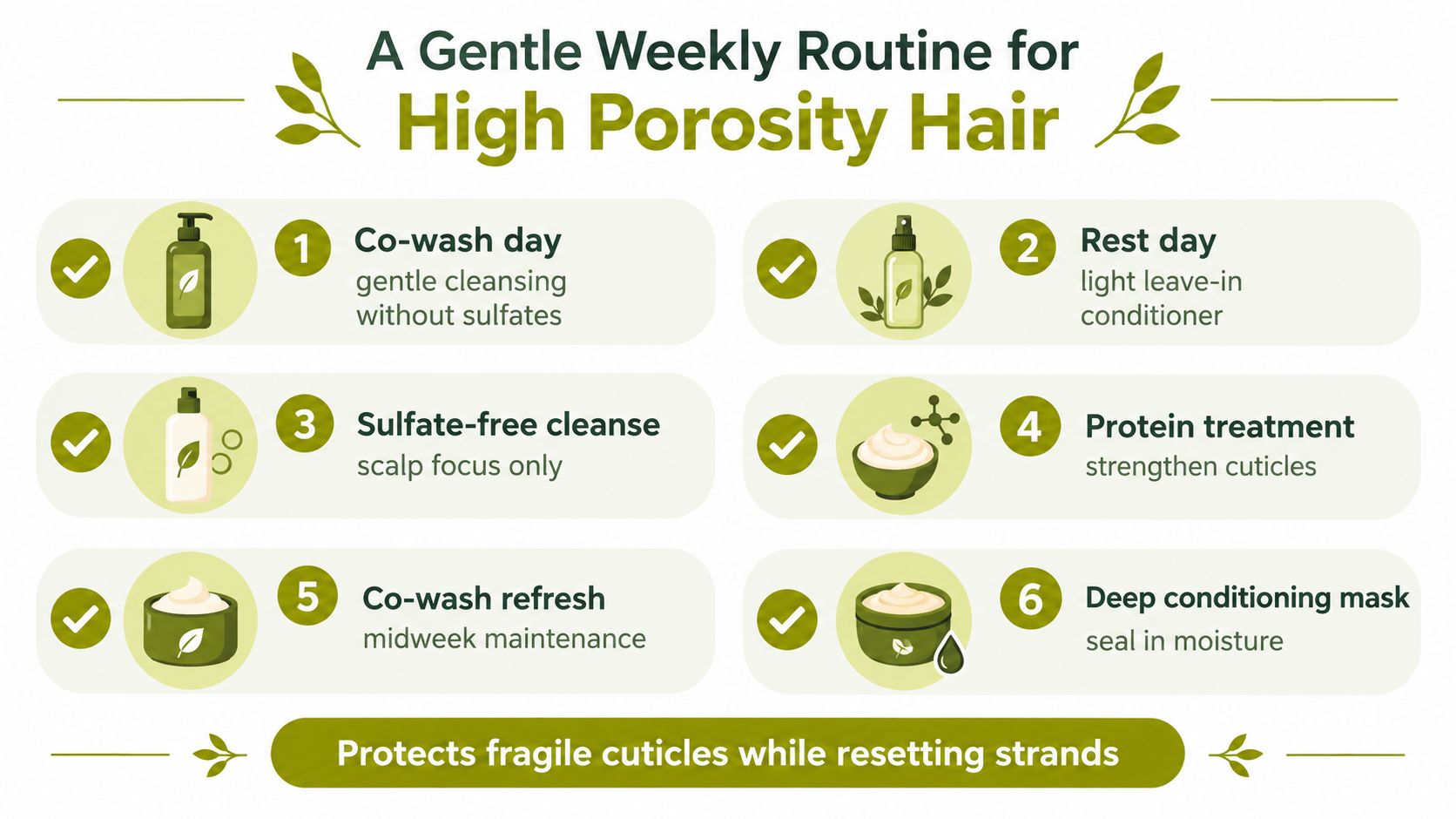
A Gentle Weekly Routine for High Porosity Hair
A good routine leaves room for adjustment. High porosity hair often benefits from regular moisture support, but that doesn't mean every wash should be a clarifying wash. Build the week around mild cleansing and conditioning, then use a reset only when your observations point to residue.
Start with a simple rhythm
First wash day: Use a co-wash or gentle sulfate-free cleanser, focusing the shampoo on the scalp and allowing the diluted lather to pass over the lengths. Follow with conditioner, a leave-in, and a small amount of sealing oil or butter on the ends.
Between washes: Refresh with a light leave-in or conditioning mist instead of adding several layers of cream and gel. If the curls feel soft and responsive, leave them alone. More product isn't always more moisture.
Targeted reset: Use clarifying shampoo only when the hair shows clear buildup clues, such as dullness, a waxy wet feel, or products sitting on the surface. Keep the cleanser mainly at the scalp and coated areas, then condition the lengths generously.
Repair and moisture: Alternate a deep-conditioning mask with a light protein treatment when your hair benefits from that balance. High porosity hair can need both hydration and structural support, but too much of either can make the hair feel less predictable.
End-of-week review: Ask whether your hair feels coated, dry, rough, springy, or flexible. That answer determines whether the next wash should be a reset, a gentle cleanse, or just a conditioning refresh.
Use tests as conversation starters
A strand-stretch check can offer a rough sense of how the hair is behaving. A strand that feels overly soft and weak may prefer a light protein step, while a strand that feels stiff may need more conditioning and less cleansing. The result isn't a diagnosis, so use it alongside your day-to-day observations.
You can also watch how water interacts with the hair. If water beads on a particular section, product may be sitting on the surface. If the hair absorbs water instantly but dries quickly, focus on moisture retention and cuticle support rather than automatically reaching for a clarifier.
Cool-water finishing and pH-conscious conditioning are small habits that can improve manageability after cleansing. They won't change the underlying porosity, but they can help the cuticle feel less raised and reduce the friction that makes detangling unpleasant.
Treat clarifying as an occasional reset inside a plant-focused self-care routine, not as a weekly obligation. ArtNaturals offers haircare options such as Tea Tree Oil Shampoo and Moroccan Argan Oil with aloe shampoo, which can fit into a cleansing routine when you compare the ingredient list and your hair's response with the needs described here.
Visit ArtNaturals to explore plant-focused shampoos, conditioners, oils, and masks that can support a simple routine for dry, coated, or hard-to-manage hair. Choose a gentle cleanser for regular wash days, reserve deeper cleansing for genuine buildup, and pair every reset with conditioning and moisture sealing.