

Haircare is a big slice of the clean beauty aisle, and the words on the front of a bottle rarely tell you how long a formula stays on your hair. Clean beauty hair products make more sense when you read amount, rinse-off versus leave-on contact, and how the hair feels, instead of treating a free-from badge as the whole story.
What Clean Beauty Means for Haircare
Haircare accounted for 18.9% of global clean beauty revenue in 2025, about USD 2.4 billion, according to Market Intelo. That share is why shampoos, conditioners, oils, and masks now carry the same front-label language you see on skincare.
Picture a Saturday shop. You pick up a bottle because the cap says plant oils. The question is not whether the word sounds gentle. The question is what the formula is built to do: lift oil from the scalp, soften lengths, or add slip so a comb moves.
Three labels people merge
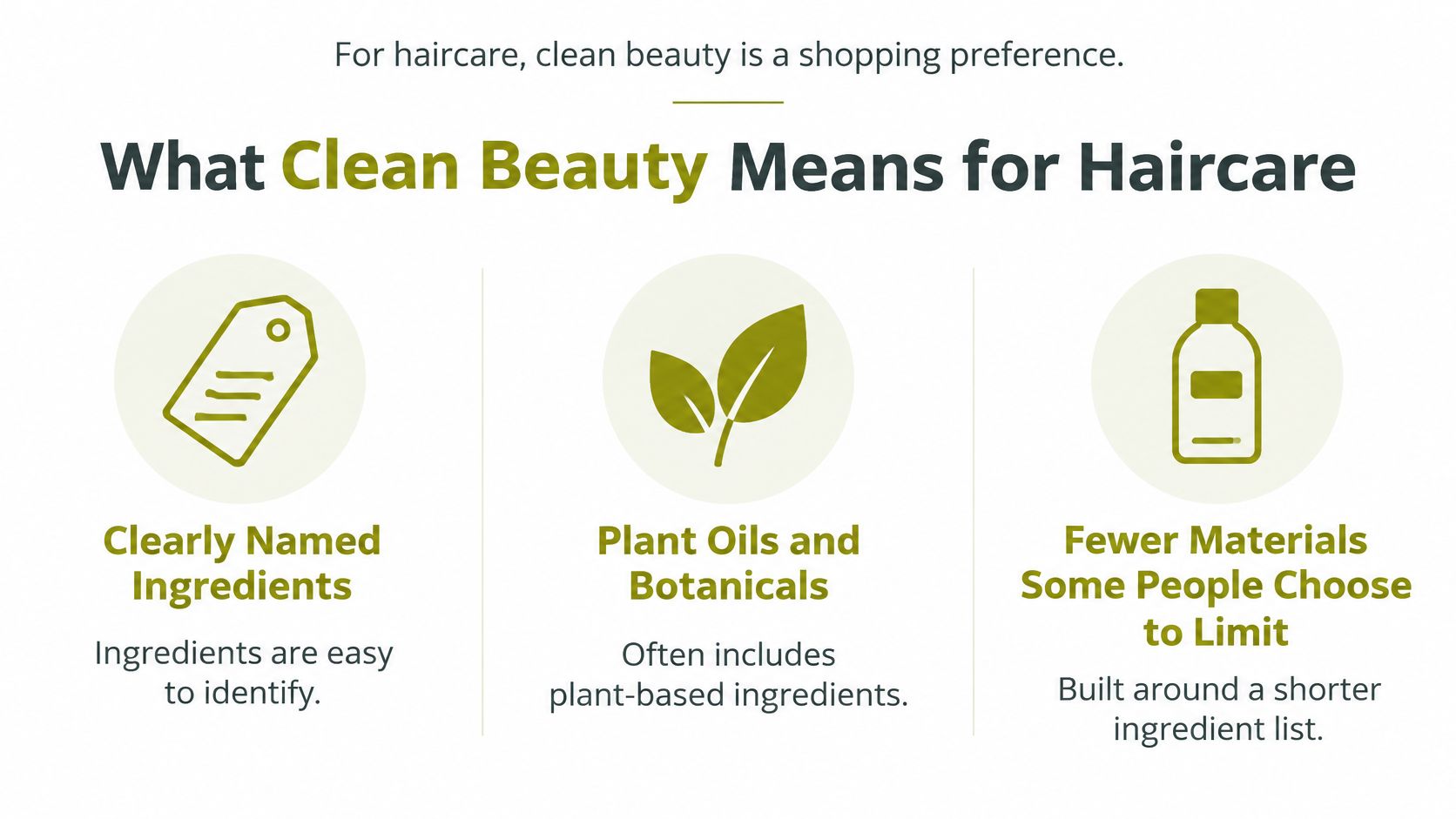
Clean is usually a brand or retailer standard. It often means clearly named ingredients, plant oils and botanicals, and fewer materials many shoppers choose to limit. The formula still has to cleanse, soften, or add slip.
Natural often points to a plant source. It doesn't automatically mean gentle. A botanical scent can still bother a scalp that dislikes fragrance.
Free-from is a short avoid list. It says little about the rest of the bottle.
Those three words work like a restaurant menu that says "house style" instead of listing the dishes. You still need the dishes. In the United States, clean, natural, and plant-based are not one legal safety certificate. They don't replace a readable ingredient list.
A cleaner label helps when it adds context about amount, contact time, and the full list.
The practical test is the panel on the back, not the badge on the front. The next pass is a simple scan of what the first names are.
How to Read a Haircare Label
Start on the ingredient panel. In the United States, retail cosmetics, including hair products, must show an ingredient declaration that is conspicuous and likely to be read at purchase, and FDA labeling guidance requires those ingredients in descending order of predominance. The first names generally make up the largest share. The word "natural" doesn't replace an ingredient's common or usual name.
Read the base first
The opening names are the base of the bottle.
Water near the top means a watery shampoo, conditioner, or leave-in, not a pure oil.
A cleanser near the top means the product is built to lift oil and product film.
A plant oil among the first names means oils are a large share, which fits a hair oil or a rich mask more than a light daily shampoo.
A conditioning agent early in the list means slip and softness are the main job.
A name at the end is a smaller share. That placement doesn't make it unimportant. Preservatives and scent materials often sit there and still affect how the product feels on skin.
Label signals worth a second look
| Signal | What it usually means | How to use it |
|---|---|---|
| Plant oil among the first ingredients | A larger share of the formula | Note if the product is a cleanser, a conditioner, or a leave-on oil |
| Sulfate such as sodium lauryl sulfate | Stronger foam and oil removal | Keep for oily scalps; ease off if lengths feel squeaky |
| Silicone such as dimethicone | Surface slip and temporary shine | Useful for frizz; wash more thoroughly if hair feels coated |
| Fragrance or parfum | An umbrella scent term | Choose named materials or fragrance-free if scent bothers you |
| Named essential oil | A botanical scent that can still sensitize | Patch-test leave-ons and skip undiluted oil on the scalp |
| Preservative near the end | A small-share stabilizer in watery formulas | Expected in many shampoos and leave-ins |
| Free-from badge only | A short marketing avoid list | Still read the full ingredient panel |
Sodium lauryl sulfate is a strong cleanser. It can suit an oily scalp and feel stripping on dry lengths.
Dimethicone lends surface slip and shine. If hair feels coated after several uses, a more thorough wash clears that film before you add more slip.
Fragrance or parfum is an umbrella term. A sensitive shopper looks for named scent materials or a fragrance-free formula. A named essential oil is still a scent.
A preservative near the end of a watery formula is there to keep the product stable. A free-from badge is a headline, not the formula.
Practical rule: Read the first five ingredients of one product aloud before you buy.
Say each name and the job you think it does. If you can't tell whether you're holding a cleanser, a conditioner, or a leave-on oil, put the bottle back and check another panel.
Clean and Conventional Ingredients Side by Side
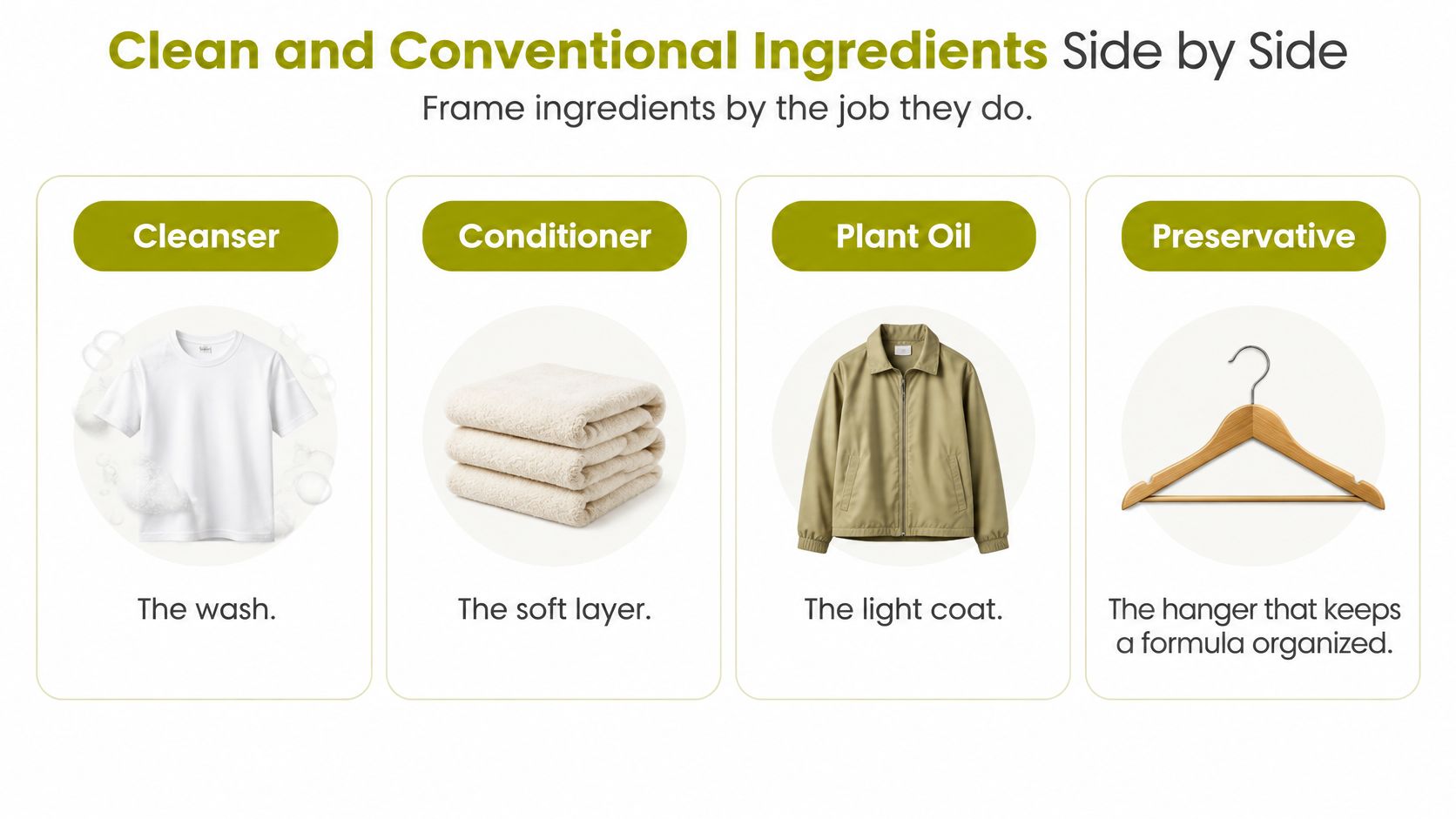
Ingredients earn their place by the job they do. A cleanser is the wash. A conditioner is the soft layer. A plant oil is the light coat. A preservative is the hanger that keeps a water-based formula wearable past the first week.
Same jobs, different materials
| Formula job | Often conventional | Often clean-positioned | Realistic result |
|---|---|---|---|
| Cleansing | Sulfate surfactants | Milder surfactants, sometimes with oils | Removes oil and product; too mild can leave buildup |
| Conditioning | Quats and silicones | Conditioning agents plus plant lipids | Softer feel and less tangling on the surface |
| Scent | Fragrance or parfum | Essential oils or named botanicals | A pleasant smell; either can bother a sensitive scalp |
| Preservation | Listed preservatives | Still required in many water-based formulas | Helps the product stay stable on the shelf |
| Shine | Silicones or oils | Plant oils such as argan or shea lipids | Less friction and temporary light reflection |
Conditioning agents cling to a weathered hair surface. Lipid-rich oils such as argan or shea reduce friction, so hair feels smoother and tangles less. That is cosmetic feel. Oil on a label isn't evidence of new growth, and it doesn't rebuild structure inside the fiber after heat or color stress. Easier combing is a surface result.
A short video walk-through of ingredient jobs can make the wardrobe picture easier to keep in mind while you shop.
Contact time changes the scent rule
Under the EU Cosmetics Regulation, certain fragrance allergens must be listed individually when they exceed 0.001% in leave-on products, including leave-on hair products, or 0.01% in rinse-off products. A shampoo can sit at a higher level before that named disclosure is triggered, because a leave-on oil or scalp treatment stays in contact longer.
Plant-based or clean doesn't mean a scent will suit everyone. Essential oils and fragrance blends can both bother a sensitive scalp. Patch-test a new leave-on, and skip undiluted essential oil on skin. A water-based shampoo or leave-in still needs a preservation system so it stays stable on the shelf.
Match one job to one product. If foam is the problem, look at the cleanser, including whether a sulfate-free shampoo fits your scalp, instead of hunting a single hero oil.
Choosing Products for Your Hair Concern
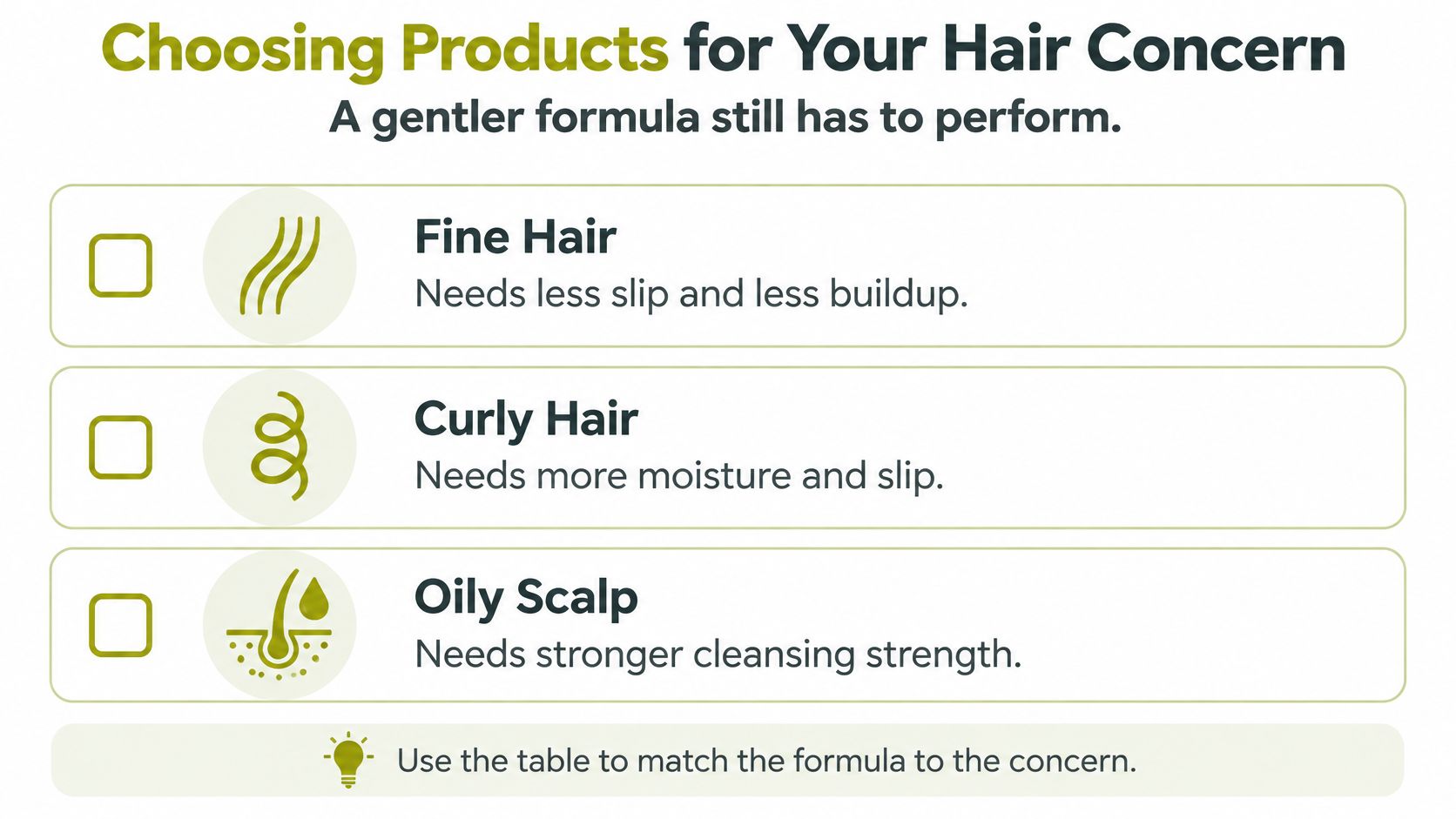
A gentler formula still has to perform. Fine hair, curly hair, and an oily scalp don't want the same slip or the same cleansing strength. Sort by today's main concern, then judge feel and manageability.
A chooser you can use in the aisle
| Concern | Prioritize | Use sparingly | Routine note |
|---|---|---|---|
| Fuller-looking hair | Scalp comfort and less snagging | Heavy root oils | Massage a light oil only if the scalp tolerates it |
| Dry or rough lengths | Conditioner and plant oils on the ends | Daily strong cleansing of the lengths | Shampoo the scalp and condition the mid-lengths |
| Shine | A light oil or smoothing conditioner | Thick butters that sit dull | Use a pea-size amount on damp or dry ends |
| Scalp comfort | A gentle cleanser and low scent | Undiluted essential oils and strong fragrance | Patch-test any new leave-on oil |
| Curly or thick hair | Slip from conditioner or oil | A fixed daily wash | Wash when oil or product builds up |
| Fine or easily flat hair | Lightweight rinse-off care | Rich oils at the roots | Keep treatment on the ends |
| Coated or limp hair | A thorough cleanse when hair feels filmed | Adding oil every day | Cleanse, then return to a smaller amount of conditioner |
What "better" can honestly mean
Fuller-looking hair is a comfort and breakage story, not a growth promise. Less snagging at the ends and a scalp that doesn't feel tight can make hair look more intact. A heavy oil on the roots often does the opposite and flattens the style.
Dry or rough lengths want conditioner and plant oils on the ends. Shampoo belongs on the scalp. Scrubbing the lengths every day with a strong cleanser is a common reason ends feel squeaky.
Shine comes from a light oil or a rinse-off conditioner that lets light bounce. Stacking thick butters can sit dull. A pea-size amount on damp or dry ends is enough for most shoulder-length hair.
Scalp comfort favors a gentle cleanser and a low scent load. Never put undiluted essential oil on skin.
Curly or thick hair usually needs slip from conditioner or oil, and a wash only when oil or product builds up. Fine hair wants that richness kept off the roots. Coated or limp hair needs a thorough cleanse before any oil goes back on.
Texture is often essential. If a product leaves hair limp, sticky, or tangled, it's the wrong match even when the badge says clean. Pick the one row that matches today's main concern, and leave the other rows for a later week.
Certifications and Packaging Worth Checking
Seals are flashlights, not finish lines. Each cue can confirm one fact. None of them replaces the ingredient panel or tells you how your hair will feel after a wash.
What a cue can and can't settle
| Cue | What you can verify | What it does not prove |
|---|---|---|
| Organic claim | The agricultural standard behind the named ingredient or product | That every ingredient is organic or gentle |
| Cruelty-free statement | The brand's animal-testing policy | Ingredient comfort or hair performance |
| EPA Safer Choice | Ingredient review against published criteria | That the product supports hair growth |
| Fragrance-free under a defined standard | No fragrance materials, including dual-use scent chemicals | That botanicals cannot bother skin |
| Recyclable or reduced plastic | A stated packaging choice such as a carton or less plastic | That the formula itself is mild |
| Recycled paperboard goal | A measurable packaging target, such as working toward 100 percent recycled content | Anything about how hair will feel |
| Clean or natural on the front | Brand language only | A legal safety approval |
An organic cue covers the agricultural standard behind the ingredient or product it names. It doesn't cover every drop in the bottle, and it doesn't promise scalp comfort.
A cruelty-free statement is an animal-testing policy. Read the brand's own policy. It doesn't grade whether a surfactant or a scent will feel mild.
When a product carries EPA Safer Choice, the Safer Choice standard evaluates every ingredient against ingredient-specific criteria, including toxicity thresholds and functional-class requirements. Its fragrance-free designation requires EPA review confirming no fragrance materials, including chemicals with a dual use as scent. That review still doesn't mean a plant extract can't bother your skin.
Packaging is a separate question
Packaging language is not the formula. A careful cue names recycled content, a refill, or a recyclable carton instead of a vague earth icon. Under that same Safer Choice standard, paperboard packaging should be made from, or work toward, 100% recycled content. A leaf graphic doesn't carry a number. A front-label clean or natural claim remains brand language. Biodegradable shipping materials, when a brand states them, describe the box, not how the shampoo behaves on hair. Our notes on sustainable beauty products separate those packaging choices from what the formula does in the shower.
Accept one cue you can verify. Ignore badges that name no standard.
Price, Size and Cost Per Wash
A higher shelf price doesn't prove a cleaner formula. Shoppers run into cost as a real barrier, so compare cost per use, not the number on the tag alone.
Four checks before you size up
- Divide price by net size. A 12-ounce bottle at 16 dollars is about 1.33 dollars per ounce. That per-ounce figure lets a large bottle and a small bottle sit on the same scale.
- Estimate a typical wash. A coin-sized amount of shampoo is a fair starting point. Divide the bottle's ounces by that amount and you get a rough wash count, then a cost per wash.
- See if you must dilute it. A concentrate that needs water in your hand isn't the same product as a ready-to-use cream. Compare them only after you know how much you dispense.
- Match the base first. Compare two options only when their ingredient lists share the same base, so the price gap reflects the formula rather than a different job. A clarifying shampoo and a leave-on oil aren't a fair pair.
Larger sizes can lower cost per wash when the product stays fresh and you finish it. A smaller trial size is the better buy when you still need to patch-test. Spend on the product that fits the concern and passes the label scan, not on the badge with the highest price. A plain look at affordable haircare starts from that same per-use math.
Switching Routines Without the Greenwash
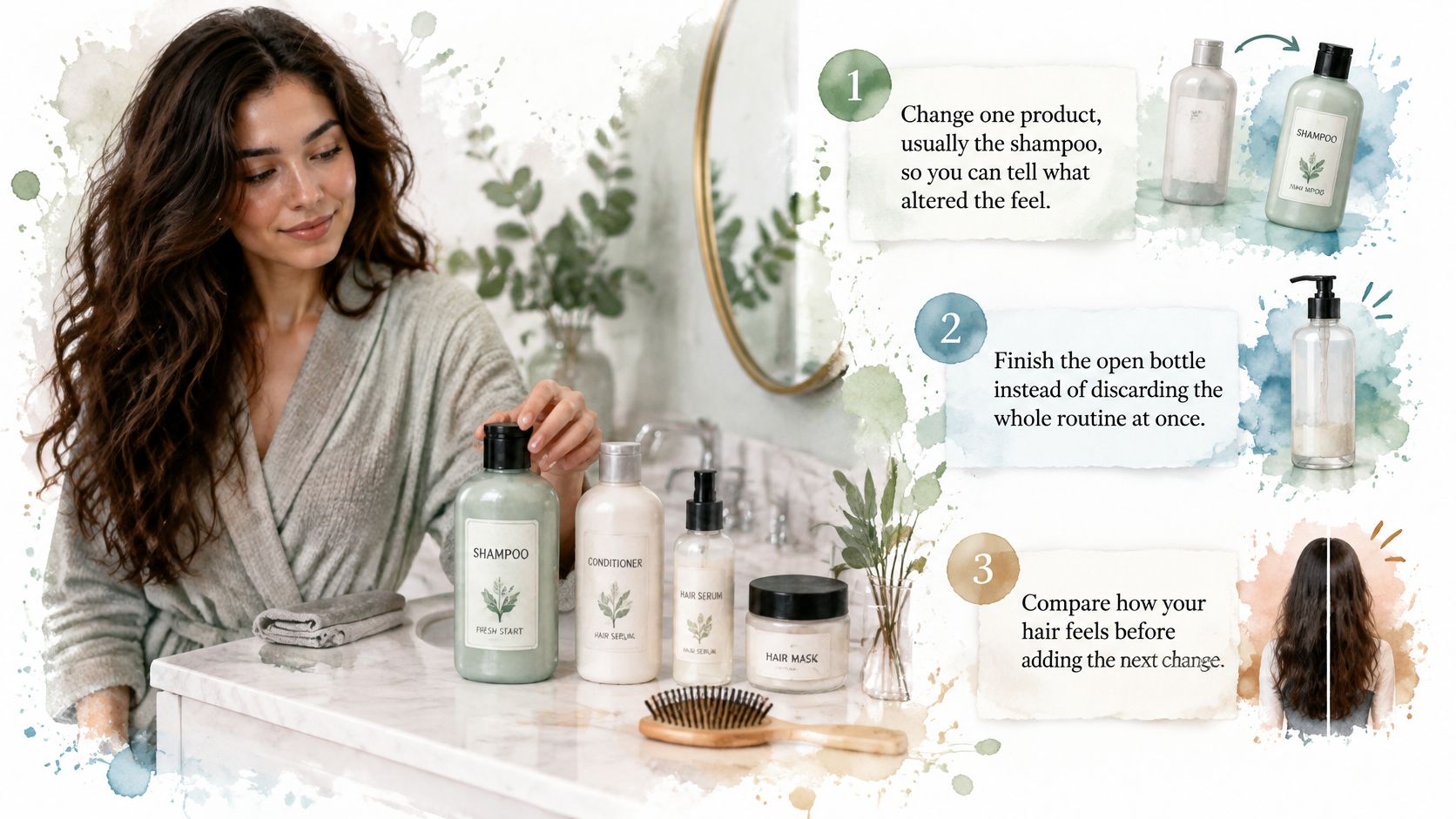
Changing the whole shower at once makes it impossible to tell what altered the feel. Switch in a way you can clearly read.
A one-variable switch
- Change one product, usually the shampoo, so you can tell what altered the feel.
- Finish the open bottle instead of discarding the whole routine at once.
- Read the new ingredient list with the same panel scan, checking the first five names and the job each one does.
- Patch-test a leave-on oil on the inner arm and wait a day before it goes near the scalp.
- Judge the swap after two or three washes. One wash mostly shows scent and first slip.
- If hair feels off, change the amount, not the whole shelf. Adjust oil or conditioner before you swap everything again.
Slogans that skip the list
Toxin-free with no definition is a mood, not a standard. Clean used as a synonym for hair growth skips the ingredient list and promises a result a cosmetic wash can't deliver. Before-and-after photos without a time frame, and a missing or unreadable ingredient list, are the same pattern. They ask you to trust the front and ignore the back.
Those words aren't a safety approval. The FDA doesn't generally approve cosmetic products or their ingredients before they enter the U.S. market, except that color additives must meet applicable approval requirements. Manufacturers and marketers are responsible for safety under labeled or customary use, and for adequate directions and warnings when misuse could be a problem. Clean, natural, and plant-based don't replace the directions or the full list.
After two weeks, check scalp comfort, tangling, and whether the amount left in your hand still feels right.
If the scalp feels tight, you may be cleansing too often or using too much. If the lengths tangle more, the conditioner amount is the first variable to change.
Build a Simple Clean Hair Routine
Decide the first purchase from the concern you already chose. Buy a shampoo if the scalp feels oily or coated. Buy a conditioner if lengths tangle. Buy a hair oil if ends look dull. Keep the rest of the current routine until that one product has had two or three uses.
A week you can actually keep
Cleanse the scalp when it needs it, not on a fixed daily schedule you copied from someone else's hair.
Condition the lengths so a comb meets slip instead of snags.
Add a few drops of oil only where hair looks dry. Roots that already look flat don't need that coat.
Why one product beats a full set
Opened or used personal care and beauty products can't be returned, for hygiene reasons. Check the seller's return policy and patch-test before a large order. If you're unsure, start with one product rather than a full set and adjust by feel. We sell shampoos, conditioners, hair masks, hair oils, styling products, and nutrition products, and the same one-at-a-time habit still applies.
Keep a simple note for the week.
Scalp comfort: tight, calm, or oily by the next morning.
Tangling: easier, the same, or worse on wet hair.
Amount used: coin-size, pea-size, or more than you expected.
That note makes the next purchase about results, not the front label. Choose one concern, one product, and one week of use before you add anything else.
ArtNaturals offers plant-based, cruelty-free haircare, including shampoos, conditioners, masks, and oils, for shoppers who want a readable ingredient list and a routine that still has to perform. If you're matching a cleanser, a softener, or a light oil to one hair concern, start with a single product and a week of use. Visit ArtNaturals to look through the haircare collection and pick the one bottle that fits today's concern.