

You've probably stood in your bathroom or next to a diffuser, holding a bottle of frankincense and wondering what it does in a blend. It's the oil people reach for when they want something calmer, deeper, and a little more grounded, but it can also feel hard to use if you're not sure what to pair it with or how much to add.
Frankincense has a long history in aromatic and self-care rituals, and that matters because it still behaves like a foundation oil today. In essential oil blends with frankincense, it often acts as the quiet anchor that helps brighter notes last longer and feel more balanced, which is why it shows up in so many diffuser mixes and skin oils. If you want a broader overview of oils and mood-oriented pairings, find essential oil benefits is a useful starting point alongside a practical routine like the one in ArtNaturals' aromatherapy guide.
Why Frankincense Anchors So Many Wellness Blends

A quiet evening routine can change the way a room feels. The lights go low, the diffuser starts to mist, and a few brighter scents need something steady beneath them so they do not feel too sharp. Frankincense does that kind of work well. It helps the blend feel settled.
A base note that steadies the whole mix
Frankincense is widely used as a base note and a natural fixative, so it helps hold a blend together instead of fading away quickly. That makes it a natural partner for citrus, floral, wood, and resin families, especially when the goal is a scent that feels rounded and easy to live with. The oil comes from Boswellia resin, and it is commonly associated with steam distillation, which helps explain why resin-based blends often feel richer and more layered than a single bright note on its own.
That structure matters in everyday rituals. A morning citrus blend can feel lively but a little brief. Add frankincense, and the aroma usually settles into something quieter and more cohesive.
For a broader overview of how essential oils are often grouped for aromatherapy routines, ArtNaturals' essential oil blending article is a useful companion, and if you want a wider starting point for pairing oils by purpose, find essential oil benefits can help frame the choices.
Frankincense also fits well in self-care blends for the face, body, or room because it gives the formula a grounded character without crowding the other notes. It is often the part that makes a blend feel finished, like the final layer that brings a room together.
Safe Dilution Guidelines for Topical Frankincense Blends
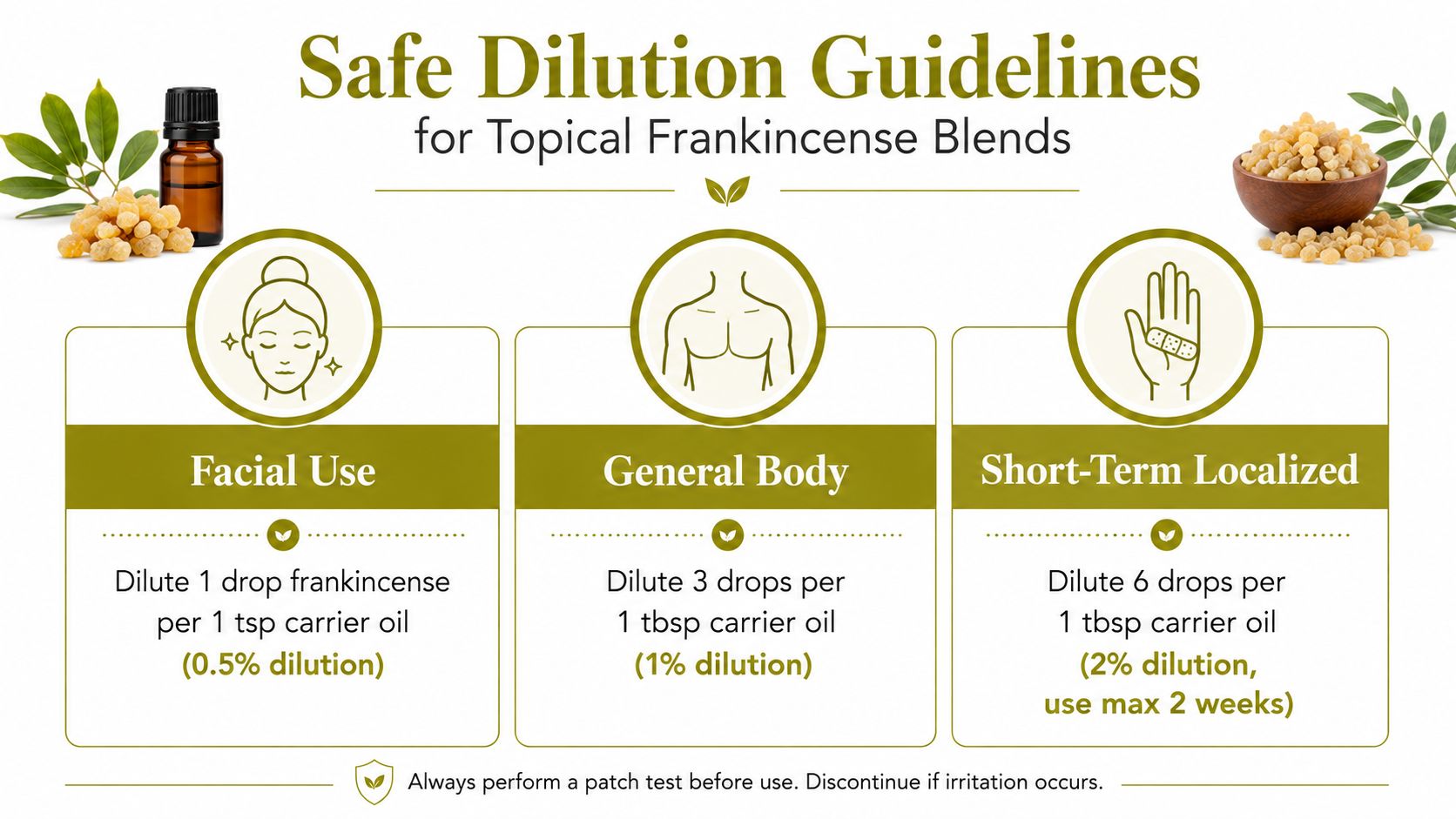
A first frankincense blend often starts with a skin question. How strong should it be, and where will it be used. The safest answer is to choose the dilution before you add a single drop, so the blend fits the skin area instead of overpowering it. For topical use, a gentle 0.5% to 2% dilution is a practical range for facial applications, while 3% to 5% belongs only in short-term, localized use, with a 24-hour patch test on the inner forearm before wider application.
Start with the skin area, then choose the dilution
For the face, keep the mix light. A 0.5% dilution is about 1 drop per 1 tsp of carrier oil, and 2% works out to roughly 6 drops per 15 mL, or 1 tbsp, of carrier oil. If you are making a spot blend for a small area, 3% is about 9 drops per tablespoon, and 5% is about 15 drops per tablespoon. Those figures give you a simple measuring frame, which is easier to follow than guessing by scent alone. biologyinsights.com
Once the dilution is set, the carrier oil becomes the base that carries frankincense evenly across the skin. Jojoba, sweet almond, coconut, and olive oil are common choices for topical blends, and they help slow the oil so it spreads in a thin, even layer. remodelormove.com If you are planning a facial blend, a darker bottle helps protect the oil from light, and a small bottle makes labeling and patch testing easier.
A simple habit keeps the process steady. Measure the carrier first, add the drops second, cap the bottle, then shake gently. That order prevents overpouring when you are still learning how frankincense behaves in a blend.
For a skin-focused reference on how topical oils are commonly used, ArtNaturals' skin oil guide pairs well with this dilution-first approach. It is easier to stay consistent when the drop count is treated like part of the formula, not an afterthought.
Choosing a Blend Family for Your Daily Ritual
A frankincense blend makes the most sense when you start with the ritual, then choose the scent family that fits it. A morning bottle, a bedtime serum, and a slow spa-style body oil all ask for different support, even if frankincense sits at the center of each one. Because it works like a base note and a quiet fixative, it can hold brighter oils in place without taking over the whole blend.
Four families, four different uses
| Blend Family | Best For | Example Pairings |
|---|---|---|
| Citrus | Morning focus, fresh rooms | Frankincense with sweet orange, bergamot, lemon |
| Floral | Evening wind-down, soft self-care | Frankincense with lavender, neroli, ylang ylang |
| Wood | Grounding body oils, steady routines | Frankincense with cedarwood, sandalwood |
| Resin | Deep, layered diffuser blends | Frankincense with myrrh, vetiver, other resin notes |
Citrus blends feel bright and open, so they suit a morning desk session or a room you want to feel cleaner and lighter. Frankincense keeps that top-note energy from fading too quickly, which is why it often reads as the anchor in these blends. Floral pairings shift the mood toward rest and softness, so they fit an evening wash-up routine or a quiet skin-care step before bed.
Wood blends usually feel slower and steadier on the skin and in the air. That makes them a good match for body oil or a simple after-shower routine, where you want the scent to stay close without feeling sharp. Resin blends go one layer deeper. They suit a diffuser session, a slow reading hour, or any blend where you want frankincense to sit alongside other grounded notes instead of standing apart.
A practical way to choose is to match the scent family to the time of day, then adjust the dilution to the body area you plan to use. A face blend calls for a lighter hand than a body oil, so the same family can work in both places if the drop count changes. The perfume shopping guide for women is a useful way to think about scent families in everyday language, because it connects note choices to the kind of mood you want to wear.
If you want a clear method for combining oils, the ArtNaturals' essential oil blending article gives a straightforward framework for mixing with more confidence. That kind of structure helps when you are deciding whether a blend should feel bright, soft, grounded, or deep.
Three Frankincense Recipes You Can Mix Today
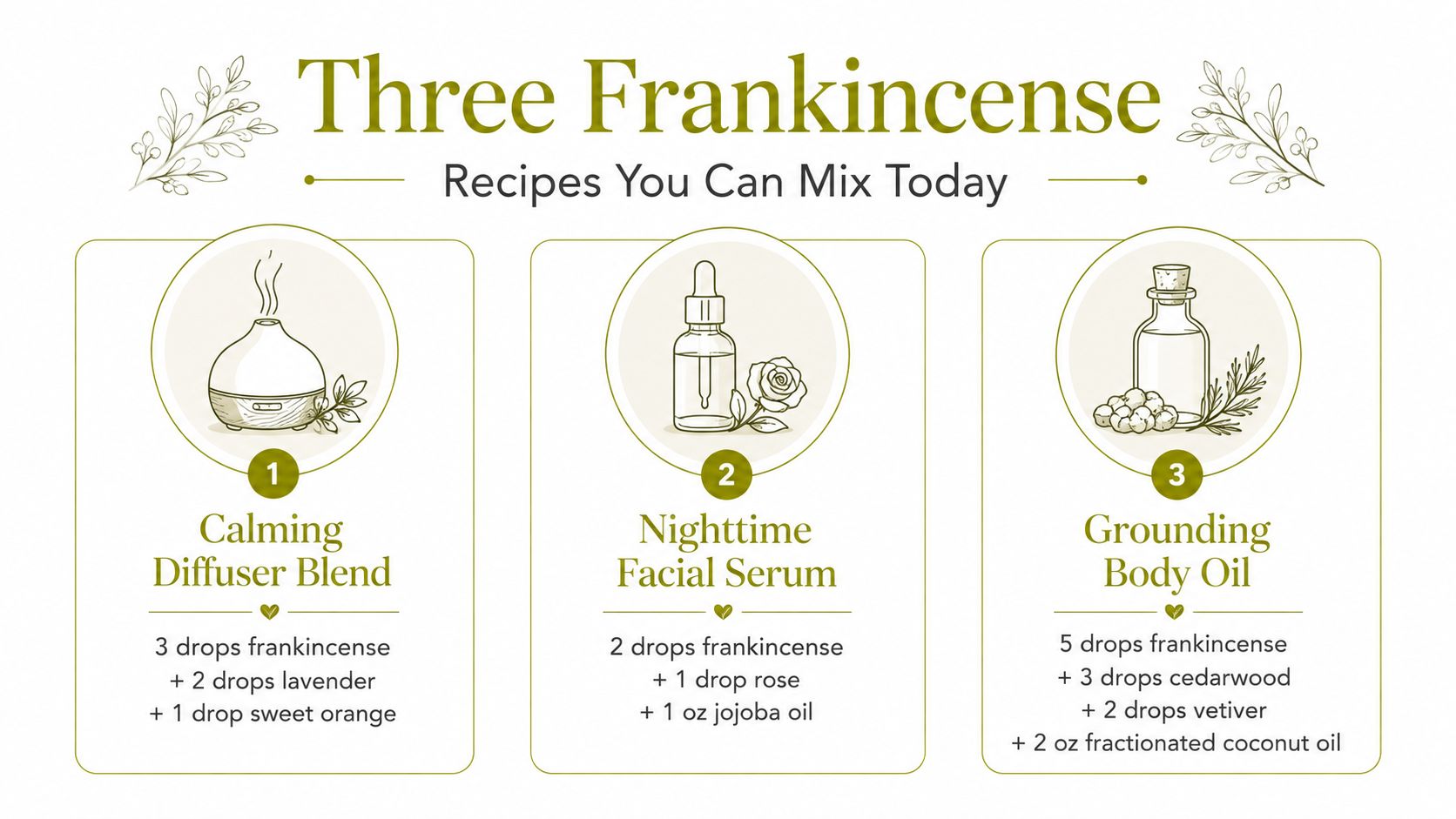
A good recipe should feel easy to return to on a busy day. These three blends show how frankincense can work as a base note in different rituals, a diffuser blend for a calm room, a face oil for a light evening routine, and a body oil for slower, grounding care.
Calming diffuser blend
Use 3 drops frankincense, 2 drops lavender, and 1 drop sweet orange. Add the oils to your diffuser reservoir with water, then let it run in the room where you sit, read, or wind down. If you are making a larger batch to revisit later, give the blend a little time to settle before deciding whether it needs a tweak. Resin notes often soften after a short rest, which helps the final scent feel more balanced.
Nighttime facial serum
Use 2 drops frankincense, 1 drop rose, and 1 oz jojoba oil. Add the essential oils to a dark glass bottle first, then pour in the jojoba oil, cap it, and shake gently until the mixture looks even. This keeps the blend in a light facial range and gives you a simple nighttime step that fits neatly into a skin-care routine without feeling heavy.
Grounding body oil
Use 5 drops frankincense, 3 drops cedarwood, 2 drops vetiver, and 2 oz fractionated coconut oil. This formula feels more anchored and less airy, which suits an after-shower routine or a slow evening massage when you want the scent to stay close to the skin. Mix it in a bottle you can label right away, so the body oil does not get mixed up with a facial blend later.
Mixing note: if a blend smells too sharp on day one, do not rush to change it. Resin-based formulas often smell more rounded after a short rest, and that pause can keep you from adjusting the recipe too soon.
Storing and Labeling Your Homemade Blends
A good blend can turn confusing fast if it is not labeled clearly. The bottle may smell great today, but a month from now you may forget whether it holds your face oil, your diffuser blend, or the body formula you meant to remake. A simple storage routine prevents that mix-up before it starts.
Keep the bottle dark, cool, and readable
Dark glass bottles help protect oils from light, which matters even more for blends you plan to keep for a while. Store them in a cool, dry cabinet, away from steam and direct sun, and keep the cap tight so the aroma stays where it belongs. If you make several blends, group them by use, face, diffuser, or body, so you can reach for the right one without opening every bottle.
Labeling matters just as much as storage. Write the blend name, the creation date, the carrier oil, and the dilution level right on the bottle or on a strip of tape. A name like “Frankincense Evening Face” or “Frankincense Cedar Body” is easier to track than a vague label like “calm mix.”
That habit also helps you learn your own preferences. If a blend feels too soft, too woody, or too bright, you will know exactly what to adjust next time. If it works well, you will have a repeatable formula instead of a lucky accident.
Here is a simple pattern that keeps things organized:
- Name: describe the ritual, not just the scent.
- Date: write when you mixed it.
- Dilution: note the percentage or drop count.
- Carrier: keep the base oil visible.
If you are sourcing frankincense oil for these recipes, look for 100% pure essential oil labeled for therapeutic use. ArtNaturals sells a frankincense oil option and includes frankincense in its Top 8 Essential Oils set, which can fit naturally into a small blending starter kit. Even then, the same storage habits still matter once you have mixed it into your own formulas.
Common Blending Mistakes and How to Avoid Them
The most frequent blending error I see is over-diluting frankincense for a face blend, then expecting the scent and feel to carry the whole ritual. Frankincense works best grounded in the base note role, where it can steady brighter oils instead of competing with them. A good blend feels balanced from the first drop to the last.
Start with the simplest check, your dilution. For facial use, keep the blend at 0.5%. For body use, 1% is a comfortable everyday level. For short-term localized use, 2% is enough, and stronger blends should be used carefully and only for limited periods.
Another common misstep is skipping the patch test because the formula feels gentle. Even a diluted blend should be tested on the inner arm for 24 hours before you apply it to the face or use it often. That pause helps you catch a reaction early, before a small irritation turns into a routine you cannot keep.
Diffusing without a break can also flatten a beautiful blend. Short runs in 30-minute cycles, followed by rest periods, keep the aroma clearer and help prevent odor fatigue. In a home ritual, that rhythm matters, because a scent that stays pleasant is easier to return to day after day.
Measuring and labeling keep the whole process steady. Write the dilution level, the carrier oil, and the blend name on the bottle so you can repeat what worked and adjust what did not. If a mix feels too soft, too woody, or too bright, those notes make the next batch easier to refine.
A calm routine beats guesswork every time. Measure carefully, patch test before full use, give the blend time to settle, and keep frankincense in its anchoring role. That approach makes homemade blends easier to trust and easier to use.