

The most popular advice about essential oils lotion is simple. It's natural, so it's gentle. Do a patch test and you're done.
That's not enough to choose well. A plant origin tells you where an ingredient came from, not how strong a lotion is, how long it'll sit on your skin, or whether you should wear it in the sun. You need the percent, the name of each oil, and a simple rule for daytime use. Those three details matter far more than the word natural on the front.
What Essential Oils Lotion Is and How It Spreads
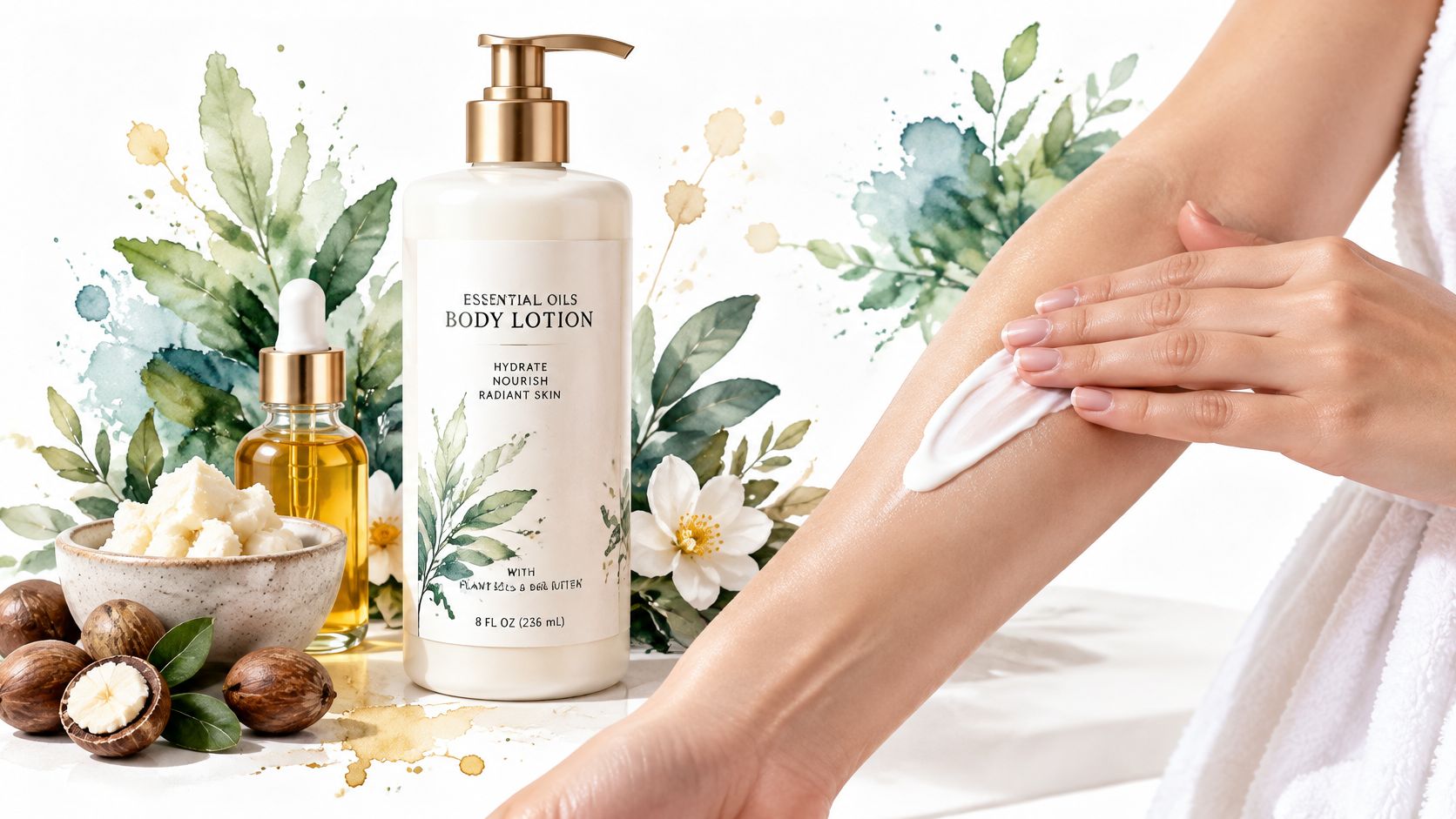
Say you open a jar after a shower. It smells like lavender and spreads like a light cream, so you cover both arms and most of your legs in under a minute. That quick, wide coverage is the point. An essential oils lotion is a moisturizer first. It's a water-based cream built on skin-softening oils or butters, with a small share of concentrated plant oil added for scent and feel. It is not a bottle of neat essential oil, and it shouldn't be used like one.
Cosmetic Language and Why It Matters
In the United States, the Food and Drug Administration treats a product applied to the body to improve appearance as a cosmetic, while claims to treat disease or affect body structure or function can make it a drug, as explained in the FDA guidance on fragrances in cosmetics. The FDA also notes there's no formal regulatory definition of "essential oils" and that plant ingredients must meet the same safety requirements as ingredients from other sources. Cosmetics generally don't require premarket approval, but makers are responsible for products being safe when used as directed.
That distinction shapes honest label language. Moisturization and fragrance fit a cosmetic. Cure, repair, or treatment language doesn't. If you're comparing scent types, the Gotham Fragrances guide to fragrance oils is a helpful plain-language resource for how essential oils differ from fragrance oils, which is useful when a front label leans on scent story more than ingredient detail.
What Happens When Lotion Spreads
A well-made lotion holds tiny oil droplets evenly through the cream. Scent spreads across skin instead of pooling in one spot, and every area gets a similar amount. Separation works against that. If a cream splits, one pump can carry mostly base and the next can carry a stronger pocket of oil.
Essential-oil constituents can interact with stratum-corneum lipids, disrupt their ordered structure, and increase penetration into lower skin layers, according to a systematic review of essential oils in topical formulations. That review of 112 studies found terpene-type essential oils accounted for 63% of included oil applications, the most frequent category in topical products. Think of many fresh, herbal, and citrus scents in that family.
Deeper movement is why concentration matters in a leave-on product. Higher exposure raises the chance of irritation or allergic contact dermatitis, especially on damaged skin. The practical lesson isn't to avoid scented lotion altogether. It's to choose a diluted, evenly mixed cream, keep the percent low for your purpose, and judge it by label clarity and skin comfort.
What a Lotion Can and Cannot Promise
The base does most of the moisturizing work. Water, glycerin, butters, and carrier oils help skin feel softer and more comfortable after washing. The essential oil adds scent and makes the routine feel intentional, especially in the evening when you're slowing down.
That's a fair promise. A lotion can support a pleasant, regular self-care habit. It can leave skin feeling smoother to the touch. It shouldn't promise to cure, clear, prevent, or change how your body functions.
Where Comfort Ends and Risk Begins
The main concerns with any fragranced leave-on product are familiar. Skin can feel irritated. Some people develop fragrance sensitivity or allergic contact dermatitis. Certain citrus oils add a sunlight concern that needs its own rule. A natural origin removes none of these possibilities.
Risk doesn't come from one pump alone. It builds from concentration, time on skin, body area covered, and how your skin feels that day. A small dab on your forearm for an hour is a different exposure from a full-body application left on overnight. That's why a strong scent isn't a sign of a better lotion. Often it's just a sign of more exposure.
Judge a lotion by whether your skin stays comfortable through normal wear, not by how strong it smells in the jar.
Use three simple checks before you commit to a full jar:
- Expect variation: Your friend's favorite scent may sting on your skin, and that's useful information, not a failure.
- Aim for comfort: Softness and an enjoyable scent are realistic goals for a cosmetic lotion.
- Stop early: Put the product aside if it burns, stings, itches persistently, or leaves a rash.
Treating essential oils lotion as a moisturizer and sensory product keeps expectations honest. You'll notice the routine more, chase dramatic changes less, and spot discomfort sooner because you're paying attention to how you feel.
How to Read an Essential Oil Lotion Label
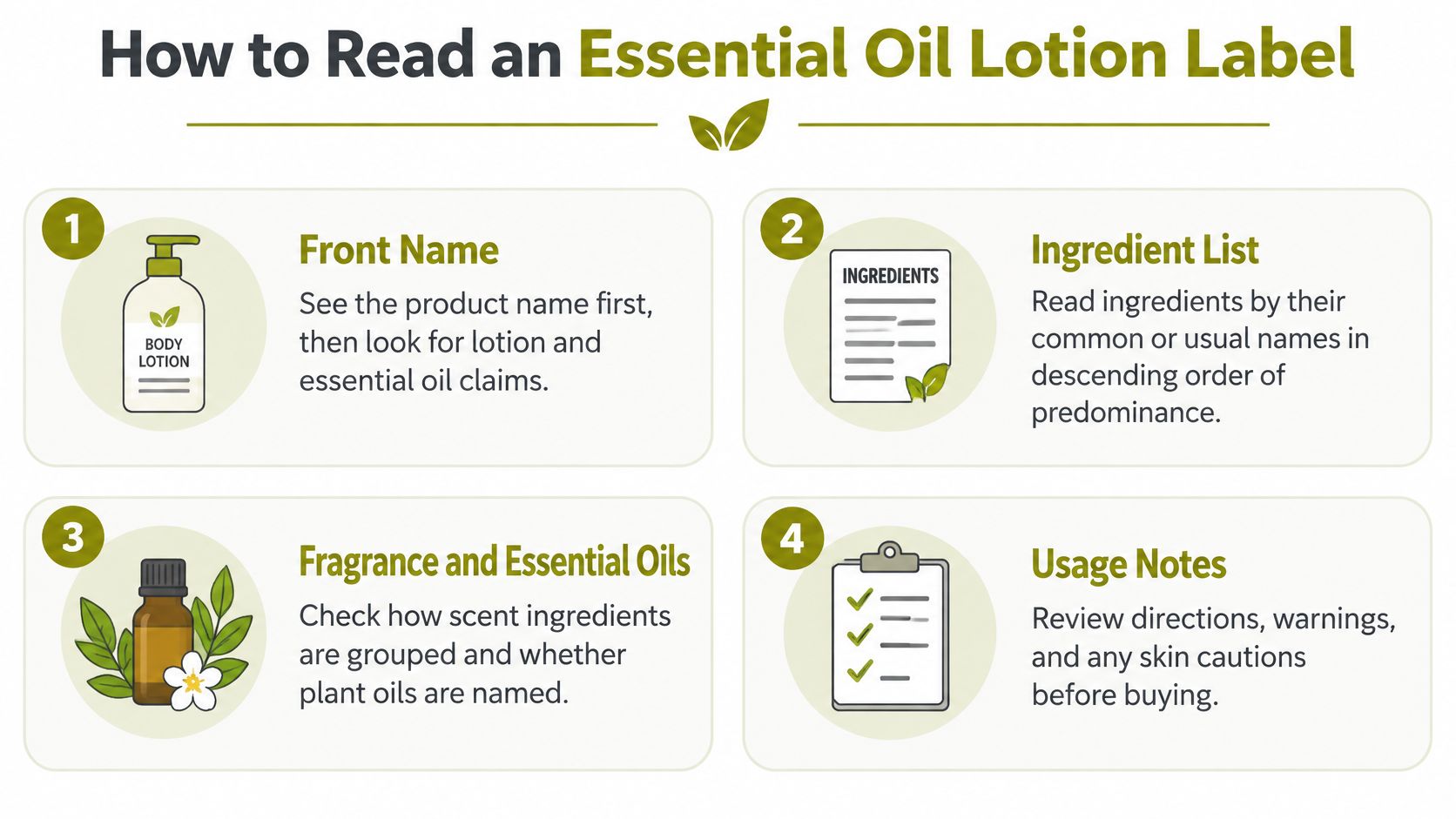
Start at the front, then turn the bottle over. The front gives you the product name and scent story. The back tells you what you're buying, how to use it, and when not to use it. Read in that order and the label gets much less confusing.
Read the Ingredient List Top to Bottom
Retail cosmetics in the United States generally list ingredients by common or usual names in descending order of predominance where shoppers can find them before purchase, as set out in the FDA cosmetics labeling guide. The same guide notes "essential oils" has no regulatory definition and plant-derived ingredients follow the same cosmetic framework as other ingredients. Labels must also provide adequate directions for safe use when needed.
Early names are usually the base. Water, glycerin, shea butter, jojoba, or sweet almond oil near the top means those ingredients make up most of the jar. An essential oil near the end is present in a smaller share. That's expected for a concentrated scent ingredient. It doesn't mean the lotion is weak or empty.
Fragrance components may sometimes be listed collectively as "Fragrance". When that happens, the romantic name on the front, such as a garden or orchard blend, may not be repeated oil by oil on the back. If you know you react to a specific scent, a grouped listing gives you less to work with. A label that names individual plant oils is easier to check against your own history.
Directions Warnings and Claims
Next, read the directions before you read the reviews. Look for body area, frequency, and warnings about eyes, broken skin, children, or sun exposure. A body lotion whose directions never mention the face shouldn't become your face cream just because the scent is appealing.
Treat "therapeutic grade" as a marketing phrase, not a safety score. It doesn't tell you the percent in the jar or whether that percent suits leave-on use. A stated dilution, a named oil, and clear directions tell you more.
Use this five-point pocket check in the aisle:
- Base first: Can you see the moisturizing ingredients near the top?
- Scent position: Where do named oils or Fragrance sit in the list?
- Directions: Does the label say where and how often to apply it?
- Warnings: Are eyes, broken skin, age, or sun addressed?
- Cosmetic claim: Does the promise stay with moisture, softness, and scent?
If the front promises to cure or change body function, set that jar aside. Choose the bottle that speaks plainly about everyday comfort.
Dilution Limits for a Leave-On Body Lotion
One total percent is a starting point, not the whole answer. For a leave-on body lotion, the Tisserand Institute dilution guidance places total essential oil at 1 to 3% of the finished blend for body oils, massage blends, and lotions. Essential oils shouldn't be applied undiluted. They belong in a lotion or carrier base.
Think of 1% as the sensible starting end, especially when a new fragranced lotion will cover arms, legs, and torso. You get scent across a large area without jumping to the top of the range. Treat 3% as the high end of general guidance, not a goal to reach. It isn't a sensible default for the face or for skin that already feels reactive.
Why Individual Oils Can Tighten the Range
Some oils need a lower cap than the blend as a whole. The Tisserand Institute essential oil dilution chart lists clove bud oil at no more than 0.5% to help reduce skin allergy risk and holy basil oil at up to 1%. It lists lemon oil at no more than 2% for phototoxicity concerns and grapefruit oil at up to 4% for the same type of concern.
Those rows change how you read a blend. A lotion could sit at 2% total and still be a poor fit if most of that percent comes from an oil capped at 0.5%. The total looks modest. The individual oil doesn't.
| Oil or total blend | Leave-on guidance | Why the cap exists | Practical read |
|---|---|---|---|
| Total essential oil in a body lotion | 1-3% | General aromatherapy range for lotions and body oils | Start near 1% on a large area |
| Clove bud | No more than 0.5% | Helps reduce skin-allergy risk | Treat as a narrow exception, not a body default |
| Holy basil | Up to 1% | Narrower than the general 1-3% band | Do not assume it can fill the whole 3% |
| Lemon | No more than 2% | Phototoxicity concern | Recheck daytime and sun-exposed use |
| Grapefruit | Up to 4% | Same family of sunlight concern | Percent alone does not make daytime use carefree |
Drops Are Not a Measurement System
Adding drops by eye feels crafty and precise. It isn't. Drop size changes with the bottle and the oil, and a quickly stirred jar can leave stronger and weaker pockets. A formulated lotion with a labeled percent removes that guesswork.
Practical rule: Match your bottle to the closest row first. If no percent is printed, follow the maker and begin with a small area.
These figures are guidance, not a personal prescription. The specific oil, body area, your skin comfort, and the product directions can all shift the right level. If you want the math in more detail, our guide to essential oil dilution ratios walks through ratios before you blend or buy. When a label gives you neither a percent nor clear directions, choose a different bottle. Certainty is part of what you're paying for.
Choosing a Lotion by Skin Feel
Choose by how your skin usually feels after a shower, not by a condition you hope a lotion will fix. Skin feel changes with weather, water temperature, and how often you wash. A product that felt perfect in summer may feel too light in January.
Dry or Dull-Feeling Skin
Skin that feels tight or rough on the shins often suits a richer cream. Look for bases built on jojoba, sweet almond, argan, or a butter, and keep the scent soft rather than sharp. A light lavender note used in a low total can fit an evening routine without taking over the room.
Try it on damp skin after an evening shower. Smooth a modest amount over your shins and arms, then give it a minute before dressing. If your pajamas stick, you used more than you needed. If you're weighing textures, our comparison of body butter and lotion helps you decide when a richer format makes sense.
Oily or Easily Congested Feeling Skin
A lighter lotion in a smaller amount usually feels better here. Heavy layers on warm skin can feel occlusive and unpleasant, even when the scent itself is lovely. Use it on the body first and don't move a fragranced body product onto your face unless the label names the face.
Modest herbal scents can work well, but modest is the key word. You want a clean finish after application, not a lingering film that makes you want to wash your hands and arms again.
Easily Reactive Skin
Start with an unscented lotion or the lowest scented option you can find. If perfume, scented laundry products, or fragranced soaps already bother you, treat that history as relevant. Approach cinnamon, clove, peppermint, thyme, marjoram, savory, and lemongrass slowly, or skip them while you learn what suits you.
Don't test a new scent on skin that already stings, looks irritated, or feels raw after shaving. Wait until your skin feels ordinary again. One new product at a time gives you a clear answer.
Comfortable, unremarkable skin gives you the widest choice. You can still start near the low end for body use and save citrus scents for times when sun exposure is easy to plan around. Don't confuse carrier oils with the fragrant concentrate. Jojoba and argan in a base mainly moisturize and carry scent. They're not the strong aromatic addition that needs the tightest cap.
Pick one scent family and one bottle. Wear it in normal life, through clothing, sleep, and a regular day. Then decide.
Sunlight Rules for Citrus Lotions
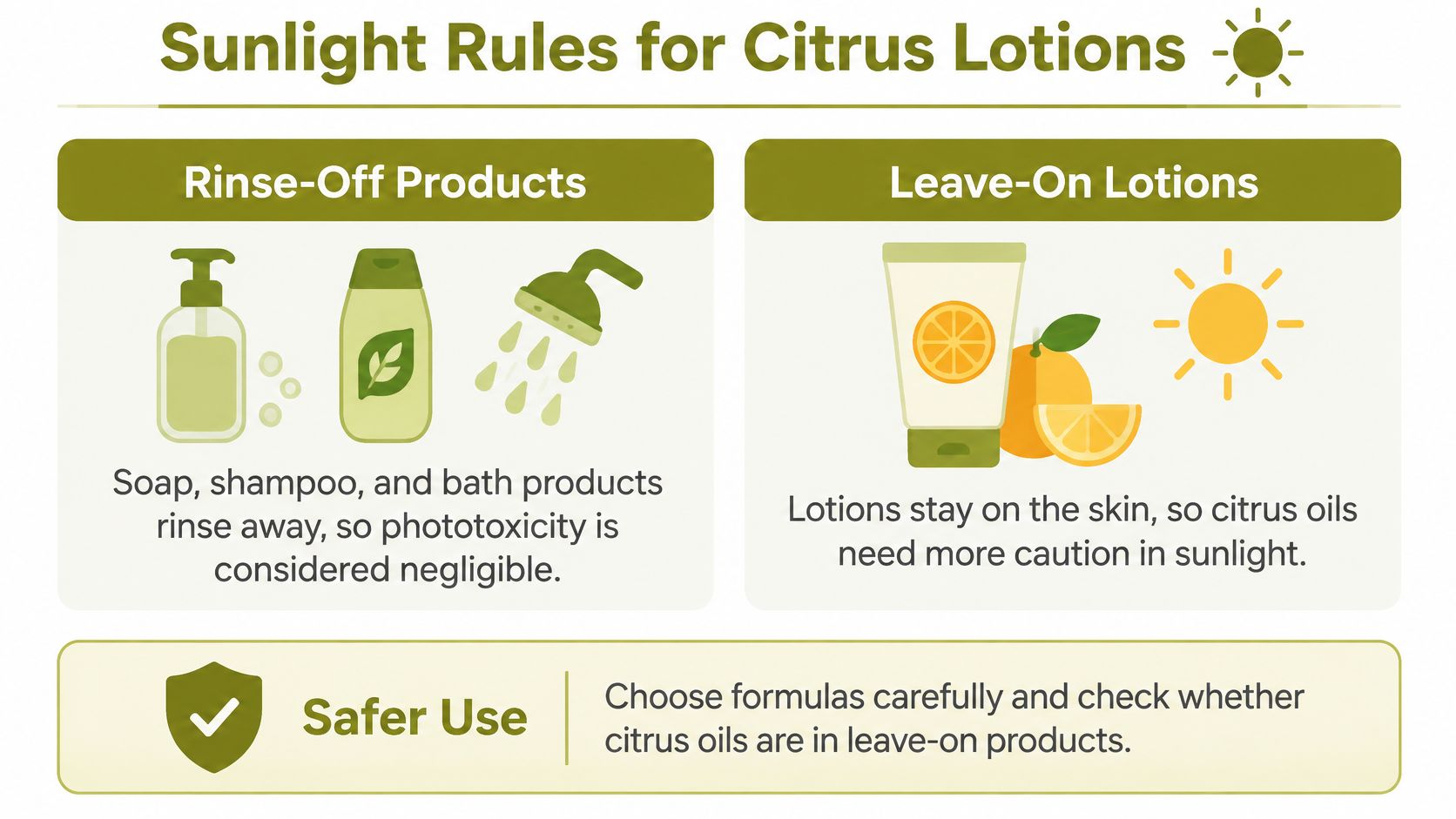
A citrus hand soap and a citrus body lotion don't follow the same rule. Soap rinses away in seconds. Lotion is made to stay on your hands, neck, chest, and legs for hours. That staying power changes the sunlight picture.
Leave-On Use Is the Dividing Line
Certain citrus oils, including bergamot, lemon, lime, orange, and angelica, can cause phototoxic reactions after topical application followed by UVA exposure, and phototoxicity is considered negligible for wash-off products but can apply to leave-on oils, gels, and lotions, according to the University of Minnesota guide on essential oil safety. The same guidance says bergamot may need a maximum final-product limit of 0.4% for areas exposed to sunlight.
Citrus is not one safety category. Extraction method, furanocoumarin content, concentration, product format, body area, and time in the sun all matter. Cold-pressed peel oils deserve particular attention because the method can retain the compounds tied to this reaction. Two bottles with lemon in the name can still present different questions.
| Citrus oil | Leave-on guidance | Daytime read |
|---|---|---|
| Bergamot | Up to 0.4% in final product for sun-exposed skin | Evening or covered use unless the cap is confirmed |
| Lemon | No more than 2% | Daytime use only with the cap confirmed, see dilution table |
| Lime | No stated cap on the label to rely on, choose evening use | Treat as sun-sensitive until confirmed |
| Orange | No stated cap on the label to rely on, choose evening use | Treat as sun-sensitive until confirmed |
| Angelica | No stated cap on the label to rely on, choose evening use | Treat as sun-sensitive until confirmed |
A Day Versus Night Habit
Phototoxicity is easy to mistake for a normal perfume tingle or ordinary sunburn. A reaction can appear hours later and worsen over the next few days, which makes the cause harder to spot. By the time skin looks angry, you may be thinking about yesterday's weather rather than yesterday's lotion.
Save citrus-scented leave-on lotion for evening or covered skin unless the label confirms a sun-appropriate limit.
Hands, face, neck, and chest are the zones people forget. You apply hand lotion, then drive with sunlight across your fingers. You smooth lotion on your neck, then wear an open collar at lunch. Plan for the skin that'll see daylight.
A quick rinse at the sink doesn't turn a leave-on lotion into a wash-off product if scented residue remains. If daytime use matters to you, look for a stated percent and directions that address sun exposure. If the label is vague, evening use is the calmer choice.
Choose One Lotion and Start Low
You don't need a shelf of scents to build a good routine. You need one bottle that fits your skin feel, a sensible percent, and a repeatable habit. Our body skincare range includes Scrubs, Lotion, Patches, and Oils, and our Oils collection includes scents such as lavender, lemongrass, peppermint, rosemary, and sweet orange. For a single evening option, the Lavender + Jasmine Face & Body Oil, 4 oz, $14.95, is suited for dull and dry skin.
A Simple Evening Routine
- Wash and pat damp. Leave skin slightly damp, not dripping, so lotion spreads without dragging.
- Separate face and body. Use a product on your face only when its label allows face use, and don't layer a second scented cream over it.
- Use less than you think. Smooth a pea-to-nickel amount over each large area of damp arms and legs to help hold moisture.
- Plan the morning. Skip citrus-scented lotion on face, neck, chest, and hands in daytime, or keep those areas covered.
- Test a new jar. Dab a small amount on your inner forearm and wait a day before wider use.
Stop if skin burns, welts, or develops a spreading rash, and seek medical care for a reaction that feels severe. A patch test gives you early information. It doesn't override a high percent or a poor daytime choice.
Keep DIY minimal. A formulated base is more predictable than loose drops stirred into a jar, which can leave an uneven, stronger pocket. If you blend, weigh the oil, keep the total near 1%, write the date on the jar, and discard it if the scent turns sharp or the cream separates.
Choose one concern you can judge, such as tight-feeling shins after a shower. Choose one product. Start low and let a week of ordinary use teach you more than the first sniff.
Questions Shoppers Ask and What to Avoid
Can lotion on my skin affect pets? Keep essential oils lotion off pet fur and away from skin your pet may lick, since essential oils can be harmful to cats and other animals. Ask a veterinarian about any exposure you're worried about.
Can children use it? Follow the label's age guidance and keep lotion away from eyes and mouth. Ask a qualified professional before use on infants or during pregnancy.
Does sunscreen solve the citrus question? Apply sunscreen as your final morning layer as directed, but citrus lotion underneath still counts as leave-on. The daytime rule still applies. Good buying habits travel across beauty categories, much like the practical checks in these peel-off nail polish FAQs, where directions and wear time matter as much as color.
How long should a jar last? Keep it closed and away from heat and direct light. Replace it when the scent sharpens, the color shifts, or the texture changes. For broader routine basics, our guide to using essential oils for skin offers a helpful next read.
Avoid a few storage and sharing habits:
- Hot storage: Don't leave a jar in a hot car or on a steamy bathroom shelf.
- Shared jars: Don't pass one open jar between people.
- Delicate areas: Keep lotion off eyelids, lips, and inside the nose.
- Mixed leftovers: Don't combine two scented brands in one jar.
Write the date you first opened a jar on its label. Freshness becomes much easier to judge a few months later.
Browse our lotions, oils, scrubs, and everyday body care at ArtNaturals, then check each label for its base, named oils, directions, and warnings before you choose. Start with one bottle, begin at the low end, and build a calm routine around the scent and skin feel you enjoy most.