

Have you ever wondered why hair can feel soft yet still look dull? The missing piece is often not “repair” in the dramatic sense. It's the way the outer surface handles light. A gloss hair treatment is best understood as a temporary cosmetic service that improves the fiber's visible reflection, while sometimes refreshing its tone.
That distinction makes gloss easier to evaluate. It can make hair appear smoother, richer, and brighter, but it doesn't rebuild the inner cortex or permanently change your natural base. The most useful question isn't whether a gloss is magical. It's whether the formula, color deposit, and routine match your hair's surface and your desired finish.
What a Gloss Hair Treatment Does
What makes hair look polished after washing, then flatter a few days later? Cleanliness and conditioning affect feel, but the surface still determines how evenly the strands reflect light. A gloss changes that visible surface temporarily by leaving a smoothing film, reducing the appearance of minor irregularities, or adding a restrained tone.
A hair gloss is generally a temporary or demi-permanent color service. A clear formula focuses on reflection without deliberately adding visible pigment. A tinted formula deposits tone over the existing shade. Professional products often use a low-volume developer or activator and may process for up to about 20 minutes, although the product directions determine the timing. NBC News describes gloss as a clear or tinted demi-permanent service designed to refresh tone and add shine.
What changes, and what doesn't
Gloss acts mainly at the hair's visible surface. Conditioning ingredients can make the fiber feel softer, while deposited pigment can make faded color appear more even. The service does not reliably lift dark hair or permanently reverse gray, and it is not a treatment for breakage, scalp concerns, or damage within the fiber.
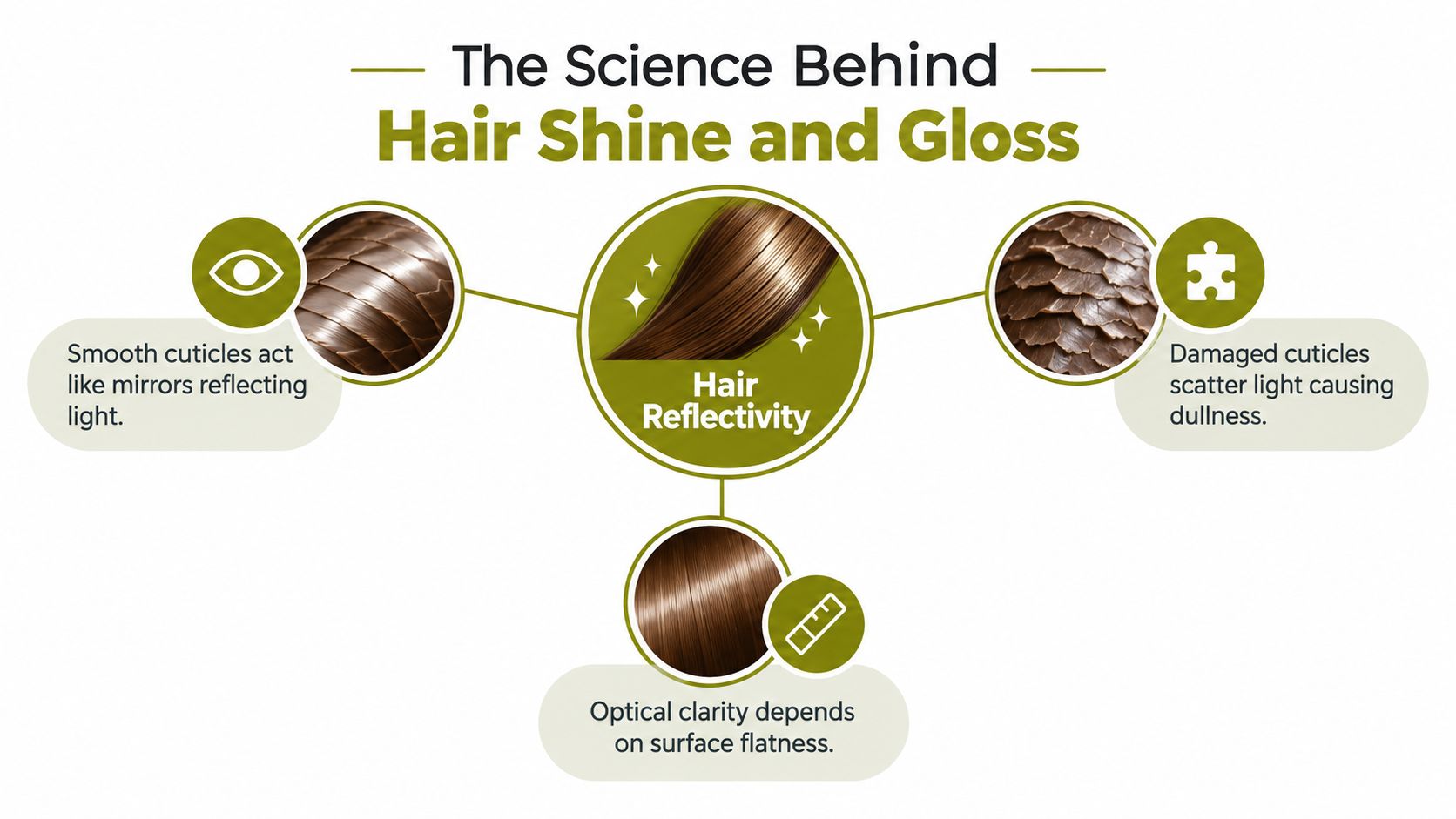
The optical effect is easier to understand through light behavior. A smoother outer cuticle sends more light in a coordinated direction, much like aligned tiles reflecting sunlight. An uneven cuticle scatters light across different angles, so the same hair can appear duller even when it feels reasonably soft.
Practical rule: Choose a gloss for tone, softness, and visible shine. Choose another color service when you need significant lightening or lasting gray coverage.
Results depend on the starting shade, porosity, existing color, formula, and washing routine. A clear gloss may give natural or colored hair a more polished appearance. A tinted gloss can subtly warm, cool, deepen, or refresh the shade, with a gentler visual shift than permanent color. Judge the service by how well its formula and color deposit suit the hair's surface and the finish you want.
The Science Behind Hair Shine and Gloss
Hair looks shiny when its outer cuticle plates sit relatively flat and reflect light in an organized way. The effect is similar to a tiled roof: aligned surfaces direct light more coherently. A lifted, worn, or irregular cuticle behaves more like broken glass, sending light in many directions and creating a duller appearance.
Researchers can measure this effect rather than relying only on a visual opinion. Glossmeters and related optical systems assess reflected light under controlled conditions, while some testing methods examine shine at 20°, 60°, and 85° viewing angles. A 2023 peer-reviewed study in the International Journal of Trichology evaluated hair brightness and shine across treated and untreated samples, showing why viewing angle and hair condition matter. The study's instrumental hair-shine measurements are available through the International Journal of Trichology.
Why oils can change brightness
The same study found that plant oils could measurably increase brightness. Grape-seed oil produced the highest gloss in parts of the experiment, while safflower-seed oil produced the strongest brightness result in natural hair. Reported colorimetric values included L* values of approximately 20 to 50, a* values of 3.9 to 12, and b* values of 3 to 20. Calculated color differences stayed relatively stable, with ΔE values between 0.5 and 2.5.
Those details support an important consumer distinction. Hair can look brighter because its surface reflects more light, even when the formula hasn't permanently changed the hair's underlying color. Results can still vary with hair type, oil composition, wear, washing history, and measurement angle.
For more everyday ideas around surface-friendly care, explore this guide to how to make hair shiny naturally. The optical principle remains simple: a smoother, more even surface usually gives light fewer directions in which to scatter.
Salon Gloss vs At-Home Gloss and Clear vs Tinted Options
The best format depends on the change you want to see. A salon service may offer more controlled application across uneven porosity, while an at-home product can fit a simple maintenance routine. Neither format removes the need to read the label, assess your starting shade, or follow the stated processing time.
Salon glosses commonly use a clear or tinted demi-permanent color with a low-volume developer or activator. Conditioning ingredients such as behentrimonium chloride and amodimethicone may support softness and slip. At-home formulas vary considerably, so their timing can be shorter or longer than a professional service.
A practical comparison
| Option | Best For | Typical Processing | Color Impact |
|---|---|---|---|
| Salon clear gloss | Enhancing reflection on natural or colored hair | May process for up to about 20 minutes | Minimal visible pigment |
| Salon tinted gloss | Refreshing tone and adding surface shine | May process for up to about 20 minutes | Deposits subtle tone, doesn't lift the base |
| At-home clear gloss | A simple shine-focused routine | Follow the package directions | Emphasizes existing color |
| At-home tinted gloss | Refreshing or adjusting an existing tone | Follow the package directions | Deposits color that fades gradually |
A clear gloss suits someone who wants a polished finish without intentionally shifting warm or cool tone. A tinted gloss makes more sense when faded color looks flat or when you want a subtle tonal adjustment. Highly porous or previously lightened sections may absorb pigment differently from healthier areas, so strand testing is sensible before applying a tinted formula everywhere.
If you're weighing a cosmetic service alongside broader hair and wellness information, ProMD Health's hair services resource offers another place to review professional options. Keep the distinction clear: gloss enhances the visible surface and tone, while permanent color is designed for a more lasting chemical change.
Safe At-Home Application Steps
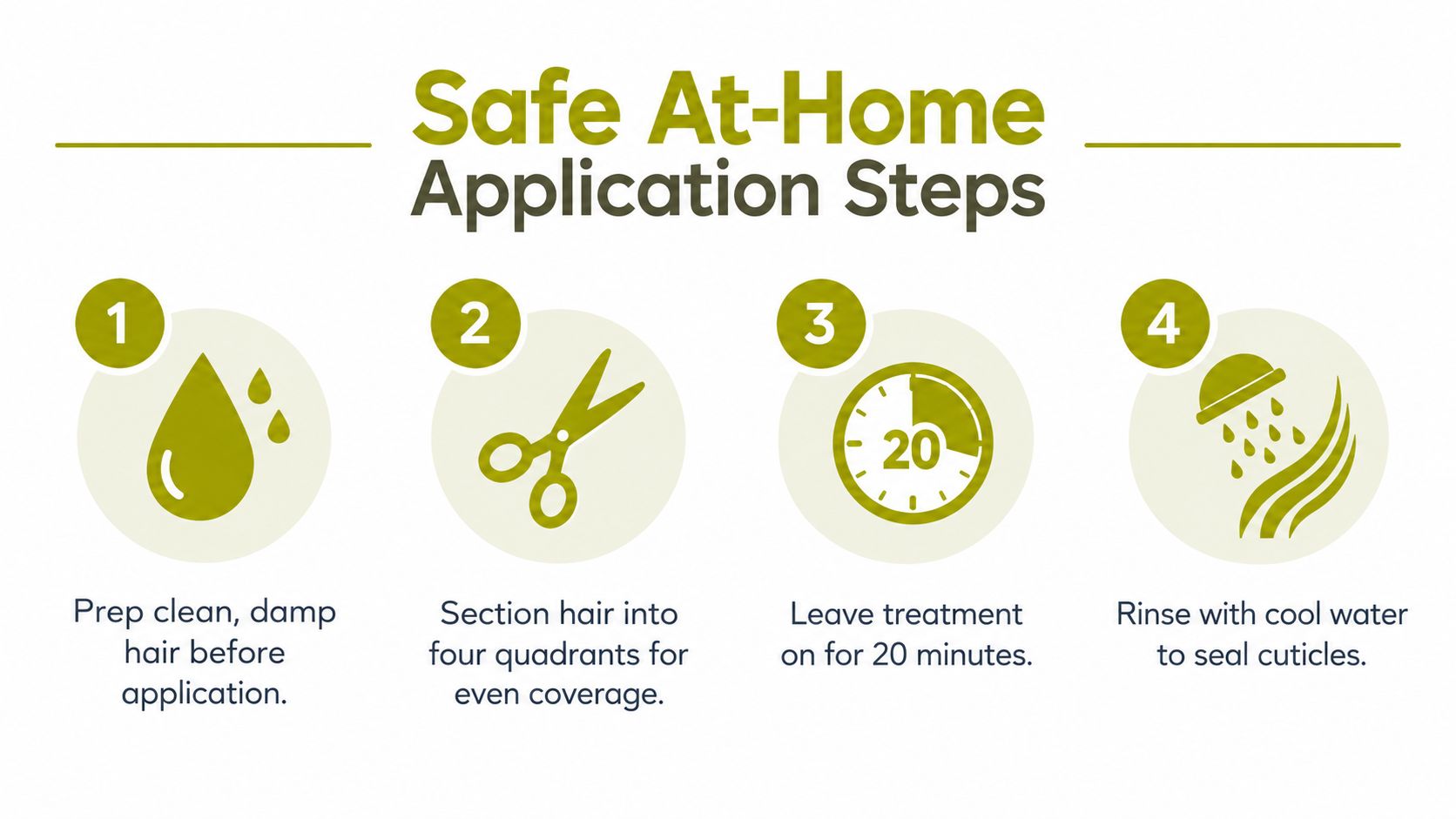
A predictable at-home result starts with controlled application rather than extra product. Clean, damp hair usually gives the formula a more even path through the lengths, but the package directions should always take priority because formulas differ.
A calm application sequence
- Prepare the hair: Wash as directed and work with clean, damp hair if the product label calls for it. Gently remove excess water so the gloss doesn't become unnecessarily diluted.
- Divide the strands: Create sections so you can distribute the product from the roots through the lengths and ends. Pay attention to dry or previously colored areas, which may not absorb the formula in the same way as less porous hair.
- Saturate evenly: Wear gloves and spread the product thoroughly. Use a timer instead of guessing. A typical professional process may take about 20 to 40 minutes overall, with the gloss sitting on the hair for roughly 15 to 20 minutes, but an at-home product may specify a different window. Healthline outlines the general application sequence and explains why package timing matters.
- Rinse completely: Keep the product away from the eyes, rinse thoroughly, and follow any label instructions for conditioning or styling. Extra product or extra processing time won't reliably create more shine and may leave an uneven tone.
For a related plant-oil routine, see this overview of an at-home hot oil hair treatment. It's a different type of service, so don't substitute its directions for those of a gloss product.
Here's a visual walkthrough to keep beside your routine:
A gloss can make the surface look more refined, but it doesn't prove that internal damage has been repaired. Treat it as timed cosmetic care, not an invitation to process hair longer.
Ingredient Guidance for Calm, Clean Gloss Routines
Gloss ingredients work through deposition, lubrication, and surface alignment. Silicones, cationic polymers, fatty alcohols, and other conditioning agents can fill or mask tiny cuticle irregularities. That reduces diffuse scattering and encourages more uniform, specular reflection, which is the visual effect people describe as shine.
Plant oils can contribute in a different way by coating and smoothing the fiber. Testing on chemically damaged hair measured gloss at the top, middle, and ends of hair bundles, with one application increasing the result from 2.90 ± 0.02 to 3.38 ± 0.02, a 16.42% mean improvement. The study explains how controlled gloss measurement can identify a visible shine change without permanent chemical alteration.
Reading a formula with more confidence
Look for a formula that matches your preferences and your hair's behavior, rather than assuming one ingredient tells the whole story.
- Conditioning films: These can improve slip and surface smoothness, though the finish may decrease as washing removes the deposit.
- Plant oils: Grape-seed, safflower, argan, and other oils may support a smoother-looking surface, but the result depends on composition, dosage, and hair condition.
- Acidic positioning: Mildly acidic treatment can help keep the cuticle flatter than a more alkaline approach. Experimental dyed-hair comparisons found better tensile strength and moisture content under a weakly acidic condition, with less visible cuticle lifting than under a weakly alkaline condition. The experimental comparison is published in the Asian Journal of Beauty and Cosmetology.
- Transparent labeling: Fragrance, preservatives, direct dyes, and oxidative color ingredients all deserve attention if your scalp or skin is sensitive.
A gloss remains a cosmetic appearance treatment. It can improve how hair feels and reflects light, but it shouldn't be described as a cure for severe fiber damage or scalp problems. For an oil-focused conditioning idea, consider this argan oil hair mask guide, while keeping the treatment purpose separate from a color-depositing gloss.
Common Misconceptions About Gloss Hair Treatment
A gloss is often described with language that makes a surface finish sound like a permanent transformation. Four clarifications help keep expectations realistic.
A gloss doesn't lighten dark hair. It deposits tone or enhances reflection rather than reliably lifting the natural base. A tinted gloss may make brunette, blonde, gray, or previously colored hair look more balanced, but it can't be counted on to create a lighter shade or permanently reverse gray.
Ammonia-free doesn't mean irritation-free. A formula can omit ammonia and still contain ingredients that don't suit every person. The FDA recommends following the label, wearing gloves, keeping dye away from the eyes, and performing a skin patch test before each use. Its consumer guidance describes placing a small amount behind the ear or inside the elbow and leaving it for two days; a rash means the product shouldn't be used. The FDA's hair-dye safety guidance provides the full patch-testing and use precautions.
Shine isn't proof of repair. A smoother coating can reduce visible scattering and improve the way the fiber feels, while internal damage remains. Evaluate softness, manageability, breakage, color, and shine as separate observations rather than treating one glossy finish as evidence of complete restoration.
Results vary by hair history. Porosity, curl pattern, previous lightening, mineral buildup, and wash frequency all influence pigment uptake and surface appearance. Highly porous sections may look darker or cooler than expected, while repeated washing can make the finish fade sooner.
The FDA also advises waiting at least 14 days after bleaching, relaxing, or perming before applying hair dye. If irritation develops during use, stop and rinse thoroughly instead of trying to complete the process.
Building a Gloss-Friendly Hair Care Routine
A gloss works best as one detail in a steady routine, not as a replacement for everyday care. Gentle cleansing helps limit unnecessary surface roughness, while mindful conditioning supports slip and makes detangling less abrasive. Washing habits also affect how long a deposited finish remains visible.
Choose the formula according to the job. A clear gloss suits a reflection-focused routine. A tinted gloss may help refresh tone, but it calls for more care on porous or previously lightened areas. Read the ingredient list, follow the processing directions, and patch test according to the product label.
Keep the routine simple
- Cleanse thoughtfully: Use a cleanser that leaves the hair comfortable rather than squeaky or difficult to comb.
- Condition the lengths: Concentrate richer products where the fiber feels dry, especially through the mid-lengths and ends.
- Handle wet hair gently: Reduce pulling while detangling, since wet strands can be more vulnerable to mechanical stress.
- Track the finish: Notice whether dullness comes from tone, buildup, dryness, or uneven cuticle alignment before choosing another gloss.
- Repeat with restraint: A temporary cosmetic service doesn't need to become an automatic weekly step. Let the product directions and your hair's response guide the rhythm.
For readers interested in broader repair concepts beyond cosmetic shine, The Repair Project's regenerative medicine research hub provides educational context. Hair gloss belongs in a self-care routine focused on appearance and manageability, not in the category of medical intervention.
ArtNaturals offers plant-oil-focused haircare options, including shampoos, conditioners, masks, and oils that can sit alongside a shine-conscious routine. Visit ArtNaturals to explore ingredient-led haircare and choose products that support your preferred approach to softness, surface smoothness, and everyday self-care.