

You rinse your hair, smooth in conditioner, and still catch the same signs in the mirror, dry ends, rough texture, frizz that won't settle, and strands that snap a little too easily when you comb them. That's the moment a regular wash-day step starts to feel too light for the job. Hair masks for damaged hair are built for that gap, giving your strands a more concentrated treatment that focuses on the hair fiber itself, not just a quick surface slip.
A good mask doesn't promise magic. It gives damaged hair a better chance to feel softer, look smoother, and break a little less easily over time. That's why the category has grown into a real part of beauty care, with one market report valuing the global repairing hair mask market at about USD 2.5 billion in 2023 and projecting USD 4.2 billion by 2032 at a 5.8% CAGR Dataintelo. Another estimate places the broader hair mask market at USD 702.1 million in 2025, rising to about USD 915.12 million by 2031 at a 5.6% CAGR Dataintelo. That growth makes sense when people want something more targeted than a standard conditioner.
Why Damaged Hair Needs More Than Conditioner
A conditioner can make hair feel smoother after washing, but damaged hair often needs more than surface slip. If your ends tangle fast, your blow-dry looks puffy by noon, or your color seems to leave the hair feeling rougher each week, you're dealing with a fiber that needs deeper support. That's where hair masks for damaged hair fit in, because they're designed as richer, more concentrated treatments for dryness, frizz, and brittleness.
What a mask does that a conditioner usually doesn't
Hair masks work more like a longer, more focused reset for the shaft. They can coat the hair, and in some cases ingredients can penetrate the fiber enough to support softness and manageability. Acibadem International explains that masks work on the hair shaft itself, so their most direct effects are on how hair feels and looks, not on scalp-based concerns like dandruff or hair loss Acibadem International.
That difference matters in everyday life. If you're heat styling often, coloring regularly, or brushing through knots on rushed mornings, the hair fiber takes repeated friction. A mask gives you a more deliberate treatment step, almost like switching from a light lotion to a richer balm for very dry skin. It's not a cure-all, and it doesn't rebuild hair into virgin hair, but it can make the surface feel smoother and the strands easier to handle.
Practical rule: use a mask for the hair you already have, not the hair you wish you had. The goal is better texture, less breakage, and easier styling, not instant reversal.
That's why a weekly mask can feel more worthwhile than piling on more conditioner. The right one supports damaged hair in a way your daily cleanser-rinse routine usually can't.
Recognizing the Signs and Sources of Hair Damage
Hair damage doesn't always look the same, which is why random product shopping often disappoints. Heat, chemicals, and mechanical stress each leave a different trail, even if the end result feels similar, dry, weak, and frustrating to manage. Once you know what's happening, it becomes easier to match the mask architecture to the problem instead of hoping one formula fixes everything.
Heat, color, and mechanical wear each leave different clues
Heat damage often shows up as roughness, dullness, and a loss of your hair's natural pattern. If curls don't spring back or straightened sections feel dry days later, the cuticle is probably taking repeated stress from hot tools. Chemical damage from coloring or bleaching usually makes hair feel porous and brittle, with more snagging and a less uniform look along the length. Mechanical damage from aggressive brushing, tight styles, or rough detangling tends to show up at the ends first, with breakage and split-looking tips.
The important part is not to guess from one bad hair day. Look for patterns over time. If your hair is color-treated and gets flat iron use most weeks, it may need a mask that supports both moisture and structure. If your hair is fine and mostly frays from brushing, a heavy buttery mask may feel too much, even if it sounds nourishing on the label.
Here's a quick way to sort the clues:
- Heat damage: rough feel, weakened bend, frizz that returns fast.
- Chemical damage: porosity, brittleness, less elasticity, faded-looking texture.
- Mechanical damage: breakage at the ends, tangling, visible split tips.
For readers who want a practical follow-up on split-end care, ArtNaturals has a helpful guide on fixing split ends. It pairs well with the idea that masks support the fiber, while trims and gentler handling still matter.
Key Ingredients That Actually Repair Damaged Hair
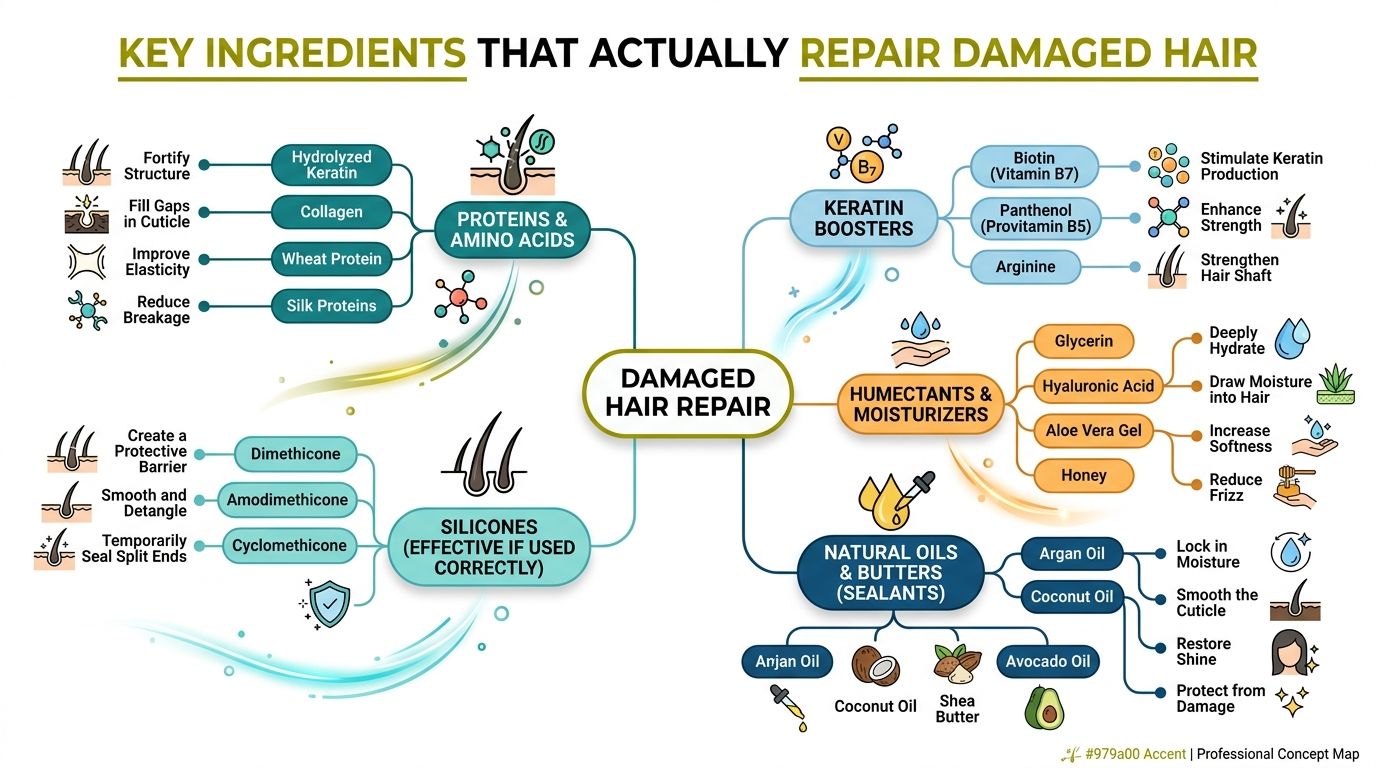
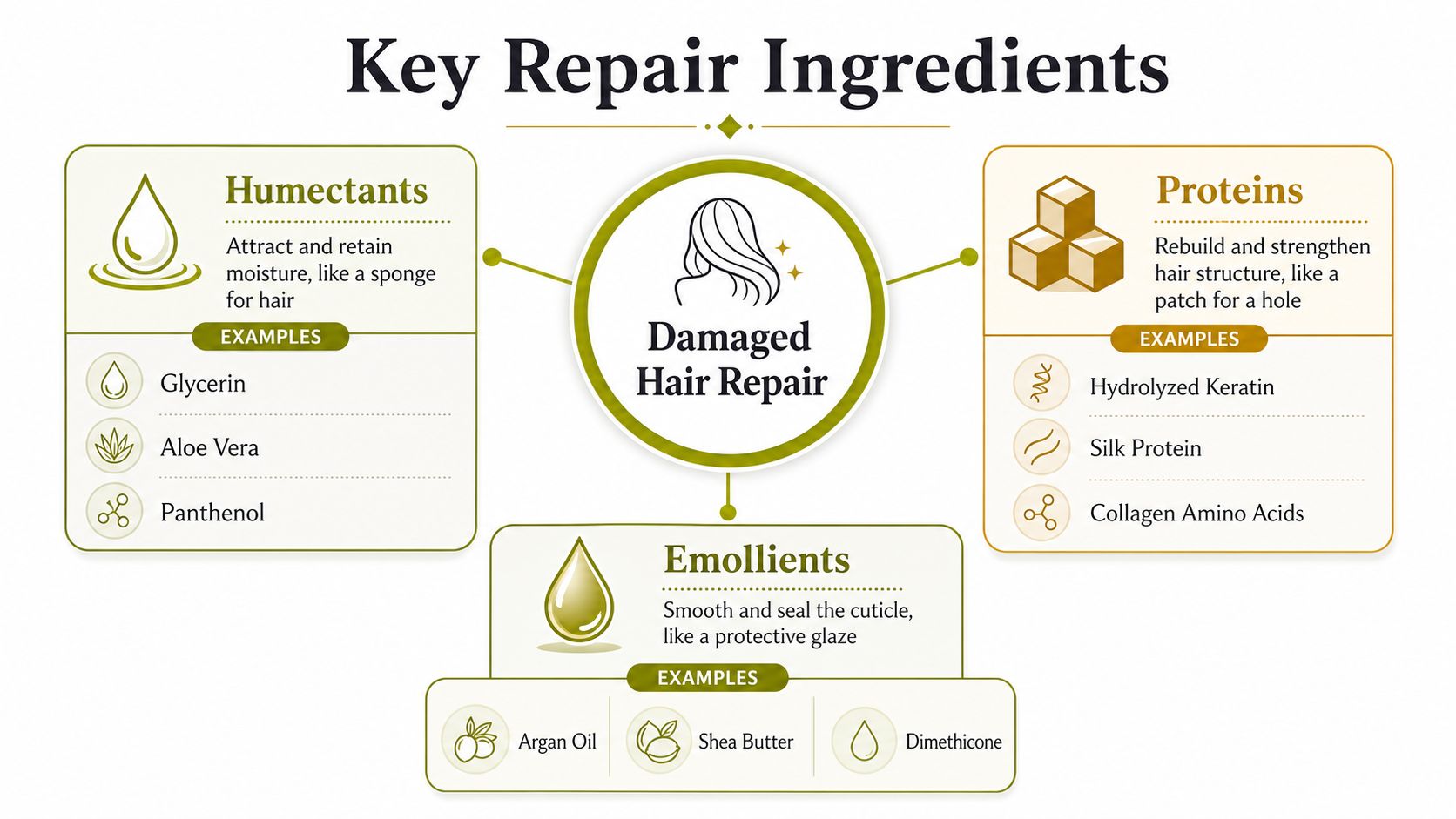
A good mask works like a small repair kit for hair. One part adds moisture back in, one part smooths rough spots, and one part helps the fiber stay together after rinsing. The label can look crowded, but the logic is straightforward once you know what each ingredient family does.
The three ingredient jobs to look for
Humectants pull water toward the hair. Glycerin, hyaluronic acid, panthenol, aloe, and sodium PCA are often used to help dry strands hold on to moisture, so hair feels less stiff and looks less frayed. That matters most when hair has lost softness but still needs movement.
Emollients and oils smooth the surface. Coconut, argan, avocado, jojoba, and shea help reduce roughness and make the cuticle feel more compact and polished. Coconut oil gets a lot of attention because its fatty-acid profile can penetrate better than many oils, and that is one reason it is repeatedly linked with lower protein loss and less breakage in damaged hair Typology.
Hydrolyzed proteins help with structure. Research on damaged hair fibers explains that hydrolyzed keratin, wheat, silk, or soy can adsorb to porous cuticles, partially penetrate them, and help improve tensile strength and elasticity by filling voids left by protein loss PMC. That is why a protein-forward mask often feels more supportive on bleached or heat-stressed hair than a formula that only adds slip.
The strongest formulas usually combine all three jobs, then include cationic conditioners such as behentrimonium chloride or cetrimonium chloride so the treatment stays attached to the negatively charged damaged fiber. This is the same kind of targeted thinking that makes skin rejuvenation microneedling feel relevant as a comparison, because it uses a specific approach for a specific concern instead of a generic one.
For a familiar ingredient example, ArtNaturals' argan oil benefits for hair and skin fit naturally here because argan is one of the oils that helps hair feel smoother without making the formula depend on just one ingredient.
Short version: if a mask only feels slippery, it may be giving temporary cosmetic softness. If it combines moisture binders, oils, and proteins, it is doing more of the work damaged hair actually needs.
Choosing the Right Mask for Your Damage Type
The smartest way to shop is to start with the damage pattern, not the marketing phrase on the front of the tube. Moisture-heavy masks, protein-forward masks, and repair-focused formulas all have a place, but they don't solve the same hair problem. When you match the formula to the issue, you waste less product and get a clearer sense of what your hair responds to.
A simple decision guide
| Damage Type | Best Mask Category | Key Ingredients to Look For |
|---|---|---|
| Heat styling dryness | Moisture plus light protein | Glycerin, panthenol, hydrolyzed protein, argan oil |
| Bleach or color stress | Protein plus emollients | Hydrolyzed keratin, wheat or silk protein, coconut oil, cationic conditioners |
| Brushing or styling breakage | Smoothing repair mask | Jojoba, shea, dimethicone or amodimethicone, hydrolyzed protein |
| Fine hair that feels flat | Lightweight moisture mask | Aloe, panthenol, cationic conditioners, lighter oils |
| Very rough, porous ends | Richer emollient mask | Coconut, avocado, shea, proteins, sealing agents |
A moisture-only mask makes sense when hair feels dry but still has some movement. A protein mask fits better when the strand feels soft but weak, especially after bleaching or repeated heat styling. Bond-builder products may belong in the routine when structural damage feels severe, though many people do better starting with hydration first and then adding protein if the hair still feels limp or stretch-prone.
Here's the rule that keeps the routine practical. If hair feels mushy, stretchy, or weak, protein may help. If it feels rough, stiff, or thirsty, moisture and emollients usually deserve priority first. For mixed-damage hair, rotate instead of stacking everything at once.
If your hair is color-treated and heat-styled, a single mask probably won't answer every need. Rotate a moisturizing mask with a protein-supportive one, then watch how the hair behaves after each wash.
How to Apply a Hair Mask for Best Results
A good formula still needs the right application. A mask can underperform if it lands on the wrong areas, sits on hair that is too wet, or gets rinsed off before it has time to do its work. Small technique changes can make the treatment feel lighter, spread more evenly, and match the needs of different damage types, whether the goal is to soften heat dryness, support color-stressed hair, or smooth breakage from brushing and styling.
The timing window is usually 5 to 30 minutes, depending on the formula Today.com. That gives the ingredients time to coat and condition the strand without turning wash day into a long project. Hair-care guidance also points to a slightly acidic pH 4.5 to 5.5 as helpful for keeping the cuticle lying flatter, which can reduce roughness, frizz, and moisture loss. A comparison chart outlining the pros and cons of using DIY versus store-bought hair masks.
A wash-day routine that keeps the mask working
Start with hair that has been gently cleansed. Removing buildup first lets the mask reach the strand instead of sitting on top of old styling residue, which is a little like trying to paint over dust. Then squeeze out the extra water. Hair that is dripping wet can dilute the product and make it slide off before the ingredients have a chance to cling.
Apply the mask from mid-lengths to ends unless the formula is meant for the scalp. Those areas usually show the most wear, especially when heat, color, or daily handling has roughened the surface. Keeping product away from the roots also helps preserve lift at the crown. Use your fingers or a wide-tooth comb to distribute it evenly, especially if your hair is thick, curly, or easily tangled.
A little heat can help some routines, especially for more porous or chemically processed hair, because warmth can help the product spread and settle. Fine or volume-sensitive hair often does better with a lighter layer and a shorter wear time, so the strands do not feel coated. For hair that gets weighed down easily, a pre-shampoo treatment can sometimes feel easier to manage than piling on more product after cleansing.
The point is not to use more. It is to place the mask where the damage lives and choose the formula that matches the problem, whether that means protein support for weak, overprocessed strands or softer conditioning for rough, thirsty ends.
ArtNaturals' Biotin Collagen Hair Mask is one example of a packaged option that fits into this more structured approach to repair care. It belongs to the kind of formula that aims for consistency from one wash to the next.
The image below compares DIY and store-bought approaches in a quick visual way.

DIY Hair Masks Versus Store-Bought Formulas
Homemade masks can be a nice ritual, especially if you enjoy mixing avocado, honey, coconut oil, or yogurt in your own bathroom. They can bring a quick sense of softness, and they're often the easier choice when you want a simple, hands-on treatment for a weekend reset. That said, the result depends a lot on your ingredients, your mixing, and how much slip or residue you're willing to tolerate.
Store-bought formulas have a different advantage. They're built around controlled concentrations of ingredients like hydrolyzed proteins, cationic conditioners, oils, and pH-balanced systems that are hard to recreate in a kitchen. That matters because damaged hair usually needs repeatable performance, not just a nice texture on application day.
ArtNaturals' Biotin Collagen Hair Mask is one example of a packaged option that fits into this broader category of structured repair care. It sits in the world of formulated treatments, where the goal is consistency from one wash to the next.
The tradeoffs are practical, not ideological
DIY masks are appealing when you want customization and a fresh-feeling routine. They can be a good fit for very dry hair that needs a simple softening step, or for people who like to treat self-care like a ritual. The limits show up when you want a reliable protein dose, better spreadability, or a formula that rinses clean without guesswork.
Store-bought masks make more sense when your hair keeps breaking, feels porous, or needs a more stable routine across several washes. They're also easier to repeat, which matters because damaged hair usually responds better to consistency than to dramatic one-off treatments.
If you're deciding between the two, ask one question. Do you want a comforting treatment, or do you want a more targeted repair system? The answer can be both, but for damage that keeps coming back, the more structured formula usually wins on predictability.
Common Hair Mask Mistakes and How to Avoid Them
A lot of mask disappointment comes from technique, not the product itself. People assume that more time, more product, or more frequent use will automatically mean better results. Damaged hair doesn't always cooperate that way.
One common mistake is using too much protein. Protein can support weak strands, but too much can make hair feel stiff or brittle instead of flexible. The fix is simple, rotate protein masks with moisture-focused ones instead of using a strengthening formula every time.
Another issue is applying the mask too close to the scalp when the hair doesn't need it there. That can flatten the roots and create buildup, especially for fine hair. Keep the heaviest product on the mid-lengths and ends unless the formula is designed differently.
A few more habits are easy to correct:
- Skipping a thorough rinse: leftover mask can dull the finish, so rinse until the hair feels clean but still soft.
- Using water that's too hot: hot water can undo the smoothing effect, so lukewarm is usually safer.
- Applying to soaking-wet hair: too much water dilutes the formula, which weakens the payoff.
Quick correction: if a mask seems to “stop working,” check your rinse, your water temperature, and how wet your hair was before application before blaming the product.
These small changes matter because hair masks work best when the fiber can hold on to the ingredients. That's especially true for damaged hair that already struggles with friction and breakage.
Building a Weekly Hair Care Routine That Maintains Results
A steady routine beats a dramatic one. If your hair is moderately damaged, a mask once a week may be enough to keep it feeling manageable. If your hair is more porous, chemically processed, or heat-stressed, you may need to adjust how often you use moisture and protein masks so the hair doesn't swing between limp and stiff.
The rest of the routine matters too. Gentle detangling, lower heat settings, and heat protection all help the mask's work last longer. If you're trying to strengthen a routine beyond the shower, the Nutrition Geeks haircare guide is a useful reference for building out sensible habits around everyday care.
Keep the routine calm and repeatable
Use your mask on the same wash day each week if that helps you stay consistent. After a few cycles, pay attention to what changes first, less snagging, easier comb-through, smoother ends, or less puffiness after drying. Those are usually more useful signs than chasing shine alone.
If hair starts feeling too soft, too flat, or oddly coated, scale back the richer formulas. If it feels rough again after a few washes, bring moisture or protein back into the rotation. Hair care works better when you treat the strand like a material with needs, not a problem to force into compliance.
The simplest long-term approach is this, choose the right mask for the kind of damage you have, use it consistently, and adjust before the hair feels overloaded. That calm, repeatable rhythm is what keeps damaged hair looking cared for instead of overwhelmed.
ArtNaturals offers haircare formulas that fit into this kind of practical routine, including mask options made for dry, damaged hair. If you're ready to build a gentler wash-day system and choose products that match your hair's needs, visit ArtNaturals and explore a repair-focused routine that feels easy to keep up.