

You wash your face, pat it dry, and your usual moisturizer suddenly stings. Your skin feels tight, looks flaky by midday, and reacts to products you tolerated last month. That's a common starting point for learning how to repair damaged skin barrier concerns, not by adding more steps, but by giving your outer layer a calmer routine to recover in.
Your Barrier Repair Routine at a Glance
| Stage | What to Use | How Often |
|---|---|---|
| Cleanse | Mild, non-soap cleanser with a low pH | Once or twice daily |
| Moisturize | Lipid-rich cream with ceramides or fatty acids | Twice daily and after washing |
| Humectant layer | Hyaluronic acid or glycerin on damp skin | Morning and night |
| Protect | Broad-spectrum sunscreen, SPF 30 or higher | Every morning, reapplied outdoors |
| Pause | Scrubs, exfoliating acids, retinoids, fragranced products | Until skin feels calm |
Think of this as a short, repeated routine, not a search for one miracle product. Your outer layer mainly needs two things while it recovers, less irritation and less water escaping from the surface. Cleansing, hydrating, and sealing work together toward that goal.
The order matters because each step prepares the next. A gentle wash leaves skin slightly damp, a humectant helps hold water near the surface, and a lipid-rich cream sits on top to slow evaporation. Sunscreen then protects that work during the day.
The Row People Skip Most Often
The pause row is the one people skip, often because they want to fix texture or dullness at the same time. Don't. Scrubs, acids, retinoids, and fragranced products can keep stressed skin reactive, which makes comfort harder to judge.
If a product stings once, adjust the amount or timing. If it keeps stinging, stop using it and choose something simpler.
This is general everyday care, so personal comfort is your guide. Use enough cream to leave a light protective film, but don't force your skin through a routine that feels worse after each use.
Signs Your Barrier Needs Repair and When to Get Checked
The pattern many people notice first is tightness after washing, followed by stinging when products go on. Rough or flaky patches often appear next. Skin may also react to familiar creams, makeup, or cleansers it once tolerated without trouble.
Those signs tell you skin feels stressed, but they don't reveal why. Similar feelings can overlap with irritant or allergic contact reactions, acne-related irritation, eczema, rosacea, and infection. That overlap is why barrier care should stay supportive rather than become a self-diagnosis.
| Situation | Start With | Get Professional Advice If |
|---|---|---|
| Stinging after a new product | Stop that product and use a simple cream | Swelling, oozing or crusting appears |
| Dry flakes with no new product | Gentle cleanser and lipid cream | Flaking persists after several weeks of consistent care |
| Redness beyond the area where a product was applied | Remove suspected triggers and wait | Redness spreads or comes with rising pain |
| Burning or tightness after every wash | Lukewarm water and a shorter wash | Eye involvement or rapidly worsening pain |
A Simple First Test
If stinging began within a day of a new product, stop that product first and watch for a week. Keep everything else unchanged, so you can see whether comfort improves. If you're managing an ongoing condition, keep prescribed treatment going unless your clinician advises otherwise, since stopping it can let inflammation build again.
If dryness keeps returning despite a calm routine, you can find help for dehydrated skin and discuss what else may be involved. Seek prompt care for spreading redness, swelling, oozing or crusting, eye involvement, fever, or rapidly worsening pain.
Remove the Irritants That Keep Barriers Stressed
Adding three new products to calm irritation is the most common mistake. Each new formula adds another variable, so you can't tell what's helping, what's doing nothing, and what's making stinging worse.
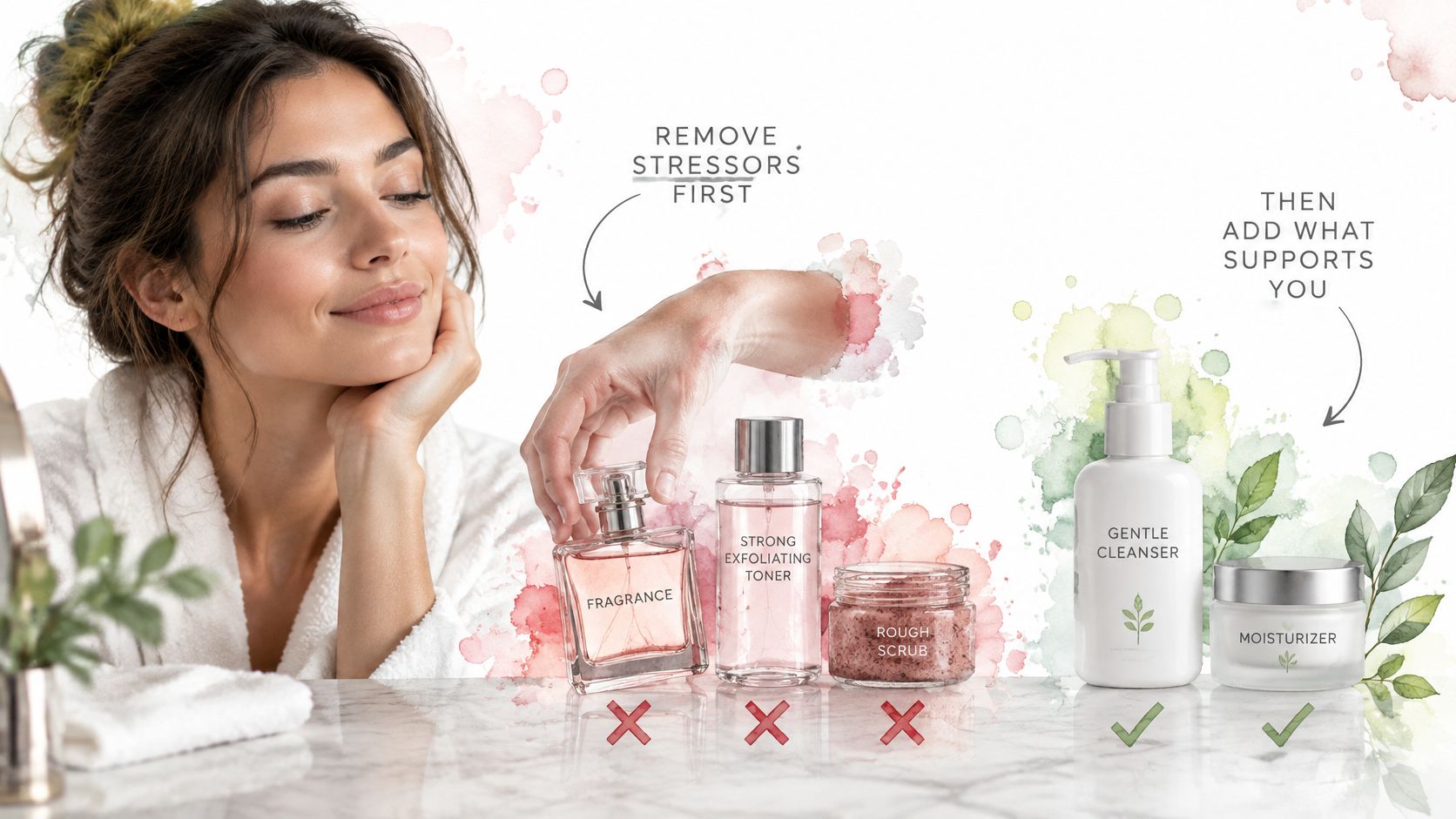
Start by sorting what you already own into gentle basics and stronger treatments.
Usual Suspects to Pause
- Physical scrubs and cleansing brushes: Friction can rough up an already sensitive surface.
- Exfoliating acids such as glycolic and lactic acid: They speed surface turnover while skin is still trying to settle.
- Retinoids: Useful in a calmer phase, but often too stimulating when skin burns after washing.
- Fragranced products and essential oils applied directly: Scent ingredients are a frequent source of irritation for reactive skin.
- Very hot water and harsh foaming cleansers: Heat and strong cleansing can strip surface lipids your skin needs.
Pause the most active products for about two to four weeks, then reintroduce one at a time. Say someone adds a vitamin C serum, a retinol, and a new scrub in the same week, then notices burning. Removing the scrub and retinol while keeping one simple cream makes the next week far easier to read.
The short video below reinforces that calmer sequence.
For acne-prone skin that's been over-exfoliated, barrier repair advice from Neutralyze offers additional context on easing back. Keep one rule throughout, change one thing at a time so the cause stays visible.
Barrier Ingredients and What Each One Does
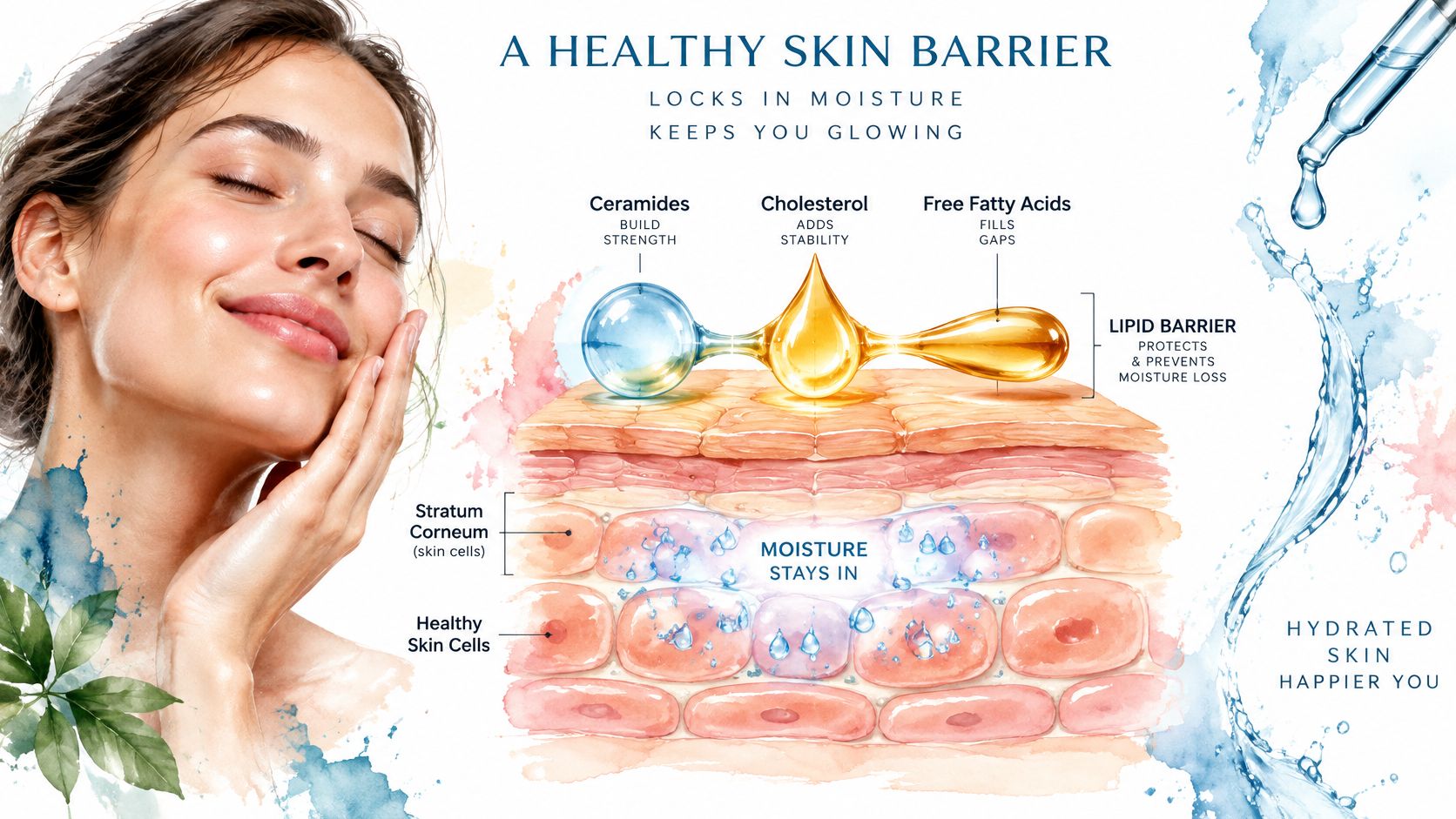
Your outer layer is held together by lipids that sit between skin cells, mainly ceramides, cholesterol, and free fatty acids. That mix helps regulate how much water leaves the skin. When it's disrupted, skin often feels dry even after you've moisturized.
Products support that structure in three complementary ways. Humectants draw and hold water, emollients smooth gaps between cells so skin feels softer, and occlusives form a film that slows evaporation. A useful routine usually combines them rather than relying on one category.
This visual breaks down how those lipid components fit together.
| Ingredient | Role in the Barrier | Watch For |
|---|---|---|
| Ceramides | Support the lipid layer between skin cells | Fragrance or blends that irritate sensitive skin |
| Cholesterol | Balances the lipid mix alongside ceramides | Often not prominent on labels |
| Free fatty acids | Contribute to the lipid structure and softness | Heavy layering can feel greasy in humid weather |
| Hyaluronic acid | Draws water toward the outer layer | Works best with an emollient on top |
| Glycerin | Humectant that holds water in the skin | Can feel tacky when used alone |
| Petrolatum or dimethicone | Occlusive film that slows evaporation | Thin layer on dry areas only |
| Squalane | Lightweight emollient with a soft feel | Not a complete routine on its own |
In people with self-perceived dry, sensitive skin and baseline TEWL above 10 g/m²/h, a pseudo-ceramide spray used twice daily for four weeks improved water content, TEWL, scaling, and ceramide profile in a randomized study described in a 2023 review on skin barrier and moisturizers. The treatment group contained 33 participants versus 19 controls, which is helpful context, not a promise for every formula.
How to Read a Label Without Guessing
Some formulations aim for a ceramide to cholesterol to free fatty acid ratio near 3:1:1, but labels rarely show exact ratios. Look for the ingredients by name instead of chasing a number you can't verify. Ingredient lists generally run from highest to lowest concentration, so ceramides near the bottom may be present in small amounts.
A lightweight serum and a richer cream feel different because they carry different mixes of water, emollients, and occlusives. More ingredients isn't automatically better, and hyaluronic acid works best when sealed with an emollient. Squalane can soften comfortably, but it isn't a complete routine on its own. For another gentle ingredient often discussed for reactive skin, read our guide to niacinamide for sensitive skin.
How to Cleanse and Moisturize Without Stressing Skin
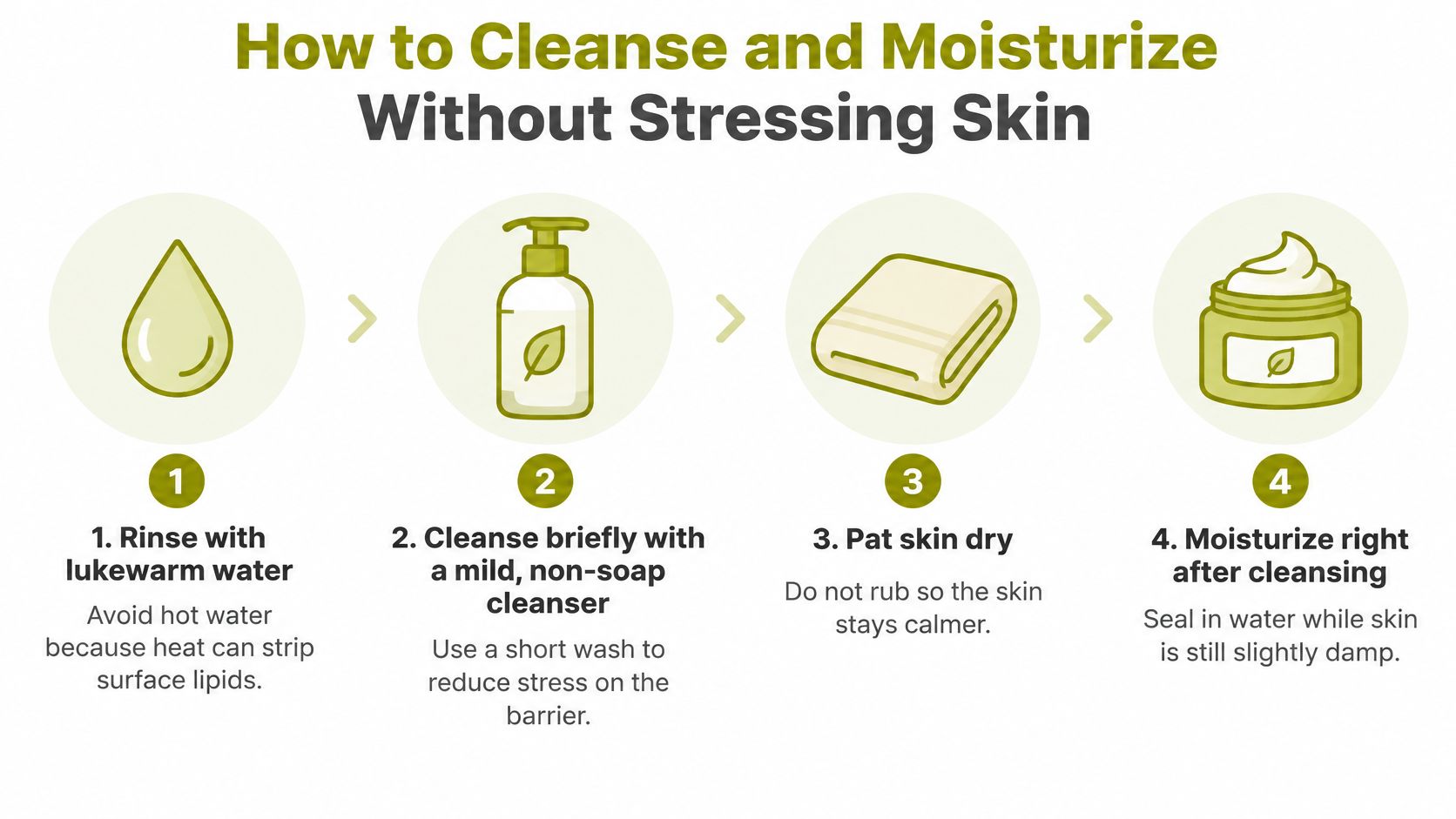
A calm daily sequence takes about five minutes. Each step has a simple job, and skipping the reason behind it is where most avoidable irritation creeps in.
The Daily Sequence
- Rinse with lukewarm water. Hot water feels soothing in the moment, but heat can strip surface lipids and leave skin tighter afterward. Keep the rinse brief.
- Cleanse briefly with a mild, non-soap cleanser. Choose one formulated near skin's natural pH, since traditional alkaline soaps can disrupt the outer layer. Massage gently with fingertips rather than scrubbing.
- Pat dry with a soft towel. Leave skin slightly damp instead of rubbing it fully dry. Rubbing adds friction and removes water you want to seal in.
- Apply a humectant to damp skin. Hyaluronic acid or glycerin helps attract water to the outer layer. A common slip is applying it to completely dry skin and stopping there.
- Follow with a lipid-rich cream. Look for ceramides, fatty acids, or cholesterol to smooth gaps and help hold moisture in. Using a thick layer of oil instead of a cream can feel nourishing, but it doesn't provide the same balanced lipid mix.
- Finish with sunscreen in daytime. Use broad-spectrum SPF 30 or higher, applied evenly and reapplied after sweating or swimming. Don't skip it on cloudy days or near windows just because skin feels fragile.
A practical protocol described in a review of moisturizers for skin barrier disorders pairs brief lukewarm cleansing with a lipid-rich moisturizer immediately after patting skin dry, repeated at least twice daily and after washing. In dry, atopic-eczema-prone skin, a single application can improve hydration and reduce dryness for about 24 hours, which supports steady reapplication rather than occasional heavy treatments.
Comfort check: Within a few minutes, skin should feel calm and flexible, not tight, hot, or heavy with grease.
A moisturizer with sunscreen can simplify mornings if you apply enough to get even coverage. If evenings feel dry, keep the same cream and add only a thin extra layer on flaky areas. For help arranging these steps around the rest of your products, see our guide on how to build a skincare routine.
Sensitive and Eczema-Prone Skin and the Limits of More Ceramides
More ceramides on a label doesn't automatically mean better results. Formulation, frequency, and consistency matter more than stacking several ceramide products at once. A well-tolerated cream used daily is easier to judge than three serums rotated through the week.
The evidence is encouraging but mixed. A 2021 review identified 12 reports in which external ceramide preparations improved dry skin or barrier function in people with atopic dermatitis, with reduced water loss commonly reported, as summarized in the Cochrane review record on emollients and moisturisers. Results varied by formulation, condition, and study design, so one product's outcome doesn't transfer neatly to another.
A 2024 randomized study in people with self-perceived dry, sensitive skin and TEWL above 10 g/m²/h found that a pseudo-ceramide spray used twice daily for four weeks improved water content, TEWL, scaling, and ceramide profile while a control spray did not, according to the PubMed record for that 2024 study. Greater application was associated with larger TEWL improvement.
Broader moisturizer evidence points in the same modest direction. The Cochrane summary on emollients and moisturisers for eczema covered 77 randomized controlled trials involving 6,603 people with mild-to-moderate eczema and found emollients generally improved outcomes compared with no moisturizer, although overall evidence quality was low.
Practical Ground Rules
- Start simple: Choose the plainest formula your skin tolerates.
- Give it time: Use it consistently for several weeks before judging.
- Don't stack duplicates: A second ceramide product on top rarely clarifies results.
- Keep prescribed care in place: Moisturizer supports skin, but it doesn't replace treatment your clinician has recommended for eczema.
Persistent or recurrent irritation calls for professional assessment rather than more products. For everyday comfort strategies, our advice on skincare for dry sensitive skin can help you keep choices gentle and consistent.
Track Progress and Start Your First Week
Barrier support is gradual. Early progress usually feels like comfort, less stinging, less tightness after washing, rather than a visible transformation. Judging a routine after a day or two rarely gives you a fair read.
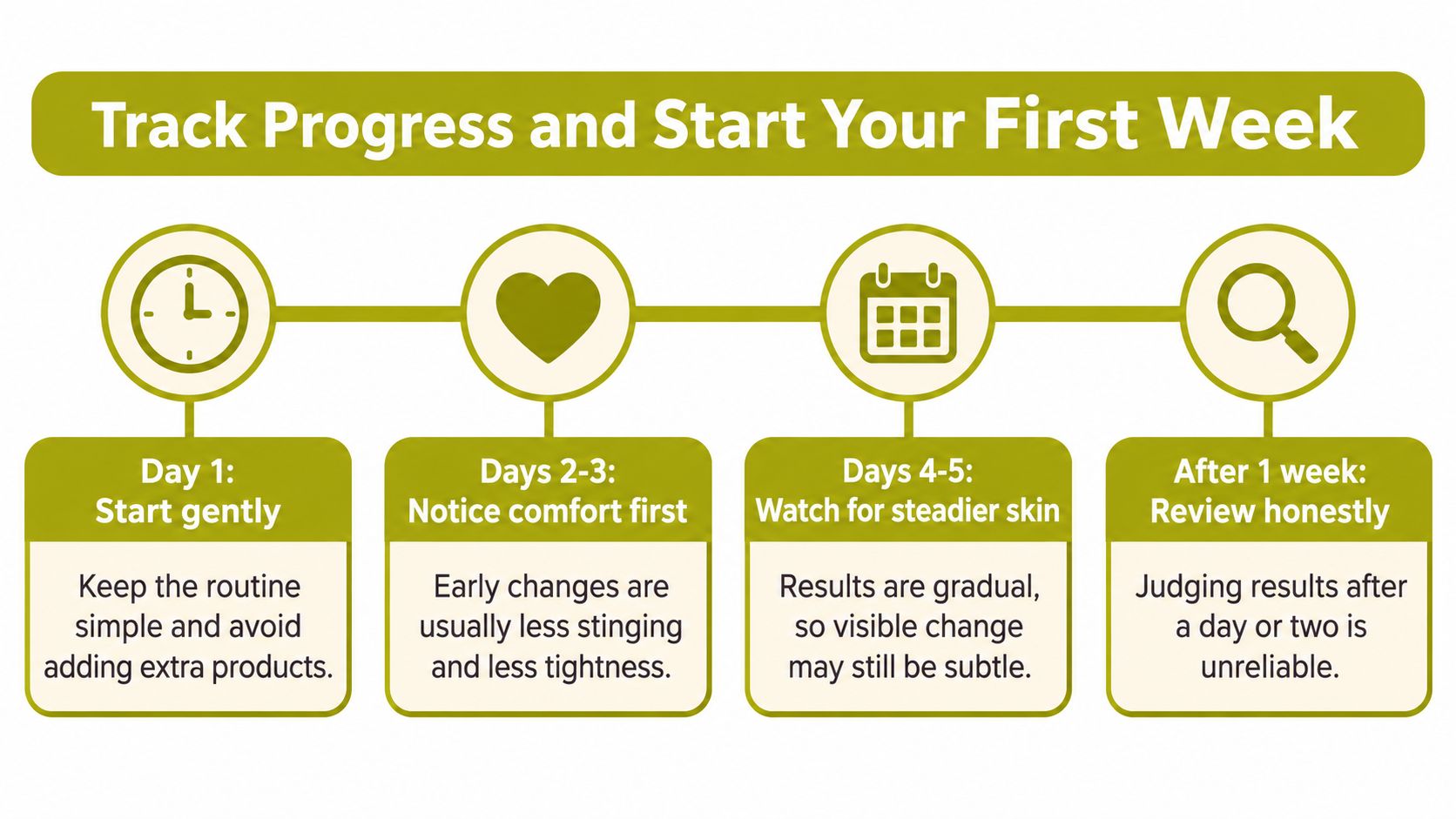
| Window | What You May Notice | What to Do |
|---|---|---|
| Days 1-3 | Less stinging after cleansing | Keep the routine simple and add nothing new |
| Week 1 | Comfort improves between washes | Keep moisturizer twice daily and log comfort |
| Weeks 2-3 | Less tightness and fewer flakes | Patch test any new product before facial use |
| Week 4 | A clearer read on progress | Reassess and book advice if there is no improvement |
Keep a simple log with the date, products used, a comfort rating from one to five, and any stinging. It takes less than a minute and stops you from relying on memory. To patch test, apply a small amount to your inner forearm or jawline for several days before facial use.
Say someone changes three products in week one and sees no clear pattern by week three. Returning to a basic cleanser and cream for two weeks, then adding one item at a time, usually reveals far more than continuing to swap formulas.
Your First Week Plan
- Day one: Pause irritating products and set up a gentle cleanser, lipid cream, and daytime sunscreen.
- Days two and three: Keep the routine unchanged and patch test anything new.
- From day four: Add nothing new until your log shows steady comfort for at least a week.
Our products use ingredients including argan oil, tea tree, vitamin C, retinol, niacinamide, hyaluronic acid, collagen and squalane oil, so introduce any active-focused option only after skin feels calm. Because opened or used personal care and beauty products cannot be returned, for hygiene reasons, patch testing first is a sensible habit.
If there's no improvement after several weeks, or symptoms worsen, professional advice is the next step rather than more products. A calm routine supports skin over time, but it doesn't replace evaluation for persistent or severe symptoms.
Start your calmer routine with gentle, plant-inspired essentials for cleansing, hydration, and daily comfort, including options built around hyaluronic acid, niacinamide, and squalane. Explore skincare grouped by concern and ingredient so you can add one well-chosen product at a time, and visit ArtNaturals to build a simple routine your skin can settle into.