

You wash your face, pat it dry, and your skin already feels tight. Your moisturizer helps for a while, then that dry, slightly dull feeling returns by afternoon. That's the moment many people reach for a hydrating serum and wonder where it fits.
Understanding hyaluronic acid serum uses gets easier once you see the serum for what it is. It's a water-binding step, not a cream, not an oil, and not a treatment for every concern. Used well, it can make skin feel more comfortable and look smoother. Used alone, without anything sealing it in, it often disappoints.
Hyaluronic Acid Serum Uses at a Glance
A hyaluronic acid serum is a lightweight, water-based step used mainly to add and hold hydration on the skin's surface.
| Use | What the serum does | When it shows | Realistic expectation |
|---|---|---|---|
| Everyday hydration | Attracts and holds water near the skin's surface | Within minutes of applying | Comfort that builds with daily use |
| Smoother-looking texture | Hydrated surface reflects light more evenly | After repeated use | Gradual, modest change |
| Temporary plumping | Water in the upper layers softens the look of fine lines | Right after application | Fades as moisture shifts through the day |
| Base under moisturizer | Creates a hydrated layer that a cream can help keep in place | Every application | Works best when paired with a moisturizer |
| Makeup-ready finish | Light, non-greasy feel before foundation | Immediately | Feel changes with skin type and humidity |
What the Numbers Behind the Table Show
In a 2021 prospective study summarized in a PubMed record of twice-daily HA serum use, 40 women aged 30 to 65 years with visible photoaging applied an HA facial serum twice daily while also using sunscreen. Corneometry showed a 134% increase in skin hydration immediately after application, and hydration remained 55% above baseline after six weeks.
At week six, smoothness, plumping, and hydration scores improved most, while changes in wrinkles were smaller. Keep the scale in mind when you read those figures. The group was small, sunscreen was used at the same time, and the pattern points to modest, short-term cosmetic change rather than permanent wrinkle removal.
That table gives you the short answer. What follows explains how the ingredient behaves, how to read a label, and how to apply the serum so the hydrated feel lasts longer than a few minutes.
What Hyaluronic Acid Does Once It Touches Skin
Think of a sponge. A damp sponge holds water near its surface and feels soft and flexible. A dry one feels stiff and rough. Hyaluronic acid works in a similar spirit on the stratum corneum, the outermost layer of your skin. It helps attract and hold water where your skin meets the air, which is why skin often feels softer within minutes of applying a serum.
A review of hyaluronic acid as a humectant in skincare describes this role plainly. Hyaluronic acid supports hydration in that outer layer, and different molecular weights behave differently, with larger forms staying closer to the surface and smaller forms moving farther into the upper layers.

The Damp Cloth Needs a Lid
Here's the distinction that prevents most disappointment. The serum is the damp cloth. Your moisturizer is the lid that keeps that cloth from drying out. Hyaluronic acid binds water, but it doesn't form the sealing layer that a cream or lotion provides, so water can still escape into the air.
Apply the serum for water, then apply moisturizer to help keep that water where you put it.
That sealing step matters more on dry days. In very dry air, a humectant left uncovered has little moisture around it to draw from, and your skin can end up feeling tight again surprisingly fast. If tightness after cleansing is your main pattern, dehydrated skin advice from aesthetic specialists can help you sort out whether your routine is missing water, a seal, or both.
Try a simple test. Apply serum to damp skin, add moisturizer to one side only, and compare how both sides feel after an hour. You'll usually notice the sealed side stays comfortable longer. Expect softer, calmer-feeling skin, not a dramatic overnight change.
Reading Molecular Size and Concentration on a Label
Hyaluronic acid isn't one uniform material. It comes in different molecular sizes, and size shapes where it tends to act. Imagine beach balls and marbles dropped into a net. The beach balls sit on top. The marbles slip farther through. Larger hyaluronic acid forms behave more like the beach balls, staying near the surface where they can form a thin, moisture-supporting film. Smaller forms move farther into the outer layers.
| Molecular size or range | Where it tends to act | Reported figure |
|---|---|---|
| Higher molecular size | Stays near the surface and can form a thin film | Limited permeability |
| Low molecular weight (about 400 Da to 100 kDa) | Moves into the stratum corneum and epidermis | Estimated dermal penetration 14% to 19% |
| Larger molecules | Mostly remains near the surface | Estimated dermal penetration about 2.73% to 10.2% |
| Cosmetic concentration | Commonly small percentages | Up to 2% in the practices reviewed |
Those penetration figures come from an ingredient review of hyaluronic acid molecular weight, which reports 14% to 19% estimated dermal penetration for low-molecular-weight molecules of approximately 400 daltons to 100 kilodaltons, compared with about 2.73% to 10.2% for larger molecules. Treat them as reported ingredient research, not a promise for any bottle on a shelf. The full formula around the ingredient shapes what happens on your skin.
What to Look for on the Label
A formula listing more than one form, such as sodium hyaluronate alongside another hyaluronic acid form, may cover more than one hydration effect. That's often more useful information than a single front-of-pack claim.
Concentration needs the same calm reading. A PubMed-indexed safety assessment of hyaluronic acid in cosmetics describes hyaluronic acid, sodium hyaluronate, and potassium hyaluronate as skin-conditioning ingredients used at concentrations up to 2% in the practices reviewed. Small percentages can still be purposeful, and labels don't always disclose the amount of each individual form.
- Check the forms listed. More than one form can signal a layered approach.
- Don't chase the highest percentage. A bigger number isn't automatically better.
- Note what's missing. If no concentration is shown, judge the product by comfort over time.
How to Apply Hyaluronic Acid Serum Step by Step
Order matters more than quantity here. The routine below takes about three minutes once it's familiar.
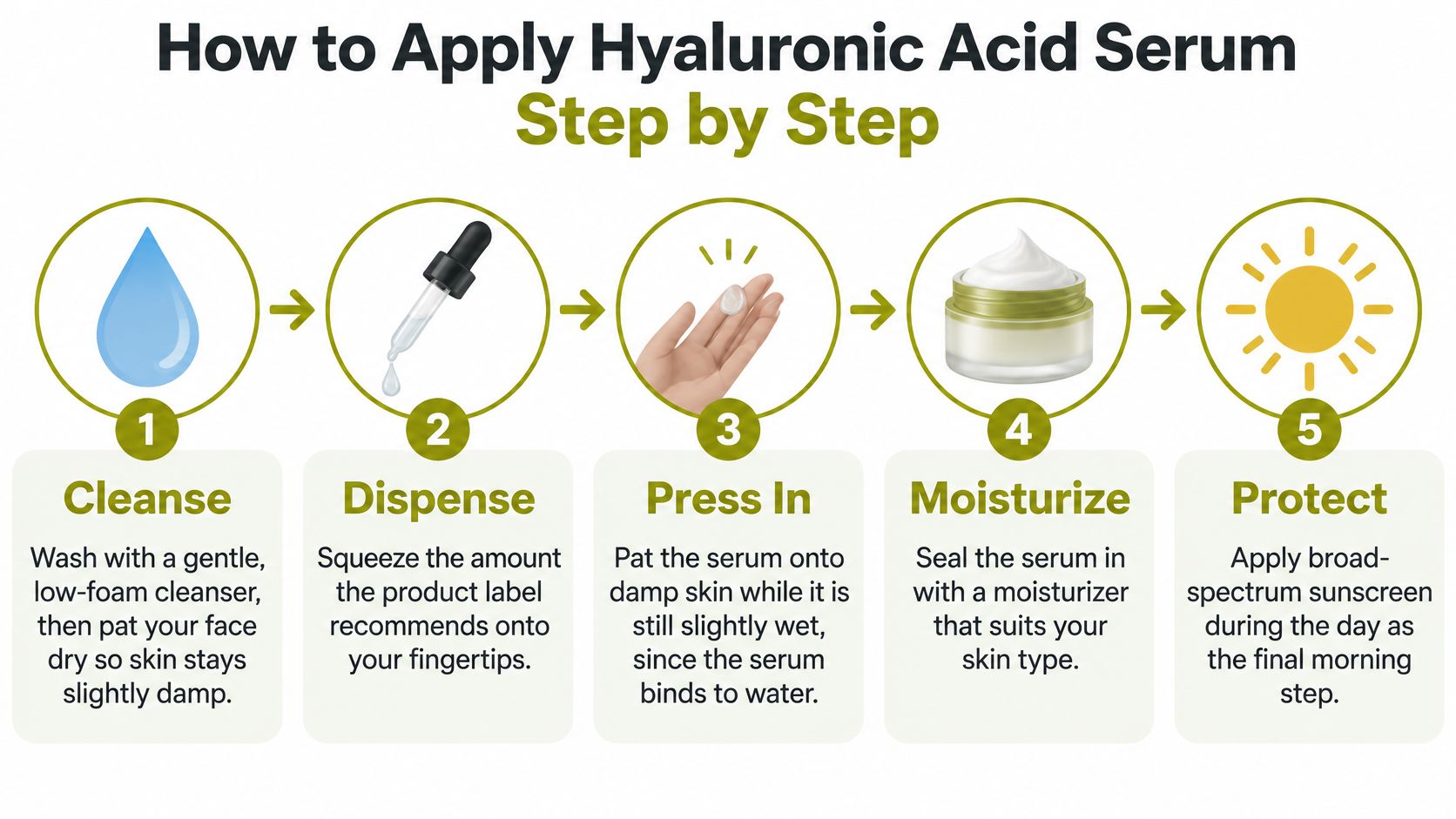
- Cleanse gently. Wash with a gentle, low-foam cleanser, then pat your face so skin stays slightly damp. The serum binds water, so damp skin gives it something to work with right away.
- Dispense a small amount. Use what the label directs, usually a few drops or a small pea-sized amount for face and neck. More product mostly means more stickiness, not more hydration.
- Press, don't rub. Warm the serum between your palms and press it gently into your skin. Pressing spreads it evenly without tugging, and it keeps the step calm.
- Wait briefly. Give it one to two minutes to settle. Your skin should feel damp and comfortable, not wet, before the next layer goes on.
- Seal with moisturizer. Follow with a richer cream on dry days or a light lotion if your skin leans oily. This is the lid that helps the hydrated feel last.
- Add sunscreen in the morning. The serum hydrates, but it doesn't protect against the sun. Sunscreen is always the final morning step.
If watching the order once helps it stick, this short demonstration walks through the same press and seal sequence.
Common Slips That Reduce the Effect
Applying serum to bone-dry skin can leave a tight feeling, because there's little surface water for it to bind. Skipping moisturizer lets the comfortable feel fade sooner. Using too much can leave a sticky film that pills under makeup.
Practical rule: Damp skin first, thin layer second, moisturizer third. If your face feels tacky after two minutes, you used more than you needed.
Many users can apply the serum both morning and evening. If your skin feels sensitive during the first week, start with evenings only and build up once your skin feels settled.
Benefits Across Skin Types
Because hyaluronic acid is a water-based humectant, its main benefit, added hydration, applies to most skin types. What changes is the pairing, the amount, and what you watch for. Dry skin usually needs a richer seal on top. Oily skin usually wants the lightest seal that still feels comfortable.
| Skin type | Where the serum tends to help | Pairing tip | What to watch for |
|---|---|---|---|
| Dry or tight-feeling | Adds water where skin feels depleted | Follow with a richer moisturizer, especially at night | Dryness can persist without a sealing layer |
| Normal | Light daily hydration that supports comfort | Use under a light lotion | Layering too many products at once |
| Combination | Hydrates drier areas without a heavy feel | Apply all over, add extra moisturizer to dry zones | Heavy layers on the oilier T-zone |
| Oily | Gel-like texture adds water without added oil | Pair with a light gel or gel-cream | A heavy routine can feel weighty on oily skin |
| Sensitive | Simple, fragrance-free formulas suit a minimal routine | Patch-test first and keep the routine short | Irritation may come from fragrance, preservatives or botanicals |
| Mature | Supports a smoother, plumper look over several weeks | Use sunscreen every morning | Expect gradual change rather than instant results |
A Note for Sensitive Skin
If a serum stings, the cause isn't always the hyaluronic acid itself. Fragrance, preservatives, or botanical extracts elsewhere in the formula can be the trigger, which is why a patch test on a small area is worth the two days it takes. For a deeper look at choosing gentler formulas, this guide to hyaluronic acid for sensitive skin walks through what to look for and what to skip.
Treat skin type as a general guide to routine choices, not a diagnosis. If your skin stays uncomfortable after you've simplified things, that's a sign to pause and seek advice from a qualified professional rather than adding more products.
Layering Hyaluronic Acid With Other Actives
One rule handles most layering questions. Apply products from thinnest to thickest, with water-based products before oil-based ones. Hyaluronic acid sits near the start of that order, after cleansing and any water-based treatment, and before your moisturizer.
| Product | How it pairs with HA serum | Order tip | Caution |
|---|---|---|---|
| Vitamin C serum | Compatible in the same routine | Apply first on clean skin, then HA serum | Patch-test on sensitive skin, as vitamin C can sting |
| Niacinamide | Compatible in the same routine | Apply after cleansing, then HA serum | Introduce one active at a time |
| Retinoid | HA serum can help cushion dryness | Follow the retinoid label; apply HA before or after as directed | Dryness or irritation can increase when combined |
| AHA or BHA exfoliant | Use HA in the non-exfoliating part of the routine | Exfoliate on alternate evenings, then HA on damp skin | Stinging or redness means pause and simplify |
| Sunscreen | Not interchangeable with HA serum | Always the final step in the morning | HA serum does not provide sun protection |
Putting the Rule Into Practice
Say your morning routine includes a vitamin C serum. You'd cleanse, apply the vitamin C to clean skin, follow with hyaluronic acid serum, then moisturizer, then sunscreen. The same thin-to-thick pattern holds in the evening. A water-based active goes on after cleansing, the hydrating serum follows, and moisturizer closes the routine.
Retinoids deserve extra care because the label on that product sets the order. Some people apply hyaluronic acid first as a cushion, others after. Either way, dryness and irritation can build when strong actives stack up, so alternate evenings are a sensible starting point.
If you'd like the full framework for ordering a routine, this overview of layering skin care products in the right order lays out the sequence step by step.
One last habit makes troubleshooting easy. Change one thing at a time, give it a week or two, and note how your skin feels. If a product's own label gives a specific order, the label wins over any general rule.
When Hyaluronic Acid Is Not Enough
The most common misconception is that a hydrating serum solves every skin concern. It doesn't, and expecting it to sets you up for frustration. A dermatology review of topical hyaluronic acid evidence notes that research on topical HA mostly measures hydration, transepidermal water loss, elasticity, or appearance, not acne treatment, eczema disease control, or wrinkle reversal as standalone outcomes. Hydration support and medical treatment are different jobs.
Four Claims Worth Correcting
- It treats acne. It isn't an acne medication. It can support comfort alongside a proper routine, nothing more.
- It removes wrinkles. Hydrated skin can look smoother and temporarily plumper, but that's a surface effect, not permanent removal.
- It replaces prescribed care. Ongoing inflammation from conditions like eczema or rosacea needs proper treatment, with hydration as a complement.
- Every serum performs the same. Molecular size, formulation, and the rest of the ingredient list all change the result.
Hydration is supportive care. It sits alongside treatment when treatment is needed. It never stands in for it.
What to Do if Your Skin Reacts
- Patch-test first. Try a small area for a couple of days before full use.
- Stop if it lingers. Pause the product if burning or redness worsens or doesn't settle.
- Simplify the routine. Drop back to a gentle cleanser, the serum only if it feels fine, and a plain moisturizer.
- Seek advice. Ongoing inflammation or a concern that won't settle deserves a dermatologist's input.
A reaction may not be caused by hyaluronic acid at all. Fragrance, preservatives, or botanicals in the overall formula are common culprits. And if you're unsure whether you even need both products, this explainer on the difference between serum and moisturizer clarifies what each one does.
Confirm Your Routine Before You Start
Run through five quick checks before you buy or begin.
- Your goal fits. Your skin often feels dry or tight, or you want a softer, more hydrated surface.
- You can seal it in. You're willing to apply the serum to damp skin and follow with moisturizer every time.
- Sunscreen is covered. Your morning routine already ends with sun protection, since the serum provides none.
- You've patch-tested. This matters most if your skin is sensitive or the formula contains fragrance.
- You can give it time. You're prepared to use it consistently for several weeks and expect gradual, modest change.
If all five fit, choose one product that lists its hyaluronic acid forms and concentration clearly, and introduce only that one new product. Watching a single change makes your skin's response easy to read. If any check is a no, fix that part of the routine first, whether that's adding a moisturizer you'll use consistently or settling your sunscreen habit.
The goal is simple. Comfortable, hydrated skin that feels like itself. Anything persistent or worsening deserves advice from a qualified professional, not another bottle.
If you're ready to put this routine into practice, ArtNaturals offers plant-powered skincare including a hyaluronic acid serum made to layer under moisturizer for everyday hydration. Browse the serums and build a calm, simple routine around your skin's needs at ArtNaturals.