

Some mornings, your skin tells you exactly what it wants. It looks a little flat, feels tight after cleansing, and seems less lively than it did a few days ago. You want one serum that helps with hydration, brightness, and that slightly worn-out look that shows up after stress, weather shifts, late nights, or too much city air.
That's where a hyaluronic acid serum with Vitamin C tends to catch people's attention. It sounds simple, but the details matter. Not every formula handles these two ingredients the same way, and not every routine uses them in the same order.
A lot of advice stops at “brighten and plump.” That's useful, but it skips the everyday questions. Which texture goes first. Why one Vitamin C serum stings and another doesn't. Why hyaluronic acid can feel comforting in one climate and oddly not enough in another. Those are the choices that usually decide whether a serum becomes a staple or gets pushed to the back of the shelf.
What This Combination Means for Your Skin
A hyaluronic acid serum with Vitamin C is usually meant to do more than one job at once. In plain terms, it brings together water-focused hydration and antioxidant support in a single step. That matters if your skin doesn't feel dry in the classic flaky sense, but still looks tired, dull, or less bouncy than you'd like.
One product, several goals
Hyaluronic acid is the moisture part of the story. It helps hold water near the skin so skin feels softer and looks smoother.
Vitamin C brings a different role. It's widely used in skincare for a brighter-looking tone and for support against daily environmental stress, especially from UV exposure and pollution.
Together, the pair is often chosen for three common concerns:
-
Dehydration
Skin can feel tight, papery, or rough even when you're already using moisturizer. -
Visible dullness
A face can look flat or less radiant without being “dry” in the usual sense. -
Everyday environmental stress
Many people want a routine step that does more than add moisture.
Why people like the pairing
This combination tends to appeal to shoppers who don't want a long routine. Instead of thinking in separate categories like “hydrating serum” and “brightening serum,” they want one formula that helps skin feel more comfortable while also supporting a fresher overall look.
Practical rule: If your skin often feels both thirsty and dull, this pairing usually makes more sense than choosing a hydration-only serum first.
There's also a bigger reason this format is so common now. Hyaluronic acid isn't a niche ingredient. The global hyaluronic acid personal care products market was valued at USD 3.0 billion in 2022 and is projected to reach USD 6.0 billion by 2030, with an 8.7% CAGR from 2023 to 2030, according to Grand View Research's hyaluronic acid personal care products market report. The same source notes a separate forecast estimating USD 2.04 billion in 2025 and USD 2.84 billion by 2031, with facial care at 81.47% of market share in 2025 and North America at 41.25% of global share.
What to expect from it
A good formula usually aims for three everyday payoffs:
- Skin feels plumper and more comfortable
- Tone looks brighter over time
- Your routine becomes easier to tolerate and finish consistently
That last point matters more than it sounds. A serum only helps if you'll keep using it.
Getting to Know Hyaluronic Acid
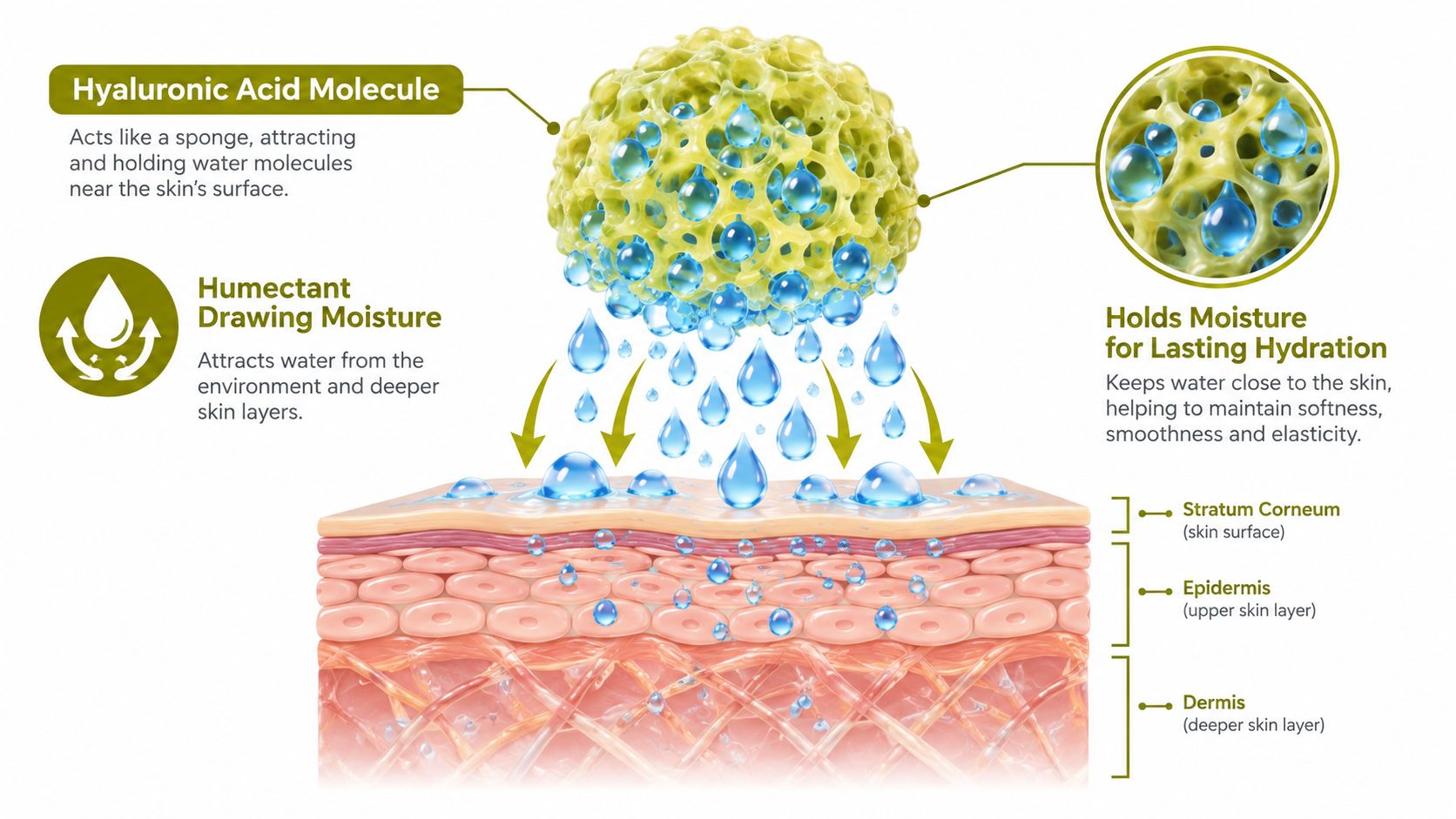
If you've heard hyaluronic acid described as a moisture magnet, that's close, but a sponge is an even better image. Think of it as a lightweight sponge that helps hold water near the skin's surface so your face feels less tight and looks smoother.
What hyaluronic acid actually does
In skincare, hyaluronic acid is a humectant. That means it helps draw in and hold moisture. It doesn't feel rich like a balm or face oil, and it doesn't work by coating skin heavily. Instead, it helps skin feel supple without much weight.
If you're new to the ingredient, this beginner-friendly guide on what hyaluronic acid serum is gives a useful product-level overview.
A lot of the immediate “plump” feeling people notice comes from that water-holding behavior. Fine lines caused by dehydration can look softer when the skin surface is holding moisture better.
Why size matters
Not all hyaluronic acid behaves the same way in a formula. One of the biggest points of confusion is molecular weight, which is just a way of describing how large or small the hyaluronic acid material is.
Here's the simple version:
- Higher molecular weight HA tends to stay closer to the surface. It's often used for a smooth, cushioned feel.
- Lower molecular weight HA is often discussed as the more flexible form for deeper delivery within the skin's upper layers.
A review on skin delivery notes that topical hyaluronic acid isn't expected to cross the stratum corneum under the classic 500 Dalton rule, yet some HA preparations can still move through alternative routes, which is why size and formulation matter more than the ingredient name alone in a finished serum. You can read that in this review of hyaluronic acid in skin delivery systems.
A label that only says “hyaluronic acid” doesn't tell you how the serum will feel or perform. The formula around it matters just as much.
Why many formulas blend different types
A blended HA serum often tries to do two things at once. One part helps with quick surface softness. Another part supports a more flexible hydration effect across the upper layers of skin.
That's why two hyaluronic acid serums can feel completely different, even when both use the same ingredient name on the front of the bottle.
Why Vitamin C Is Paired with Hyaluronic Acid
Vitamin C and hyaluronic acid are paired so often because they solve different problems. One helps support a brighter-looking, more even appearance. The other helps skin hold onto comfort and water. In the same formula, they can make a serum feel more complete.
The shield and sponge idea
An easy way to think about this pair is shield and sponge.
Vitamin C is the shield. It's used for antioxidant support, which is why people often reach for it when they want help with visible dullness and the effects of daily exposure to sun and pollution.
Hyaluronic acid is the sponge. It helps maintain a hydrated, cushioned feel so skin doesn't just look brighter, but also feels more comfortable.
That balance matters because brightening-focused formulas can sometimes feel sharp, especially when the Vitamin C form is more active.
Not all Vitamin C is the same
“Vitamin C” on a label can mean a few different things. The ingredient family includes forms such as L-ascorbic acid, sodium ascorbyl phosphate, and magnesium ascorbyl phosphate. They don't all behave the same way in texture, stability, or skin feel.
L-ascorbic acid is the form many shoppers hear about first. It's also the one most associated with low-pH formulas. According to this reference guide on cosmetic pH settings, L-ascorbic acid is typically formulated at about pH 2.6 to 3.2, while hyaluronic acid is reported as stable across a wider pH 4.5 to 7.5 range. That mismatch is one reason brands often separate these ingredients or balance them very carefully in one serum.
If you want a broader ingredient overview, this guide to Vitamin C serum basics is a helpful place to compare common forms and routine styles.
Why the pairing can feel easier to use
The formula becomes more than the sum of its parts. Vitamin C handles the antioxidant and brightening side. Hyaluronic acid helps with the hydration and comfort side. That can make a combined serum feel more beginner-friendly than a strong Vitamin C formula on its own.
A major 2026 paper on topical Vitamin C adds context to why this pairing is so popular. In one study of a 12% pure Vitamin C serum, epidermal thickness increased by 16.4% after 84 days versus baseline. In another randomized, double-blind trial of a 10% Vitamin C serum in 66 healthy women, after 12 weeks advanced glycation end products fell by 17.65%, carbonylation fluorescence dropped by 49.22%, IL-1α decreased by 58.73%, and skin yellowness and redness improved by 6.13% and 16.46%. Those details appear in this 2026 Springer article on Vitamin C serum effects.
How Formulation Shapes What the Serum Delivers
A hyaluronic acid serum with Vitamin C can look promising on the front label and still be disappointing in use. The reason is usually formulation. Four checkpoints tell you more than the marketing line does.
Four things worth scanning first
| Checkpoint | What to Look For | Why It Matters |
|---|---|---|
| pH balance | A formula designed for the chosen Vitamin C form, rather than a vague “Vitamin C blend” | Vitamin C and hyaluronic acid prefer different pH zones, so balance affects comfort and stability |
| Packaging | Opaque bottles, air-restrictive pumps, minimal light exposure | Vitamin C degrades more easily with heat, light, moisture, and oxygen |
| Active type | L-ascorbic acid versus derivatives such as sodium ascorbyl phosphate or magnesium ascorbyl phosphate | The Vitamin C form changes potency, gentleness, and how picky the formula needs to be |
| Supporting ingredients | Glycerin, panthenol, ceramides, Vitamin E, ferulic acid | These often improve feel, tolerance, and overall formula design |
pH is the quiet deal-breaker
This is one of the least glamorous parts of skincare, but it's one of the most important. Hyaluronic acid and sodium hyaluronate are commonly described as most comfortable in a neutral-to-slightly acidic zone of about pH 4.5 to 6.5, according to this hyaluronic acid ingredient stability reference.
Vitamin C can pull in a different direction, especially if the formula uses pure L-ascorbic acid. That's why brands either separate the two ingredients, use a Vitamin C derivative, or design the whole system very carefully.
Packaging and concentration both matter
If Vitamin C sees too much air and light, it won't stay in top shape for long. Opaque, airtight packaging is usually a better sign than a clear dropper bottle that leaves the serum exposed each time you use it.
Concentration can also be misunderstood. More isn't automatically better. Ingredient-label guidance commonly places hyaluronic acid's effective use range in finished products at about 0.1% to 2%, and it often appears as sodium hyaluronate, the more stable salt form, as explained in this guide to reading skincare labels.
When you read a serum label, ask three plain questions. What form of Vitamin C is this. How is the bottle protecting it. Does the rest of the formula sound calming or stripped down.
A practical example
If you want a real-world example of this category, ArtNaturals Vitamin C Serum with Hyaluronic Acid is one option that combines the duo in a single product format. The useful part isn't the name alone. It's checking how the formula packages the actives, what Vitamin C form it uses, and whether the texture fits your routine.
A formulation paper on Vitamin C serums reported a finished pH between 4 and 6 and retained stability in accelerated testing up to 40°C, with pH remaining stable over 30 days. The same source also described hyaluronic-acid-coated carriers that increased ascorbic acid delivery, with the best sample reaching 116.55 ± 7.54 µg/cm² penetration and 134.8 ± 10.04 µg/cm² accumulation in human skin. That work appears in this 2025 formulation and delivery paper on Vitamin C serums.
Layering a Hyaluronic Acid Serum with Vitamin C in Your Routine
Don't get confused about whether these ingredients can go together. The confusion lies in where the serum goes, whether skin should be damp or dry, and what to do if the texture pills under moisturizer or sunscreen.
For a broader routine overview, this guide on layering skin care helps make the order easier to visualize.
If it's one combined serum
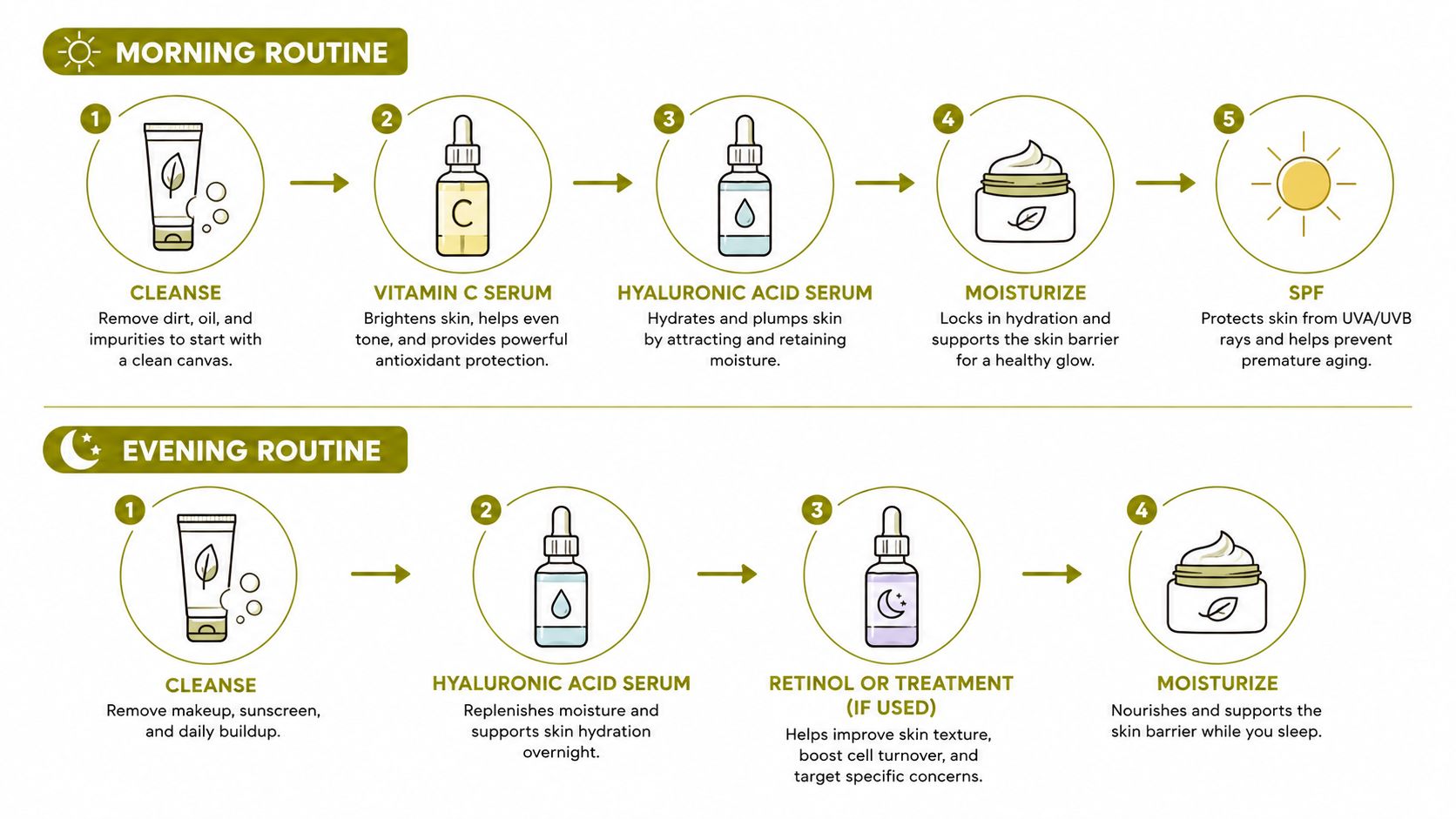
If your product is already a hyaluronic acid serum with Vitamin C, the routine is simple. Apply it after cleansing and before moisturizer. In the morning, finish with sunscreen.
The more complicated question comes up when you use separate Vitamin C and hyaluronic acid serums.
If you use separate serums
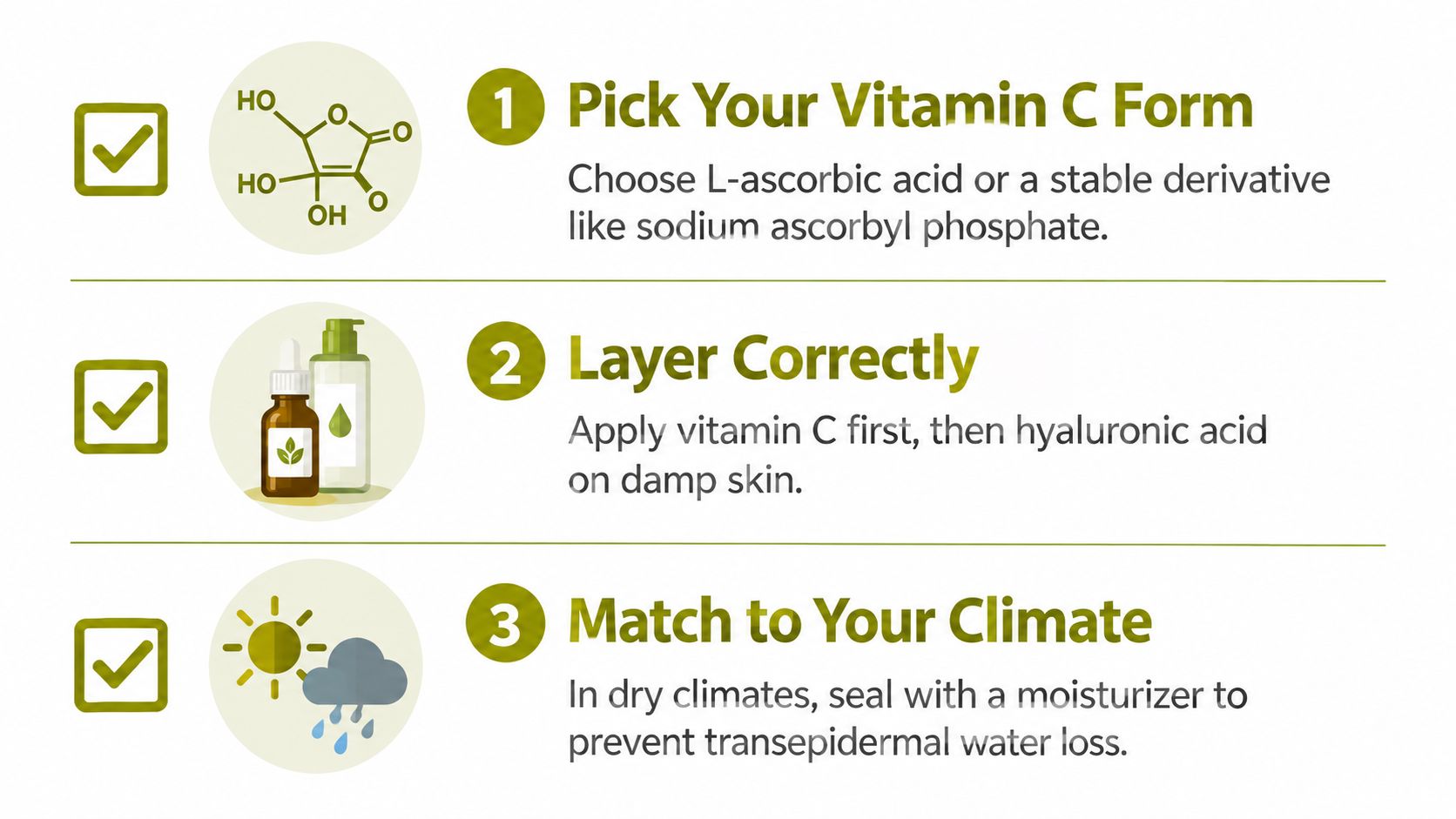
Routine guidance from beauty publishers commonly recommends applying Vitamin C first on clean, dry skin and layering hyaluronic acid afterward. This approach is tied to Vitamin C's pH sensitivity and the role of hyaluronic acid as a hydrating follow-up. That recommendation appears in Lancôme's guide to using Vitamin C and hyaluronic acid together.
A simple morning order looks like this:
-
Cleanse gently
Remove overnight oil and residue without leaving skin stripped. -
Apply Vitamin C first
This step usually works best when the formula is watery and light. -
Add hyaluronic acid next
Press it on while skin still has a little moisture left from the previous layer or from a light mist. - Use moisturizer
- Finish with sunscreen
Texture can change the answer
This is the part many beginner guides skip. The order isn't always universal. A recent guide notes that watery Vitamin C usually goes before hyaluronic acid, but a Vitamin C emulsion or oil serum may need hyaluronic acid first to reduce pilling and make layering smoother. You can see that nuance in Clarins' guide to Vitamin C and hyaluronic acid order.
If your routine pills, don't assume the ingredients are incompatible. Check texture first. A thin liquid behaves differently from an emulsion or oil serum.
A simple evening option is even shorter:
- Cleanse
- Apply your combined serum, or use hyaluronic acid alone if you prefer your Vitamin C in the morning
- Moisturize
- Add facial oil last, if you use one, to help seal things in
Patting usually works better than hard rubbing, especially with layered serums. Give each layer a brief moment to settle so the next step doesn't roll up.
Tolerance, Climate, and Sensitive Skin Considerations
People often hear that hyaluronic acid and Vitamin C are easy together. That's mostly true, but it's not the full story. The more helpful question is whether the formula suits your skin state, your climate, and the rest of your routine.
Why sensitive skin can react
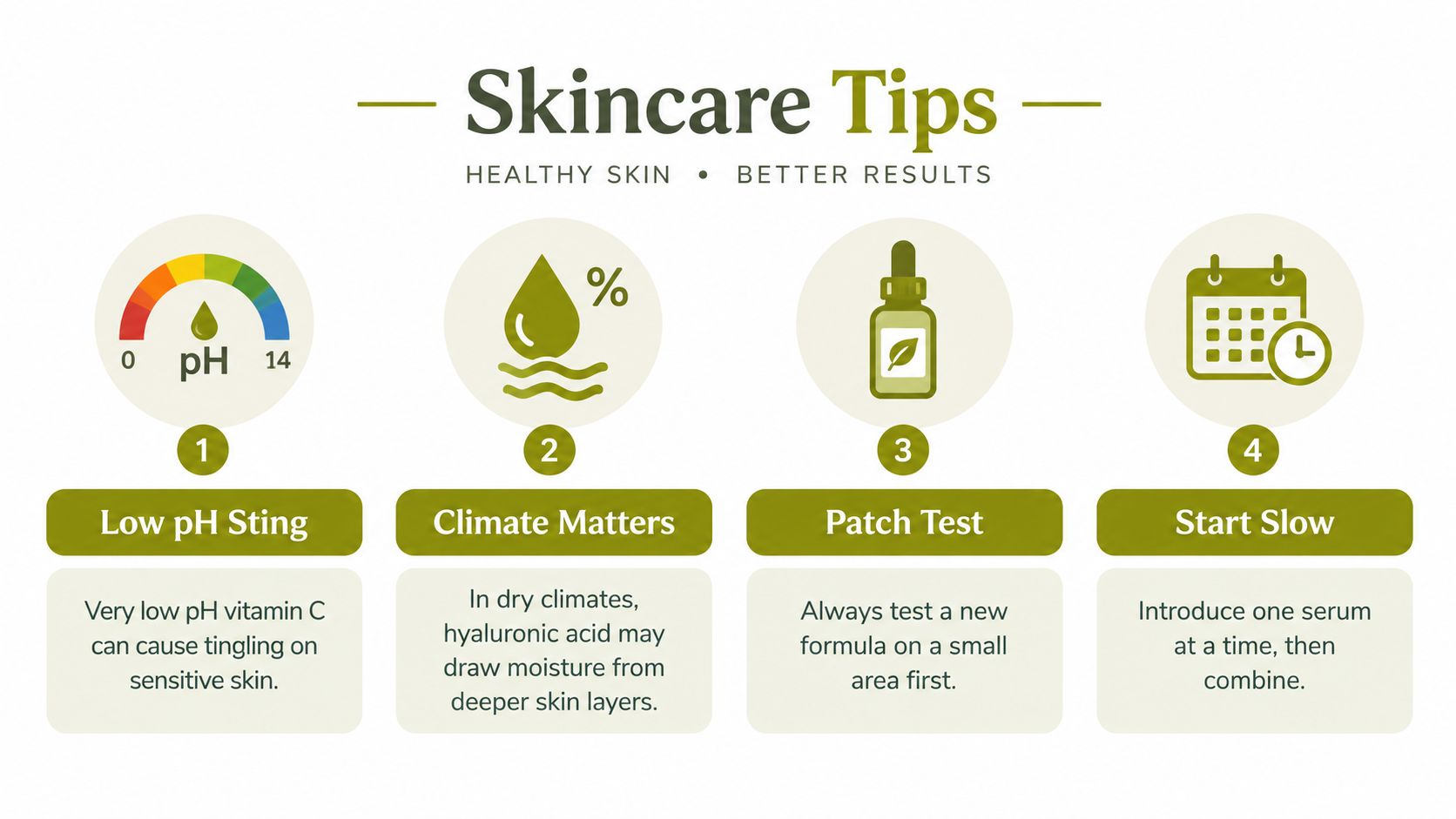
Low-pH Vitamin C formulas can feel sharp on skin that's already irritated, recently exfoliated, or adjusting to retinoids. Some people describe a brief tingle. Others get redness that lingers longer than feels comfortable.
That doesn't always mean the product is wrong for you. It may mean the timing is wrong, the formula is stronger than your skin likes, or your barrier needs a simpler routine first.
A few adjustments often help:
-
Use fewer drops
Start with a smaller amount than the label allows. -
Space it out
Try alternate mornings instead of daily use. -
Buffer your routine
A hydrating toner or plain moisturizer around the serum can make the routine feel gentler.
Here's a useful visual walkthrough on the same theme:
Climate changes the experience
This is the edge case that gets left out of a lot of skincare advice. Hyaluronic acid doesn't always feel the same in every environment.
A recent FAQ-style guide points out that while the duo is generally well tolerated, very low humidity can make hyaluronic acid feel less satisfying unless you follow with a moisturizer to seal it in. The same piece notes a trend toward more multi-weight HA systems paired with Vitamin C for layered hydration support. That perspective appears in Cactus Botanics' discussion of Vitamin C and hyaluronic acid use in different skin settings.
In dry air, don't stop at the serum. Add moisturizer after it, or the routine can feel incomplete.
A calm patch-test approach
If your skin is reactive, keep the test simple.
-
Night one
Apply a small amount near the jawline. -
Night two
Repeat in the same area. -
Then decide
If skin stays calm, introduce it to the full face slowly.
Normal adjustment is usually mild and brief. Ongoing warmth, persistent redness, or a stinging feeling that builds each time is a sign to pause and simplify.
Your Next Step Toward a Smarter Serum Choice
Choosing a hyaluronic acid serum with Vitamin C gets easier when you stop chasing vague promises and start looking for a good fit. The smartest pick usually comes down to three decisions.
The three things that matter most
First, check the form of Vitamin C. If your skin is easygoing and you want a more classic active approach, you may be comfortable with L-ascorbic acid. If your skin tends to flush or sting, a derivative may feel easier to live with.
Second, look at the hydration design. A thoughtful serum often pairs hyaluronic acid or sodium hyaluronate with other support ingredients such as glycerin or panthenol, so the product doesn't rely on one humectant alone.
Third, inspect the packaging. A formula can sound impressive and still be frustrating if the bottle exposes it to too much light and air.
A simple seven-day trial
Don't judge a new serum from one bright morning in bathroom lighting. Give it a week of steady, low-drama use.
Try this:
- Patch test for the first two days
- Use it on alternate mornings for one week
- Take a photo in the same lighting
- Judge texture, comfort, and tone together
That last part matters. A serum isn't only about immediate glow. If your skin feels smoother, less tight, and easier to moisturize, that's useful progress too.
A shelf-side checklist
When you're deciding between bottles, keep this short list in mind:
-
Vitamin C form
Is it pure L-ascorbic acid or a derivative that may be gentler? -
HA support system
Does the formula include sodium hyaluronate, glycerin, or panthenol? -
Bottle style
Is it opaque and reasonably protective? -
Texture match
Will it sit well under your moisturizer and sunscreen?
A good serum choice rarely comes down to price alone. Stable formulation, sensible layering, and patience usually matter more.
ArtNaturals offers ingredient-focused skincare that makes this kind of routine easier to build, including serums centered on Vitamin C, hyaluronic acid, and other everyday staples. If you want to compare textures, formats, and simple self-care options in one place, visit ArtNaturals.