

You're standing in the shower with a bottle in one hand and a conditioner in the other, trying to answer a simple question that never feels simple in the moment, what is Moroccan argan oil doing for your hair? The label promises softness, shine, and a cleaner, calmer routine, but your real concern is more basic. Will this duo help your hair feel better without leaving it heavy, itchy, or coated?
That's the right place to start. Moroccan Argan Oil Shampoo Conditioner is less about a miracle ingredient and more about how a full formula cleanses, conditions, and fits into the way your scalp and strands behave day to day. Argan oil has a long cultural and agricultural history in southwestern Morocco, and that context matters because it explains why the ingredient is treated as a premium cosmetic lipid, not just a trendy extract. UNESCO recognized the region as a Biosphere Reserve in 1998, and later added “Argan, practices and know-how concerning the argan tree” to its Intangible Cultural Heritage list in 2014, which shows how closely the ingredient is tied to place, labor, and tradition. WIPO's overview of Moroccan argan oil's cooperative history gives helpful background on that sourcing story.
A Morning Routine Moment Worth Understanding
The strongest way to think about this routine is through the person who just wants manageable hair before work. They don't need a lecture. They need to know whether the shampoo will clean well enough, whether the conditioner will make detangling easier, and whether the whole set will feel good on their specific hair type.
That's why this guide focuses on the formula, not just the hero ingredient. A shampoo and conditioner can both contain argan oil and still behave very differently depending on cleansing strength, conditioning polymers, fragrance, and how much oil the formula deposits. Argan oil has become a staple in natural haircare because it sits at the intersection of sensory appeal, conditioning feel, and a recognizable plant origin, but the bottle only works as well as the system around it.
What this routine should help you figure out
- What argan oil can realistically do, so you're not expecting growth claims it can't support.
- How shampoo and conditioner work together, so you know why one product alone usually isn't enough.
- Whether your scalp is sensitive, so you can judge the whole formula instead of blaming the oil.
- How to adapt the routine to your hair type, especially if your hair is fine, dry, curly, or prone to buildup.
If you've ever bought a bottle because the front label sounded soothing, then wondered a week later why your scalp still felt off, this is the kind of shopping guide that fills in the missing steps.
What Argan Oil Actually Is Inside the Bottle
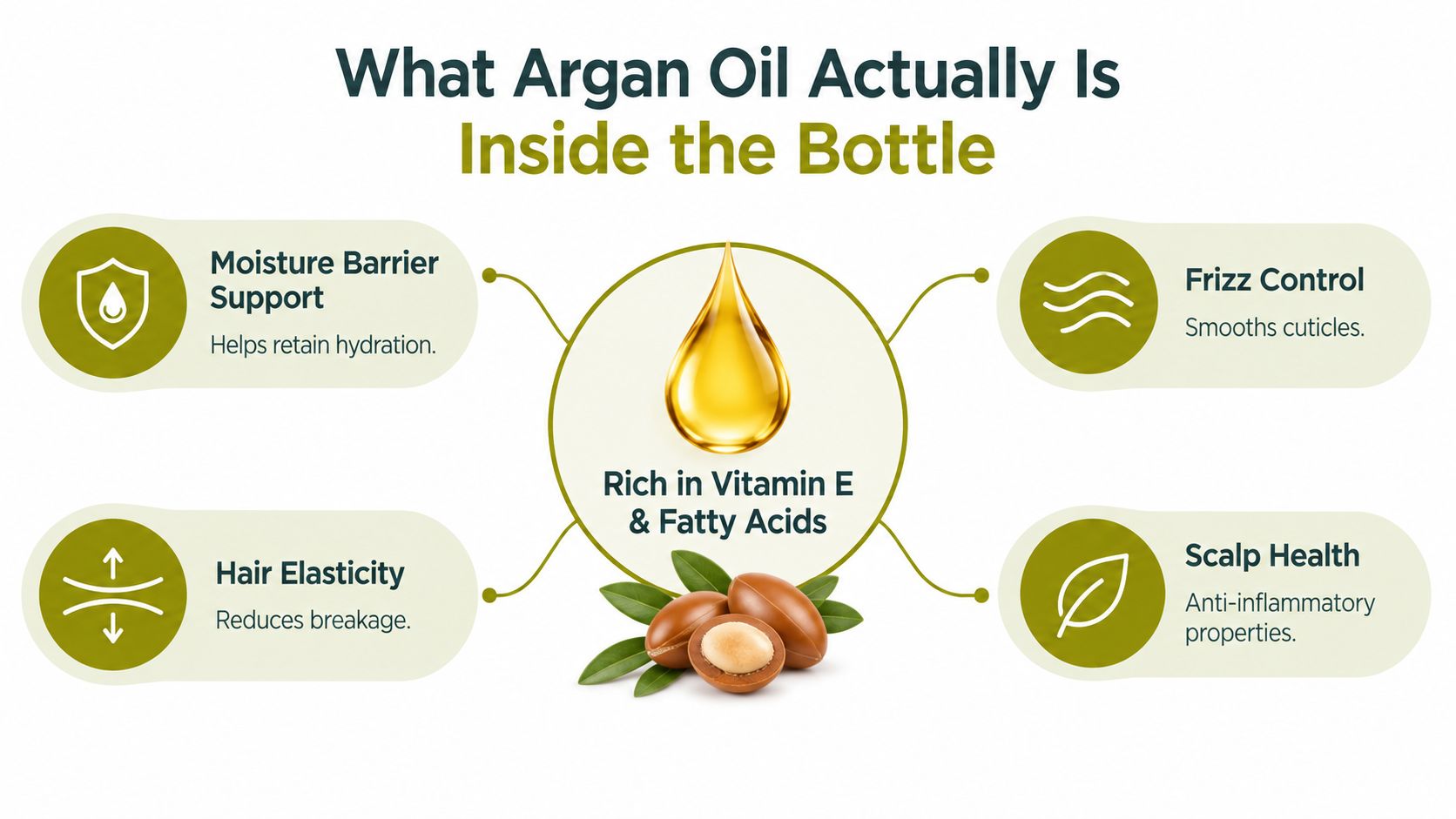
Argan oil makes sense in haircare because its chemistry is built around unsaturated fatty acids. One published analysis reports about 45.01% oleic acid and 35.39% linoleic acid, with those two together making up more than 80% of the oil's fatty-acid content. In plain language, that gives the oil a lightweight, emollient character that can help hair feel smoother and more conditioned when it's built into a cosmetic formula. The fatty-acid profile is laid out in the published analysis here.
Why the oil matters in rinse-off haircare
Argan oil is not a cleanser. Shampoo removes sebum, dirt, and product residue, while conditioner leaves behind a thin conditioning layer that changes how hair feels after rinsing. In a rinse-off system, the oil can contribute to emollience and slip, but only if the formula is designed to deposit it well enough to matter.
That's also where sourcing context comes in. Moroccan argan oil isn't a mass commodity oil in the same way as many kitchen staples. The argan supply base is geographically limited, and cooperative production in Morocco helped move it from household-scale production into a more organized commercial model, which is why “argan oil” often signals a geographically specific ingredient story as much as a cosmetic one. For a deeper brand-level background, see ArtNaturals' overview of argan oil from Morocco, which helps connect the ingredient to its origin story.
Practical rule: think of argan oil as a conditioning lipid, not a repair claim. If the formula doesn't help the oil land on the hair fiber, the ingredient can't do much on its own.
What the oil can do in a formula
A well-built conditioner can make argan oil feel more useful because it pairs the lipid with ingredients that help it stay on the fiber after rinsing. That matters most for hair that gets rough at the ends, tangles easily, or loses softness after washing. The point is not that argan oil fixes hair, but that it can support a smoother cosmetic finish when the rest of the formula is designed for deposition.
How Shampoo and Conditioner Work as a System
Shampoo and conditioner solve different problems, so treating them like interchangeable steps usually leads to disappointment. Shampoo is there to remove oil and buildup, while conditioner is there to improve wet combability, softness, shine, and friction by depositing conditioning ingredients onto the hair fiber. The two-step routine works because each product prepares the hair for the next one.
A conditioner's conditioning polymer matters because polymer substantivity generally increases with molecular size, polar-group attachment, and especially cationic charge. That's the chemistry reason a rinse-off conditioner can still leave hair feeling smoother after the water is gone. Argan oil fits best in that system when it's paired with a targeted conditioning polymer, because the polymer helps the formula stay where it needs to be.
Why the sequence matters
Damaged or weathered hair carries more negative charge, which makes it easier for cationic conditioning ingredients to cling. That gives a conditioner more grip on the fiber than a simple oil rinse would on its own. A shampoo first clears the path, then the conditioner deposits the softening layer.
This is also why a richer conditioner can build up if the cleansing step is too gentle for the amount of product being used. Conditioner-surfactant complexes may accumulate over time, even though rinsing removes some excess. If your hair starts to feel coated, flat, or slower to dry, that's often a sign to adjust the balance rather than abandon conditioner entirely.
For readers who wash extensions or blend multiple hair types in one routine, this washing guide for hair with extensions is a useful reminder that cleansing and conditioning technique change when the hair system changes.
A simple way to think about the duo
- Shampoo preps, by removing oil and residue from the scalp and hair.
- Conditioner protects, by leaving behind slip and softness on the lengths.
- Together, they make detangling easier and reduce the friction that can make hair feel rough.
When a formula includes argan oil, the oil doesn't replace those roles. It sits inside them.
Hair Concerns Argan Oil Routines Can Support
Argan oil routines make the most sense when the concern is cosmetic, not medical. Dryness, dullness, rough texture, and breakage from combing are the kinds of issues a conditioning routine can support because they're tied to how hair feels, moves, and holds up during everyday handling. That's different from asking a shampoo to change what your follicles are doing.
What you can reasonably expect
A good argan-oil conditioner can make hair easier to detangle, which often translates into less tugging during brushing and styling. It can also leave the surface looking more even and feeling less rough to the touch, especially on mid-lengths and ends. Those are the kinds of changes people notice over repeated washes, because the routine is smoothing the hair fiber rather than changing its biology.
That's also why “more length” and “more growth” shouldn't be treated as the same thing. Length retention can improve when hair breaks less, but that isn't the same as new growth from the scalp. If a product makes hair easier to manage, the visible result may be fewer snapped ends and a neater finish, not a faster growth cycle.
For a more detailed wash-day angle focused on dry strands, see ArtNaturals' guide to argan oil shampoo for dry hair.
Where the line is
Good fit: dry ends, rough feel, frizz from dryness, and hair that tangles easily.
Not the right promise: new follicle growth, fixing hair loss, or treating a scalp problem.
A calm routine can still feel remarkable in the mirror because softer hair reflects light better and slides more easily between your fingers. That's real, but it's cosmetic. It's also enough for many people.
How to think about breakage versus growth
If your hair seems to be getting shorter at the ends, that can be breakage. If you're noticing more hair in the shower or on your brush, that's a different question. A conditioning routine can support the first by reducing friction, but it shouldn't be positioned as a solution to the second.
Building a Routine That Fits Your Hair
The most useful wash-day routine is the one that matches how your scalp behaves. The American Academy of Dermatology notes that people with straight hair and an oily scalp may choose to shampoo daily, while people with dry, textured, curly, or thick hair may wash as needed, sometimes as infrequently as every two to three weeks, and recommends focusing shampoo on the scalp rather than the full length. Their hair-washing guidance is here.
Where each product belongs
Shampoo belongs on the scalp first, because that's where oil and buildup collect. Conditioner belongs mainly on the mid-lengths and ends, especially if your hair is fine or gets weighed down easily. If your strands are drier, you can be a little more generous, but the logic stays the same, cleanse the roots and condition the lengths.
A good rule is to apply conditioner where the hair needs glide, not where you're trying to avoid heaviness. That means you don't need to coat the scalp just because the bottle contains argan oil. The closer the product sits to the roots, the more likely it is to feel rich on fine or oil-prone hair.
How to watch for buildup
If hair starts losing bounce, feeling coated, or taking longer to feel clean after a wash, the routine may be too rich. At that point, use a simpler cleansing shampoo occasionally and keep conditioner focused on the ends. For many people, a lighter hand with conditioner solves more than changing the whole routine.
A flexible routine in plain language
- Cleanse the scalp first. Massage shampoo where oil collects, then let the lather rinse through the lengths.
- Condition only where it helps. Mid-lengths and ends usually need more attention than the scalp.
- Rinse thoroughly. Leftover conditioner can make even a good formula feel heavy.
- Adjust by hair type. Straight or oily scalps often need more frequent cleansing, while dry or textured hair may prefer less.
- Reset when needed. If buildup shows up, simplify for a wash or two.
That approach works especially well when the formula is meant to support softness without turning the hair into a greasy finish.
When the Formula Matters More Than the Ingredient
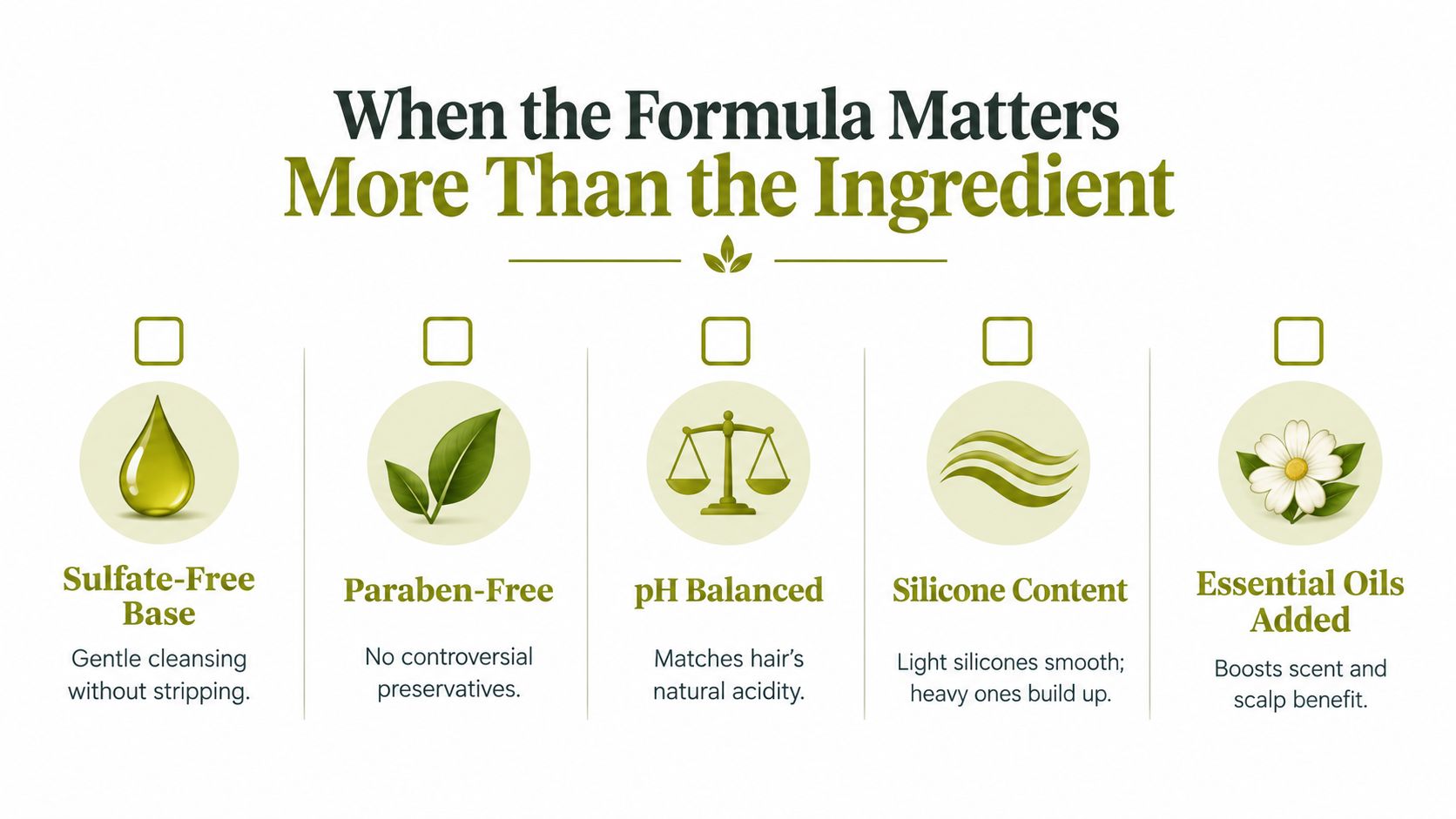
A bottle can say argan, natural, or clean and still be irritating for a sensitive scalp. That's because reactions often come from the full formula, not the featured oil. A 2024 review found that allergic reactions to hair products accounted for 9% of positive reactions in a North American patch-test dataset of 38,770 patients, with fragrance identified as the leading allergen in shampoos and conditioners and preservatives, propylene glycol, and surfactants also implicated. The review is here.
What to look for on the label
U.S. cosmetic labels generally need an ingredient declaration, but fragrance components can be listed together as “fragrance” or “flavor” instead of individually naming each one. The FDA explains that labeling approach here. That means a shopper can confirm whether argan oil appears in the ingredient list, but still not see every fragrance component spelled out.
If your scalp reacts, assume the whole formula is the question. Persistent itching, burning, rash, or flaking means the product may not suit you, even if the front label sounds gentle.
Natural fragrance isn't automatically easier on the scalp. The important habit is reading the full ingredient list and noticing whether the formula leans heavily on scent, strong surfactants, or preservatives you've reacted to before. For some people, fragrance-free is the simpler path. For others, a lightly scented formula is fine as long as the rest of the ingredients behave well.
A practical sensitivity checklist
- Check the scent story. Strong fragrance can be a problem for reactive scalps.
- Notice the cleansing agents. Some shampoos feel harsher than others.
- Test before committing. Patch testing a new product is a smart habit when your skin tends to react.
- Separate irritation from preference. A product can feel too strong without causing a true allergy.
The point isn't fear. It's precision.
Choosing the Right Formula for Your Hair
The right argan-oil formula depends on what your hair needs most, not on how glossy the bottle looks on a shelf. Fine hair usually does better with a lighter conditioner, while thicker or drier hair can handle a richer feel. If your scalp is sensitive, fragrance-free or lightly scented formulas are easier to evaluate because they remove one common source of confusion.
For shoppers who like to compare labels carefully, the internal ArtNaturals argan oil shampoo page can be a useful place to review how a shampoo is framed before you choose a conditioner to match.
A simple decision framework
If your scalp gets oily quickly, choose a formula that cleanses clearly and leaves the conditioner for the lengths only. If your hair is dry or curly, you may prefer a softer cleanser and a conditioner that feels more cushioned. If your strands are fine, start small with conditioner and build up only if your hair still feels rough after rinsing.
Ingredient order can help, too. When conditioning ingredients appear later in the list, the formula may feel lighter. When the emollient and conditioning components are higher up, the feel is usually richer and more noticeable on dry ends.
The same logic applies to fragrance. A product that smells beautiful isn't automatically a better match for a reactive scalp. A product that is gentler on the skin isn't automatically the best fit for coarse, dry lengths. Matching formula to need is the true skill.
What to do if the routine stops working
If your hair starts feeling coated, cut back on conditioner richness before giving up on the whole routine. If your scalp feels irritated, stop treating argan oil as the likely culprit and inspect the complete ingredient list instead. If shedding, patchy loss, or persistent scalp discomfort keeps showing up, that's the point to step away from product tinkering and get a professional opinion.
For readers who want to extend that careful-label approach into another routine, Bonna Beauty's lash extension cleanser guide shows the same principle in a different category, the formula matters as much as the label promise.
A Moroccan argan oil shampoo conditioner routine is at its best when it feels like quiet upkeep, not a dramatic fix. ArtNaturals offers plant-forward haircare that fits that kind of everyday self-care, with Moroccan argan oil shampoo and conditioner options designed to help you build a routine around cleansing, slip, and manageability. If you want to explore that kind of ingredient-aware haircare for yourself, visit ArtNaturals and choose the formula that matches your hair, your scalp, and your wash-day habits.