

You've washed your hair, added your usual conditioner, and started styling, but your roots still look flat. Your lengths feel coated rather than soft, and another mist of dry shampoo doesn't seem like the answer. Before reaching for a stronger cleanser, it helps to ask what you're trying to remove.
Natural clarifying shampoo is a tool for a particular need, not a requirement for every wash day. A thoughtful routine starts with observable buildup, considers the complete formula, and leaves room for gentler care when your hair needs something else.
When Your Hair Signals It Needs Clarifying
At your bathroom mirror, it can be hard to distinguish yesterday's styling products from ordinary oil. Perhaps you've layered leave-in conditioner, curl cream, and finishing spray, then noticed that your hair feels unusually heavy. That's a reasonable moment to consider clarification, but it isn't proof that every part of your hair needs stronger washing.
The familiar urge to add another styling product can make the decision feel more confusing.

Look for a pattern, not an isolated bad hair day
Consider what's changed since your hair last felt comfortable and manageable.
- Recent product layering: A coated feeling after repeated styling makes cosmetic residue worth considering.
- Unusual heaviness: Hair that feels weighed down despite your usual wash may benefit from reassessing cleansing.
- Dullness with residue: A visible or tactile coating is more useful information than dullness alone.
- Roughness without coating: Dry, snapping lengths call for caution rather than an automatic deeper wash.
Treat these as prompts for observation, not a diagnosis. Oil at the roots, residue along the lengths, and fragile ends can coexist, so they don't necessarily need the same response.
Keep scalp care separate from hair cleansing
If you're exploring exfoliation, a guide to glycolic acid scalp care offers context for a different routine decision. Don't assume that adding exfoliation and clarification together is the right response to an uncomfortable scalp.
Practical rule: Choose a clarifying wash because you can identify something you want to remove, not because your hair has failed a calendar deadline.
A useful first step is to name the concern: coated lengths, oily roots, or persistent discomfort. That small distinction helps prevent unnecessary cleansing.
What Natural Clarifying Shampoo Actually Does
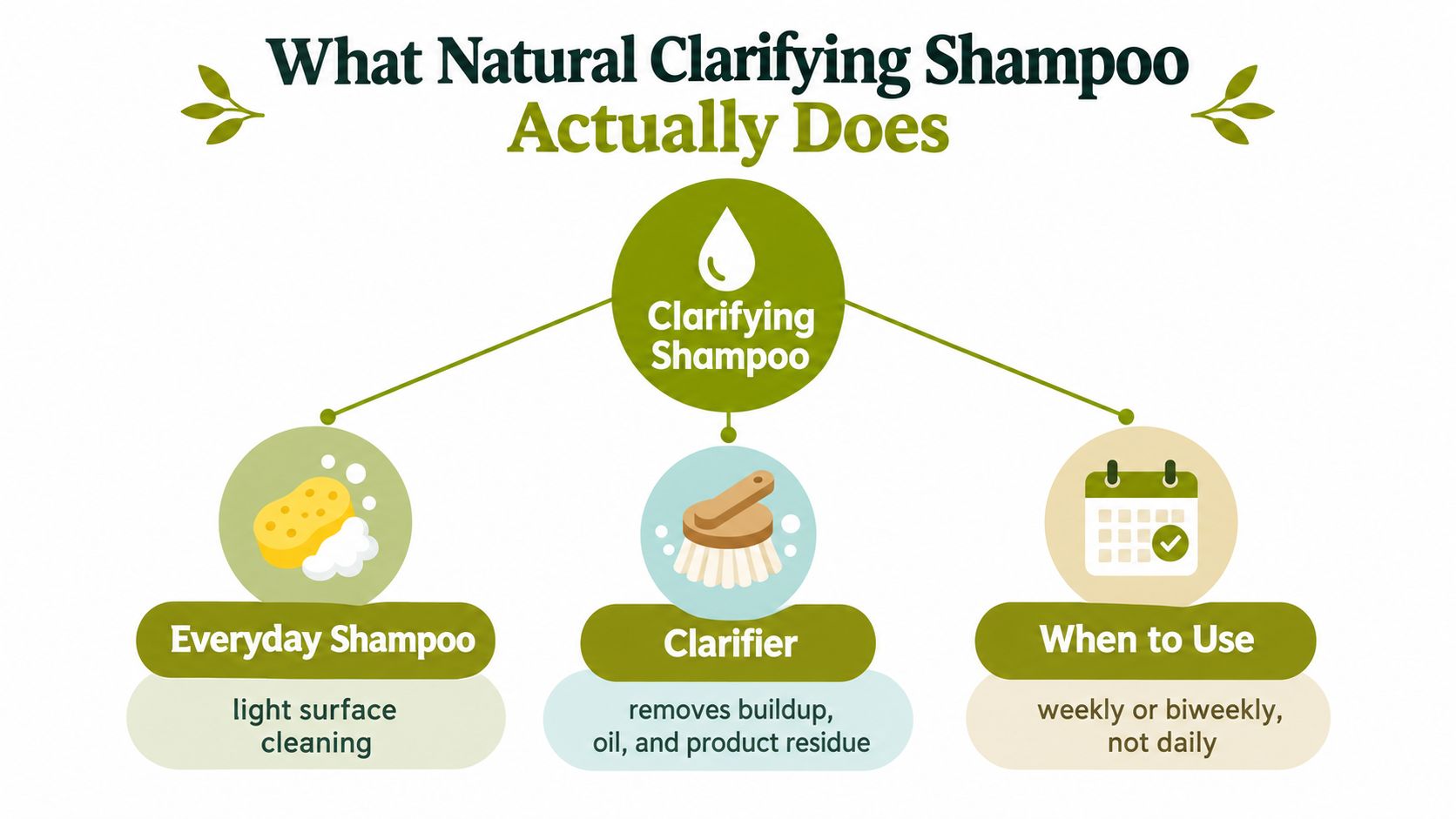
Clarifying means removing accumulated material from the hair and scalp. Think of everyday shampoo as routine tidying and a clarifier as targeted cleaning after something has built up. These are descriptions of intended use, not rigid product categories: the actual cleansing strength depends on the formula.
The overview below illustrates that purpose. Its weekly reminder isn't a universal schedule; your hair's condition and the product's directions should guide use.
How residue leaves your hair
The main workers are surfactants, cleansing ingredients with oil-compatible and water-compatible portions. The oil-compatible portion associates with impurities and residues, while the water-compatible portion helps suspend that material so you can rinse it away, as explained in this overview of shampoo cleansing and hair cosmetics.
A useful analogy is a small connector between oily residue and rinse water. Water alone doesn't readily carry away everything sitting on your hair; the cleanser helps those materials move into the water.
This is why a botanical extract isn't necessarily the ingredient doing most of the cleaning. A natural clarifying shampoo still needs an effective cleansing system, whether its front label emphasizes plants, fragrance, or ingredients it leaves out.
What a cosmetic reset doesn't mean
Removing a coating isn't the same as repairing a damaged strand. Similarly, washing away surface oil doesn't establish that a product manages the scalp's underlying oil output.
Keep these goals distinct:
- Cosmetic cleansing: Removing accumulated oil, soil, or styling residue.
- Hair-fiber care: Maintaining comfortable, manageable lengths through appropriate cleansing and conditioning.
- Scalp concerns: Recognizing when ongoing discomfort needs attention beyond a cosmetic wash.
The word natural describes an aspect of ingredient selection, not the entire performance of the finished product. A formula can include plant-derived ingredients and still be unsuitable for your particular routine.
For another format to accompany the cleansing explanation, the following video can be viewed alongside your product's own instructions.
There's no need to chase the strongest possible wash. The useful outcome is removal of the unwanted residue with a finish your hair can comfortably tolerate, not a dramatic sensation of being stripped clean.
How to Read Natural Clarifying Shampoo Ingredients
Turn the bottle around before deciding whether its front-label promise fits your hair. An ingredient list can tell you what's in a formula, but it won't reveal every detail about concentration, finished pH, or how the ingredients perform together.
Start with the cleansing system
In the United States, cosmetic shampoo ingredients are generally listed in descending order of predominance. Color additives and ingredients present at 1% or less may fall outside strict predominance order, according to the FDA's cosmetic labeling guide.
That makes the beginning of the list a sensible place to start, without treating every later position as a precise ranking.
- Primary surfactants: Look for the ingredients responsible for the main cleansing work.
- Secondary surfactants: Consider the supporting cleansers as part of a blend, rather than judging each name alone.
- Conditioning components: Note whether the formula also includes ingredients intended to improve the feel of freshly washed hair.
- Botanical ingredients: Read plant extracts and oils in context, not as proof of cleansing strength.
Alkyl polyglucosides are one plant-derived surfactant family you may encounter. Ingredient origin is useful information, but it doesn't replace questions about the complete product.
Understand the supporting ingredients
Conditioning polymers, humectants, and lightweight oils can contribute to the finish of a cleanser. They shouldn't be read as evidence that a formula cannot feel drying, just as an unfamiliar surfactant name shouldn't automatically disqualify it.
For mineral-related concerns, ask whether the manufacturer identifies chelating capacity, rather than assuming any clarifier addresses every deposit. Essential oils and botanical extracts also don't tell you the product's pH.
For broader label-reading context, explore this guide to organic shampoo and conditioner. If you're gathering additional hair-product reading, you can also check Aroma Warehouse for hair products, while keeping your decisions grounded in each product's actual label and directions.
Ask about the finished formula's pH
pH is a useful quality indicator, not a stand-alone guarantee. Published shampoo guidance recommends that products used on the scalp should not exceed pH 5.5, with more alkaline conditions associated with increased electrical charge and friction between fibers, as described in this explanation of shampoo pH and hair-fiber behavior.
Separately, hair-shaft evaluations found minimal structural and protein effects within pH 5 to pH 7, supporting attention to the finished product's acidity rather than botanical claims alone.
Those benchmarks address different questions, so they aren't interchangeable product certifications. Ask the manufacturer for finished-product information and compatibility guidance, especially when your hair is processed or fragile.
A promising ingredient list is a starting point. The finished formula and your experience using it complete the picture.
How to Use Clarifying Shampoo Without Overdoing It
Start with the product directions and the specific area carrying residue. If your roots feel coated but your ends feel delicate, there's no reason to give both areas identical handling.
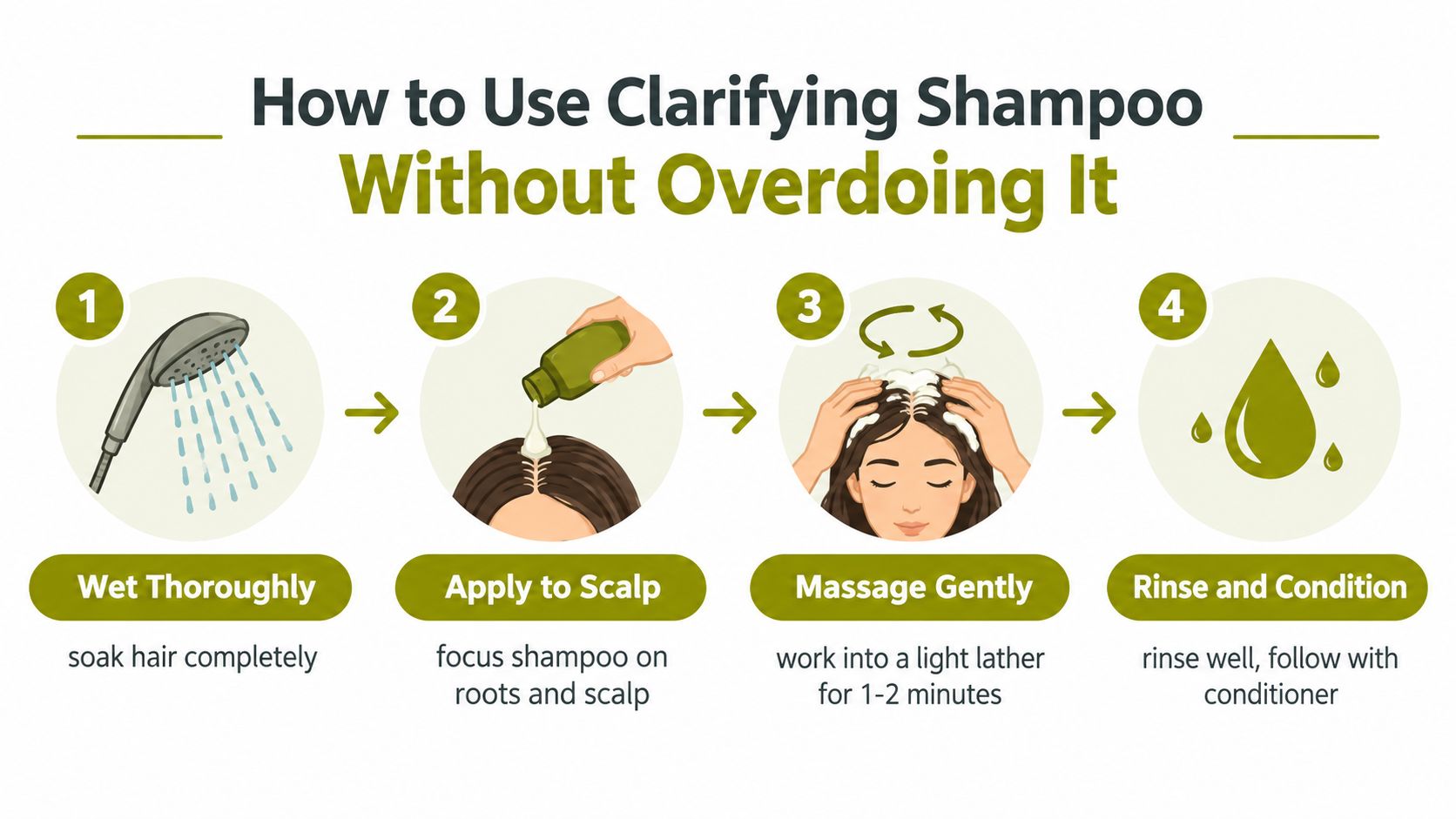
The basic sequence is simple: wet, apply thoughtfully, massage gently, rinse, and condition.
Use water and gentle handling
Before full use, follow any label-directed skin-testing guidance and consider observing the product on a small section of hair. That's a cautious introduction, not assurance that you won't experience a reaction.
- Wet thoroughly. Allow water to reach the scalp and the interior of dense sections before applying cleanser.
- Place shampoo deliberately. Concentrate on the scalp and areas where you've identified buildup, limiting unnecessary exposure of dry lengths.
- Massage with fingertips. Distribute the product without scratching or aggressively rubbing strands together. Follow the label for contact time.
- Rinse carefully. Give loosened material time to leave with the water, then apply conditioner mainly through the mid-lengths and ends.
Surfactant-assisted cleansing involves roll-up, spontaneous emulsification, penetration, and solubilization, mechanisms that loosen and disperse residue rather than merely producing foam, as outlined in this technical explanation of surfactant removal mechanisms.
In everyday terms, you don't have to scrub harder to make the cleanser useful. Thorough distribution and rinsing deserve more attention than force.
Evaluate the result after conditioning
Judge the wash once your hair is dry and styled in its usual way. You're looking for less of the original coated feeling without a new problem of roughness or discomfort.
- A comfortable result: Hair feels less burdened by residue and remains reasonably manageable.
- A reason to pause: Persistent tightness, increased tangling, roughness, or more snapping after washing.
- An inconclusive clue: Reduced lather by itself doesn't tell you whether you need another application.
Avoid repeatedly washing because you expected a particular amount of foam. If the original concern remains, reconsider what it might be before increasing cleansing strength or frequency.
Choosing a Clarifying Routine for Your Hair
An oily scalp and dry ends can belong to the same person. Likewise, someone with curls may use few styling products, while someone with straight hair may layer several. Hair type informs the decision, but product use and the response after washing matter too.
Choose your approach from what you observe rather than assigning yourself a permanent schedule.
Clarifying Routine Guide by Hair Type
| Hair Type | Possible Clues | Routine Adjustment | Watch For |
|---|---|---|---|
| Oily roots | Surface oil, heaviness, residue after styling | Assess ordinary cleansing first; clarify when accumulation warrants it | Scalp discomfort after stronger washing |
| Dry hair | Coating alongside already-rough lengths | Keep clarification occasional and targeted | More tangling or a stripped feel |
| Color-treated or bleached hair | Styling residue on processed strands | Check compatibility and minimize unnecessary lengths exposure | Reduced manageability or snapping |
| Curly or textured hair | Product coating after layering stylers | Apply selectively and condition lengths afterward | Difficulty detangling or increased dryness |
| Porous or chemically processed hair | Residue with fragile-feeling ends | Use a cautious small-section introduction | Persistent roughness after conditioning |
Oily roots need a clear goal
If your main concern is oil that returns between washes, decide whether you're addressing surface accumulation or expecting a long-term change in oil production. Those aren't the same outcome.
During 28 days of shampoo use, scalp moisture increased significantly while sebum production didn't change significantly, a useful reason not to describe surface cleansing as an oil-production reset in light of these findings on shampoo use, moisture, and sebum.
For everyday cleanser selection, this guide to choosing shampoo for oily hair provides a separate starting point. You may need an appropriate ordinary wash routine rather than adding frequent clarification.
Dry, curly, and processed lengths need restraint
For dry or chemically processed hair, make comfort after washing part of the decision, not an afterthought. Curly and textured hair also calls for careful distribution so you can address residue without repeatedly working cleanser through every length.
A practical adjustment might be to change where you apply the product before changing how often you use it. Another is to review how many styling layers you need.
Let your hair's response after drying help determine whether the next clarifying wash is necessary.
Know when a different approach is needed
Hard-water deposits, cosmetic residue, ordinary oil, and persistent scalp symptoms aren't interchangeable. If you suspect mineral deposits, look for explicit product guidance about that purpose instead of assuming a general clarifier is sufficient.
Persistent flakes, redness, itching, or inflammation deserve discussion with an appropriate healthcare professional. Repeated cosmetic clarification isn't a substitute for understanding ongoing discomfort, and rough, breaking lengths shouldn't automatically be interpreted as dirty hair.
Formulating and Using Plant-Based Products Safely
A thoughtful plant-based formula has to balance cleaning with the way hair feels afterward. Selecting a botanical ingredient is only part of that work; the cleanser blend, concentration, supporting ingredients, and directions all matter.
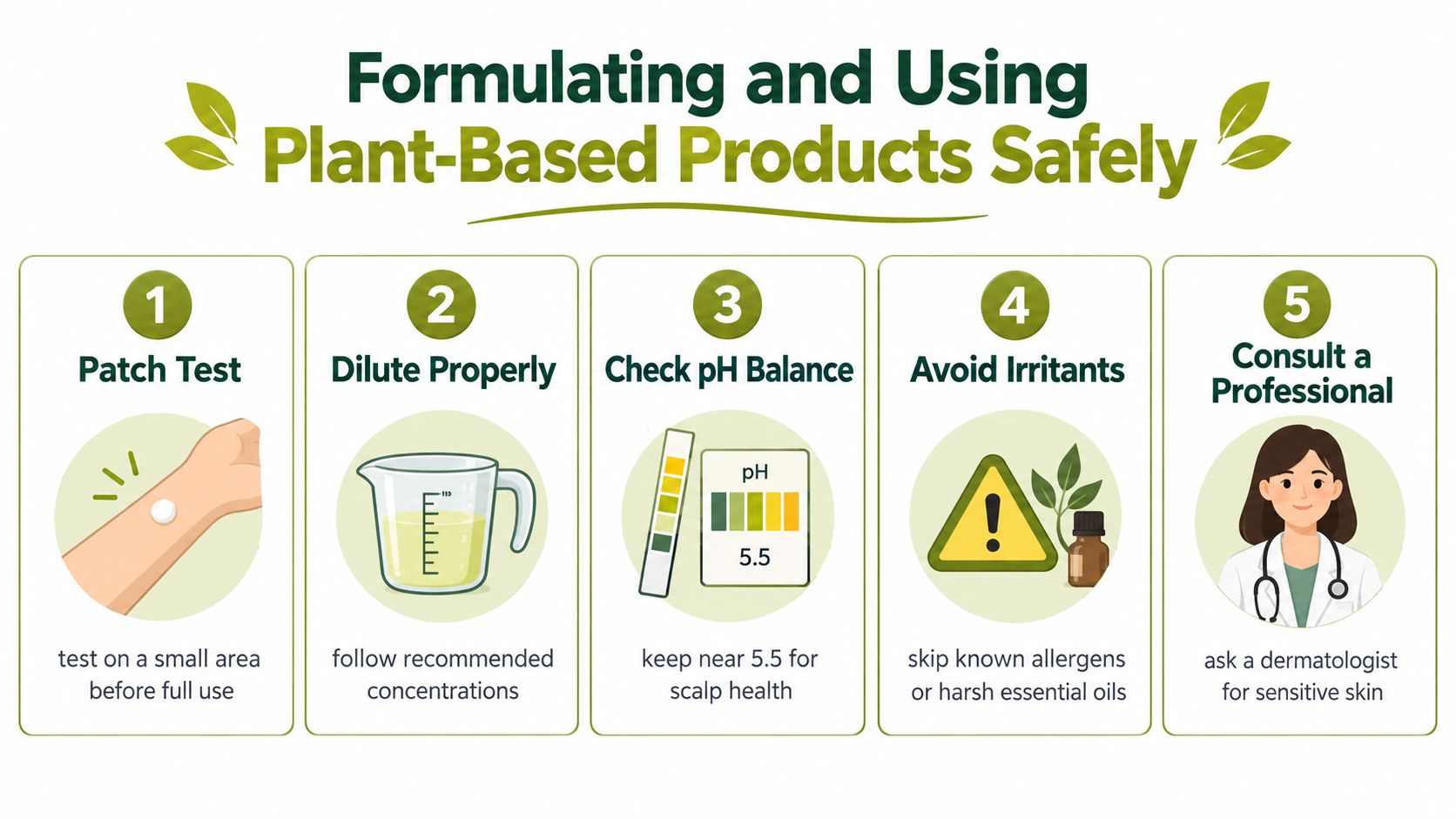
The checklist below is a reminder to approach plant-based products deliberately, not to customize a finished shampoo at home.
Balance removal with comfort
Plant-derived surfactants can remove sebum effectively, yet repeated detergent exposure may also extract protective lipids and leave hair feeling stripped. A balanced formulation may combine a primary cleanser with milder secondary surfactants, supported by conditioning polymers, humectants, or lightweight oils, as discussed in this explanation of cleansing activity and formulation trade-offs.
An ingredient described as mild in an irritation assessment doesn't necessarily predict how dry your lengths will feel. That distinction is especially useful when a product seems comfortable during washing but leaves hair difficult to handle afterward.
For consumers, the practical checks are straightforward:
- Follow the supplied directions: Don't add extra cleanser or extend contact time to pursue a stronger sensation.
- Use the finished product as intended: Dilute only if the manufacturer explicitly instructs you to do so.
- Check personal compatibility: Review ingredients you already know don't suit you, including scented components.
- Introduce cautiously: Follow label-directed testing guidance and stop using a product that causes discomfort.
Evaluate environmental language separately
Plant origin doesn't establish a product's environmental profile. The U.S. EPA Safer Choice surfactant criteria consider both aquatic toxicity and biodegradation, making them more informative than a naturally derived scent or plant-origin claim alone, as explained in the EPA's surfactant screening criteria.
Look for transparent information and clearly identified standards rather than filling gaps with assumptions. A botanical name may tell you something about sourcing, but not everything about performance, personal suitability, or environmental behavior.
Choose products with readable ingredient declarations, clear instructions, and a way to ask the manufacturer questions. If sensitivity is an ongoing concern, seek professional guidance instead of repeatedly experimenting with stronger cleansers or concentrated botanical additions.
Build a Thoughtful Hair Reset Routine
A useful hair reset begins with a modest question: What am I trying to remove? If you can identify a coating after styling, clarification may be worth considering. If your main concern is fragile ends or ongoing scalp discomfort, a deeper wash may miss the point.
Use a simple check before reaching for the bottle.
- Confirm the need: Name the observable residue or accumulation rather than relying on a vague feeling that your hair needs a detox.
- Choose deliberately: Look for transparent cleansing information, suitable directions, and finished-formula details.
- Observe the outcome: Notice how your hair feels after conditioning and drying before deciding when to repeat.
Make the reset serve everyday care
Keep the earlier distinctions in mind: surfactants handle cleansing, pH adds useful formulation context, and gentle application supports a more considered wash. None of those features makes an automatic schedule necessary.
Between clarifying washes, keep your routine manageable. Notice which styling combinations leave a coating, avoid changing several products at once, and give yourself a clear point of reference for what feels comfortable.
Occasional, purposeful clarification is a more useful goal than habitual deep cleansing. Plant-based haircare can be part of that approach without becoming a promise that every ingredient will suit everyone.
At your next wash, choose a response to the concern you have. Sometimes that's clarification; sometimes it's an ordinary cleanse, more attentive conditioning, or advice about a persistent problem.
ArtNaturals offers plant-based haircare, including shampoos, conditioners, and oils for everyday routines. Visit ArtNaturals to review ingredient information and directions, then choose care that fits your buildup concerns and conditioning needs.