

You warm a few drops between your palms, smooth them over your arms, and wait for the familiar oily shine. Instead, the surface feels soft, comfortable, and almost dry within moments. Then you wonder how an oil can feel so light while still leaving skin and hair smoother.
That experience is the starting point for understanding a weightless healing dry oil. The phrase combines a sensory description with a wellness promise, but it doesn't mean the product penetrates, repairs every concern, or works like a medical treatment. A better way to read it is as a lightweight oil blend designed to spread quickly, soften the surface, and help slow moisture loss.
What a Weightless Healing Dry Oil Actually Feels Like
A weightless dry oil usually begins with a small amount. You rub it between your palms, press your hands over freshly cleansed arms, or smooth a trace through the ends of your hair. Instead of leaving a thick, reflective layer like a traditional massage oil, it spreads into a thin veil that feels satiny rather than slick.
That finish comes from formulation. A dry oil may combine fluid carrier oils with lighter emollients and, sometimes, a volatile component that evaporates after application. The result is a fast-spreading texture, not proof that the ingredients travel into skin.
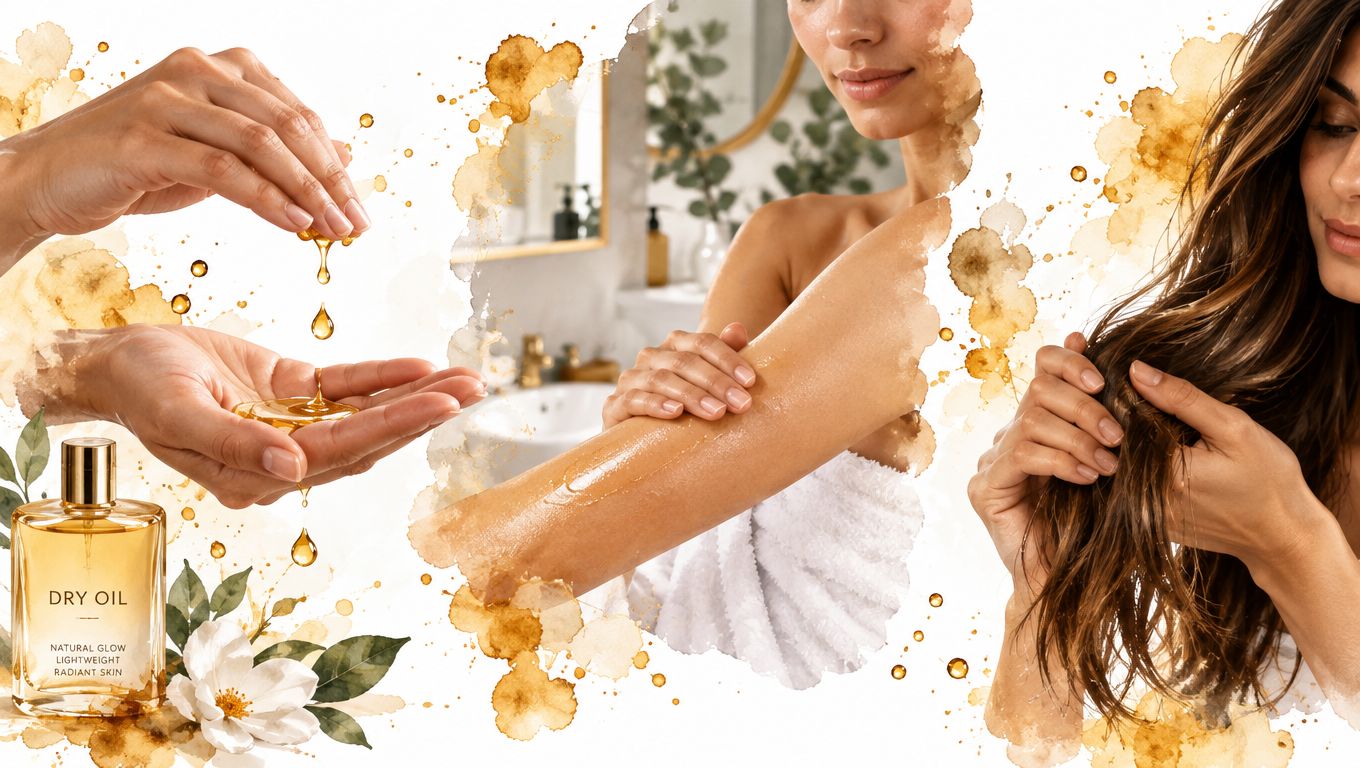
Three signals hidden in the phrase
Weightless describes the sensory experience. The formula feels thin, distributes easily, and leaves less residue than a dense balm or body butter. Dry oil refers to the finish, not to an absence of oil. The product still relies on oils or oil-like emollients to create slip and softness.
Healing needs more careful interpretation. In everyday beauty language, it may suggest a comforting ritual or a softer-feeling surface. It shouldn't be read as a promise to treat a skin concern. Your results will depend on the oils, their proportions, the condition of the formula, and how you apply it.
DermNet explains the difference clearly: occlusives are oil-based substances that form a water-resistant layer on the skin, helping reduce evaporative water loss, while emollients soften and smooth the surface. You can read its explanation of emollients and moisturisers for the terminology behind that finish.
A thick body butter is richer and more cushiony. A traditional massage oil is often designed to remain slippery for longer. A facial serum may contain oils, water-based ingredients, or both, and usually serves a more targeted routine. A weightless healing dry oil sits somewhere else. It's a light finishing product for skin, hair lengths, cuticles, or shoulders when you want softness without a heavy coating.
A useful expectation: light feel and meaningful moisture retention can coexist, but they aren't the same thing.
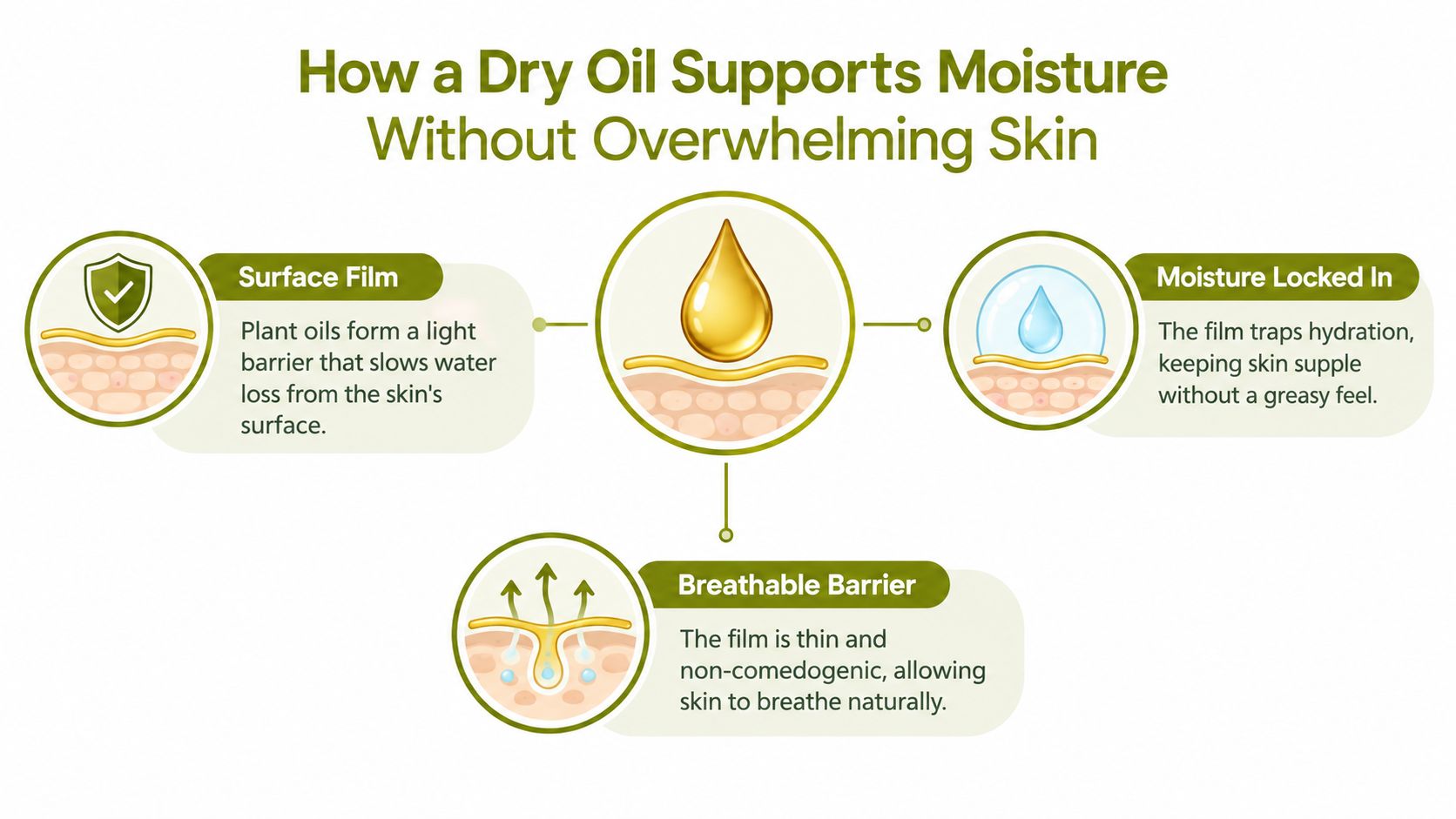
How a Dry Oil Supports Moisture Without Overwhelming Skin
Think of skin as a surface that can lose water over time. A water-based moisturizer supplies or attracts water, while an oil can act more like a breathable rain jacket. It doesn't fill the surface with water, and it isn't a heavy wax coat. It creates a light, water-resistant layer that helps slow evaporation.
That distinction makes a dry oil easier to place in a routine. Emollience means smoothing rough-feeling surface texture. Occlusion means slowing water loss with a surface film. A moisturizer may add water or water-binding ingredients. One product can support more than one of these actions, but the terms shouldn't be treated as interchangeable.
A simple layering sequence
- Cleanse gently. Remove sweat, sunscreen, or daily residue without leaving skin feeling stripped.
- Moisturize when needed. Use a water-containing lotion or cream if your skin wants more hydration than oil alone can provide.
- Lightly seal. Apply a small amount of dry oil while skin is still slightly damp, or smooth it over moisturizer once the product has settled.
The timing matters because oil helps hold onto water that's already on or near the skin's surface. Applied to completely dry skin, it can still soften and add slip, but it has less existing moisture to help retain.
One randomized, observer-blinded trial involved 60 children and adults with mild dry skin. After 28 days, the group using a commercially available bath oil had transepidermal water loss, or TEWL, that was 1.9 g/m²/h lower than the control group, and stratum-corneum hydration was also higher, according to the published trial record. The product tested was a bath oil, not a specific weightless healing dry oil, so the finding supports the general moisture-retention mechanism rather than proving the performance of every formula.
Practical rule: use oil as a finishing layer when you want comfort and softness. Don't expect a light oil to replace every water-based moisturizer, especially when skin feels unusually dry.
A thin oil film isn't the same as sealing skin shut. It works at the surface, and its comfort depends on the formula and the amount used. Start small, observe the finish, and adjust rather than assuming more product will create more benefit.
The Oils Most Often Inside a Weightless Formula
The word natural doesn't tell you how an oil will feel. The carrier oils in a blend set much of its slip, richness, after-feel, and suitability for different uses. Argan, jojoba, sunflower, coconut, sweet almond, grapeseed, and rosehip oils can all appear in plant-focused formulas, but they don't behave identically.
Read the fatty-acid balance
A review indexed by PubMed identifies the ratio of linoleic acid to oleic acid as an important factor in the potential barrier-supporting properties of plant oils. Oils with more oleic acid may be less suitable for some barrier-support needs, while oils with a higher linoleic-to-oleic balance may offer a different feel and behavior. The review's discussion of plant oils is summarized in this ingredient-focused publication.
That doesn't make one oil universally best. It gives you a more useful question to ask: what is this blend trying to do, and which oils appear near the top of the list?
- Jojoba often feels elegant and close to the skin's natural surface oils. It can add slip without the dense sensation associated with heavier butters.
- Sunflower oil is commonly valued for a lighter feel and a linoleic-acid-rich profile. It can suit a formula focused on softness and moisture retention.
- Grapeseed oil is typically fluid and quick-spreading, which makes it appealing in lightweight body and hair blends.
- Argan oil can give hair ends and skin a smooth, polished finish without necessarily feeling as thick as a butter.
- Sweet almond oil tends to bring softness and glide, though the complete formula determines whether the result feels light or rich.
- Coconut oil can create a more noticeable coating, especially in cooler conditions, so it may feel less weightless in some blends.
- Rosehip oil is often included for its distinctive plant-oil profile and lightweight appeal, but concentration and freshness still shape the experience.
Ingredient lists also need context. The first oils usually have a stronger influence on texture, but a small amount of a fragrant essential oil can still affect how a product feels to sensitive users. If you're unfamiliar with aromatic ingredients, this introduction to essential oil basics offers useful background before you assess a blend.
Try a small area first, then compare how the formula feels on skin and hair ends. Ingredient literacy works best as observation, not as a search for one perfect oil.
How to Layer a Dry Oil Into Your Everyday Routine
The easiest time to use a weightless healing dry oil is after bathing. Pat your skin so it stays slightly damp, warm a small amount between your palms, and press or smooth it over the areas that tend to feel tight. The water provides a starting point, while the oil creates a light finishing layer.
The American Academy of Dermatology's moisturizer guidance recommends applying moisturizer after a shower or bath, after handwashing, and whenever skin feels dry. It also explains that non-comedogenic means a product is formulated not to block pores, which can be a helpful label cue when considering facial use.
A routine that stays light
- After a shower or bath: Begin with a small amount on damp arms, legs, shoulders, or hands.
- After moisturizer: If lotion alone doesn't leave the finish you want, apply a few drops over it once the lotion has spread.
- On hair ends: Rub a trace between your fingers and touch only the lower lengths. Add more only if the hair still feels rough or looks frizzy.
- On cuticles: Use the residue left on your fingertips rather than adding a full pump.
For the face, start with less than you think you need. A small amount spread between both hands can be pressed onto the cheeks and outer areas, while people prone to a heavy finish may prefer keeping a body oil away from the T-zone.
This guide to layering skin care can help you think through the order of water-based products, creams, and oils. For cleansing ideas, a resource such as the 2026 green tea cleanser guide can add context about choosing a gentle first step.
Hair needs a separate approach. Use a tiny amount on damp ends for softness, or on dry ends when you want to smooth flyaways and add shine. Avoid saturating the lengths if your hair becomes limp or greasy easily.
Watch the bottle as well as your skin. Keep the cap closed, store the product away from direct heat and sunlight, and pay attention to changes in scent, color, or texture. Plant oils can oxidize, and freshness affects both the sensory experience and tolerability.
Reading the Label Like an Ingredient Care Practitioner
The front label tells you how a product wants to be understood. The ingredient list tells you more about how it may behave. When you pick up a weightless healing dry oil, scan past phrases such as "glow," "dry touch," or "fast absorbing" and look for the structure underneath.
Start with the carrier oils
Find the oils that appear first. Jojoba, sunflower, grapeseed, argan, sweet almond, coconut, or rosehip may each shift the feel in a different direction. A fluid blend may suit someone who dislikes residue, while a richer combination may work better on hair ends or areas that need more cushion.
Then look for essential oils and fragrance. Lavender, citrus, floral, or spice notes can make a ritual feel inviting, but scent isn't a measure of moisturizing performance. If your skin tends to react to fragranced products, an unscented formula may be the more comfortable choice.
The order of ingredients gives a general sense of concentration, although the list alone can't tell you the exact performance of the finished blend. A formula can feel dry because of its full rheology, not because every individual oil is lightweight.
Reviews report that almond, jojoba, soybean, and avocado oils mostly remain on the skin surface or within the upper stratum-corneum layers. That surface film can still reduce water loss through occlusion, as discussed in this review of topical oils and skin behavior.
Label-reading habit: separate what a product feels like from what its ingredients can reasonably support.
“Non-comedogenic,” “dry-touch,” and “fast-absorbing” are useful descriptors, not guarantees for every person. “Healing” is best understood as comfort-oriented beauty language unless the product has a specific regulated use and directions.
For essential-oil concentration and dilution context, see this practical resource on essential oil dilution ratios. Also consider sourcing, packaging, freshness, and price. A transparent formula in recyclable packaging can be a sensible choice, but clean presentation doesn't replace reading the actual ingredients.
When Natural Does Not Automatically Mean Better
Plant-based ingredients can fit beautifully into a self-care routine, but natural isn't a special safety category. The FDA states that “natural” and “organic” products don't receive a special cosmetic safety exemption. It also notes that some plant materials may irritate skin or trigger allergic reactions, and that certain citrus oils can create problems on sun-exposed skin. Its aromatherapy safety information explains these points in more detail.
Carrier oils and essential oils deserve different levels of attention. A carrier oil forms the main emollient base of a blend. An essential oil is a concentrated aromatic ingredient added for scent or a particular sensory character. A few drops of essential oil can change the fragrance profile significantly, so check the label rather than assuming that a botanical formula is fragrance-free.
Situations that call for extra care
If your skin feels reactive, fragrance-free may be a more comfortable direction. If you're considering a product for a child, during pregnancy, or on skin that has recently become unusually sensitive, a cautious approach makes sense. Follow the label, avoid applying fragranced oils near the eyes or on irritated areas, and ask a qualified healthcare professional when your personal situation raises questions.
A small-area test can help you notice immediate discomfort, but it can't predict every future reaction. Stop using a product if burning, itching, or persistent redness develops.
Formula freshness matters too. Heat, light, and air can change plant oils over time. A shift in smell or color isn't a reason to ignore the product's age or storage conditions just because the ingredients are natural.
The most balanced approach isn't pro-natural or anti-natural. It's ingredient-aware. Choose the texture you enjoy, read the aromatic components, use a modest amount, and treat claims such as “clean” or “healing” as context rather than proof of universal suitability.
Everyday Ways People Reach for a Healing Dry Oil
A dry oil earns its place through uses that fit real routines. Its “weightless” feel describes how quickly it spreads and settles, not how much barrier support it can provide. The right amount depends on the area, the season, and the fatty-acid balance listed on the bottle.
After-shower body softness
Seasonal timing changes the experience. In winter, press a little oil onto damp shins, elbows, and hands, where cold air can leave the surface feeling tight. In summer, a thin layer over shoulders or legs can add softness before dressing without the heavier feel of body butter. Allow it a moment to settle before putting on clothes.
Hair-end polish
Oil works like a fine finishing coat on hair ends. Smooth a small amount over dry ends when you want to reduce the look of flyaways or add shine before going out. On fine hair, keep the application near the tips. Coarser or textured hair may accept more, but oil cannot repair structural damage or replace gentle detangling.
A quick facial finish
A face may benefit from a dry oil as a final comfort layer when the formula suits it. Use a very small amount over a moisturizer, concentrating on cheeks or other areas that feel dry. Pressing it in helps you control the finish. If your face stays shinier than you prefer, save the oil for your body or use less.
A quiet massage ritual
A dry oil provides enough glide for a short hand, shoulder, or foot massage while settling sooner than a traditional massage oil. Warm a few drops between your palms, then use slow, steady strokes. The appeal is the sensory pause and the routine, not a therapeutic promise.
Legs, shoulders, brows, and knuckles
For a warm-weather sheen, apply a light layer to the tops of your legs or shoulders and let it settle before dressing. A tiny amount can also smooth unruly brows, provided it stays away from the eyes. After handwashing, massage any remaining trace over dry-feeling knuckles. These uses turn a bottle into a practical grooming item rather than a shelf decoration.
This guide to natural body oil uses offers more ideas for adapting plant oils to different parts of a daily routine. Start with less than you expect, then assess the feel after a few minutes.
A Calm Takeaway for Your Self-Care Shelf
A weightless healing dry oil makes the most sense as a light finishing layer, not as a cure-all and not as a substitute for every moisturizer. Start with the simple sequence: cleanse, moisturize if your skin wants added water, then lightly seal with oil while the surface is still slightly damp.
Read the carrier oils instead of relying only on the front label. Notice whether the formula contains fragrance or essential oils, especially if your skin feels reactive. For hair, begin at the ends and use the smallest amount that gives you the softness or shine you want.
The best product is the one that fits your routine, feels comfortable, and sets realistic expectations. A few thoughtful drops can support a calm daily ritual without turning self-care into a complicated project.
ArtNaturals offers plant-oil-based skincare, haircare, bath and body products, essential oils, and grooming essentials for simple everyday routines. Explore the collection at ArtNaturals and choose a formula that fits the way you want your skin and hair to feel.