

The advice to choose beard oil by its most impressive plant ingredient misses something important: a plant-oil list is a recipe, not a promise. Jojoba, castor, lavender, and peppermint don't do the same job, and natural origin doesn't mean every face will welcome them. A more useful approach is to identify the conditioning base, separate out the scent, and decide whether the finished blend fits your daily routine.
What Goes into a Beard Oil
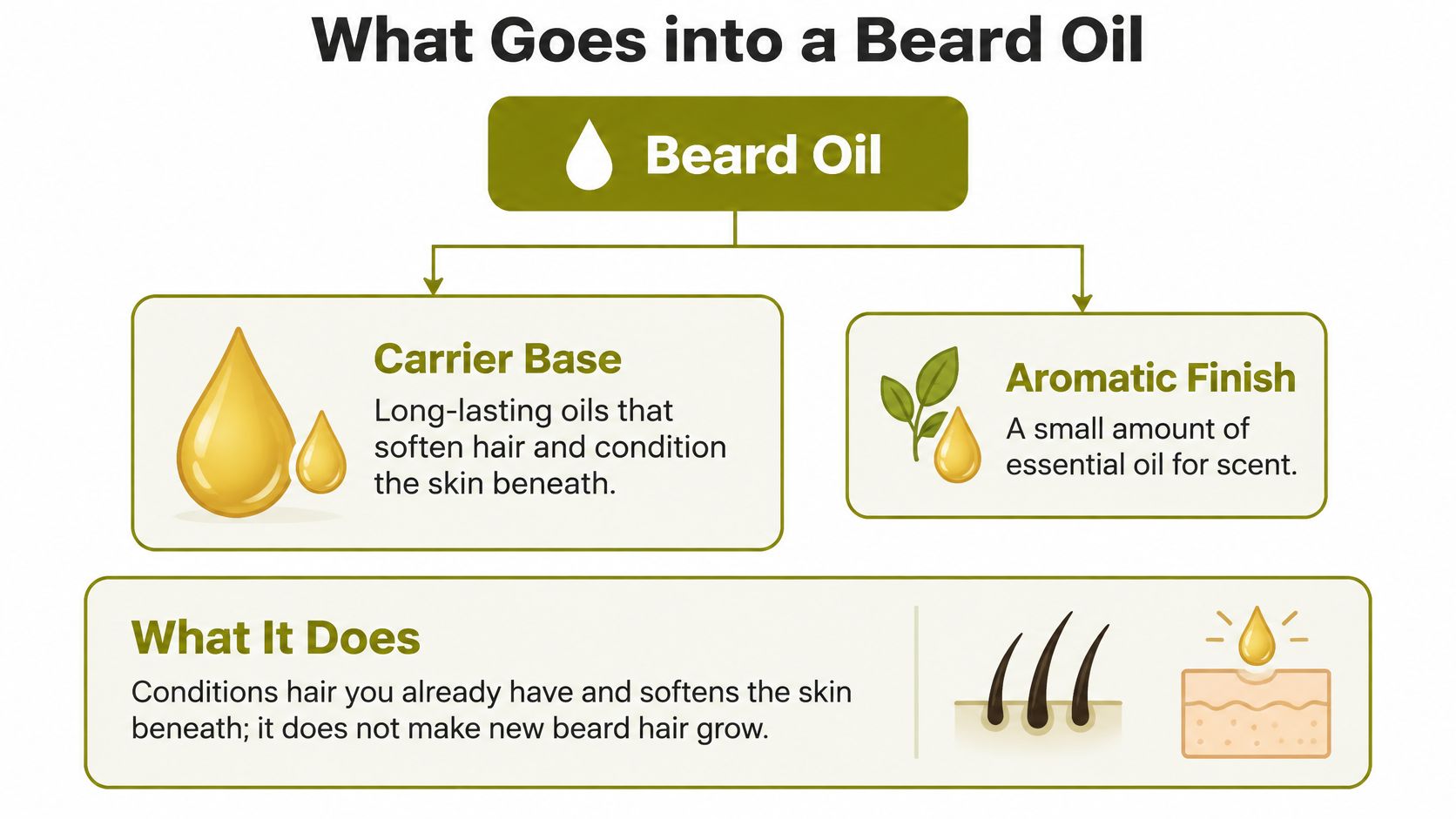
A beard oil is easiest to understand as a substantial carrier base with an optional, much smaller aromatic finish. The base provides slip and softness. The finish changes how the product smells, not how much conditioning work the carriers do.
Say your beard feels rough after washing. You apply a little oil, work it through the hair, and comb gently. The useful payoff is a smoother feel, easier grooming, and less dry-feeling skin beneath, not new beard growth.
The diagram separates those everyday jobs.
Keep the ingredient groups separate
Most labels become easier to read when you sort their contents into these groups:
- Carrier and botanical oils make up the conditioning foundation.
- Essential oils supply concentrated plant-derived fragrance.
- Vitamins and antioxidants support the formula, often by helping protect its freshness.
- Optional texture ingredients adjust glide, richness, or the finish left on hair.
Carrier oils accounted for 65.69% of the global beard-oil market by ingredient type in 2025, according to Mordor Intelligence. That's a market measure, not the percentage of carrier oil inside an individual bottle.
Think in finished-bottle shares
When reading a recipe, every share belongs to the finished blend. Adding another aromatic oil means dividing the scent portion, not giving every fragrance ingredient its own generous allowance.
A useful mental picture is a bottle filled almost entirely with conditioning oils, with small supporting additions. Exact proportions require a complete formula and ingredient-specific use guidance. A scented formula also needs attention to the particular essential oils involved, rather than a single blanket dilution rule.
Practical rule: Choose the base for how you want your beard to feel. Treat scent as an optional preference, not a sign of better care.
The honest expectation is straightforward: beard oil can condition the hair you already have. It shouldn't be chosen as a way to change where facial hair grows.
Beard Oil Ingredients by Role and Share
Common beard oil ingredients, shares, and watch-outs
The numerical shares below are illustrative recipe choices, not established typical-use ranges or universal safety limits. Each essential-oil row belongs within one combined scent allowance.
| Ingredient | Role | Illustrative share or selection rule | Feel or job | Watch-out |
|---|---|---|---|---|
| Jojoba | Carrier, liquid wax | For example, 20–40% | Light slip from wax esters | Still patch test; not a growth ingredient |
| Argan | Carrier oil | Allocate part of the remaining carrier base | Soft, cushioned finish | Richer feel; use fresh oil |
| Sweet almond | Carrier oil | For example, 10–30% | Smooth slip | Skip with tree-nut allergy |
| Grapeseed or sunflower | Carrier oil | For example, 10–25% | Lighter, drier feel | Freshness suffers with poor storage |
| Castor | Carrier oil | For example, 5–10% | Body and a little control | Can feel sticky or heavy when overused |
| Fractionated coconut | Optional carrier | Replace part of another carrier | Light slip | Some faces dislike its finish |
| Vitamin E (tocopherol) | Antioxidant | Follow the supplier's formulation guidance | Helps protect blend freshness | Keep it small; it isn't fragrance |
| Cedarwood or lavender essential oil | Scent | Part of the combined scent allowance | Woody or soft aroma | Fragrance preference and allergen risk |
| Rosemary essential oil | Scent | Part of the combined scent allowance | Herbal aroma | Can bother sensitive skin |
| Peppermint essential oil | Scent | Part of the combined scent allowance | Cool scent | Tingling or irritation isn't a benefit |
| Tea tree essential oil | Scent | Part of the combined scent allowance | Fresh, sharp aroma | Strong aroma; easy to overdo |
Why jojoba deserves its own category
Jojoba is unusual because it's a liquid wax, rather than a conventional triglyceride-rich vegetable oil. The jojoba composition review describes it as approximately 97–98% wax esters, with small amounts of other components, and discusses ester chains of approximately 36–46 carbon atoms.
Those details help explain why formulators value jojoba's conditioning glide. They don't establish that jojoba stimulates follicles, and a lightweight feel doesn't mean every person will tolerate it.
Argan belongs in the carrier-oil category, while castor is useful when a blend needs more body. Tocopherol has a different assignment altogether: it supports freshness rather than supplying the main conditioning base or aroma.
Read the shares as a balance
A recipe table isn't a checklist of ingredients you need to collect. A simple blend can make sense, and adding every oil listed may make the finished product harder to evaluate.
If a hypothetical recipe reserves a small portion for fragrance, cedarwood, lavender, and any other essential oil must fit together inside it. They aren't separate full-size additions. Likewise, replacing a carrier means adjusting the base so the finished recipe remains balanced.
Individual faces also respond differently. A pore-clogging rating can't tell you exactly how a complete blend will feel on your skin, especially when you change the amount applied or layer it over other products.
Choose ingredients by their role first. A recognizable botanical name is useful information, but it isn't a guarantee of comfort or performance.
Carrier Oils and How They Feel
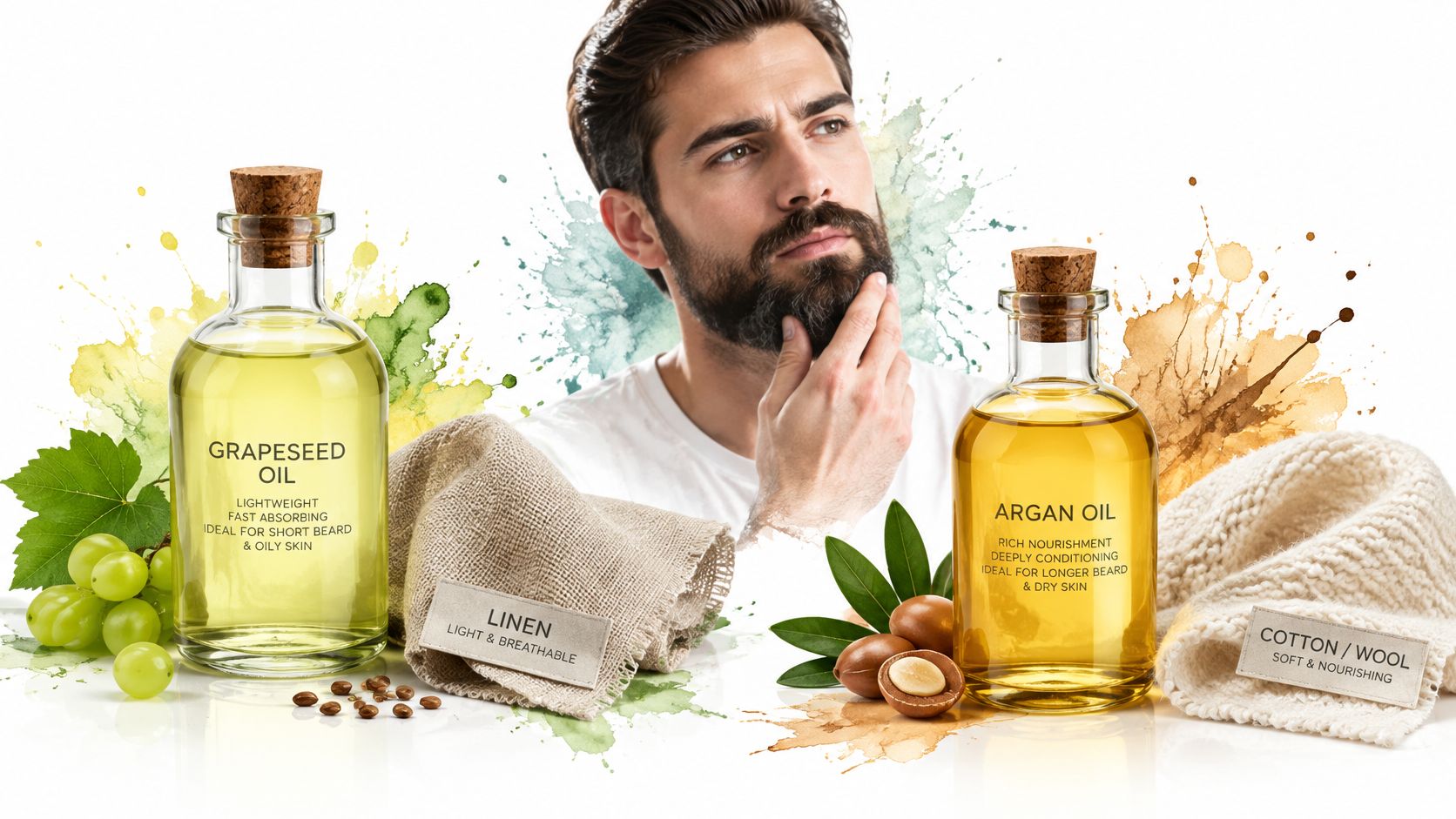
Think of carrier oils as fabrics you might choose for different days. You're deciding how much weight, movement, and cushion you want, rather than searching for a universally best material.
The fabric analogy makes those texture choices easier to picture.
Choose the weight you enjoy wearing
Grapeseed and sunflower can be thought of as a linen shirt: useful when you want an easy-spreading, less weighty finish. A short beard often needs less coating than a long one, particularly when you dislike feeling product on your cheeks.
Argan and sweet almond are more like a soft knit, adding cushion and slip to hair that feels wiry. Jojoba offers a smooth everyday glide, while castor is the structured layer you add sparingly when the blend needs more substance.
Ordinary coconut oil is closer to a heavy coat. Some people enjoy that substantial finish, while others find it excessive. Fractionated coconut is an option when you prefer a lighter coconut-derived carrier.
Fatty-acid composition helps explain why plant oils aren't interchangeable, but it doesn't predict personal comfort by itself. The dermatology overview of natural oils discusses why the balance between linoleic and oleic acids matters when considering oils for skin.
For a broader explanation of how a conditioning base carries aromatic ingredients, our guide to carrier oils for essential oils provides useful background.
This video offers another way to explore beard-oil care.
Match the blend to an ordinary morning
Start with the part of your routine that feels inconvenient:
- A short beard that feels coated easily: Consider jojoba with a lighter seed oil, and begin with a modest application.
- A long beard that catches on the comb: A more cushioned carrier blend, with argan and a little castor, may feel more comfortable.
- A shiny finish that lasts longer than you want: Reduce the amount before assuming you need an entirely different formula.
Storage matters too. Keep the cap closed, avoid a sunny windowsill, and choose a cool shelf away from shower heat. Dark glass helps limit light exposure, but it can't compensate for repeatedly leaving the bottle open.
A familiar ingredient stored thoughtfully is a more useful choice than an elaborate blend you won't finish while it still smells fresh.
Essential Oils and Sensitive Skin
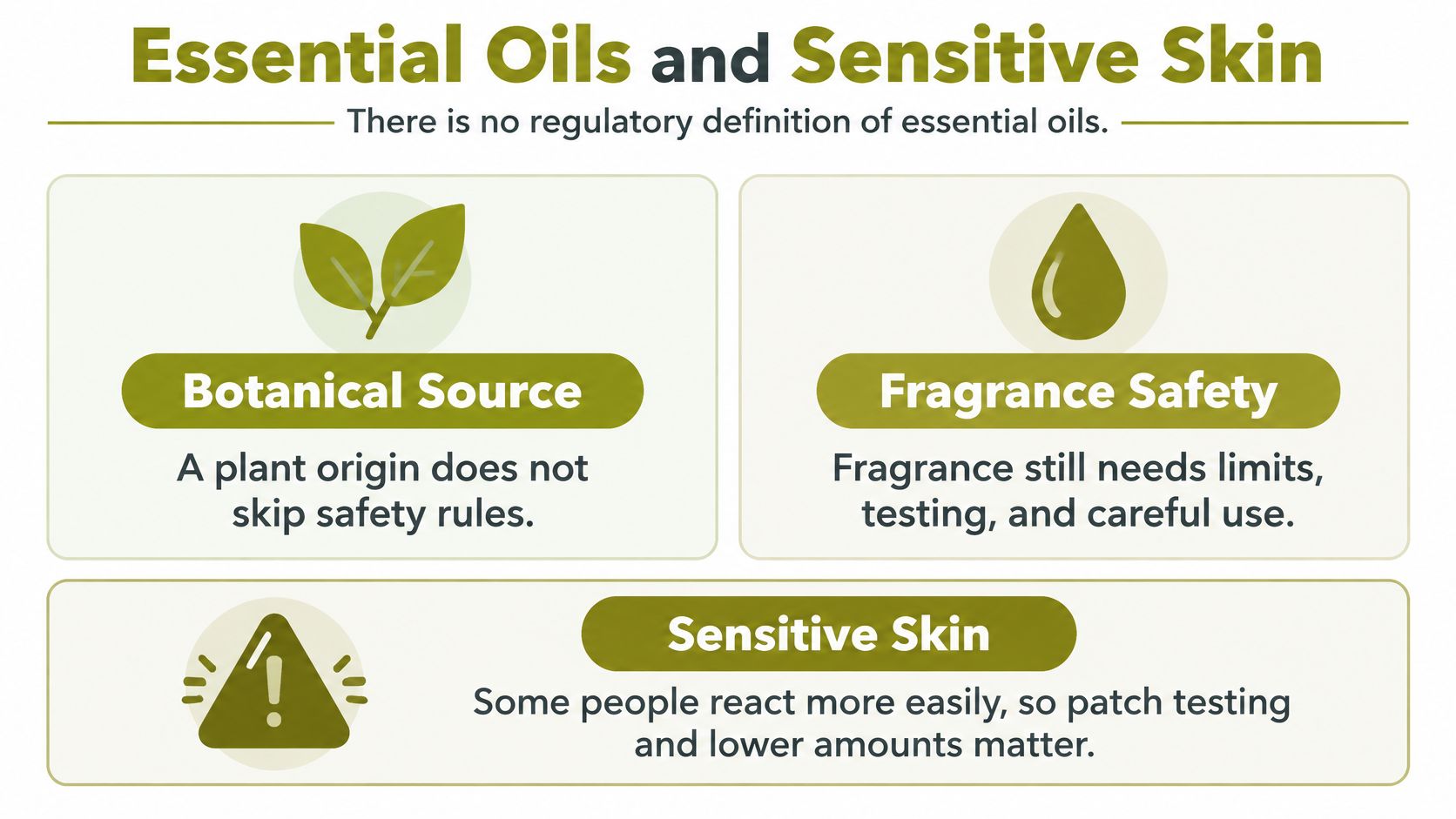
Natural scent can still be uncomfortable on facial skin. The FDA's guidance on fragrances in cosmetics states that there's no regulatory definition of essential oils, that plant-derived cosmetic ingredients face the same safety requirements as other ingredients, and that manufacturers remain responsible for safety even though fragrance ingredients don't require premarket approval.
Beard oil is a leave-on product. That makes the amount and identity of its fragrance ingredients worth attention, even when the scent seems soft or familiar.
The distinction between botanical origin and careful use is important.
Look beyond the plant name
Under European Commission fragrance-allergen guidance, listed fragrance allergens generally require individual disclosure above 0.001% in leave-on products, equivalent to 10 parts per million, compared with 0.01% in rinse-off products. Those are disclosure thresholds, not recommended recipe amounts or guarantees of tolerance.
Names such as limonene, linalool, citral, and eugenol may refer to fragrance components shoppers don't immediately associate with essential oils. The FDA's cosmetic-allergen guidance explains why fragrance deserves attention when reviewing a product that causes an unwanted response.
Age and storage can matter as well. The essential-oil safety review discusses concentration, oxidation, and individual sensitivity, so an old aromatic blend shouldn't be treated as interchangeable with a fresh bottle.
For scent vocabulary, the Jackpot Candles essential oil guide introduces familiar aromatic oils. Use it to explore aroma preferences, not to determine facial-use dilution; our guide to using essential oils for skin keeps the focus on skin-contact considerations.
Screen a new product gently
- Apply a small dab to an inconspicuous area, such as the inner forearm.
- Allow time to observe the area before applying the product throughout your beard. A home check can't guarantee future tolerance.
- Introduce only one new product at a time.
- Keep oil away from eyes, mucous membranes, and broken or inflamed skin.
- Stop using it if redness, swelling, burning, or itching persists.
Beard oil reactions and what to adjust
| What you notice | Often linked to | Next step |
|---|---|---|
| Greasy or congested feel | Heavy carriers such as castor or coconut | After your skin settles, consider jojoba and a lighter seed oil |
| Brief cool tingle that fades | Peppermint or another strong essential oil | Use less scent or skip that oil |
| Itchy red rash that persists | Possible fragrance sensitivity | Stop the product; seek advice if symptoms persist |
| Watery eyes or sting | Oil drifting toward eyes or mucous membranes | Stop application and keep future use away from the eye area |
Don't describe irritation as purging or keep applying a product to build tolerance. A fragrance-free routine is a complete grooming choice.
Vitamins and Small Supporting Additives
Supporting ingredients are the finishing touches, not the main story. A front label may emphasize vitamin E, but the carrier base still determines much of the oil's everyday feel.
Tocopherol, commonly identified as vitamin E, is used as an antioxidant to help protect an oil blend from becoming stale. The appropriate amount follows the particular ingredient's supplier guidance, rather than the assumption that more makes a richer beard treatment.
Separate freshness from fragrance
Rosemary can appear on a label in different forms. Rosemary leaf extract used as an antioxidant and rosemary essential oil used for scent shouldn't be treated as the same ingredient.
- Antioxidant rosemary extract: Chosen to help protect the formula's freshness.
- Rosemary essential oil: An aromatic ingredient that belongs with the fragrance components.
- Mixed tocopherols: Another supporting ingredient to recognize when reviewing an oil's freshness system.
Antioxidants also aren't a substitute for thoughtful storage. Keep water out of the bottle, close it after use, and don't leave the dropper resting against wet hair.
Keep extras in perspective
Squalane is an optional lightweight lipid that some formulas use for slip. It isn't a requirement for a useful beard oil, and its presence doesn't make a complicated formula necessary.
Ingredients associated with supplements or other beauty products need similar perspective. Biotin, collagen, or vitamin C language doesn't turn an outside conditioning oil into nutritional care. Retinol or exfoliating acids would make the product a different sort of facial formula, not automatically a better beard oil.
A supporting ingredient should have a clear job you can explain without relying on the front-label promise.
Finally, check the bottle itself. A clean, mild nutty or soft herbal smell can be normal, but an unexpected sharp paint-like, crayon-like, or rancid odor is a reason to retire it. Don't try to cover a changed smell by adding more essential oil.
How to Read a Beard Oil Label
Consider these imaginary ingredient lists. They're examples for practicing label reading, not endorsements of either formula.
| Example | Ingredient list |
|---|---|
| List A | Jojoba, argan, sweet almond, tocopherol, Lavandula angustifolia oil |
| List B | Jojoba, sunflower, argan, rosehip, sweet almond, grapeseed, castor, tocopherol, fragrance |
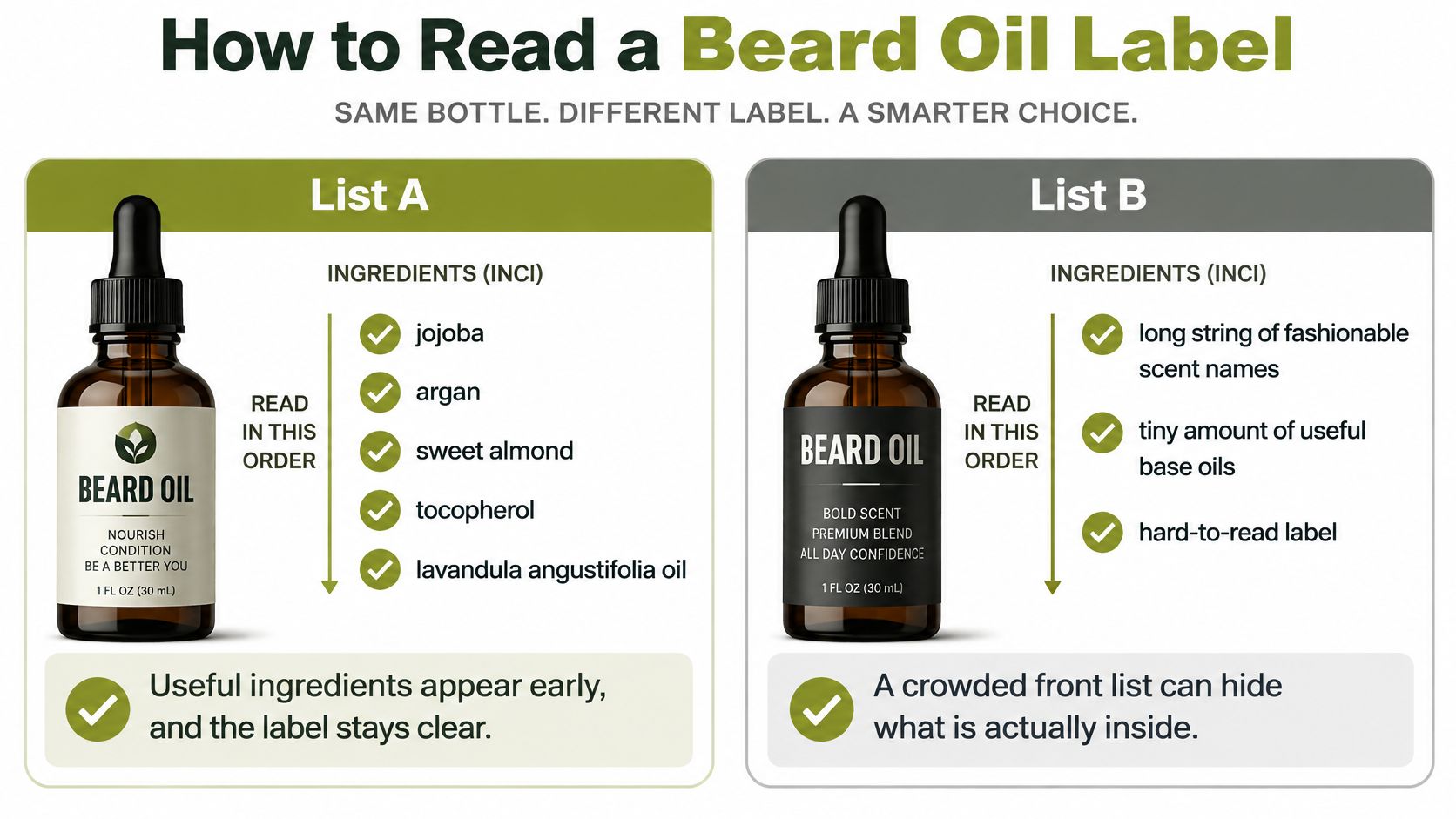
List A is shorter, while List B contains more botanical names. Neither list alone tells you which will feel better on your face, and a crowded list doesn't automatically mean poor quality.
This visual offers a quick label-reading prompt, but length alone isn't a quality test.
Understand what order can tell you
The FDA Cosmetics Labeling Guide says U.S. cosmetic ingredients are generally listed in descending order of predominance, but ingredients present at 1% or less may be listed without regard to predominance; fragrance may also be declared generically.
That exception matters. You can identify the leading carrier ingredients, but you can't reliably calculate the amount of tocopherol or lavender from their position near the end.
Nor can you assume that the first oil is the best ingredient. It primarily tells you about predominance, not suitability, freshness, or the care taken in making the finished product.
Turn the list into a useful decision
Read for jobs rather than prestige:
- Find the base: Identify the leading emollient oils and decide whether their likely texture sounds appealing.
- Separate the aroma: Look for named essential oils, fragrance, or perfume.
- Check ingredient clarity: Botanical names can help distinguish similarly named materials.
- Inspect the bottle: Favor a closure and packaging you can keep clean and protected from light.
- Question the promise: Growth or cure language doesn't belong in your expectations for an everyday conditioning oil.
International labels can look different because allergen-disclosure requirements differ across markets. A more detailed fragrance list may help someone avoid a known ingredient, but it doesn't necessarily mean the underlying product contains more fragrance.
For a fragrance-sensitive shopper, a short aromatic list can make screening easier. Still, a single essential oil may be unwelcome, while a longer carrier list may feel perfectly comfortable.
A label supports an informed choice, not a reverse-engineered recipe. Use it to understand the base and scent style, then judge the product by a careful introduction and ordinary daily wear.
Choose a Blend That Fits Your Routine
A medium-length beard may suit a blend with smooth slip, a little cushion, and limited castor for body. The following is a hypothetical formulation example, not a universal facial-use recommendation.
Its fragrance portion is optional. Before making a scented version, confirm the intended-use guidance for the exact essential oils and antioxidant you have; if that information isn't available, choose a professionally formulated product or leave the scent out.
An illustrative balanced blend
| Ingredient | Example share of the finished blend |
|---|---|
| Jojoba | 30% |
| Argan | 25% |
| Sweet almond | 25% |
| Grapeseed | 12% |
| Castor | 6% |
| Vitamin E | 1% |
| Cedarwood essential oil | 0.6% |
| Lavender essential oil | 0.4% |
| Total | 100% |
If tree-nut allergy is a concern, don't use sweet almond. Replacing that portion with jojoba creates a different version of the example, but anyone with a known allergy should also check the suitability of the other ingredients.
For a fragrance-free version, replace the entire aromatic portion with carrier oil. Don't leave it as an invitation to add a different essential oil later without recalculating the formula.
Blend carefully and keep the routine simple
- Prepare the container. Start with a clean, completely dry amber bottle, a small funnel, and suitable measuring equipment.
- Add the carriers, working from the larger shares toward the smaller ones. Measure consistently rather than estimating from drop size.
- Mix in the antioxidant according to its supplier's guidance.
- Add essential oils last, only if you've confirmed that the exact ingredients and amounts are suitable for facial leave-on use.
- Cap, mix, and label. Record the ingredients and preparation date so you can identify the blend later.
- Screen a small area before broader use, then begin with a modest amount on a slightly damp beard.
- Store the bottle cool and dark. Discard it if its smell changes, rather than assigning every homemade blend the same shelf life.
Application matters as much as ingredient selection. Spread the oil between your palms, work it through the beard, and comb gently; add more only if the hair still needs it. Our guide to beard oil benefits can help you set realistic expectations for that routine.
Choose for daily comfort: A lighter finish suits someone who dislikes coating, more cushion may suit coarse hair, and no added fragrance is often the simplest preference to maintain.
At ArtNaturals, we offer men's beard care, including Beard Oil for Men, 2oz, priced at $12.95, along with Argan Essential Carrier Oil, 4 oz, listed as suited to all skin and hair types. Visit ArtNaturals to explore a finished beard oil or a carrier oil, using the ingredient roles and label-reading habits above to guide your choice.