

If a serum is vegan, does that tell you whether it's gentle, cruelty-free, or right for your skin? Not necessarily. Those are separate questions, and the front label rarely answers all of them.
Finding the best vegan skincare starts with matching a product to your everyday needs, then checking what its claims cover. You don't need a complicated routine or an ingredient dictionary. You need a clear starting point, readable ingredient information, and a little patience as you introduce something new.
Vegan Skincare Picks by Skin Concern
| Skin concern | Start with | Ingredients to look for |
|---|---|---|
| Anti-aging | Serum | Retinol, vitamin C, plant-based peptide, confirm no collagen |
| Dry and dehydrated skin | Serum or face oil | Hyaluronic acid, squalane oil, confirm plant source, rose and vitamin E oil |
| Dull skin | Serum | Vitamin C, niacinamide |
| Congested and oily skin | Serum | Niacinamide, salicylic acid, lactic acid |
| Sensitive skin | Simple moisturizer or fragrance-free serum | Hyaluronic acid, squalane oil, short ingredient list |
| Acne and pores | Serum or cleanser | Salicylic acid, glycolic acid, lactic acid |
This table shows where to start, not what results will follow. These concern groups match the way we organize skincare at ArtNaturals, but your skin type, climate, and personal tolerance still guide the final choice.
A serum is usually where you'll find concentrated actives. A moisturizer or face oil supports everyday softness and comfort, while a gentle cleanser removes buildup and prepares skin for the products that follow.
Read each row as a starting point
For anti-aging concerns, decide whether your priority is the appearance of uneven tone, texture, or dryness before choosing an active. Don't buy retinol, vitamin C, and peptides together just because they appear in the same row.
Dry or dehydrated-feeling skin calls for a texture check as well as an ingredient check. Hyaluronic acid belongs in the moisture-attracting category, while a face oil adds an emollient layer. Rose and vitamin E oil may appeal if you enjoy an oil texture, but check whether the formula contains added scent.
For dull-looking skin, consider a focused vitamin C or niacinamide serum rather than several brightening products at once. Congestion and the appearance of pores also overlap, so the acid names in those rows are options to assess individually, not a recipe for layering them all.
Sensitive skin needs the simplest starting point. A comfortable moisturizer may be a more useful first purchase than an active-heavy serum.
Use the table without overbuying
When browsing collections organized around skin renewal, the Maximum Health Products skin renewal collection offers another opportunity to practice checking product descriptions against full labels. A collection name helps you find items, but it doesn't verify ingredient origin or suitability.
Use this short sequence:
- Find your main concern. Choose the issue that most affects daily comfort or your preferred appearance.
- Choose a product type. Start with the missing role in your routine, not every ingredient in the row.
- Read the label. Check the claim, ingredient list, and sourcing information before buying.
What Vegan and Cruelty-Free Labels Really Promise
| Label | What it covers | What it leaves open |
|---|---|---|
| Vegan | No animal-derived ingredients, and sometimes manufacturing methods, depending on the certifier | Animal testing, performance, environmental impact |
| Cruelty-free | No animal testing of the finished product or its ingredients, within the policy's scope | Whether ingredients are animal-derived |
| Certified vegan and cruelty-free | Both ingredient and testing scope under a published standard | Performance and sustainability |
| Natural | No single legal meaning for cosmetics across markets | Ingredient origin, testing, and safety |
| Clean | No shared legal definition, with criteria set by each brand | Vegan status and performance |
Vegan concerns ingredient origin. Cruelty-free concerns animal testing. A formula without animal ingredients still needs a testing-policy check. A product made without animal testing could contain beeswax or honey.
The Vegan Society's explanation of beauty labeling states that there's no legal definition of what makes a product vegan or cruelty-free when those terms appear on labels. That's why the certifier's published requirements matter: similar wording doesn't necessarily mean identical verification.
Read the scope behind the wording
A certification logo should lead to an identifiable organization and an explanation of its rules. Look for whether those rules cover ingredients, manufacturing, and animal testing, including any stated testing cutoff or supplier requirements.
Don't treat a leaf symbol or an animal illustration as a substitute for that information. Packaging can communicate an idea without documenting how a product meets it.
The same care applies to natural and clean. Those words may describe a brand's ingredient preferences, but they don't independently establish that a product is vegan, fragrance-free, or suited to your skin.
Practical rule: Treat a label as the beginning of your questions, not the end of them.
Keep environmental questions separate
A vegan claim also doesn't establish lower environmental impact. Packaging, sourcing, manufacturing, and disposal each deserve their own explanation rather than being folded into an ethical-sounding phrase.
For a broader shopping perspective, our guide to eco-friendly skincare brands can help you think about the environmental questions alongside ingredient preferences.
Before trusting any label, identify who defines it, what it covers, and what remains unverified. That approach lets you choose according to your values without expecting one word to answer every question.
How to Verify a Vegan Claim in Six Steps
A useful verification check follows the product from its packaging to the information behind it. Keep the product page and full ingredient list open while you work through these steps.
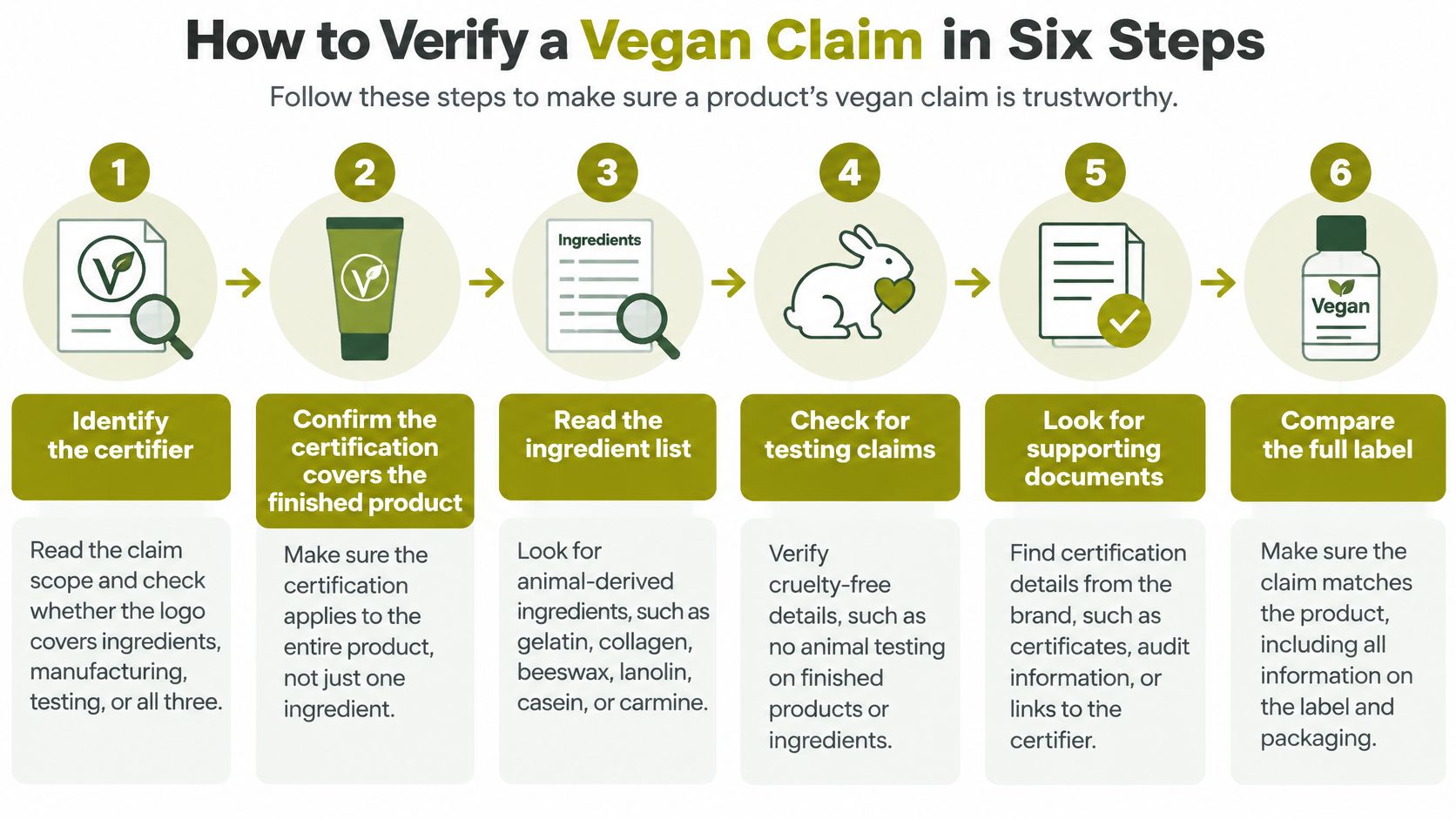
Follow the product beyond the front label
- Identify the certifier and read its scope. Find the organization behind the logo and check whether its rules cover ingredients, manufacturing, animal testing, or all of these. The common slip is trusting a bunny-style illustration without checking whether it represents certification at all.
- Confirm coverage of the finished product. Match the certification details to the exact product and formula you're considering, not just the brand name. A certified ingredient doesn't automatically establish that everything else in the bottle meets the same standard.
- Read the complete ingredient list. Screen for honey, beeswax, lanolin, collagen, silk, and insect-derived dyes rather than relying on a plant-focused product name. A botanical ingredient highlighted on the front can sit alongside animal-derived materials elsewhere in the formula.
- Check processing requirements. The Vegan Action certification criteria exclude sugar filtered with bone char and require products not to be processed with animal products or by-products. A familiar ingredient name doesn't reveal every processing aid used to make it.
- Look for supplier and development documentation. Check whether the brand explains ambiguous ingredient sources and provides supporting certification details. A short list can be easy to read without showing how each ingredient was developed or manufactured.
- Confirm testing policies and performance support separately. Read the animal-testing policy, then check whether claims about the finished product's appearance-related benefits have support from human testing. Don't assume evidence for an ingredient establishes what every formula containing it will do.
Keep a simple record
Save the certification page and product ingredient list if those details influence your purchase. If the information is unclear, pause rather than filling in the gaps from a green package or a familiar ingredient name.
This is especially useful for a product you plan to repurchase. You'll have a clear record of the formula and claim you originally assessed, rather than relying on memory.
A verified label connects a named standard to the finished product, with accessible ingredient, sourcing, and testing information.
Ingredients to Look For and Avoid
| Ingredient | Typical role | Vegan check |
|---|---|---|
| Sunflower or safflower oil | Plant oil for softness | Confirm plant origin on the full list |
| Argan oil | Plant oil for softness | Plant-derived, check the rest of the formula |
| Vitamin C | Antioxidant active | Plant or synthetic origin, both can be vegan |
| Retinol | Vitamin A derivative | Often synthetic, confirm the source |
| Niacinamide | Vitamin B3 active | Usually synthetic, confirm the source |
| Hyaluronic acid | Humectant | Often fermentation-derived, confirm the source |
| Squalane | Emollient | Check for plant-derived, such as olive, rather than shark-derived |
| Collagen | Film-forming ingredient | Animal-derived collagen isn't vegan, look for plant-based alternatives |
| Beeswax, honey, lanolin | Texture and humectant roles | Not vegan |
| Carmine | Red colourant | Not vegan, insect-derived |
| Essential oils and fragrance | Scent | Can be vegan but sensitizing, check sourcing and fragrance details |
An ingredient list helps you understand a formula, but the name alone doesn't always establish the source. Synthetic and fermentation-based ingredients can fit a vegan routine, so natural origin isn't a requirement.
The Vegan Trademark standards extend their requirements to product and ingredient development and manufacture, excluding animal products, by-products, and derivatives. That makes sourcing and production information relevant even when the finished list looks straightforward.
Collagen, squalane, and fragrance need extra attention
Collagen is the first common trap. Animal-derived collagen isn't vegan, while a product named collagen booster may refer to a formula built around other ingredients rather than collagen itself. Check the actual composition for a plant-based or fermentation-based alternative instead of deciding from the product name.
Squalane requires an origin check because it can come from plant or animal sources. Look for an explicit plant-source statement, such as olive-derived, rather than assuming all squalane follows the same sourcing route.
Fragrance needs a different question. Even when its ingredients are vegan, that doesn't tell you whether your skin will enjoy a scented leave-on product. Keep the origin check and the comfort check separate.
Choose oils for the whole formula
Plant oils differ in their fatty-acid profiles. The published review of plant oils and skin barrier function supports paying attention to those differences rather than treating every botanical oil as interchangeable.
Sunflower, safflower, grapeseed, and evening-primrose oils are linoleic-rich options often considered for comfort-focused routines. Oleic-rich oils such as olive may feel heavier on some skin, but the finished texture also reflects the amount used and the rest of the formulation.
Compare the oil listed first, then consider whether the product is a pure oil, a blend, or a water-based emulsion. An oil's name isn't a promise about how the finished product will feel.
Green tea, grape-seed, and aloe extracts are also worth noticing when reading botanical formulas. Still, a recognizable plant name doesn't establish a particular result, and an appealing blend isn't a reason to skip the source check for its other actives.
Serum, Cleanser and Moisturizer Checks
Check each category for its job in your routine, then examine the formula behind the product name.
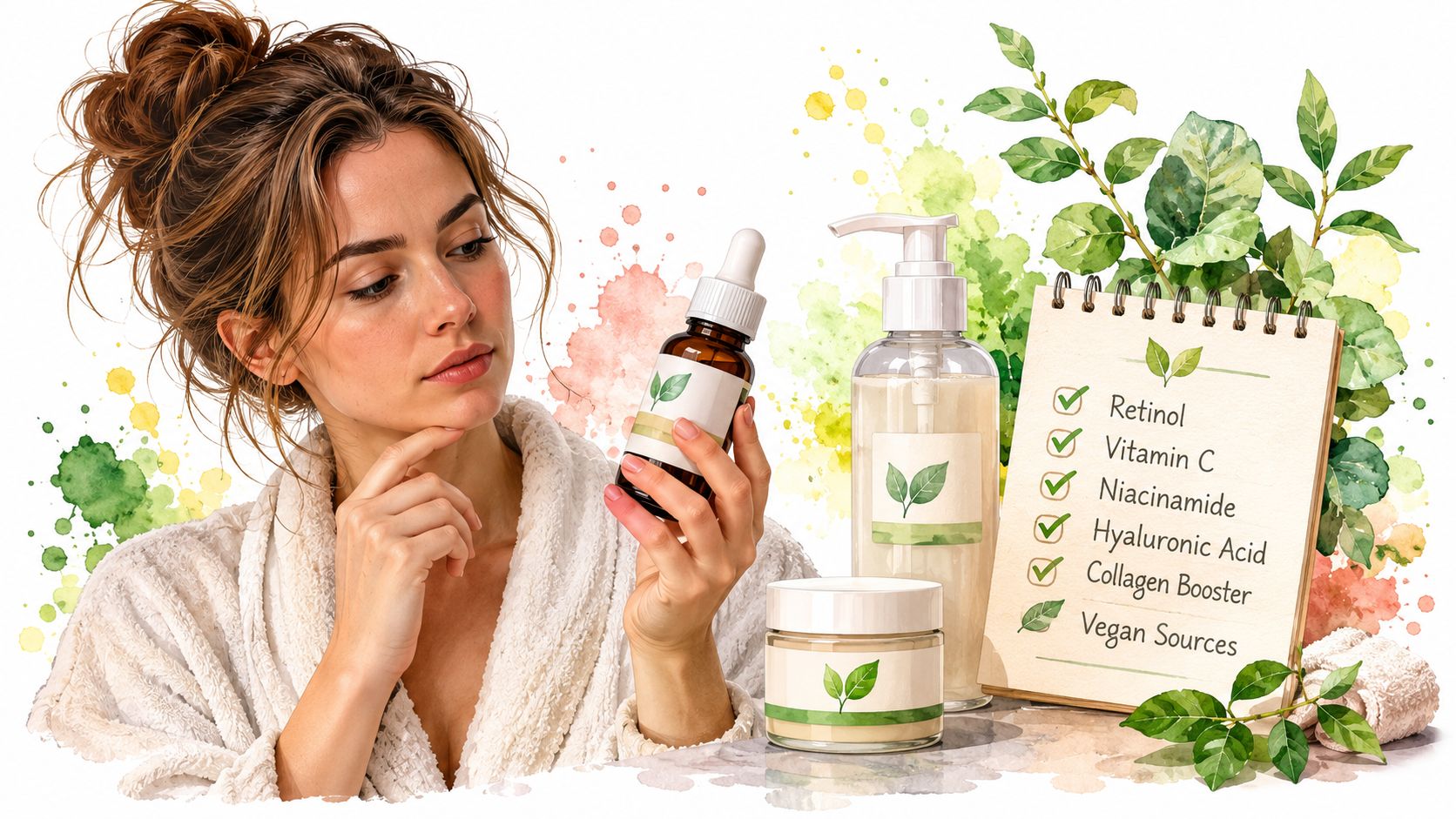
Serums and focused actives
Our facial skincare includes oils, serums, and patches. The serum collection includes collagen, glycolic acid, hyaluronic acid, lactic acid, niacinamide, retinol, salicylic acid, squalane oil, and vitamin C options.
Our 1 oz Niacinamide, Collagen Restore, Glycolic Acid, Lactic Acid, Hyaluronic Acid, Retinol, and Squalane Oil serums are each $12.95. Choose by formula and purpose, not price alone: check retinol and humectant sources, confirm plant-derived squalane, and read a collagen-named product for animal collagen.
Cleansers and daily moisture
For cleansers, look for a rinse-off formula with clearly explained ingredients. If your skin reacts easily, check for a fragrance-free label as well as the complete list.
If you're browsing Vitamin Planet, the listing to shop Sukin cleanser in 125ml is a place to practice that label-reading process, not a substitute for verifying its claims.
For moisturizers and face oils, let texture and climate guide your shortlist. A water-based gel may feel comfortable in humid weather, while a richer cream may suit dry air; oil richness also reflects the blend, not just its headline ingredient.
Use this video alongside your own product labels as you consider your routine.
Across categories, keep the same buying filter: certifier, claim scope, full ingredient list, and testing policy. Add a category only when it fills a useful gap.
Fragrance and Sensitive Skin Checks
Vegan doesn't mean gentle. Botanical ingredients can contain scent compounds that some people find uncomfortable, including in products presented as natural or wellness-focused.
A review of botanical cosmetic ingredients identifies fragrance components as an important sensitivity concern and names linalool, limonene, eugenol, and citral among compounds commonly found in essential oils. Their natural occurrence doesn't tell you how your skin will respond.
Read beyond the scent description
Look for fragrance, parfum, essential oil blend, and the individual compound names on the full list. A product described as fresh, herbal, or calming can still contain added scent.
A fragrance-free label is a useful filter, but it doesn't remove every naturally occurring compound from botanical ingredients. Don't stop reading as soon as you find that phrase.
For ingredient-focused reading, Healtsy's guide to choosing ingredients for sensitive skin provides another resource to consider alongside the product label. Our guide to natural skincare for sensitive skin also keeps the focus on a manageable routine rather than an extensive collection.
Give your skin room to respond
Patch test a small area, such as the inner arm or jaw, for a day or two before full use. This is a cautious introduction, not a guarantee that a reaction won't occur later.
- Start small. Choose a straightforward moisturizer or fragrance-free serum.
- Watch for discomfort. Stop using a product that stings, burns, or itches rather than assuming discomfort means it's working.
- Leave space between additions. Keep a comfortable starting routine for a few weeks before considering more products.
For ongoing irritation or a skin concern that worries you, speak with a qualified healthcare professional.
Building a Simple Vegan Routine
A practical routine gives each product a clear purpose. You don't need to use an active at every opportunity, and you don't need to replace comfortable products to make the shelf look coordinated.
Use this sequence as a guide to product order, while keeping sunscreen as the final morning skincare step.
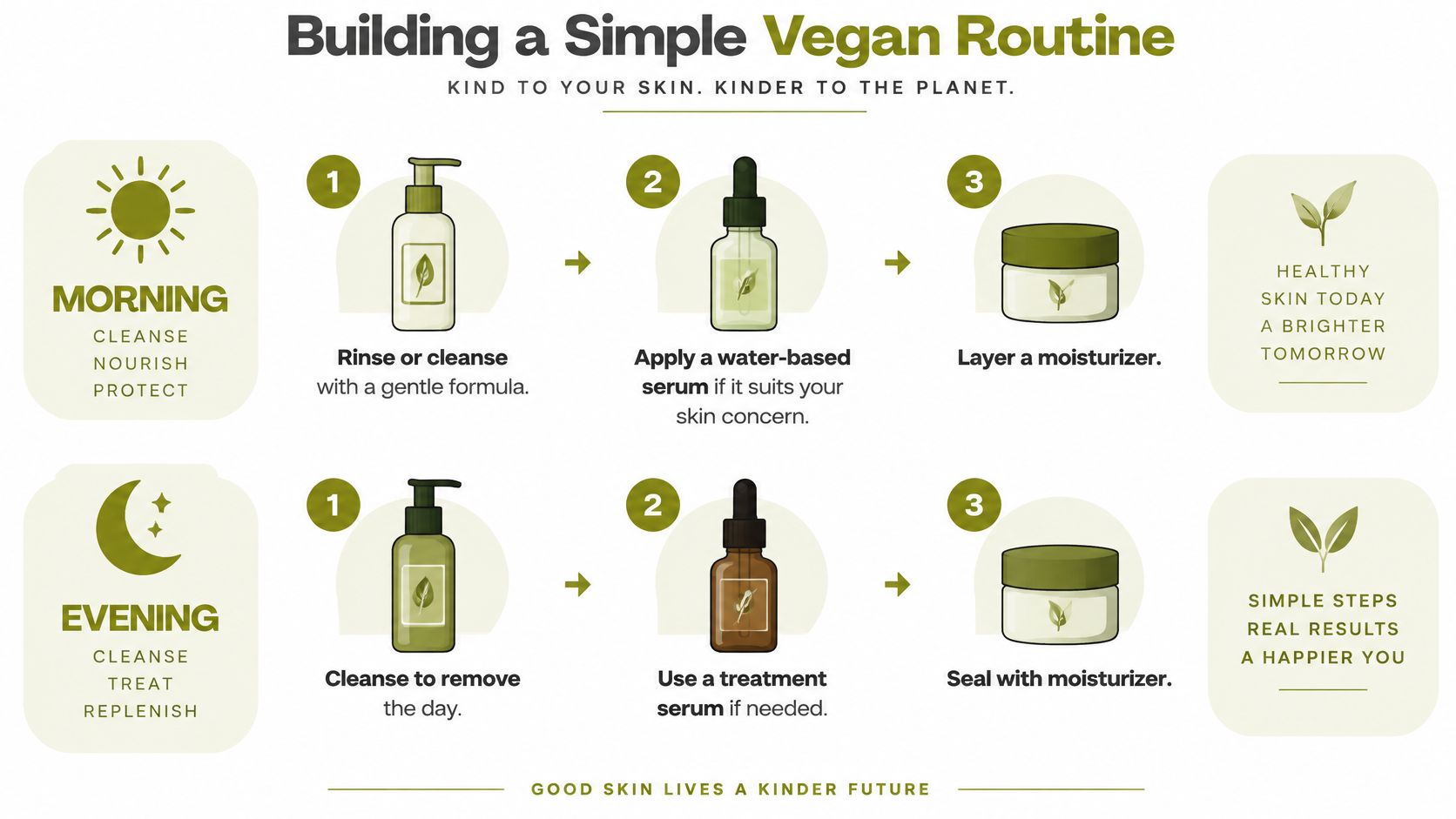
Morning
- Rinse or cleanse gently. Choose a gentle formula when you need to remove overnight residue. Avoid adding a strong scrub just because your skin feels oily on waking.
- Apply a water-based serum if it serves a purpose. Choose an ingredient that fits your main concern and use the product's directions to guide application. Don't add a serum because a routine appears to need another step.
- Layer moisturizer or a light face oil. Choose the texture that leaves your skin comfortable without feeling overloaded. Applying a rich oil before a water-based serum can make layering awkward, so keep the lighter water-based step first.
- Finish with sunscreen. Use it as a daily step and follow its application and reapplication directions. A brightening serum isn't a replacement for sunscreen, and face oil doesn't provide that missing step.
Evening
- Cleanse to remove the day. Take off sunscreen, makeup, and accumulated residue with a suitable gentle cleanser. Avoid scrubbing harder to compensate for a formula that doesn't remove what you wear.
- Use a concern-matched serum if needed. Keep this step focused, particularly when introducing acids or retinol. Don't stack several unfamiliar actives because their product descriptions sound appealing.
- Finish with moisturizer or face oil. Adjust the amount and texture to how your skin feels and the surrounding air. More product isn't automatically more comfortable, especially if your layers already feel rich.
Introduce changes slowly
Add a new product on its own and wait one to two weeks before introducing another. Patch test a small area for a day or two before full use, and allow more time whenever your skin feels unsettled.
Keep the routine simple enough that you can tell which product you enjoy using and which one doesn't suit you.
Our guide to how to build a skincare routine can help you organize the steps around what you already own. Reassess every few weeks, considering comfort, ease of use, and whether each product still has a useful role.
Choose Your First Vegan Product
Choose the product that fills the clearest gap in your routine. If cleansing already feels comfortable but your skin feels dry afterward, a moisturizer may be a more practical purchase than another active serum.
Before checking out, match the exact product to its certification information and full ingredient list. Introduce it on its own, patch test before full use, and give yourself a few weeks to assess whether it earns a place in your routine.
Make the evidence match the promise
For sustainability language, look for specific sourcing or packaging information. For performance claims, look for support relevant to the finished formula and the appearance-related benefit being described, rather than a broad statement about plant ingredients.
The best vegan skincare choice is one you can understand and comfortably use. Let documentation guide your values-based decision, and let your own tolerance guide its place in your day.
- Concern matched. The product has a clear purpose.
- Label verified. The certifier, scope, and ingredients are understandable.
- One product started. Other routine changes can wait.
- Patch test completed. You've made a cautious introduction.
- Routine reviewed. Reassess comfort and usefulness after a few weeks.
ArtNaturals offers plant-based, cruelty-free, and sustainable products for whole-body care, including facial oils and ingredient-focused serums. Visit ArtNaturals to explore skincare by concern and ingredient, then choose a starting product using the label checks that matter to you.