

A stabilized vitamin C serum is usually the best choice for dark spots, not just the strongest one. In a 2026 evaluation, a 12% pure vitamin C serum reduced the number of dark spots by 9.8% and their intensity by 16.7% after 56 days.
You may be searching after noticing a new mark in the mirror, studying an old post-breakout spot, or wondering why your complexion looks uneven despite a careful routine. Vitamin C can be a useful part of that routine, but it isn't an instant eraser. The most sensible choice is a formula that balances stability, skin comfort, and consistent use over time.
The best vitamin C serum for dark spots depends on what you want it to do. Prevention means helping reduce the environmental factors that contribute to new discoloration. Fading means gradually softening the appearance of marks that are already there. Maintenance means keeping your tone looking even after you've made progress.
Understanding How Vitamin C Brightens Skin
Someone looking for a quick fix may imagine vitamin C working like an eraser. Apply it to a dark spot, wait a few mornings, and the mark disappears. Skin usually behaves more slowly and more subtly than that.
Vitamin C helps support a brighter-looking complexion in two complementary ways. It provides antioxidant support against everyday environmental stressors, while also interacting with the process that produces melanin, the pigment responsible for much of the color in dark spots. Specifically, vitamin C can inhibit tyrosinase by interacting with copper at the enzyme's active site, which may reduce melanin formation. The mechanism is described in this dermatology review of topical vitamin C.

A shield, not an eraser
Think of a vitamin C serum as part of your skin's daily support system. It doesn't cover a mark or scrub away pigment. Instead, it helps create conditions that support a more even-looking tone while your skin naturally renews itself.
That distinction matters because prevention and fading aren't the same job. A morning serum may help your skin handle oxidative stress and may reduce the tendency for existing discoloration to look deeper. Established marks often need more patience and, depending on the person, a broader routine.
A large review of topical vitamin C included 139 volunteers ages 23 to 72 with Fitzpatrick skin types I through V and found vitamin C useful for uneven, wrinkled skin with depigmenting properties. Independent summaries of trial data report improvement in hyperpigmentation for 73% of participants, while Harvard's overview says most participants in topical vitamin C trials saw improvement in dark spots with low irritation. These findings are summarized through the review of topical vitamin C for melasma and photoaging.
Practical rule: Judge a serum by how well you can use it consistently, not by how dramatic the first application feels.
For a plain-language overview of ingredient choices and everyday use, you can also explore this vitamin C serum guide. A clinical guide to dark spots 2026 can provide additional background for readers who want to understand the topic in more depth.
Choosing the Right Form and Strength
The label matters, but the ingredient list doesn't tell the whole story. L-ascorbic acid, also called pure vitamin C, is the form most often discussed for visible brightening. It can work well in an appropriately designed low-pH formula, but its acidity may feel uncomfortable for some people.
A practical benchmark for L-ascorbic acid is 10% to 20%, with acidic pH generally needed to support penetration. The same review notes that efficacy tends to rise with concentration up to about 20%, after which a higher percentage isn't automatically a better choice. A strong formula that causes repeated stinging may be less useful than a gentler one you'll keep applying.
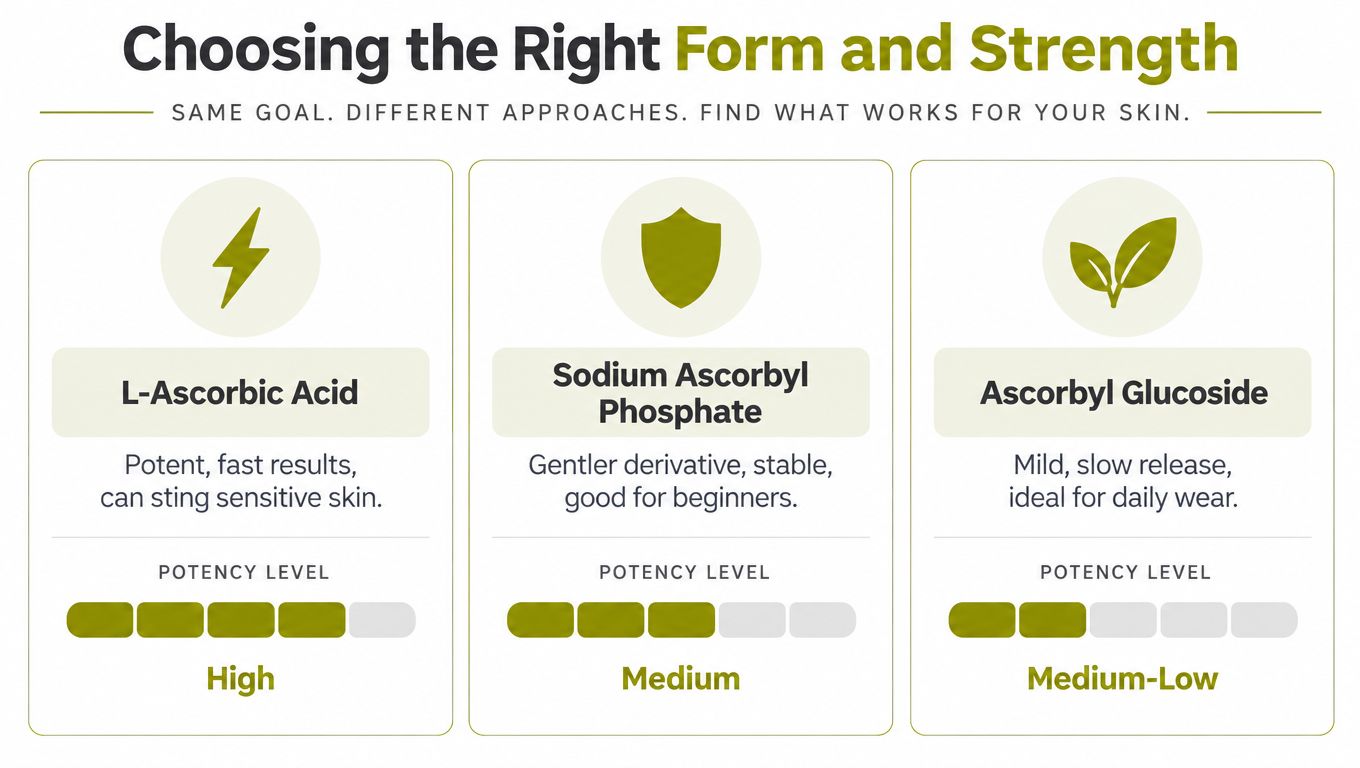
Match the form to your comfort level
L-ascorbic acid is the more direct, acidic option. Derivatives such as sodium ascorbyl phosphate and ascorbyl glucoside are often chosen when someone prefers a milder experience or wants a formula that feels easier to use regularly. Derivatives must be converted by the skin into active vitamin C, so their action may feel less immediate, but comfort can support better consistency.
| Vitamin C form | What it may suit | What to keep in mind |
|---|---|---|
| L-ascorbic acid | Experienced users seeking a direct, potent form | Low-pH formulas can sting sensitive skin |
| Sodium ascorbyl phosphate | Beginners or people who prefer a gentler derivative | Often selected for a more comfortable routine |
| Ascorbyl glucoside | Daily wear and gradual brightening routines | Its slower release may suit people who dislike strong sensations |
The formula's delivery system matters as much as the headline percentage. A stabilized low-pH system, especially one pairing L-ascorbic acid with vitamin E and ferulic acid, is frequently emphasized in dermatology reviews for pigmentary concerns and photoaging. That makes stability a selection criterion, not a technical detail to ignore.
Watch the accompanying video for a visual introduction to vitamin C forms and routine decisions.
A formula can also be difficult to compare if the exact vitamin C percentage isn't disclosed. In that situation, look for the named form, packaging that limits light and air exposure, and clear directions for use. A transparent label is more helpful than a vague promise of maximum strength.
Building a Gentle Daily Routine
A vitamin C serum works best when it fits into a routine you can repeat without irritation. For many people, morning application makes sense because the serum can sit beneath moisturizer and sunscreen as part of a daily environmental defense routine.
Start with a clean, dry face. Apply a small amount of serum, allow it to settle, then use moisturizer and sunscreen. Avoid the eye area unless the product is specifically designed for it.
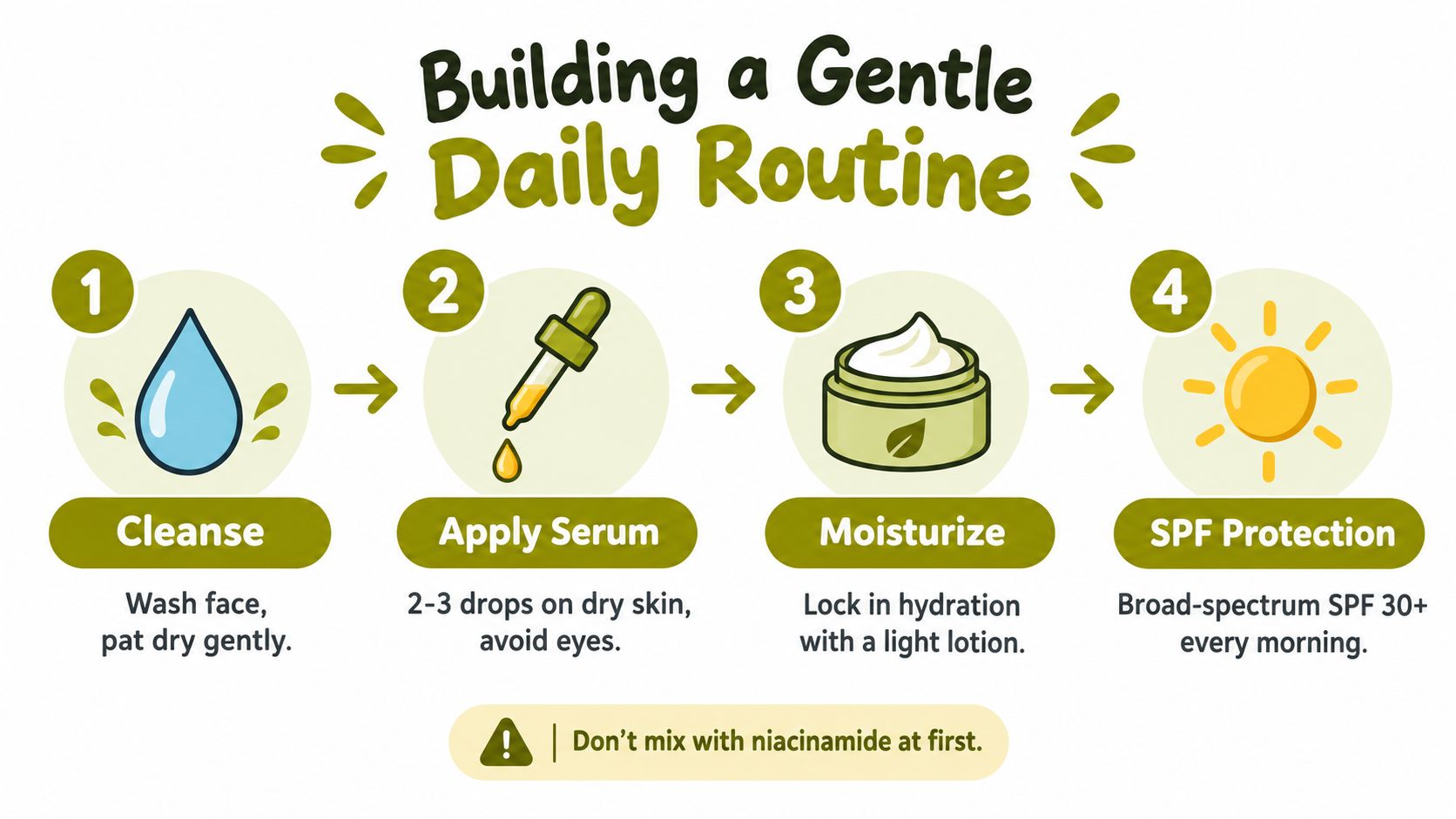
Compare the routine options
A direct L-ascorbic acid serum may suit someone whose skin already tolerates active products. Start with a modest application and observe how your skin feels. A derivative can be a better fit when your priority is a calm, repeatable routine rather than a strong first impression.
The order is simple:
- Cleanse gently: Remove overnight oil, residue, and daily buildup without scrubbing.
- Apply vitamin C: Use the amount directed on the label over dry skin, keeping it away from the eyes.
- Moisturize: Follow with a comfortable moisturizer to support hydration and reduce the chance of tightness.
- Protect in the morning: Finish with broad-spectrum sunscreen, because ongoing sun exposure can make uneven tone harder to manage.
Sunscreen doesn't replace vitamin C, and vitamin C doesn't replace sunscreen. They serve different roles in the same morning routine.
Using more serum won't necessarily improve the outcome. Excess product can increase tackiness or discomfort without making the process more effective. If a formula pills under moisturizer, try using less, waiting briefly between layers, or changing the texture of the product beneath it.
The infographic includes a caution about mixing vitamin C with niacinamide at first. Older skincare advice often treats that combination as automatically unsuitable, but the more useful approach is to introduce products one at a time. If you're curious about how the ingredients may fit together, this guide to vitamin C and niacinamide offers a helpful starting point.
Pairing Vitamin C with Other Actives
Vitamin C doesn't have to carry the entire routine. The right supporting ingredients can make a regimen more balanced, while adding too many brightening products at once can make it difficult to identify what your skin tolerates.
Begin with one vitamin C product and a basic moisturizer. Once your skin feels comfortable, consider whether you need another ingredient for a specific purpose.
Build combinations gradually
Vitamin E and ferulic acid are natural partners in many antioxidant formulas. They're used to support stability and the overall performance of the system rather than to create a more aggressive sensation. A stabilized combination may be preferable to a very high percentage in a less thoughtfully packaged serum.
For established discoloration, some people explore ingredients such as azelaic acid, retinoids, kojic acid, niacinamide, arbutin, or tranexamic acid. Dermatology guidance summarized in independent beauty coverage recommends considering combinations like these, particularly for people with deeper skin tones, because vitamin C alone may not be the most suitable fading ingredient for everyone. Introduce only one additional active at a time and follow its product directions.
A simple layering plan looks like this:
- Use vitamin C in the morning after cleansing.
- Apply moisturizer and sunscreen.
- Reserve a second brightening or renewal active for another time of day if its directions allow.
- Avoid adding several potentially irritating products during the same introduction period.
- Pause and simplify if your skin becomes persistently uncomfortable.
Prevention, fading, and maintenance
These three goals often get blended together, which creates unrealistic expectations. Prevention is about daily antioxidant support and sun protection. Fading involves gradual work on visible marks that have already formed. Maintenance means keeping a simple routine after your complexion looks more even.
That framework can help you decide whether you need one dependable serum or a broader plan. If you're mainly concerned about preventing new discoloration, a comfortable morning formula may be enough. If you're focused on established spots, consider discussing suitable options with a qualified skincare professional, especially if your skin is reactive or the marks are changing.
Realistic Expectations for Dark Spots
A serum can be well formulated and still need time. Independent editorial guidance says meaningful visible brightening commonly takes 8 to 12 weeks with a vitamin C product in the 10% to 20% range, while newer coverage also emphasizes that vitamin C may be more useful for preventing new discoloration and stopping existing spots from appearing deeper than for quickly erasing established marks. See the independent guidance on vitamin C and dark spots for that distinction.
The first signs of progress may be subtle. Your overall tone might look a little more rested, or a spot may appear less noticeable in consistent lighting. A single mark rarely changes in a dramatic way overnight, and comparing your skin under different lighting can make small changes difficult to judge.

Let stability and patience work together
A stable product preserves more of the ingredient's usefulness between opening and application. Opaque or airless packaging can help limit exposure to light and air, and storing the serum in a cool, dark place may help protect its condition. If the product changes noticeably in color, smell, or texture, follow the manufacturer's guidance rather than assuming it's still performing as intended.
The 2026 evaluation mentioned at the beginning reported further changes after 84 days. At that point, the number of dark spots was down 15.7%, dark spot intensity was down 25.0%, dark spot size was down 33.3%, and epidermal thickness had increased 16.4% from baseline. Those figures come from the 2026 evaluation of a 12% pure vitamin C serum, and they shouldn't be treated as a promise for every product or person.
A useful progress check is consistency, comfort, and gradual change, not a perfect-looking result after a few applications.
If a mark remains stubborn despite a careful routine, professional options exist, but they're a separate decision from choosing a daily serum. Readers interested in learning how light-based procedures are discussed can review this overview of laser treatments for hyperpigmentation. It's wise to seek professional advice before pursuing any procedure.
Caring for Sensitive Skin Types
Sensitive skin doesn't automatically rule out vitamin C, but it does make formula quality and pacing more important. A product that feels too intense can lead to redness, tightness, or reluctance to use it again. Long-term skin health is better served by a moderate routine that feels comfortable than by a high-strength product that repeatedly disrupts your skin's balance.
Choose a formula with clear ingredient information and packaging designed to reduce exposure to air and light. L-ascorbic acid can be useful, but a gentler derivative may be the more practical choice if acidic products cause discomfort. A product's percentage is only one part of the decision.
Use a slower introduction
Patch test according to the product's directions before applying a new serum across your face. When you begin, apply it less frequently than your final routine if your skin needs time to adjust. Keep the rest of your skincare simple so you can tell whether the vitamin C feels comfortable.
A calm introduction might look like this:
- Start with clean basics: Use a mild cleanser and familiar moisturizer while testing the serum.
- Apply a small amount: More product isn't a shortcut to better results.
- Watch your skin's response: Persistent burning, swelling, or marked irritation is a reason to stop and seek qualified advice.
- Add other actives later: Don't introduce retinoids, exfoliating acids, or several brighteners during the same adjustment period.
- Protect your progress: Daily sunscreen supports an even-looking complexion and helps limit the impact of ongoing sun exposure.
Dermatology reviews emphasize that the strongest formulas aren't always the most useful formulas. Stabilized low-pH systems, particularly those combining L-ascorbic acid with vitamin E and ferulic acid, are discussed for pigmentary concerns and photoaging, while a 2023 systematic review noted that visible depigmenting effects can require long-term use. A clinical regimen using 30% vitamin C for 12 weeks is also cited in the dermatology literature, but a higher concentration shouldn't be treated as a universal recommendation. The evidence and formulation discussion appear in this review of vitamin C stability and topical use.
For more practical guidance on easing into a vitamin C routine, see this vitamin C serum guide for sensitive skin.
Store your serum according to the label, ideally away from direct light and heat. A stable, comfortable product used consistently is a better foundation for brightening care than a harsh formula chosen only because its percentage looks impressive.
ArtNaturals offers skincare options including a Vitamin C Serum and an Anti-Aging Vitamin C + Jojoba Face Serum for people building a vitamin-focused self-care routine. Visit ArtNaturals to explore its skincare collection and choose a formula that fits your skin's comfort level and daily habits.