

If an essential oil supplies the scent, is the carrier oil just there to fill the bottle? Not quite. The base you choose influences how a blend spreads, how oily it feels, how your skin tolerates it, and how well it stays fresh.
The difference between essential oil and carrier oil starts with their roles: one supplies concentrated aromatic compounds, while the other provides a conditioning base. Understanding both makes it easier to choose ingredients thoughtfully and replace the vague habit of adding a few drops with a measured approach.
Essential Oil and Carrier Oil at a Glance
Essential oil versus carrier oil at a glance
| Criterion | Essential oil | Carrier oil |
|---|---|---|
| Origin | Aromatic compounds distilled from plant material | Fixed oil pressed or extracted from seeds, nuts or fruit |
| Volatility | Evaporates readily and carries scent | Does not evaporate readily at room temperature and stays on the skin |
| Typical share of a blend | A few percent or less | Most of the formula |
| Texture on skin | Usually thin and aromatic, not applied neat | Smooth, oily and moisturizing |
| Main role | Scent and concentrated plant compounds | Dilutes, spreads and conditions |
| Storage sensitivity | Can lose or change aroma with heat, light and air | Can turn rancid over time with heat, light and air |
| Typical use | Diffusers, diluted blends and scent | Base for massage, body oil, hair and beard care |
The word oil can make these ingredients sound interchangeable. They aren't. An essential oil contributes the concentrated aromatic portion of a formula; a carrier oil supplies the bulk of the blend and the slip you feel when you spread it.
Read the label before choosing a routine
Origin gives you an initial clue. Lavender essential oil and sweet almond oil both come from plants, but they represent different parts of plant chemistry, not different strengths of the same ingredient.
Volatility explains another familiar difference: you can smell an essential oil as its aromatic molecules enter the air. A carrier remains as an oily layer rather than disappearing in the same way.
For practical shopping, translate the table into simple decisions:
- For fragrance: Look for an essential oil with a clearly identified botanical ingredient.
- For softness and glide: Choose a carrier with a texture you enjoy wearing.
- For a finished blend: Check whether the essential oil is already diluted before adding anything.
- For a diffuser: Follow the device instructions rather than substituting a carrier oil.
Texture alone isn't a reliable identification test. Packaging, color, and the size of a bottle don't tell you whether an oil needs dilution, either. Read the ingredient list and intended-use directions instead of assuming that every small bottle contains essential oil or every large bottle contains a carrier.
You can also use a carrier oil on its own. Adding fragrance isn't necessary to enjoy a softer feel on skin or a smoother finish on hair ends.
Practical rule: Think of the essential oil as the ingredient you measure and the carrier oil as the base you build around it.
How Essential Oils Are Made and Why They Are Potent
Steam distillation helps explain why essential oils smell so concentrated. The University of Florida essential-oil guide describes how volatile plant compounds separate from condensed water, leaving aromatic water called a hydrosol.
The process follows a clear sequence.
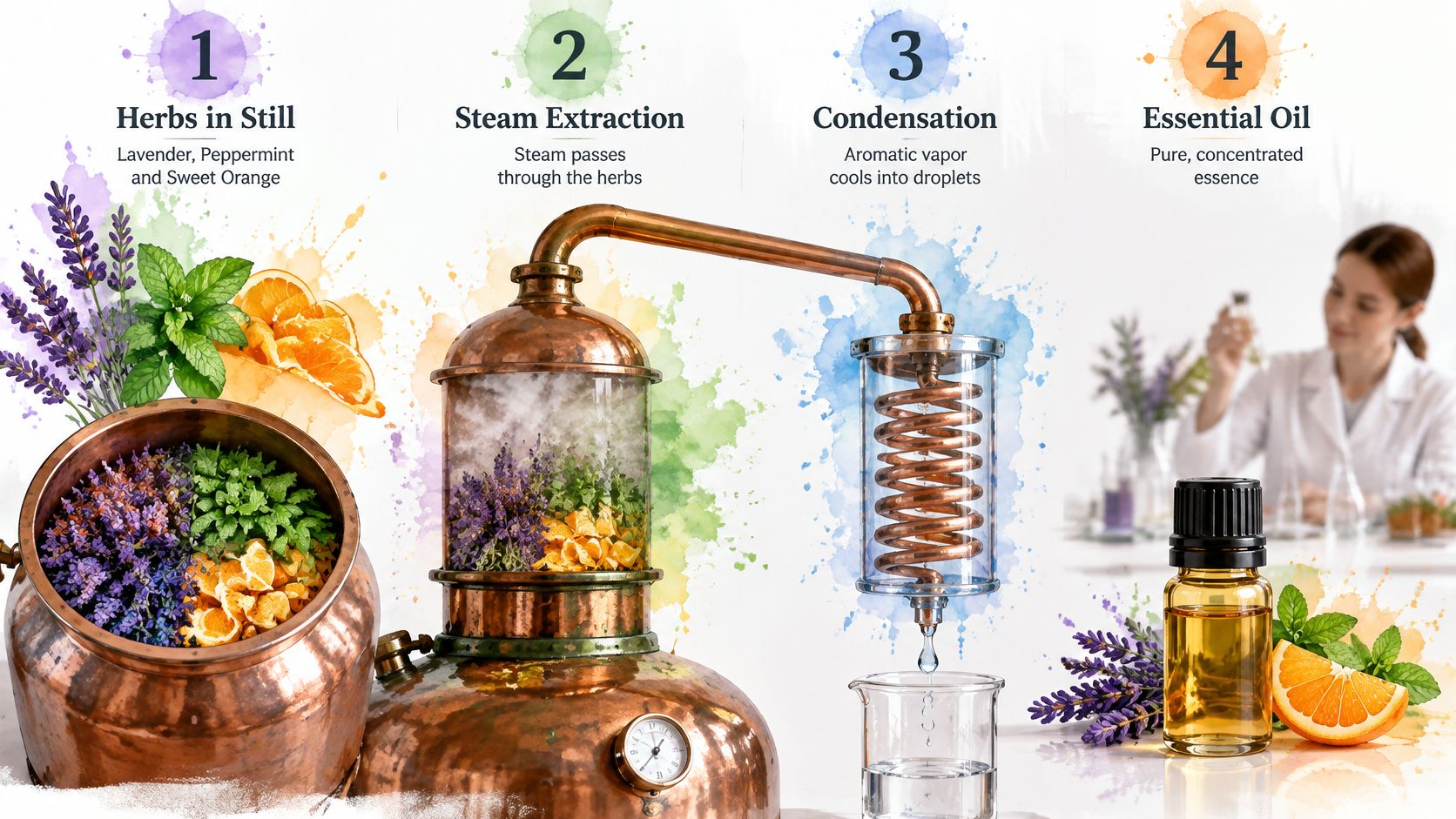
- Load the plant material. Leaves or flowers, such as peppermint or lavender, go into a still.
- Pass steam through the material. The heat carries volatile aromatic molecules into the vapor.
- Cool the vapor. A condenser turns it back into liquid containing water and aromatic oil.
- Let the liquids separate. The essential oil is largely insoluble in water and commonly floats above it, where it can be collected.
The remaining hydrosol has a much milder aroma than the separated essential oil. It isn't an essential oil diluted to a known concentration, so don't substitute it into an oil-blending recipe.
Concentration and evaporation are different qualities
A small bottle contains aromatic material gathered from a much larger quantity of plant matter. That's why a drop can smell far more intense than a leaf rubbed between your fingers. Concentrated doesn't mean suitable for direct skin application.
Volatility describes how readily aromatic compounds enter the air, not how beneficial an oil is. Sweet orange tends to smell bright and evaporate quickly, while vetiver and patchouli generally linger longer on a scent strip. Many citrus oils, including sweet orange, are commonly expressed from peel rather than steam-distilled, so distillation isn't the only extraction method.
For a visual introduction to extraction and essential oils, watch the demonstration below.
Faster-evaporating aromas can suit lighter scent blends; slower ones contribute a lingering base. If you prefer fragrance as part of a shower routine, Cleverfy Beauty's a guide to aromatherapy for shower lovers offers useful context for that setting.
When buying, check the botanical name, plant part, and ingredient list. Confirm whether you're choosing a single essential oil, an essential-oil blend, or a fragrance blend.
What Carrier Oils Add to Every Blend
A carrier isn't an empty background ingredient. Because it makes up most of a topical blend, it strongly influences spreadability, finish, and how much residue you notice afterward.
Most fixed plant oils consist mainly of triglycerides containing fatty acids. The review available through the National Library of Medicine explains the distinction between volatile essential oils and nonvolatile lipid carriers, including how a carrier can affect evaporation and delivery in a topical formula.
In everyday terms, oleic-rich oils tend to feel richer, while oils with more linoleic acid often feel lighter. That's a useful starting point, not a promise about how every bottle will feel. Processing and the complete formulation matter, too. Jojoba is a useful exception to the usual triglyceride description because it's primarily a liquid wax.
Choose by feel and purpose
Common carrier oils by feel and use
| Carrier oil | Typical feel | Common use |
|---|---|---|
| Sweet almond oil | Light, smooth and moisturizing | Body oil, massage and general skin care |
| Jojoba oil | Fluid, with a feel similar to skin's own oils | Face, scalp and beard care |
| Grapeseed oil | Light and silky with little scent | Massage and body oil |
| Olive oil | Rich and heavy, with a lasting conditioned feel | Dry skin, body oil and hair masks |
| Sesame oil | Medium weight with a warm massage feel | Massage and body care |
| Fractionated coconut oil | Very light, stays liquid and has little scent | Blends for body and general use |
| Argan oil | Fine and silky with a soft finish | Hair ends and skin care |
For dry hands or rough-feeling hair ends, a richer base may provide the finish you want. For the face, scalp, or beard, start with a lighter texture if you dislike greasy residue. Our guide to carrier oils for essential oils can help you narrow the options by routine.
Consider tolerance and freshness
If your skin is acne-prone or easily congested, don't choose a base solely because someone calls it non-greasy. Fatty-acid profiles and textures differ, and individual responses aren't identical. Test the carrier alone on a small area before introducing fragrance.
Sweet almond oil comes from a nut. If you have a nut allergy, check the source and seek appropriate guidance before using it; jojoba or fractionated coconut are common alternatives, but they still need their own tolerance check.
Carriers also differ in oxidative stability, so they won't all stay fresh equally well. Their natural scent can influence the finished blend, especially when you use a lightly scented essential oil.
The carrier controls much of how a blend feels. The essential oil controls much of how it smells.
Dilution Ratios for Body, Face and Scalp
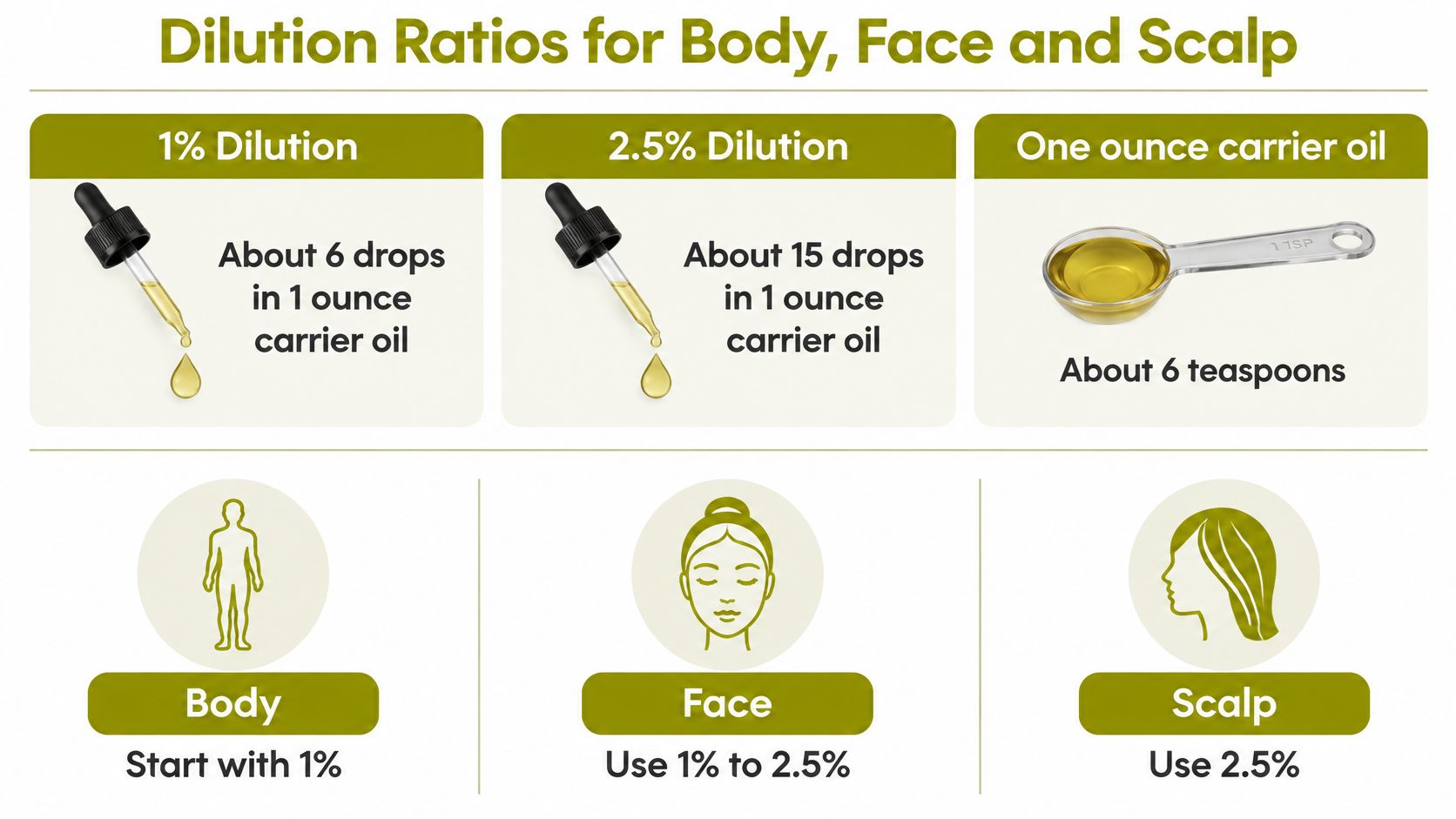
1% and 2.5% are useful reference points for understanding dilution, not universal permissions for every oil or body area. The National Association for Holistic Aromatherapy guidance lists 1% to 10% for creams, lotions, and gels, and 2.5% to 10% for massage or body oils, with approximate drop counts reflected below.
Those broad ranges describe formulation options. They don't mean a beginner should work toward the upper end, or that every essential oil is suitable throughout the range.
Essential oil concentration and drops per ounce of carrier
| Concentration | Drops per 1 oz of carrier | Common starting use |
|---|---|---|
| 0.5% | 3 | Sensitive areas and the first trial of a new suitable oil |
| 1% | 6 | Face, delicate areas, creams and lotions |
| 2.5% | 15 | Everyday body oil for most adults, where appropriate |
| 3% | 20 | Massage and body oil |
| 5% | 30 | Body oil only when appropriate and lower levels are tolerated |
| 10% | 60 | Upper end of the listed range, not a starting point |
These are approximate drop-based recipes, not exact laboratory percentages. The rounded entries shouldn't be treated as a precise conversion system.
The visual below summarizes common dilution references. Its body-area labels are general guides, not oil-specific safety limits.
Calculate for the amount you're actually making
An ounce of carrier oil is about six teaspoons. To scale a drop-based recipe, multiply its listed drops per ounce by the ounces of carrier you're using.
For example, a hypothetical 2-ounce batch at 2.5% uses about 30 drops using this method. A hypothetical 4-ounce batch at 1% uses about 24 drops. Count the total essential-oil drops across the whole blend, not that amount for each essential oil.
Drop size changes with the oil and bottle opening. For greater precision, use a suitable scale and a consistent weight-based formula:
Essential-oil weight ÷ total finished-blend weight × 100 = percentage by weight.
Don't mix weight percentages and volume percentages within the same recipe. A marked pipette can help measure volume, but it doesn't make every free-falling drop identical. Our essential-oil dilution-ratio guide provides another practical reference for planning a blend.
Match the formula to the person
Mayo Clinic's aromatherapy guidance says topical mixtures between 1% and 5% don't typically represent a safety concern, while higher concentrations increase the potential for skin reactions. That general guidance doesn't override a particular oil's lower limit or personal sensitivity.
Start low with a new ingredient. Increase only if there's a clear reason, the oil's directions allow it, and your skin has tolerated the blend. Face, scalp, beard, and body routines shouldn't automatically share a formula.
A pre-formulated product already has its intended composition. Follow its directions rather than adding more essential oil, and remember that dilution doesn't remove the need to check skin tolerance.
Safety, Storage and Quality Checks for Both Oils
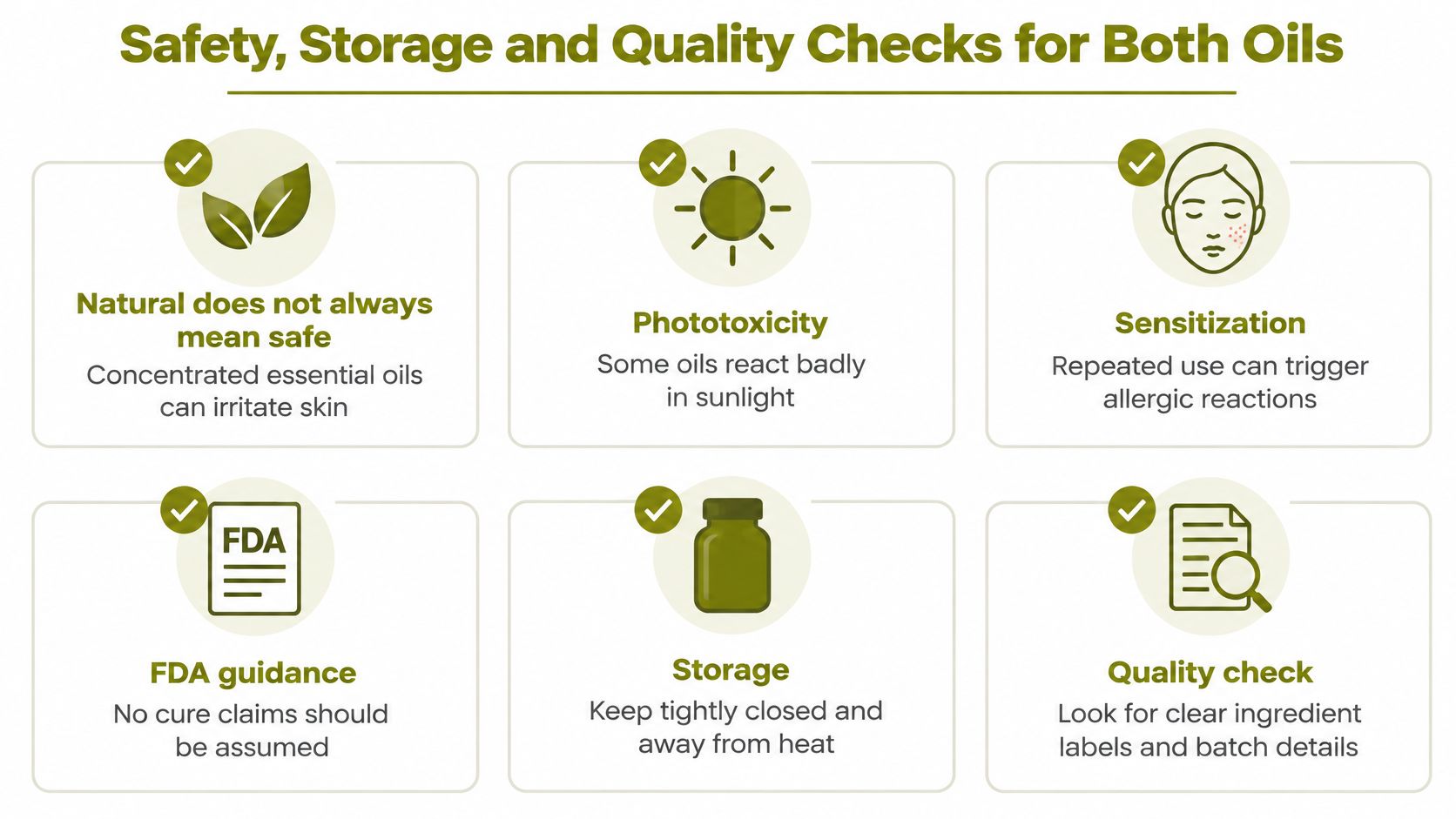
Does a natural label tell you an oil will be gentle? No. Plant origin doesn't establish whether a concentrated ingredient is suitable for your skin, your routine, or sun exposure.
The U.S. Food and Drug Administration's fragrance guidance states that there is no regulatory definition for essential oil and explains that intended use and claims affect how products are regulated. It also notes that cumin oil may blister skin and that some citrus oils can harm sun-exposed skin even when they're safe as food flavorings.
Irritation can happen when an ingredient doesn't agree with skin. Sensitization means an allergic response can develop, including after previous use without obvious trouble. Phototoxicity concerns certain ingredients reacting with light exposure, so check the specific oil's sun-related directions.
Check the whole formula
A carrier lowers essential-oil concentration, but it isn't a guarantee against reactions. Contamination, adulteration, and an unsuitable base can also create problems. Regulatory warnings about substandard cosmetic oils include irritation and more serious reactions, which makes clear sourcing and ingredient labeling important.
Look for:
- Ingredient identity: A readable ingredient list and clear botanical identification.
- Intended use: Directions that distinguish skin use from fragrance or diffuser use.
- Traceability: Batch details and useful manufacturer information.
- Condition: No unexplained changes in smell, appearance, or packaging integrity.
Keep these checks together when organizing your oils.
Try a small area before wider use
A home tolerance check can help you notice a reaction, but it can't rule out allergy or guarantee future tolerance.
- Prepare the finished blend at the concentration you intend to use.
- Apply a small amount to intact skin on the inner forearm or behind the ear.
- Protect the area from rubbing. If covering it, use a loose covering rather than sealing the oil under an airtight dressing, and leave the test area undisturbed for 24 hours unless discomfort develops.
- Check the skin for redness, itching, swelling, or bumps.
- If a reaction appears, wash the area and stop using the blend. Don't wait out discomfort.
Store essential oils in tightly capped dark glass, away from heat and sunlight. Keep carrier oils cool and dark, and smell them before use. A newly sharp, stale, or otherwise changed odor is a reason to set the oil aside.
Storage habit: Label a new blend when you make it, not when you next remember what went into it.
Use extra caution for children, during pregnancy, and with known sensitivities. When suitability is uncertain, ask a qualified professional before experimenting.
Choosing Pairings and Mixing Your First Blend
An evening body oil, a light facial oil, and a beard blend need different starting decisions. For the body, you may want enough slip for a relaxed massage. For the face, comfort and a light finish may matter more than fragrance. For a beard, consider both the hair and the skin underneath.
Choose the carrier first. Then decide whether an essential oil adds something you want. Easily irritated skin may be better served by leaving fragrance out altogether.
Match the pairing to the routine
Starting pairings by routine
| Routine | Carrier to start with | Starting essential oil level | Practical note |
|---|---|---|---|
| Evening body oil | Sweet almond or grapeseed | 2.5% | Choose grapeseed if nut allergies are a concern, after checking suitability |
| Light face oil | Jojoba or fractionated coconut | 0.5% to 1% | Patch test before first facial use |
| Scalp massage | Jojoba or fractionated coconut | 1% | Keep oil away from the eyes |
| Beard care | Jojoba or argan | 1% to 2.5% | Wipe off excess to avoid buildup |
| Hair ends | Argan or olive | 1% | Olive feels heavier, so use less |
| Hand and body massage | Sesame or sweet almond | 3% | Warm the oil gently between your palms before use |
Treat these as planning examples for suitable adult-use ingredients, not universal recipes. For a first attempt, choose the lowest suitable concentration rather than assuming a routine requires the table's higher option. Don't apply essential-oil blends to eyelids or close to the eyes.
For an evening blend, lavender may provide a scent you enjoy, without needing to promise a particular wellness outcome. For facial or beard care, an unscented carrier can be a complete routine on its own.
Make a small, clearly labeled batch
Use a clean, dry mixing vessel, a suitable measuring tool, and a dark-glass bottle. Our guide to blending essential oils offers additional help with organizing ingredients and scent choices.
- Pick the routine. Decide whether you're making body oil, face oil, or beard care.
- Choose a carrier whose feel suits that use. Check nut sources and other ingredient concerns before mixing.
- Set the concentration. Use the low end appropriate to the particular essential oil, then calculate the amount for your batch.
- Check the finished blend on a small area for 24 hours before broader use.
- Bottle and label it. Record the ingredients, concentration, and mixing date.
Don't add neat essential oil to bathwater. Mixing it into a carrier first dilutes it, but carrier oil doesn't disperse essential oil evenly through water. For bathing, choose a properly formulated bath product or an appropriate dispersing system, and remember that oils can make the tub slippery.
Choose one routine this week and make a small batch at 1% or 2.5%, only if that level suits the chosen ingredient and application. Check tolerance first, then reassess the feel and fragrance after a few weeks instead of automatically making the next batch stronger.
Our oils are offered as Essential Oils, Hair Oils, and Skin Oils, with oil products listed in 4oz, 16oz, and rollerball formats; the Oils collection includes 10ml, 59ml, 118ml, and 473ml sizes. Visit ArtNaturals to explore options for your chosen routine, checking whether you're selecting a concentrated aromatic ingredient, a conditioning base, or a finished blend before you begin.