

You set the diffuser on after a long day because you want your home to feel calm, clean, and comforting. Then your cat jumps onto the arm of the sofa, or your dog curls up on the rug nearby, and the question lands fast. Is this safe for them?
That concern is a good instinct.
Many people who love natural wellness also share their homes with animals, and that combination can feel confusing. One article says an oil is “pet friendly.” Another warns against using it at all. It's easy to end up stuck between wanting a peaceful ritual for yourself and wanting to protect the animals you love.
A better approach is to understand the why behind the warnings. Once you know how pets interact with essential oils, it becomes much easier to make thoughtful choices at home. If you enjoy relaxing scent rituals for yourself, ideas like these essential oil blends for relaxation can still inspire your routine. The key is learning how to adapt that routine when paws, whiskers, and curious noses are part of the household too.
Enjoying Aromatherapy in a Pet-Friendly Home
A pet-friendly wellness routine starts with one simple shift. Instead of asking, “Which oils are good or bad?” ask, “How might this oil move through my home, and how might my pet come into contact with it?”
That question changes everything.
Pets don't experience scent the way we do. They rest on floors where residue can settle. They lick their fur. They can't tell you when a smell feels overwhelming, irritating, or uncomfortable. So the goal isn't to give up every enjoyable ritual. It's to build a home practice with more awareness.
A calm home needs a different kind of planning
If you live with pets, aromatherapy works best when it's treated like a shared environment choice, not a personal beauty product floating in the background. A room spray, an open bottle, a diffuser, or oil on your hands can all become part of your pet's world.
That's why essential oils and pets belong in the same conversation every time.
A thoughtful routine usually includes a few small habits:
- Choose location first: Decide where an oil will be used before opening the bottle.
- Think beyond scent: Consider skin contact, surface residue, and grooming behavior.
- Leave room for choice: Your pet should always be able to walk away from the scent.
A home can feel nurturing and smell beautiful without asking a pet to share every part of the experience.
When people feel overwhelmed by pet safety advice, it's often because they're handed isolated rules. The more helpful path is understanding the differences between human bodies and animal bodies. That's where the biggest clarity begins.
Why Pets and Essential Oils Need Special Care
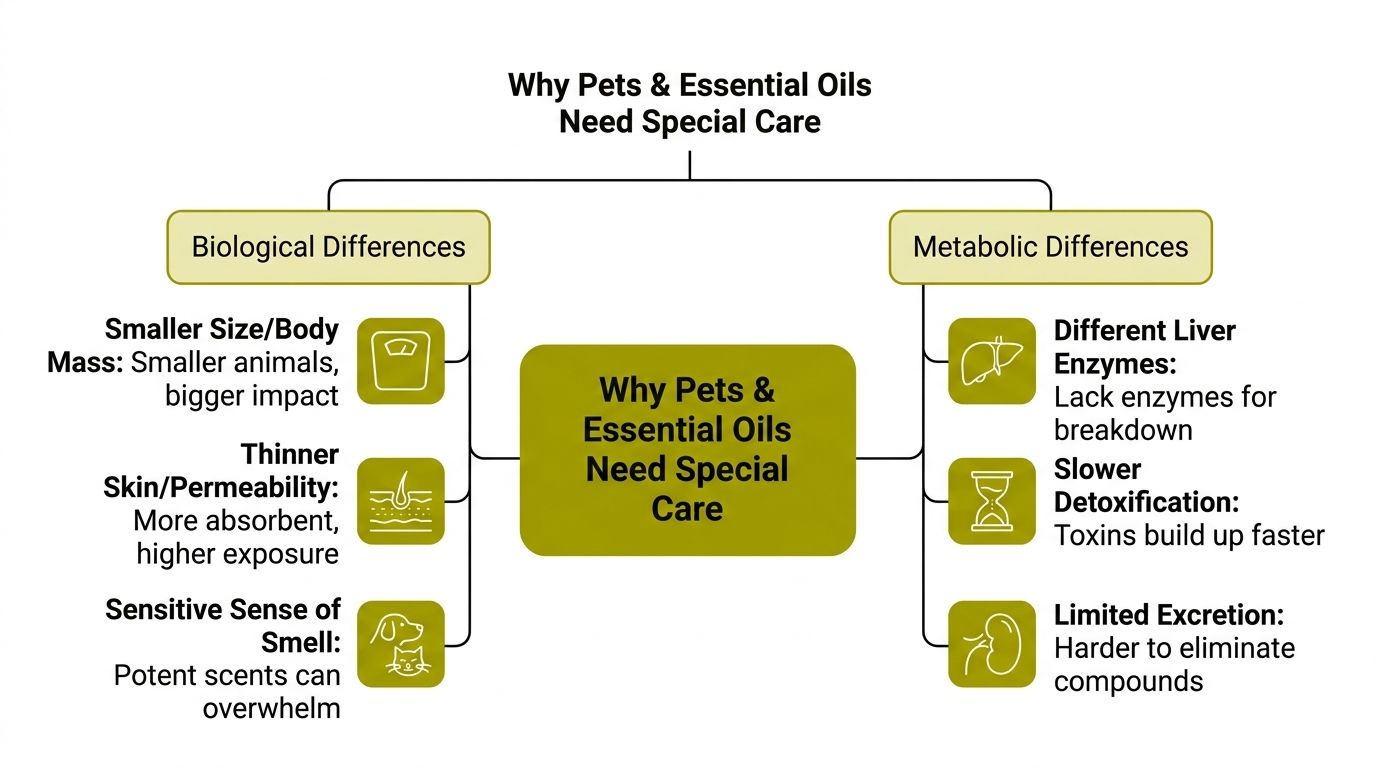
Some of the confusion around essential oils and pets comes from assuming that what feels gentle to a person must also be gentle to an animal. It doesn't work that way. Pets are smaller, closer to surfaces, and much more sensitive to smell. Their bodies also process compounds differently.
Think of the body like a filter system
A simple way to picture this is to imagine the body as a filter and cleanup system. Human bodies and animal bodies don't all use the same filters. Some compounds move through one system more smoothly than another.
Cats need especially careful handling around essential oils because cats and birds face a significantly higher risk of essential oil toxicosis because they lack a specific liver enzyme, glucuronyl transferase, needed to break down compounds like phenols, and clinical signs can appear within minutes to hours of exposure, according to the Merck Veterinary Manual overview of essential oil toxicosis.
That's the part many “safe oil” lists skip. They focus on names of oils, but not on the reason certain oils create more risk.
Why species matter so much
A dog and a cat might live in the same room, but they don't necessarily respond the same way. Cats groom themselves constantly, which means something that lands on the coat can quickly become something swallowed. Birds are also especially delicate around airborne exposures.
Even for larger pets, size doesn't make fragrance exposure casual. A small amount to you can still be a lot to them because they're breathing it in with a more sensitive nose and, in many cases, a much smaller body.
Here's where many households benefit from stepping back from fragrance altogether in shared spaces. If your pet seems sensitive to any indoor scents, these practical scent-free home strategies can help you create a calmer environment without relying on added fragrance.
Practical rule: If an oil routine depends on your pet tolerating it, it isn't a pet-first routine.
The missing piece in most advice
The primary issue isn't whether a bottle has a soft, herbal, or floral aroma. The issue is whether your pet's body can comfortably handle the compounds in that oil after inhalation, skin contact, or grooming.
That's why a list alone won't protect your household. Understanding the mechanism behind the risk helps you make better decisions when a product label, diffuser blend, or social media tip sounds harmless but leaves out the details that matter.
A Guide to High-Risk and Lower-Risk Oils
Many people want a simple “safe list,” but that can create false confidence. A more useful way to think about oils is through caution levels. Some oils are widely recognized as high-risk and should be avoided around pets, especially dogs and cats. Others may be discussed as lower-risk in some settings, but that still doesn't make them automatically appropriate for every home.
High-risk means avoid, not experiment
For dogs, some oils are repeatedly named as especially concerning. Tea tree, wintergreen, pine, cinnamon, citrus, eucalyptus, peppermint, and ylang ylang are known to be particularly toxic to dogs and should be avoided, as noted by Garden State Veterinary Specialists.
That list matters because it cuts through a lot of mixed messaging online.
Some of these oils contain compounds that pets have a harder time processing. Others are too potent, too easy to overuse, or too risky if inhaled, licked, or absorbed through the skin. The problem is rarely just the fragrance itself. It's the combination of concentration, exposure route, and species.
A comparison that's more helpful than a yes or no list
| Caution Level | Common Examples | Reason for Caution |
|---|---|---|
| High | Tea tree, wintergreen, pine, cinnamon, citrus, eucalyptus, peppermint, ylang ylang | These are widely recognized as especially risky for dogs and are best avoided in pet homes. |
| Moderate | Strong blends with unknown ingredients, heavily fragranced room products, oils used around grooming areas | The exact oil may be unclear, concentration may be high, and exposure can happen through fur, paws, or surfaces. |
| Lower | Oils some people consider gentler when used very sparingly and with careful environmental controls | “Lower-risk” does not mean safe for every pet, especially in multi-pet homes or homes with cats. |
Why “lower-risk” still needs caution
Many owners get tripped up when they see a popular oil in an aromatherapy guide and assume it's suitable for a home with pets. But pet safety isn't only about the oil's reputation in human wellness use. It also depends on whether your pet can leave the room, whether any residue lands on fur, and whether the formula is concentrated.
If you enjoy learning about oils from an ingredient perspective, guides on the best essential oils for aromatherapy can be helpful for personal use. In a pet household, though, every oil still needs an extra layer of evaluation.
An oil can be pleasant for people and still be the wrong choice for a room your pet uses every day.
A better decision filter
Before bringing any oil into a shared space, ask:
- What species live here: Cats require a different level of caution than many people expect.
- How concentrated is it: Stronger products leave less room for error.
- Could it end up on fur or paws: If yes, the risk changes immediately.
That mindset is more useful than memorizing a trend-based “approved” list.
Understanding Pet Exposure to Essential Oils
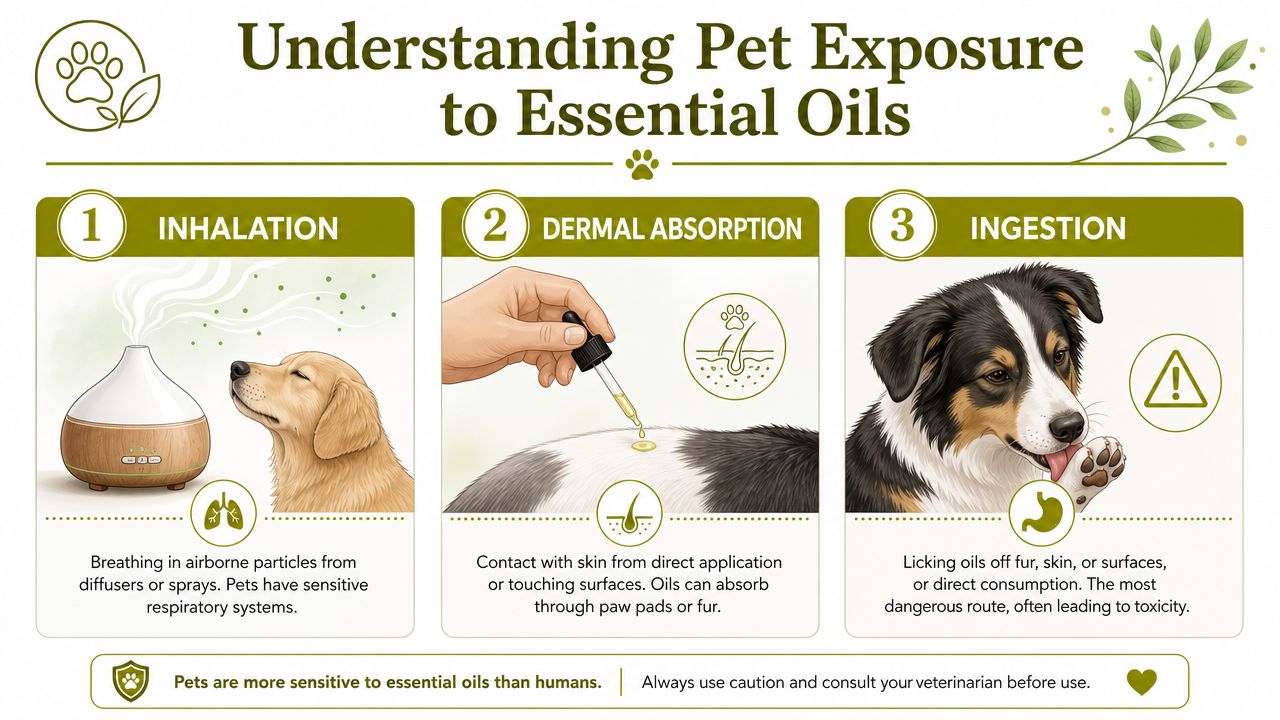
Most problems don't start with a dramatic mistake. They start with ordinary household moments. A diffuser runs in the corner. A drop lands on the floor. A pet rubs against a blanket after you've applied oil to your own skin. Exposure can happen in ways people don't notice at first.
Inhalation in shared air
Diffusers get the most attention because the scent is obvious, but inhalation isn't just about a pet smelling something strong. Airborne particles and vapors move through the room your pet lives in. A dog may stay because it wants to be near you, not because the environment feels comfortable.
This matters even more in small rooms, closed bedrooms, and spaces with limited airflow. A pet that can't leave the area doesn't have much control over its exposure.
Contact through skin and coat
Skin exposure can happen directly or indirectly. A pet might brush against a surface, step in a spill, or lie where product residue has collected. The ASPCA's guidance on essential oils around pets notes that in their concentrated 100% form, essential oils can cause health concerns if pets walk through them, get them on their coat, or have the oils placed directly on their skin.
That's an easy detail to underestimate. Something on the coat doesn't stay “outside” the body for long, especially with self-grooming animals.
Ingestion is often more indirect than people expect
A pet doesn't have to drink from a bottle for ingestion to happen. It can happen when a cat grooms its side after oil mist settles on fur. It can happen when a dog licks a paw after walking through residue. It can happen when a curious pet licks a countertop edge or a dropped cap.
Three common exposure routes deserve equal attention:
- Breathing it in: Diffusers, sprays, and poorly ventilated spaces all matter.
- Getting it on the body: Fur, paw pads, and bedding can hold residue.
- Licking after contact: Grooming turns surface exposure into internal exposure.
The route of exposure often matters as much as the oil itself.
This is why safe use at home starts long before a pet shows discomfort. It starts with understanding how easily oils travel from bottle to air, from air to coat, and from coat to mouth.
Mindful Aromatherapy Practices for Pet Homes
Once you understand exposure, the safest habits become much more intuitive. The goal isn't perfection. It's building routines that reduce avoidable risk and give your pet space, fresh air, and distance from concentrated products.
Start with less than you think you need
For dogs, concentration matters a great deal. Essential oil safety is highly dose-dependent, and topical application at a 2% dilution or less in a carrier oil is generally considered low-risk, whereas undiluted oils can cause severe reactions, based on this veterinary-focused YouTube discussion on essential oil use in dogs.
That doesn't mean you should start applying oils to your dog. It means dilution changes the risk picture, and undiluted use deserves serious caution.
If you use oils for your own routines, learn your base oils well. A guide to carrier oils for essential oils can help you understand why ingredients like jojoba or coconut oil are used to dilute stronger essential oils for personal care.
Habits that make a real difference
A mindful setup usually looks simple:
- Keep pets out of direct application routines: Don't apply oils to collars, bedding, or fur.
- Use ventilation generously: Open the room, improve airflow, and avoid trapping scent in small spaces.
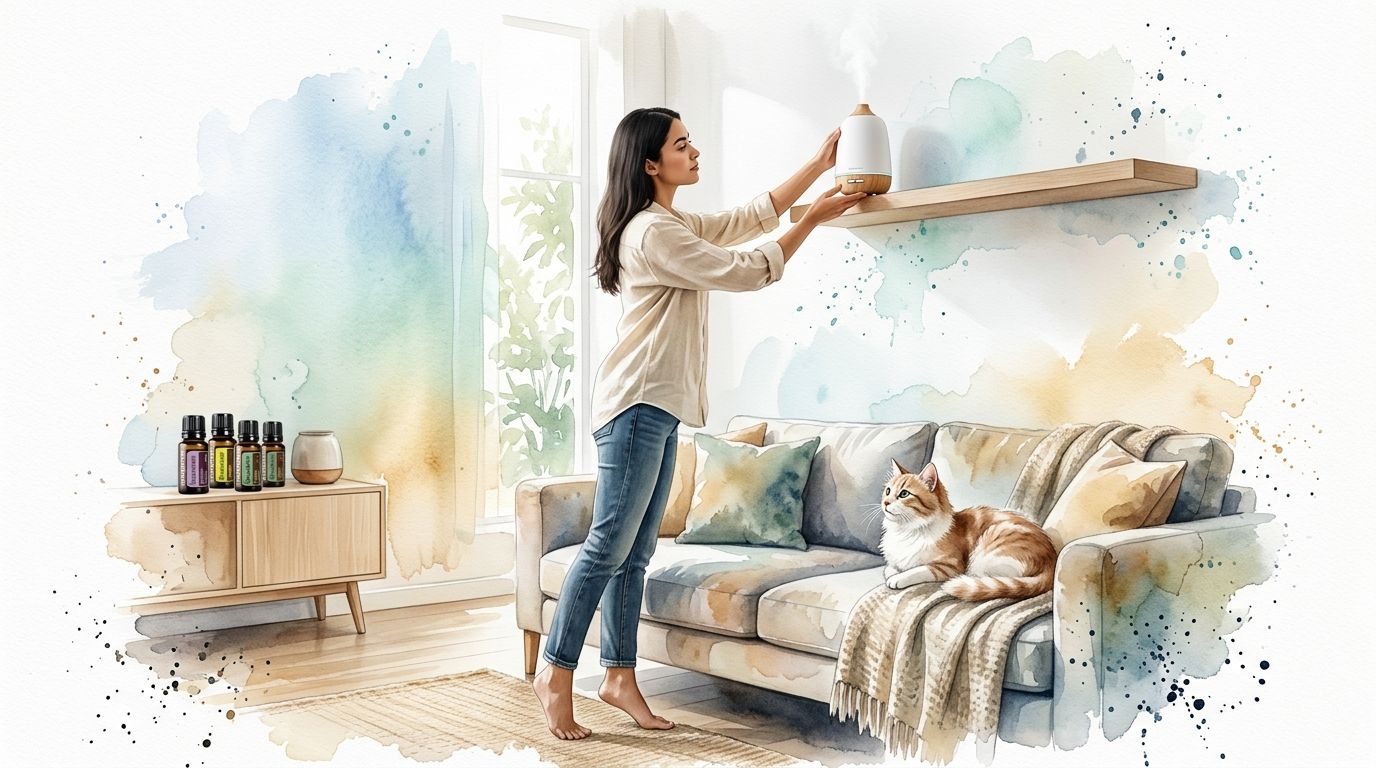
- Preserve exit options: Your pet should never be stuck in the same room with an active diffuser.
- Clean quickly: Wipe spills right away and wash residue from surfaces your pet can reach.
Some households decide that passive fragrance feels easier to manage than active diffusion. For example, a product used briefly in a closed, pet-free bathroom may be easier to control than a diffuser running in the living room where animals sleep and groom.
Here's a helpful visual overview of mindful setup ideas in the home:
What not to normalize
Certain habits become common because they're marketed as natural or cozy, not because they're wise for pets.
Avoid treating these as harmless defaults:
- Direct application to pets
- Using oils on pet beds or blankets
- Diffusing strong blends in closed rooms
- Letting bottles, droppers, or oily tissues sit within reach
If you have to wonder whether your pet is getting exposed, assume the environment needs adjusting.
A pet-safe home often feels less scented than a wellness-focused social media feed. That's okay. Calm doesn't have to smell intense to feel restorative.
Recognizing Signs of Discomfort and What to Do
Pets don't always show distress in obvious ways first. The earliest sign may be that your cat starts hiding, your dog seems unusually tired, or your pet leaves a room it normally enjoys. Small behavior changes matter.
Signs that deserve attention
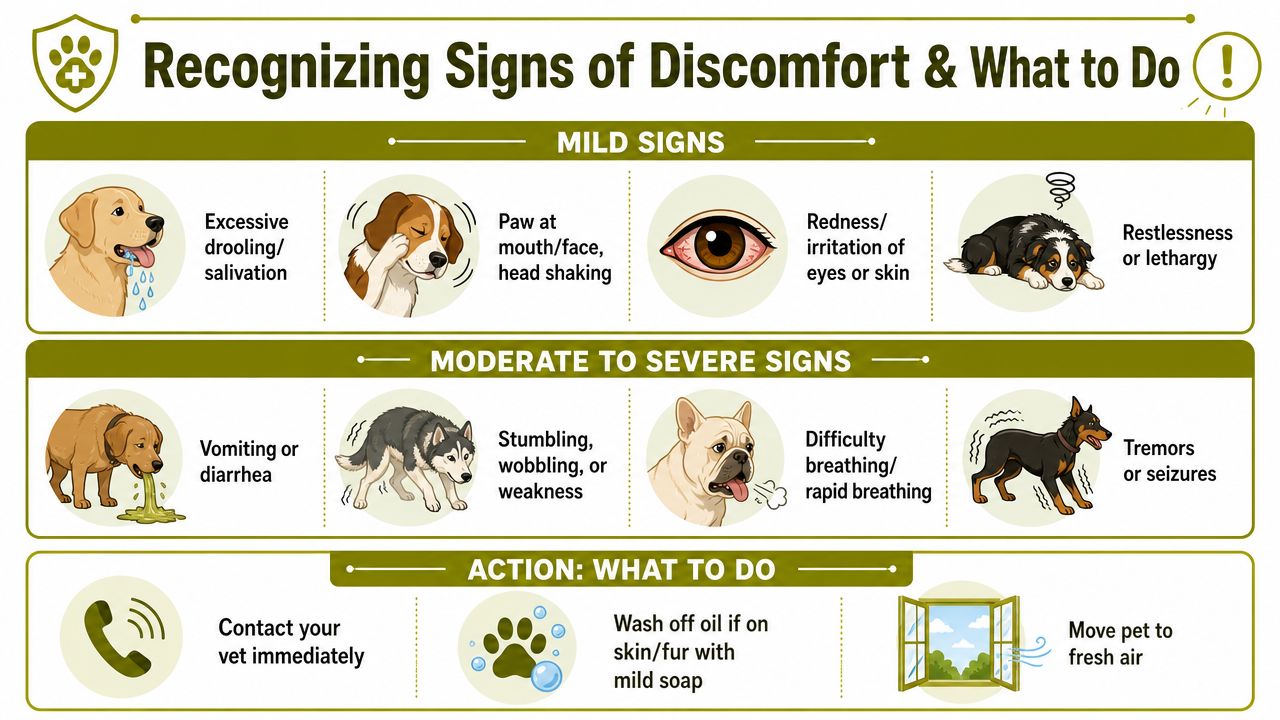
Cats exposed to toxic oils can experience liver failure, tremors, and ataxia, and because there is no specific antidote, immediate veterinary care is critical. Signs can include drooling, vomiting, seizures, respiratory distress, and low body temperature, according to the Pet Poison Helpline guidance on essential oils and cats.
Those are serious signs, but don't wait for a severe reaction before taking your concern seriously.
Watch for changes like these:
- Early changes: Drooling, licking lips, hiding, restlessness, or seeming “off”
- Visible physical distress: Vomiting, wobbliness, weakness, coughing, or trouble settling
- Urgent warning signs: Tremors, seizures, breathing difficulty, collapse, or extreme lethargy
What to do right away
If you suspect exposure, act quickly and calmly.
- Move your pet away from the source. Fresh air and distance matter.
- Prevent further contact. If oil is on the coat or paws, gently wash it off with mild soap.
- Call a professional immediately. Contact your veterinarian, the Pet Poison Helpline at (855) 764-7661, or the ASPCA Animal Poison Control Center at (888) 426-4435.
- Don't induce vomiting unless a professional tells you to. That can make things worse in some situations.
Trust your instincts
Many owners hesitate because they don't want to overreact. But if your pet has had possible exposure and isn't acting normally, calling for guidance is the right move.
When behavior shifts suddenly after scent exposure, treat that change as useful information, not something to monitor casually for hours.
Keep the bottle or product label nearby when you call. The exact oil, blend, or ingredient list can help a veterinary professional give more specific guidance.
Creating a Safe and Serene Home for Everyone
A pet-aware wellness routine isn't about fear. It's about respect. When you understand how essential oils move through a home and how differently animals process them, your choices become clearer and kinder.
That often means keeping fragrance lighter, more contained, and more intentional. It may also mean deciding that some rooms stay scent-free, some products stay for personal use only, and some oils aren't worth the uncertainty in a home with pets.
Gentle home choices that support the whole household
A serene space doesn't have to depend on active fragrance. Many people find comfort in simpler choices:
- Unscented cleaning products in the rooms pets use most
- Fresh airflow from open windows and good ventilation
- Pet-free self-care zones for masks, baths, and personal oil rituals
- Cleaner indoor environments supported by attention to dust, airflow, and filtration
If you're rethinking the whole atmosphere of your space, learning more about whole-home air quality can be a useful next step. Sometimes the most comfortable home is the one that feels fresh, not fragranced.
The heart of essential oils and pets is simple. Your pet doesn't need to share every ritual for your home to feel beautiful. A calmer, safer setup is often the most luxurious one anyway.
Your home can still be a place for wellness, rest, and everyday self-care. It just needs to be designed with every family member in mind, including the ones with paws.
If you're building a more thoughtful self-care routine, ArtNaturals offers plant-powered essentials for beauty and wellness that can help you create calming rituals while keeping your home habits intentional and informed.