

Hyaluronic acid is a humectant that attracts and holds water in the outer layers of the skin. If it only holds water that's already nearby, why do some serums leave skin feeling comfortable for hours while others seem to vanish in minutes?
That gap usually comes down to two things shoppers can't see on a front label. The first is the size of the molecule. The second is what you put around it. Once you understand both, you can read a label, layer a routine, and set calm expectations without guessing.
How Hyaluronic Acid Holds Water in Skin
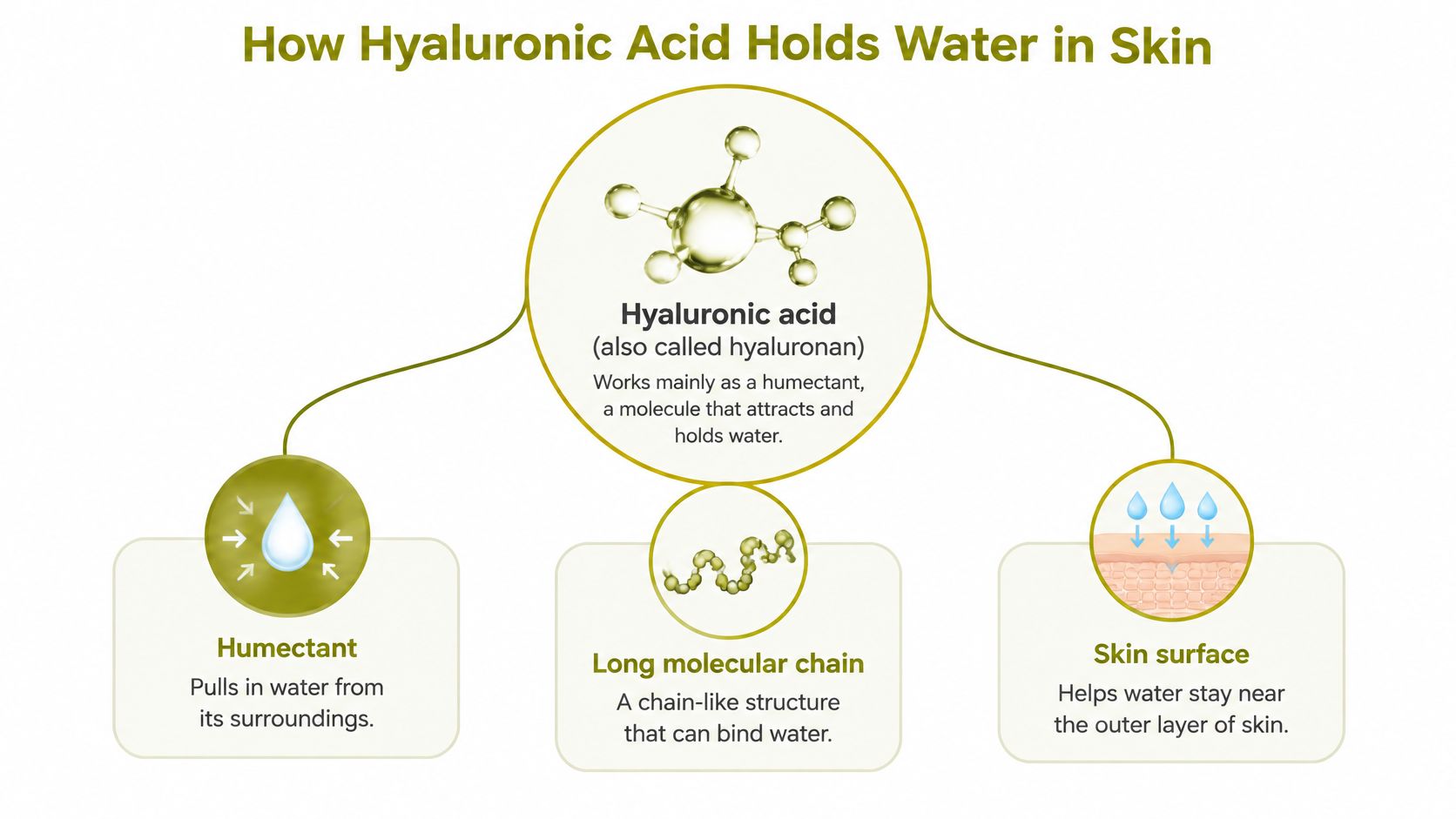
Hyaluronic acid, also called hyaluronan, works mainly as a humectant, a molecule that attracts and holds water. It isn't an exfoliating acid and it doesn't replace anything in your skin. Its job is simpler. It helps water stay where your skin can use it.
Think of a single HA molecule as a long chain. Along that chain sit many small groups that water is drawn to. When the chain meets water, it holds that water loosely, the way a damp cloth holds moisture in its fibers rather than letting it run off.
What the Chain Is Doing
A review of hyaluronic acid chemistry describes HA as a negatively charged structure with numerous polar groups, including hydroxyl, carboxyl, and acetamide groups, that form hydrogen bonds with water. Those are technical words for a plain idea. The chain gives water many places to attach.
That same review reports that HA can bind approximately 1,000 times its volume in water. That figure explains the ingredient's appeal, but it doesn't mean a finished serum delivers that much water to your face. The outcome depends on the ingredient's concentration, molecular size, and the rest of the formula. Two bottles that both list HA can feel quite different for that reason alone.
Where HA Already Lives in the Body
HA isn't a new cosmetic invention. It's a naturally occurring polymer found throughout connective tissue, including the dermis under the surface of your skin. There it forms a hydrated, gel-like network in the extracellular matrix, which is the space surrounding cells.
That network helps keep the area around cells moist and flexible. The same type of molecule also appears in cartilage and in synovial fluid, the fluid in joints, where its water-holding, slippery quality supports lubrication and cushioning. In each place, the basic talent is the same. HA holds water in a soft gel so tissues don't feel dry and stiff.
This body context helps explain a common confusion. Because HA exists naturally in deeper tissue, people often assume a serum works the same way at the same depth. A topical product works at the surface and in the outer layers first. It supports the water balance there, which is where tightness and rough texture are usually felt.
What HA Does Not Do
HA doesn't supply barrier lipids, the fatty materials that help seal the skin surface. It also doesn't create water from nothing. It binds water that's available from the formula itself, from water left on your skin after cleansing, and from moisture in the surrounding air.
That's why a serum can feel plumping for a short time yet fail to settle persistent dryness on its own. If water evaporates quickly, or if the outer barrier is rough and depleted, the held water doesn't stay put. Your moisturizer and daily habits matter as much as the serum. For background on that protective layer, our guide to skin barrier repair walks through how the barrier holds water in.
HA holds water in place and works alongside the skin's own barrier rather than replacing it.
So when you're asking how does hyaluronic acid work, the grounded answer is water management. A long, water-loving chain gathers moisture near the surface and within the outer layers. Concentration, molecular size, and the rest of the formula decide how much of that promise you feel, so two products are rarely identical.
Why Molecular Weight Changes Where HA Acts
Molecular weight sounds technical, but the idea is simple. HA chains come in different lengths, and length is measured in kilodaltons, written as kDa. A longer chain behaves differently from a shorter one, mainly in where it can go.
| Size band | Molecular weight | Where it tends to act |
|---|---|---|
| High molecular weight | at least 1,000 kDa | Very limited penetration; stays on the surface and forms a water-holding film |
| Medium molecular weight | 250 to 1,000 kDa | Partial; depth of action varies by formula |
| Low molecular weight | 10 to 250 kDa | Can diffuse farther into the outer skin layers |
A review of hyaluronic acid size and skin permeability defines high-molecular-weight HA as at least 1,000 kDa, medium-molecular-weight HA as 250 to 1,000 kDa, and low-molecular-weight HA as 10 to 250 kDa. It also notes that some findings identify approximately 200 kDa as the upper limit for measurable penetration, while other reports describe diffusion through the stratum corneum for molecules below 400 kDa.
The Largest Chains Stay at the Surface
High-molecular-weight HA has very limited penetration. It tends to remain on the skin's surface, where it can form a water-holding film and help reduce transepidermal water loss, which is water escaping outward through the skin. That surface film is useful. It can make skin feel smoother and less tight right after application, because water is being held right where dryness is noticed.
Surface action isn't a lesser action. For many people, surface comfort is exactly the goal. A large molecule doing reliable surface work can be the right fit for daily hydration.
Medium and Smaller Chains Move Differently
Medium-weight HA sits in the middle. Some of it may move into the outer layers and some may stay nearer the surface, and the formula around it influences the balance. That's why this band is hardest to sum up with a single promise.
Smaller chains can diffuse farther into the outer skin layers. That doesn't automatically make them better. Deeper movement into the outer layers and strong surface film formation serve different purposes, and comfort depends on both. Skin that's well hydrated at the surface often looks smoother, even if the molecule never travels far.
Practical rule: A lower molecular weight number isn't a quality ranking. It's a description of where the molecule tends to act.
Reading a Label Without Guessing
Most consumer labels don't list molecular weight at all. You may see hyaluronic acid, sodium hyaluronate, or hydrolyzed hyaluronic acid, with no size information. Without that detail, you can't tell from the name alone whether a product leans toward surface film formation or farther movement into the outer layers.
Use a short check instead.
- Confirm the ingredient name: Look for hyaluronic acid or sodium hyaluronate clearly listed.
- Look for size language: Note any mention of molecular weight, multi-weight blends, or hydrolyzed forms.
- Judge the whole formula: Consider texture, how it layers, and how your skin feels after moisturizer.
- Skip the ranking trap: Don't assume smaller, larger, or higher percentage means superior.
A balanced formula that your skin tolerates well will tell you more over a few weeks of use than a single headline number on a bottle.
Topical Serums and Injectable Fillers Work Differently
A topical serum is the everyday category. You apply it to the surface, and it acts mainly in the outer layers. It doesn't need special equipment, and you can pause or adjust it as your routine changes.
A review of topical and transdermal hyaluronic acid applications describes several ways HA interacts with the barrier. These include hydration of the stratum corneum, adhesion to the skin, hydrophobic interactions with the outer barrier, and viscoelastic behavior. In plain terms, the formula wets and clings to the outer layer, interacts with its surface, and forms a flexible, gel-like presence there.
Why Formulas Mix Sizes
Those pathways help explain why many formulas use more than one molecular-weight form. Larger molecules can support surface hydration, while smaller forms may move farther into the outer skin layers, consistent with the size bands shoppers see described as high, medium, and low weight.
There's a limit to what you can predict, though. Those pathways are formulation- and size-dependent, so a product's ingredient list alone can't predict exactly how well or how effectively it will hydrate. Texture, supporting ingredients, and how you layer the product all change the experience.
A Separate Professional Category
HA placed beneath the skin by trained professionals is a different category, with different products, settings, and questions. It isn't an extension of a home serum routine, and a skincare guide can't substitute for professional information about it. If you're researching that category separately, the Georgia Plastic & Reconstructive Surgery guide covers professional filler options in that context.
Keeping the categories separate protects your expectations. A serum is a daily hydration step for the surface and outer layers. It works best with consistent use, a moisturizer over it, and patience.
If you have a specific skin question, ongoing irritation, or a concern that doesn't settle, speak with a qualified professional. A calm routine is a good foundation, but it isn't personal advice.
Does Eating Hyaluronic Acid Work Too?
Oral hyaluronic acid (HA) has a different path from a serum: it passes through digestion before any effects on the skin can be assessed. Evidence for supplements is limited, so measured outcomes matter more than broad promises.
A 2025 systematic review and meta-analysis of oral hyaluronic acid examined seven randomized controlled trials. It found statistically significant improvements in skin hydration, elasticity, and wrinkle depth, but not in firmness, wrinkle volume, or transepidermal water loss. The authors also noted that the studies had small samples and varied in their methods.
What a Single Trial Can and Cannot Show
Individual trials have reported hydration gains, but results can vary with the dose, study design, and participants. A result from one product or group cannot establish that every supplement will work the same way.
The overall findings make a benefit plausible, but they do not promise a quick or dramatic change. Oral HA is best treated as an optional addition, not a replacement for topical care, sunscreen, or advice from a qualified professional.
Check the daily amount, study length, and whether results were measured.
A useful endpoint might be skin hydration, elasticity, or wrinkle depth. If a label offers no amount, timeframe, or measured outcome, claims about glow or transformation are difficult to assess.
For most shoppers, a comfortable topical routine is a practical starting point. Consider supplements separately, and judge their claims by the specifics rather than expecting a shortcut to visible change.
How to Layer HA for Surface Hydration
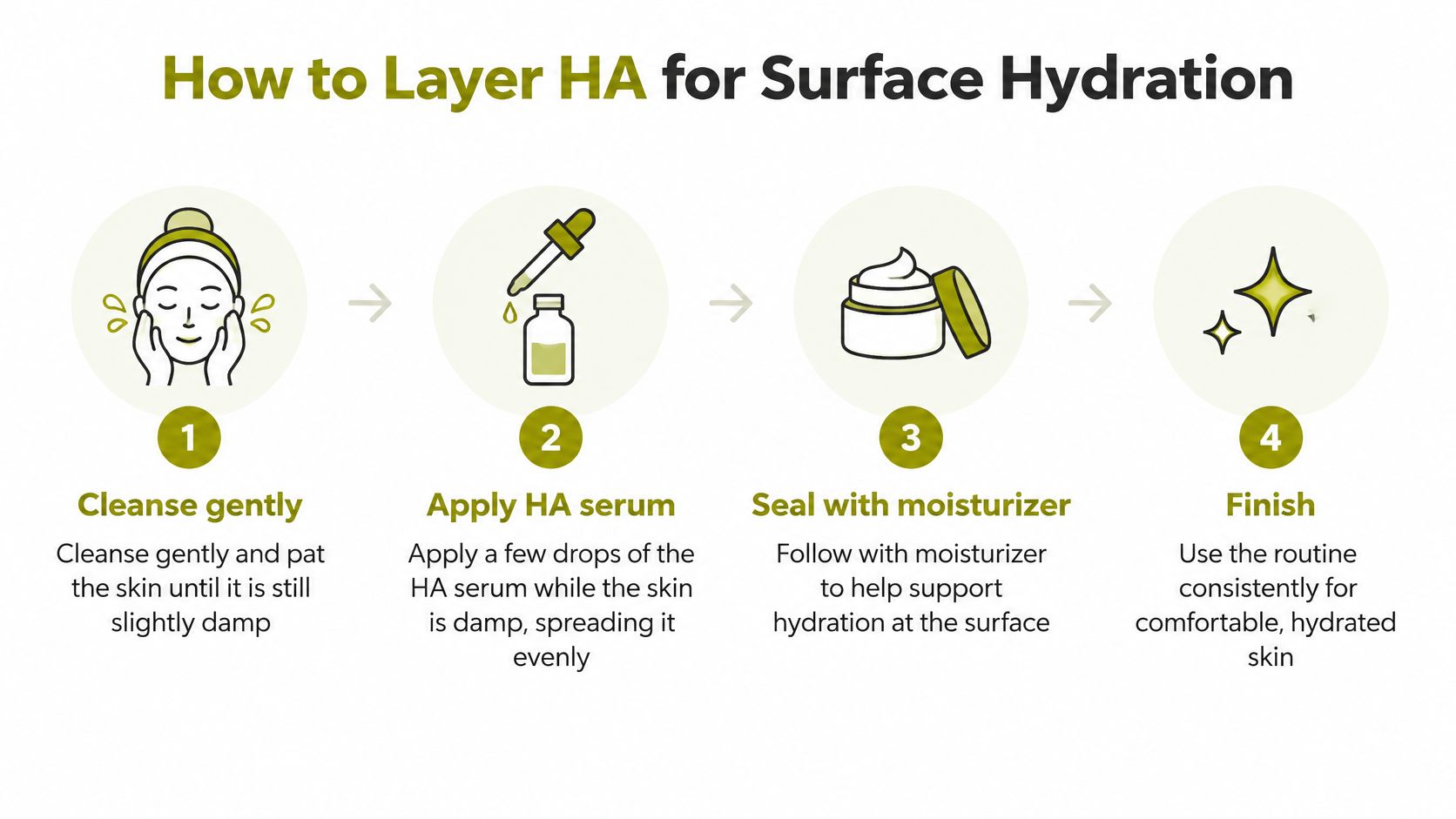
Layering matters because HA binds water that's already available. A review of high-molecular-weight hyaluronic acid in skincare explains that larger HA polymers, generally above approximately 1 MDa, primarily remain near the stratum corneum, where they form a surface film that can reduce transepidermal water loss. It describes application to slightly damp skin followed by an occlusive or emollient layer as technically rational, because HA helps bind available water while the second layer limits evaporation.
A Simple Five-Step Routine
- Cleanse gently and leave skin slightly damp. Pat, don't fully dry. That leftover water gives the serum something to hold.
- Apply a few drops of HA serum to damp skin. Spread it evenly across the face and neck. A thin, even layer works better than a thick one.
- Press the serum in gently. Pressing keeps the layer even and avoids the drag that rubbing can create on damp skin.
- Wait briefly, then apply moisturizer. The moisturizer forms a second layer that limits evaporation and helps hold the water in.
- Finish with sunscreen in the morning. Sun exposure can work against the surface comfort you're building, so sunscreen closes the daytime routine.
For a broader walkthrough of ordering your steps, see our guide to layering skin care.
Common Slips to Avoid
Applying HA to fully dry skin is the most common slip. The serum formula contains water, so it isn't useless on dry skin, but damp skin gives it more to work with. Skipping moisturizer is the second slip. Without that second layer, held water can evaporate and the comfortable feeling fades quickly.
The third slip is expecting the serum to do all the work alone. HA's effects aren't determined solely by concentration. Molecular-weight distribution, polymer structure, cross-linking, and formulation environment all influence film formation, hydration, penetration, and biological activity. Your cleanser, moisturizer, and consistency shape the result too.
Damp skin, a thin serum layer, then moisturizer. That order does most of the work.
A well-hydrated feel is easy to recognize. Skin feels smooth and comfortable, makeup sits more evenly, and tightness after cleansing eases. You shouldn't feel sticky for long, and persistent stinging or redness is a reason to stop and reassess the product.
Changes are gradual. Surface comfort can improve quickly, but a fair judgment takes several weeks of consistent use. Judge the routine by how your skin feels across ordinary days, in weather changes and heated indoor air, not by a single morning.
Ingredients That Pair Well With Hyaluronic Acid
HA is one part of a routine, not the whole routine. Pairing it with complementary ingredients supports the same goal, comfortable and hydrated skin, from different directions.
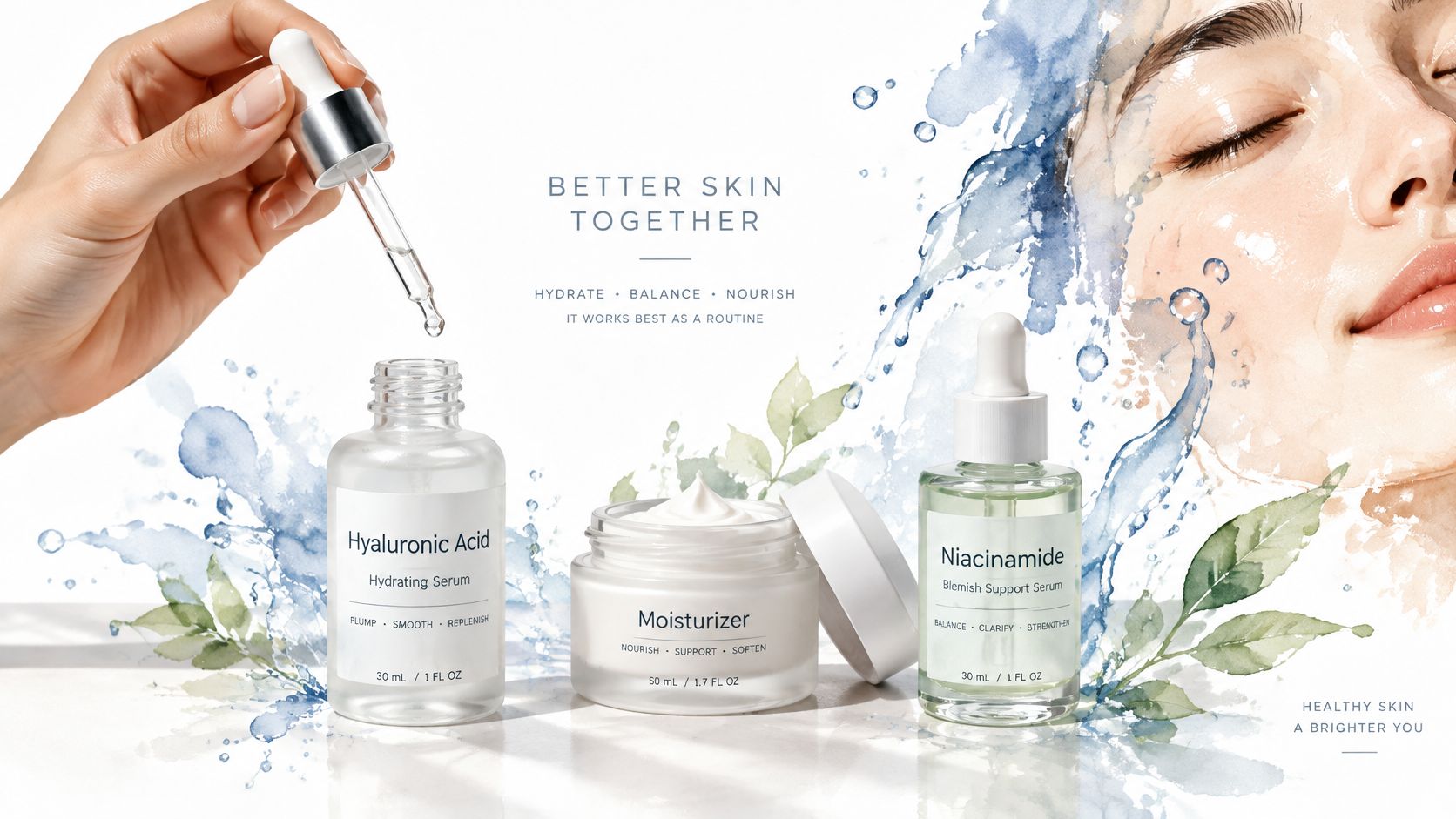
The display below shows the kind of simple pairing most routines need, a hydrating serum, a supportive second serum, and a moisturizer to finish.
| Ingredient | Role alongside HA | Where it fits |
|---|---|---|
| Glycerin | Second humectant that draws water into the outer layers | Under or mixed into the HA serum |
| Squalane | Lightweight oil that softens skin and helps slow water loss | After the serum, under the moisturizer |
| Niacinamide | Supports a comfortable, even-looking skin feel | Morning or evening, after cleansing |
| Vitamin C | Antioxidant step in a daytime routine | Morning, before the serum and moisturizer |
| Ceramide-rich moisturizer | Adds barrier-supporting lipids to keep water in place | Last step before sunscreen in the morning |
Glycerin works alongside HA as a second humectant, and you'll often find both in the same bottle. Squalane adds softness without a heavy feel. Niacinamide is a common partner for a comfortable, even-looking feel, and our explainer on niacinamide with hyaluronic acid covers how people combine the two. Vitamin C usually sits in the morning as an antioxidant step, while a ceramide-rich moisturizer supplies the barrier-supporting lipids HA doesn't provide.
The short video below shows how a simple layered routine comes together in practice.
Introduce one new ingredient at a time and patch test on a small area first. Avoid stacking many strong actives in one routine, since you won't know which step helped or irritated. A simple, consistent routine usually matters more than the longest ingredient list.
Choose a Hyaluronic Acid Serum for Your Routine
Choosing well is mostly about clarity and fit. You want a label you can understand and a texture you'll reliably use twice a day.
A Short Checklist for Today
- Confirm the ingredient is listed clearly: Hyaluronic acid or sodium hyaluronate should be easy to find.
- Look for molecular weight information: Note any size or multi-weight language, without treating it as a ranking.
- Consider your skin type and feel: Choose a texture that layers comfortably under your moisturizer and makeup.
- Check size and format: Pick a size that fits daily use, so the bottle doesn't sit half used and forgotten.
A simple product used twice daily is easier to judge than several products changed at once. Start with the layering steps, morning and evening, for several weeks. Watch how your skin feels over time, especially tightness after cleansing and comfort by afternoon, rather than expecting immediate change.
Our Hyaluronic Acid serum comes in a 1 oz size priced at $12.95. Our skincare range is also grouped by main ingredient, including Vitamin C, Vitamin A / Retinol, Hyaluronic Acid and Peptides, so you can compare formulas on your own terms and keep the rest of your routine steady while you judge one change.
Hydration is a daily habit, not a single purchase. A calm, consistent routine, with HA layered on damp skin under moisturizer, is the most reliable next step. Give it weeks, keep notes on how your skin feels, and adjust one thing at a time.
If you're ready to build that routine, explore our hyaluronic acid serum and ingredient-based skincare collections, compare textures and pairings at your own pace, and visit ArtNaturals to find the formula that fits your daily self-care.