

You wash your face after a long day, apply the products that usually feel comforting, and then notice something is different. Your skin feels tight instead of refreshed. A familiar serum suddenly stings. Dry patches appear around the nose, cheeks, or mouth, while the rest of your face may still look shiny. That confusing mix often leads people to add even more products, but skin barrier repair usually begins with less.
The outer layer of skin helps hold moisture and maintain everyday comfort. When it's stressed by over-cleansing, frequent exfoliation, dry weather, or too many active products, skin can feel rough, reactive, or unusually thirsty. Supporting it isn't about forcing a fast transformation. It's about reducing unnecessary disruption, adding the right kind of moisture, and giving a simple routine enough time to work.

A calm approach can include a gentle cleanser, a hydrating layer, and a moisturizer with barrier-supporting lipids. It can also include lifestyle details that make your environment more comfortable, such as choosing shop low-chemical bedding covers if you're trying to create a simpler, lower-irritant bedroom routine. For more everyday ideas, natural skincare for sensitive skin can help you think about product selection through a gentler lens.
This guide matches routine intensity to the kind of stress your skin is showing. Dryness may need more moisture retention, irritation after over-exfoliation may need a pause, and sensitivity may call for fewer ingredients overall. The aim is comfortable, hydrated, predictable skin, not a crowded shelf or an overnight fix.
Introduction to Skin Barrier Repair and Everyday Comfort
Your skin barrier usually gets noticed when everyday care stops feeling easy. A cleanser that once felt fresh may leave your cheeks tight, a familiar serum may sting, and makeup or sunscreen may settle unevenly. Flaking, rough texture, or a dull appearance can follow, even when you are applying more hydration than usual.
This shift often follows several exfoliating products, frequent washing, dry air, or multiple product changes at once. The right response depends on the kind of stress involved. Irritation after over-exfoliation usually calls for a pause, dryness may need better moisture retention, and sensitivity often benefits from fewer ingredients. Matching the routine to the problem helps prevent repair itself from becoming another source of irritation.
Repair is a support process
The skin barrier works like a protective surface that slows water loss and helps the outer layer stay organized. Researchers have measured recovery through transepidermal water loss, or TEWL, for more than 30 years. A landmark 1992 paper described barrier recovery as an active, ion-regulated process after solvent disruption, rather than dry skin becoming less dry. The history of this work appears in the Journal of Clinical Investigation reference.
That distinction changes how daily care makes sense. A rich cream can soften skin quickly, while lasting comfort depends on repeated, compatible support. Moisture replenishment, reduced water loss, and a calm surface environment need to work together.
A 2007 clinical study found that reducing TEWL for 23 hours per day over 3 weeks improved barrier function, while limiting occlusive exposure to 8 hours per day did not produce significant change. You do not need to copy that study setup at home. Its practical message is simpler: time and consistency matter.
A minimalist routine keeps the number of variables low. Start with the least disruptive steps, then add only what addresses the specific concern. A gentle cleanser, a hydrating layer, and a suitable moisturizer may be enough while skin settles. If you are also simplifying your bedroom environment, you can shop low-chemical bedding covers. Guidance on natural skincare for sensitive skin can also support gentler product choices.
A gentle routine should make your skin feel more settled, not give you more sensations to interpret.
Skin barrier repair can support hydration and comfort, but it cannot identify the cause of persistent redness, scaling, pain, or ongoing reactions. If symptoms keep worsening or feel difficult to manage, professional guidance is more appropriate than continually adding products. For ordinary dryness or routine-related stress, choose a smaller plan and give it time.
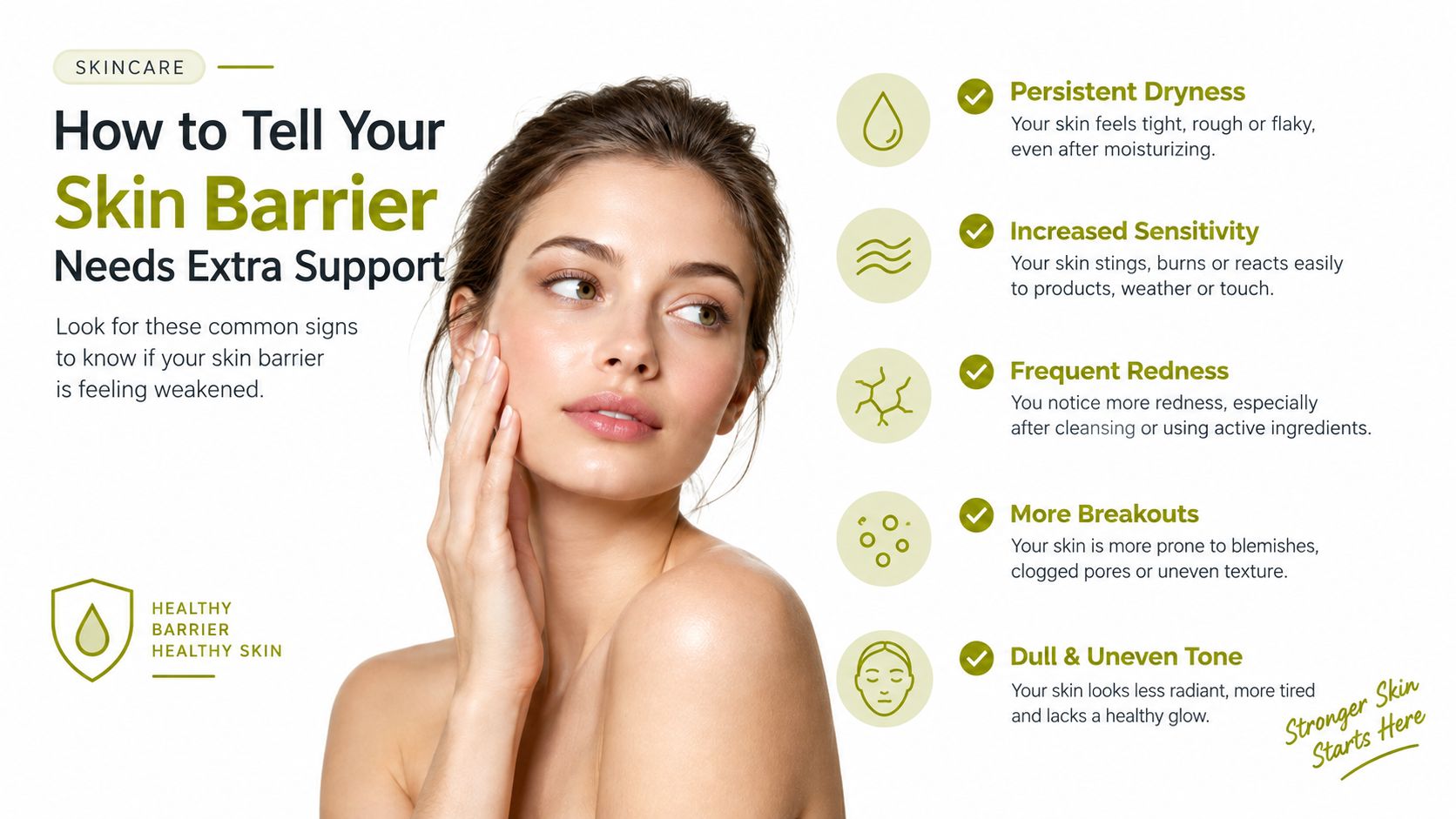
How to Tell Your Skin Barrier Needs Extra Support
Your skin often gives useful clues before it looks dramatically different. The most helpful approach is to notice patterns rather than diagnose yourself from a single dry patch. Ask what changed recently, then observe how your skin behaves over several days while you remove possible sources of irritation.
Notice how products feel
Stinging is often more informative than a product's marketing label. If water, cleanser, moisturizer, or a familiar serum suddenly causes discomfort, your skin may be asking for a quieter routine. That doesn't prove one specific cause, but it's a good reason to pause strong products and avoid testing several new formulas at once.
Tightness can also be easy to misread. Skin may feel stretched immediately after cleansing, or it may become uncomfortable later in the day as moisture leaves the surface. Oily skin can feel tight too, especially if cleansing or drying products are being used aggressively. Look for the combination of sensation and timing, not just whether your face appears shiny.
Look for visible changes
Flaking, roughness, and makeup catching on certain areas suggest that the outer surface isn't feeling even. Redness may appear around the nose, cheeks, chin, or other areas that receive more rubbing. New or unusual blemishes can occur alongside dryness, but treating every change with a stronger active may add more stress.
Use a short observation list:
- After cleansing: Does your face feel comfortable, tight, or squeaky?
- After moisturizing: Does the product settle gently, or does it sting?
- During the day: Do dry patches return quickly, or does comfort last?
- After product changes: Can you identify one new formula that came before the reaction?
- By evening: Does skin feel softer and calmer, or more irritated?
If several signs appear together, simplify for a while. Keep cleansing gentle, pause exfoliating products, and choose one uncomplicated moisturizer rather than layering multiple treatments. The Protect-A-Bed eczema insights offer broader context about how barrier concerns can overlap with sensitive-skin experiences, but everyday observation still can't replace individualized advice.
This video can provide another visual explanation of the signs people commonly notice:
Listen to repeated signals. One unusual sensation may pass, but a pattern of tightness, flaking, and stinging deserves a gentler routine.
Understanding What Supports a Healthy Skin Barrier
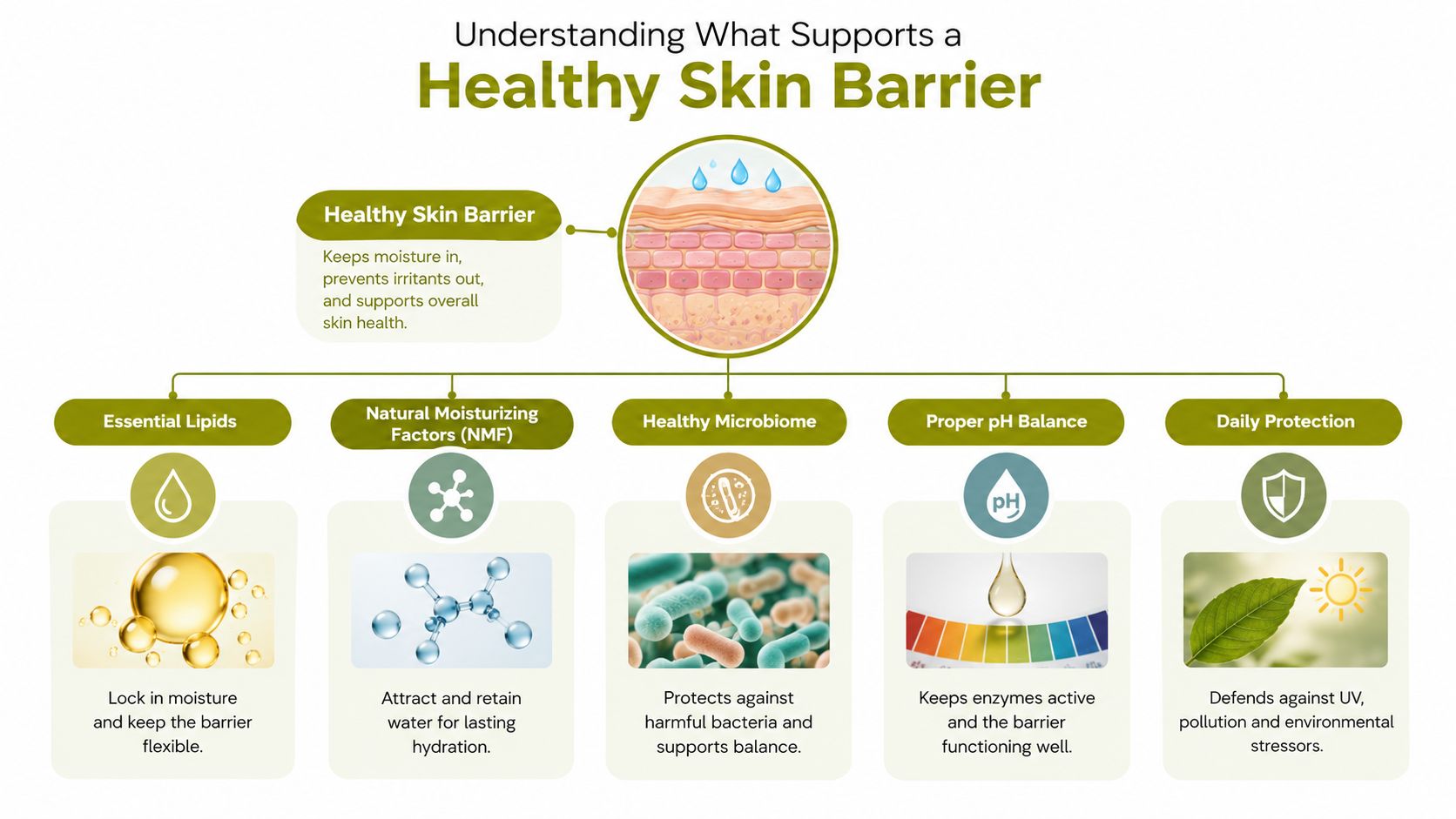
A helpful way to understand the barrier is to separate three jobs: holding water, supplying lipids, and limiting unnecessary disruption. These jobs overlap, but different ingredients support them in different ways.
The outer surface contains organized lipids, including ceramides, that help reduce water loss and support the structure of the stratum corneum. Ceramide-containing formulas are repeatedly discussed as barrier-supporting because they can reduce TEWL, improve surface structure, and increase lipid content in the outer layer. The proposed mechanisms are outlined in this review on ceramides and skin barrier support.
Water itself isn't the whole answer. A damp surface can feel comfortable briefly, but a moisturizer needs to help hold that hydration in place. Humectants draw and bind water into the outer layers, while creams, oils, and ointments can slow the escape of that water. This is why a balanced formula often feels more supportive than a single ingredient used alone.
Water loss is part of the picture
TEWL gives researchers an objective way to track how readily water passes from skin into the surrounding air. In a human irritation model, sodium lauryl sulfate exposure and tape stripping produced a 6-fold increase in TEWL, after which recovery could be tracked over subsequent days. That model and related findings are discussed in this human skin barrier repair research.
You won't need a Tewameter at home to use the principle. If skin repeatedly feels tight after cleansing or loses comfort quickly, consider reducing water exposure, using lukewarm rather than hot water, and applying moisturizer while the skin is still slightly damp.
Surface balance matters too
Barrier-focused formulas are often developed around the skin's naturally acidic surface environment. One source describes a physiologic skin surface pH of 4.0 to 6.0, while another describes the surface as approximately 4.5 to 5.5. These ranges come from the skin barrier speaker deck.pdf?rev).
That doesn't mean you need to measure your face or reject every product outside a particular number. It does suggest choosing cleansers and moisturizers described as gentle or pH-aware, especially when your skin already feels reactive. A product that leaves your skin comfortable is more useful than one that creates a squeaky-clean sensation.
The strongest home routine is therefore not the one with the most steps. It's the one that combines modest cleansing, water-binding hydration, lipid support, and protection from unnecessary water loss.
A Gentle Daily Routine to Support Skin Barrier Repair
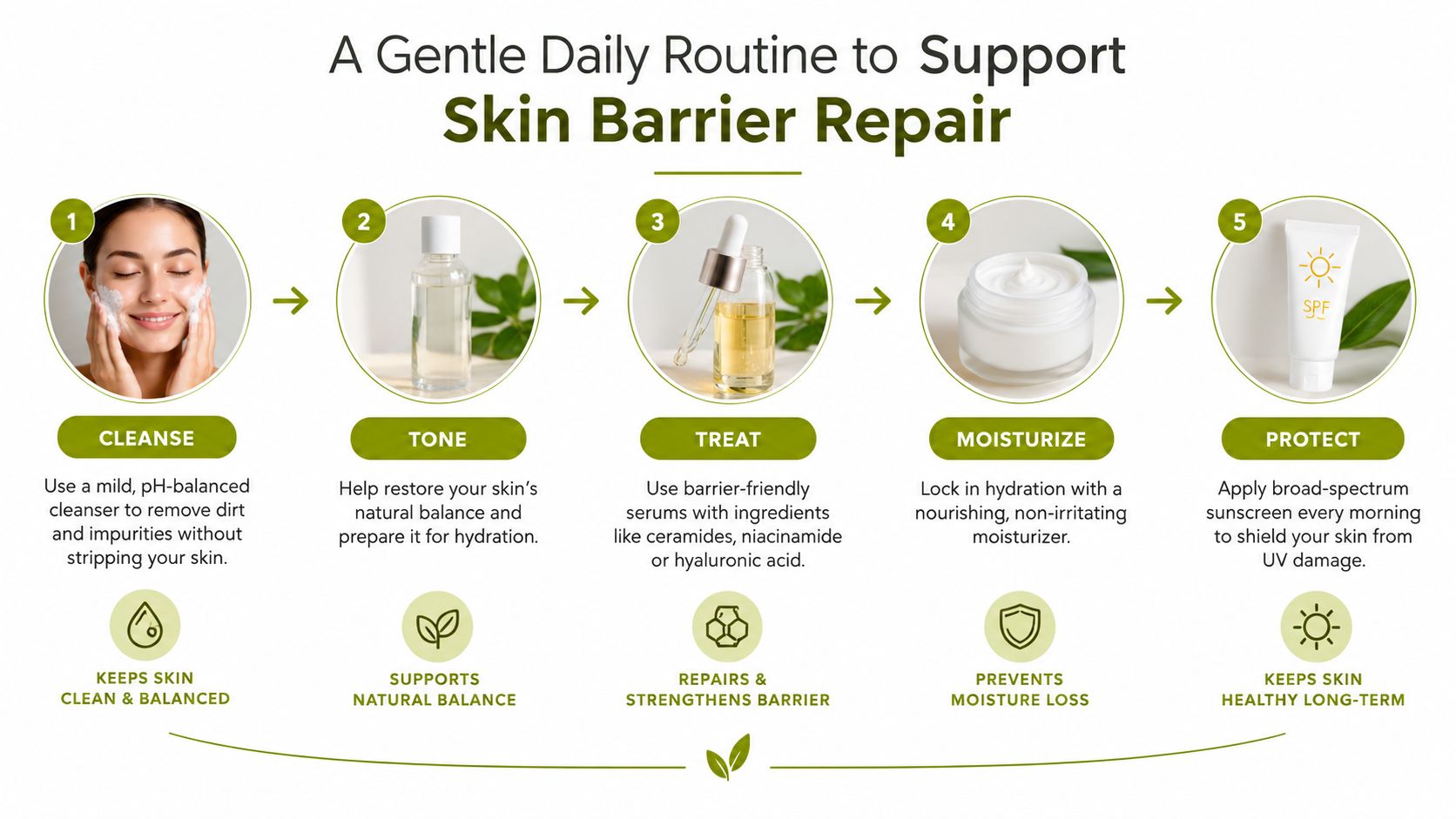
If cleansing leaves your face tight, or a new product makes it sting, a crowded routine can make the problem harder to read. Start with the smallest set of steps that restores comfort, then match the routine to the type of trouble: reduce irritants after over-exfoliation, add moisture for dryness, and keep products simple when sensitivity is the main concern.
Morning care
If your skin feels comfortable, begin with a lukewarm water rinse instead of a full cleanse. Use a mild cleanser when you wake with residue, oil, or sunscreen to remove. Keep the water lukewarm and use light fingertips. Heat and vigorous rubbing can make tightness and sensitivity more noticeable.
Add one simple hydrating layer if dryness is the main complaint. A serum or lightweight lotion containing glycerin, hyaluronic acid, or panthenol may help skin feel more comfortable. You do not need several humectants in separate products. One formula that spreads easily, without repeated rubbing, is enough to test.
Follow with a ceramide-containing moisturizer. Apply it while skin is slightly damp, using enough to leave a comfortable surface rather than a heavy film. Research on a daily ceramide-dominant regimen found improvements in hydration and transepidermal water loss at measured time points, with the strongest effects reached by week 4. In the active emulsion arm, hydration increased 21.9% and TEWL fell 36.7%, compared with 8.9% and 5.1% in controls, respectively, as reported in this controlled barrier care review.
Finish with daytime protection that your skin tolerates. If sunscreen stings, keep the layers beneath it unchanged while you investigate. A shorter routine makes it easier to identify whether the discomfort comes from the sunscreen, another product, or friction during application.
Evening care
At night, remove sunscreen and makeup with a gentle cleanser. Fingertips are preferable to a cleansing brush, rough cloth, or abrasive tool. Rinse thoroughly, pat dry, and moisturize before skin remains exposed and begins to feel tight.
Repeat the hydrating layer only if your skin likes it, then apply your ceramide-rich moisturizer. Twice-daily use after cleansing is a practical pattern supported by barrier research, particularly when you can maintain it consistently for at least 2 weeks. A randomized study reported that a 1% ceramide cream reduced TEWL by 24.46% after 14 days, compared with 21.63% for 10% lanolin, 20.73% for 10% urea, and 17.33% for petrolatum, with p<0.05, according to this ceramide moisturizer review.
When over-exfoliation is the likely trigger, pause exfoliating acids, retinoids, scrubs, and strongly fragranced products that cause discomfort. For simple dryness, a moisturizer may be sufficient. For sensitivity, remove extra layers and reintroduce one active at a time after your skin feels calm and predictable.
For a broader framework around arranging skincare steps, see this guide to building a skincare routine. Here, frequency and consistency matter more than an elaborate sequence.
Ingredient Guidance for Barrier Support Without Overdoing It
Ingredient labels are easier to use when each category has a clear job. Humectants attract and hold water in the outer layers, ceramides support the skin's lipid structure, and occlusives slow moisture loss at the surface. They work differently, so layering several products from every category can make irritation harder to trace.
Common humectants include glycerin, hyaluronic acid, urea, lactic acid, panthenol, and sorbitol. They can help skin that feels tight or dehydrated, as explained in this ingredient education resource on humectants. One humectant-focused product under moisturizer is often a clearer starting point than several hydrating layers.
Ceramides are lipids naturally associated with the outer skin layer. A formula that pairs ceramides with other physiologic lipids can support an organized barrier structure, since the barrier relies on a lipid environment rather than one isolated ingredient.
Occlusives serve another purpose. They create a surface layer that slows water loss. A balm, ointment, or richer cream may suit dry patches, while a small amount applied only where needed can feel more comfortable than covering the entire face.
Choosing Barrier Support Ingredients by Everyday Need
| Skin Feeling | Best Ingredient Focus | Examples to Look For |
|---|---|---|
| Tight after cleansing | Humectant hydration followed by a moisturizer | Glycerin, hyaluronic acid, panthenol |
| Dry or flaky in patches | Lipids plus a gentle occlusive layer | Ceramides, physiologic lipid blends, shea butter |
| Easily irritated by products | Short ingredient list and mild cleansing | Fragrance-free formulas, a pH-aware cleanser, fewer layers |
| Comfortable but losing moisture quickly | Moisture retention | Ceramide cream, squalane, a targeted balm |
| Oily and tight at the same time | Lightweight hydration with barrier support | Glycerin, a light ceramide lotion, minimal occlusive use |
Keep the formula strategy simple
A higher ceramide content does not guarantee a better fit for every person. A review found substantial variation in TEWL comparisons across ceramide products and study designs, reflected by I²=92%. That result supports judging a formula by its texture, supporting ingredients, and how your skin tolerates it, rather than choosing by one ingredient alone.
Start with one moisturizer and use it consistently before adding a serum or oil. If over-exfoliation caused stinging, keep the routine especially short. If dryness is the main concern, add targeted richness only where needed. If sensitivity is the concern, fewer layers make it easier to identify what your skin accepts.
ArtNaturals lists a Hyaluronic Acid Serum, which fits the humectant category, and a Niacinamide Face Serum containing vitamin B3 and sunflower oil. Either can remain optional, particularly while skin stings. For more context on choosing hydration for reactive-feeling skin, read this guide to hyaluronic acid for sensitive skin. A minimalist approach usually means one hydrating layer, one moisturizer, and no extra occlusive unless your skin needs it.
Timelines Troubleshooting and When to Seek Professional Care
Skin barrier repair follows the type of stress involved. After over-exfoliation, stinging may settle before dryness does. If dryness is the main issue, comfort can improve sooner than flaking or uneven texture. Sensitivity often needs the quietest routine, because adding more products can keep the skin reactive.
Use comfort as your first progress marker. Your cleanser may feel less stripping, moisturizer may stop stinging, and tightness may return less quickly. Early changes can appear within days, while fuller improvement may take several weeks. Flaking and uneven texture often take longer, so avoid changing products every day in response to small fluctuations.
A calm troubleshooting plan
- If stinging continues: Remove optional serums and use gentle cleansing, moisturizer, and daytime protection that feels comfortable.
- If dryness lingers: Apply moisturizer to slightly damp skin. Add a richer product or a targeted occlusive only to the driest areas.
- If your face feels heavy or congested: Reduce layers instead of dropping hydration altogether. Choose one humectant or one moisturizer, rather than several versions of both.
- If you're unsure what caused the change: Rebuild your routine one product at a time and keep a simple note of what you used.
- If symptoms persist or worsen: Seek personalized guidance from a qualified dermatologist or another appropriate professional.
A stronger repair routine is not automatically better. Match the response to the problem: shorten the routine after irritant over-exfoliation, add focused richness for dryness, and use fewer layers for sensitivity. Newer research is exploring physiological lipids, biomimetic approaches, and peptide formulations, but everyday home care still benefits from restraint. Barrier dysfunction can also appear alongside different chronic skin concerns, so the right routine depends on the kind of stress involved, not only on the word “sensitive.”
For mild dryness after over-cleansing, a minimalist routine may be enough. Ongoing burning, pronounced redness, persistent scaling, or post-procedure skin call for professional advice, especially when guessing could prolong irritation. The most supportive routine is the one your skin can tolerate consistently.
ArtNaturals offers skincare options for hydration and ingredient-focused routines, including hyaluronic acid and niacinamide formulas that may fit a carefully layered plan. Visit ArtNaturals to explore these products, then choose one supportive addition at a time and give your skin room to respond.