

Ever wonder about the magic of a leave in conditioner? It's a beautifully simple hair care step. You apply this lightweight product to damp or dry hair and, as the name suggests, you just leave it in. No rinsing is needed. Think of it as a daily hydrator for your hair, working gently throughout the day to nourish, soften, and support your strands.
A Gentle Introduction to Leave-In Conditioner
If you’re new to the world of leave-in conditioners, the concept is refreshingly simple. Your traditional, in-shower conditioner does its work for a few minutes before being washed away. A leave-in, on the other hand, stays with you. Its lighter formula is designed to be absorbed by your hair, delivering benefits that last all day long.
Adding this one step to your routine can make a beautiful difference in how your hair feels. It’s like a primer for your hair, preparing it for whatever comes next, whether that’s styling products or just facing the day. For many, it's become an essential part of their hair care ritual. You can explore some plant-powered conditioner options to see what might work for you.
The Core Purpose of a Leave-In
At its heart, a leave-in conditioner is all about giving your hair a continuous dose of moisture and making it more manageable. It creates a very light coating on the hair shaft, which helps to smooth down the cuticle—the outermost layer of each strand.
This simple function can lead to some wonderful, noticeable results for your hair's look and feel:
- Effortless Detangling: It adds "slip," which is a gentle way of saying it helps your comb or brush glide through knots and tangles without a struggle.
- Lasting Hydration: It helps seal in moisture from your shower, keeping hair feeling soft and flexible instead of dry.
- Frizz Management: A smoother hair surface often means fewer flyaways and a more polished, serene appearance.
This focus on daily hair wellness is becoming more common. The global market for these products is growing, expected to go from roughly $1.8 billion in 2023 to $3.4 billion by 2032. It's clear people are looking for simple, effective solutions that fit into a busy life. You can learn more about this growing market on dataintelo.com.
More Than Just Moisture
A good leave-in is more than just a hydrator. It's a foundational part of your hair care routine and can be used with a wide array of styling products, acting as the perfect primer. By creating a soft, hydrated base, it helps other products you use—from curl creams to heat protectants—work more effectively. It’s the simple first step that sets your hair up for a good day.
The Benefits of Using a Leave-In Conditioner
Adding a leave-in conditioner to your daily ritual isn't just another step—it's an act of continuous care for your hair. Unlike products that rinse away, a leave-in’s benefits unfold throughout the day, offering support you can both see and feel.
The most immediate reward is often effortless detangling. A quality leave-in formula can provide the perfect amount of slip, smoothing the hair’s surface so knots and tangles gently release. That simple change can turn your post-shower routine into a much calmer, more mindful experience.
Lasting Hydration and Softness
One of the core purposes of a leave-in conditioner is to deliver lasting moisture. Think of it as a long drink of water for thirsty strands. It helps seal in the hydration from your wash, which can help with the dryness that sometimes appears as the day goes on.
This continuous moisture can make a noticeable difference in your hair's texture. Strands may feel softer, more flexible, and resilient to the touch. This sustained hydration helps lay the foundation for hair that looks vibrant and feels well-cared-for.
A Smoother, More Polished Look
Frizz and flyaways can happen when the hair's outer layer—the cuticle—becomes raised. A leave-in conditioner works to gently smooth these cuticles down, creating a more uniform and sleek surface. This is a helpful step for taming unruly strands and achieving a more polished appearance.
By calming that frizz, this single product may boost your hair’s natural shine and texture. For more ideas, you can explore our guide on how to reduce frizzy hair naturally. The result is a look that feels intentionally cared for, yet effortlessly natural.
A leave in conditioner provides a gentle buffer between your hair and the world. It’s not just about aesthetics; it's about creating a delicate shield that supports your hair’s integrity every single day.
This quality is one of its most valuable benefits. It can act as a light barrier against daily environmental stressors, like dry air, which can affect hair's natural moisture and vibrancy. By working a leave-in conditioner into your routine, you’re taking a gentle step toward maintaining resilient, beautiful hair.
Choosing Nourishing Ingredients for Your Hair Type
Think of the ingredient list on your leave-in conditioner less like a complex code and more like a recipe for happy hair. When you know what to look for, you can pick the perfect product that aligns with your hair goals and a clean, plant-powered philosophy.
This move toward reading labels is part of a larger wellness trend. More people are seeking out natural and organic leave-in conditioners as part of the clean beauty movement. Wellness-minded shoppers are showing more interest in plant-based products that feel both effective and trustworthy. You can learn more about the rise of clean ingredients on marketsandata.com.
Matching Ingredients to Your Hair's Needs
Just like you'd choose different foods to fuel your body, certain ingredients are better suited for specific hair needs. Some are known for their deep moisture, while others are prized for being light as air. The trick is knowing which is right for your hair.
Here are a few powerhouse ingredients you'll often find in natural formulas:
- Argan Oil: This is often called 'liquid gold' for a reason. It’s wonderful for hydrating and adding a gorgeous, natural-looking shine without feeling heavy.
- Shea Butter: With its rich, creamy texture, shea butter is a go-to for deeply moisturizing coarse, coily, or very dry hair.
- Rosemary: A long-time favorite in hair care rituals, rosemary is associated with invigorating the scalp and creating a healthy environment for hair.
Choosing the right ingredients is like assembling a personalized self-care toolkit for your hair. The goal is to find a blend that helps your hair feel its best, whether that means taming frizz, boosting shine, or simply adding a touch of daily moisture.
Practical Tips for Different Hair Types
Getting this right often comes down to your hair type. You want to strike the perfect balance between moisture and weight, giving your hair exactly what it needs without overwhelming it.
If you have fine or thin hair, the goal is hydration without sacrificing volume. Look for lightweight botanicals like Jojoba Oil or Aloe Vera. They're known for moisturizing and softening strands while keeping things feeling light and bouncy. You can find more great options in our guide to the best oils for hair growth and health.
On the other hand, if you have thick, curly, or coily hair, you can—and should—embrace richer, more intensive moisturizers. Ingredients like Castor Oil and Coconut Oil can deliver the deep conditioning that may help keep your curls defined, soft, and less prone to frizz. When you learn what your hair truly loves, your daily routine becomes a nurturing ritual.
To help you get familiar with what’s out there, here's a quick reference for some popular natural ingredients and what they're known for.
A Quick Guide to Hair-Nourishing Ingredients
Use this reference to understand popular natural ingredients in leave-in conditioners and the hair care benefits they are commonly associated with.
| Ingredient | Commonly Associated With |
|---|---|
| Argan Oil | Adding shine, softening, and taming frizz. |
| Shea Butter | Deeply moisturizing and sealing dry, porous hair. |
| Coconut Oil | Supporting strand strength and hair's natural proteins. |
| Jojoba Oil | Lightweight moisture that mimics the scalp's natural sebum. |
| Aloe Vera | Soothing the scalp and providing lightweight hydration. |
| Rosemary Oil | Invigorating the scalp and promoting a healthy foundation. |
| Castor Oil | Intense hydration and sealing hair cuticles. |
Knowing just a few of these ingredients can make you feel much more confident when you're scanning the back of a bottle, helping you find the perfect match for your hair's unique needs.
How to Apply Leave-In Conditioner the Right Way
Getting the most out of your leave-in conditioner isn't just about which one you use, but how you use it. Mastering the application can be a game-changer, turning a good product into your hair's best friend. The secret starts with the perfect canvas: clean, damp hair.
Right after you wash, grab a soft towel or an old t-shirt and gently blot your hair. You want to remove the dripping water but leave enough moisture behind. Think of your hair like a sponge—it's more receptive to soaking up goodness when it's already a little damp. This is the sweet spot for your leave-in to spread evenly and get to work.
Start With a Light Touch
Here’s a helpful rule of thumb: less is almost always more. You can always add another spritz or a tiny bit more cream, but it's much harder to take it away. A common reason hair feels heavy or greasy after using a leave-in is simply using too much.
Start with a small, coin-sized amount if you're using a cream, or just a few light mists for a spray. Warming the product between your palms for a second first is a nice touch. This little step helps it apply more evenly, ensuring it glides onto your hair in a thin layer instead of clumping in one spot.
Focus on Mid-Lengths and Ends
Now, where should you apply it? Concentrate on the areas that tend to be the thirstiest: the mid-lengths and ends. This part of your hair has been around the longest and is usually the driest and most prone to feeling stressed. It will appreciate the extra attention.
Use your fingers to gently rake the product through your hair. Try to avoid putting it directly on your roots. Your scalp produces its own natural oils to keep that area hydrated, and adding more product there can sometimes weigh hair down. This targeted approach gives moisture right where it's needed most.
Think of your hair care routine with the same intention you bring to your skincare. Just as you gently pat serum onto your face, applying a leave-in conditioner with care and focus transforms it from a task into a moment of self-care, which can lead to better results.
This diagram offers a great visual for how to approach your leave-in, depending on your hair's needs.
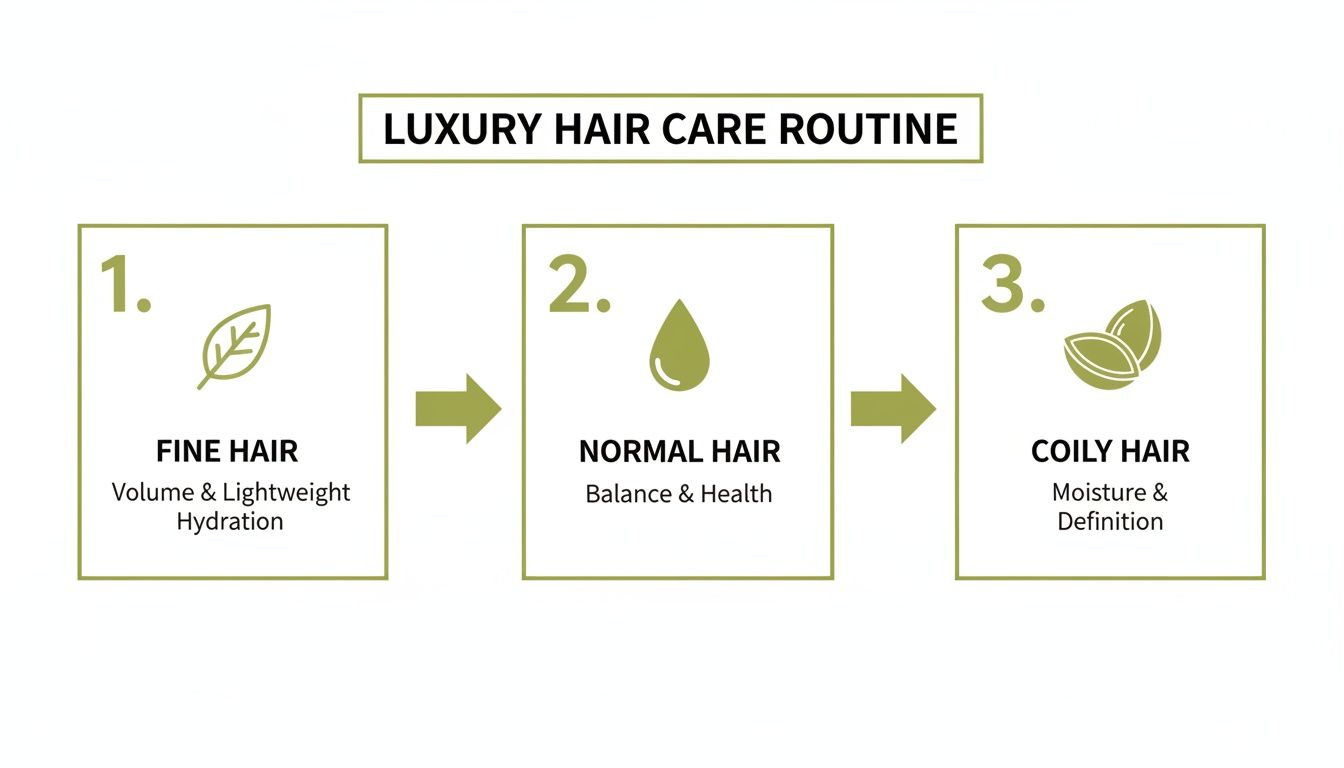
As you can see, the right product choice—from a feather-light mist for fine hair to a nourishing cream for coily textures—goes hand-in-hand with the right technique.
Tailoring Application to Your Hair Type
Your hair’s unique personality will help determine the best application method. What works for a friend might need a few tweaks for you, so pay attention to how your hair responds and don't be afraid to adjust.
- For Fine Hair: A lightweight mist is often a great choice. To keep from overloading your delicate strands, try spraying it onto your hands first, then lightly glazing it over your mid-lengths and ends.
- For Wavy or Curly Hair: A light cream or lotion can work beautifully. It's often best to work in sections, scrunching the product upward from the ends to encourage and define your natural pattern.
- For Coily or Thick Hair: Your hair may appreciate a richer cream. Divide your hair into manageable sections and work the leave-in from root to tip to make sure every strand is coated for deep hydration and definition.
Following these simple tips can help your hair soak up all the benefits of your leave-in conditioner, leaving it soft, manageable, and beautifully nourished.
How to Layer Leave-In Conditioner with Other Products
Figuring out the right order for your hair products can feel a bit like getting dressed in the morning—you wouldn't put your coat on before your shirt. The same logic applies to your hair, and your leave-in conditioner is almost always the first thing you should reach for after washing.
Think of it as the primer of your hair routine. Applying it to clean, damp hair creates the perfect hydrated and supported base. This foundational layer of moisture helps other styling products you use work more effectively, preventing them from just sitting on top of dry strands.
The Logic of Layering
As a general rule, it's a good idea to apply your products from lightest to heaviest. A leave-in conditioner is usually a lightweight spray, lotion, or cream that’s meant to sink right into the hair shaft, giving it that first essential dose of moisture and slip.
Putting it on first creates a smooth canvas for everything that follows. It's a simple step, but it can help prevent a tacky or stiff feeling you might get when products are piled on in the wrong order. This way, each product can do its job without getting in the way of the others.
Think of your leave-in as setting the stage for success. It preps, supports, and moisturizes, letting every other product—from your mousse to your finishing oil—truly shine. It’s this thoughtful layering that can make all the difference.
Product Pairing Ideas
The real magic can happen when you find products that work well together. Once your leave-in has been applied and worked through, you can start layering other stylers to create the look you’re going for. The key is to choose products that complement each other.
Here are a few combinations that often deliver lovely results:
- For Defined Curls: Start with your leave-in conditioner to hydrate and detangle. Follow that with a good curl cream to help your curls form and encourage their natural pattern, then finish with a light gel to lock it all in and manage frizz.
- For Sleek Volume: After towel-drying, spritz a lightweight leave-in spray from your mid-lengths to your ends. Then, work a volumizing mousse into your roots before you blow-dry for extra lift.
- For Extra Shine and Softness: Once your leave-in has soaked in, smooth a few drops of a nourishing hair serum or oil through your ends. This final touch seals in all that great moisture from the leave-in and can leave you with a beautiful, glossy finish.
Your Top Leave-In Conditioner Questions, Answered
Even when you know the benefits, adding a new product to your routine can bring up a few questions. A leave-in conditioner is a beautifully simple tool, but a few tips can help you use it with confidence and get the best results. Let's clear up some of the most common things people ask.
Conditioners have become a cornerstone of modern hair care, bridging the gap between a professional salon visit and what we can do for ourselves at home. The numbers reflect this: in the U.S., conditioners are part of a hair care market valued at around $20.84 billion in 2024. With North American conditioner sales projected to reach $4.34 billion by 2025 and 70% of users saying it makes their hair feel softer, it's clear this step is important for many. You can learn more about the conditioner market trends on datainsightsmarket.com.
How Often Should I Use a Leave-In Conditioner?
There's no single right answer here—it’s all about listening to your hair. How often you use a leave-in really depends on your hair's unique texture, condition, and what it’s telling you it needs.
If your hair is naturally dry, coarse, or has been color-treated or heat-styled, using a leave-in daily can be a wonderful habit. A little spritz each day can help replenish moisture and keep everything feeling smooth and manageable.
On the other hand, if your hair is fine or tends to get oily, you might find that applying it just on wash days is the sweet spot. You could also lightly mist your ends on non-wash days to give them a little refresh. The bottom line? If your hair feels soft and looks healthy, you've found your perfect rhythm.
Can I Use a Leave-In Conditioner on Dry Hair?
Yes, you absolutely can! While it’s often most effective on clean, damp hair, a lightweight leave-in is a fantastic tool for reviving dry hair between washes.
Think of it as a quick drink of water for your strands. A light mist can instantly calm down flyaways, bring some bounce back to day-old waves, or help redefine curls that have lost their shape. It’s the perfect way to add a bit of polish and moisture when you’re on the go.
Just remember, a little goes a long way on dry hair. Use less than you would on damp hair and focus just on the areas that need some attention, like the mid-lengths and ends.
Is Leave-In Conditioner the Same as Regular Conditioner?
This is a very common question, but they are two different products designed for different purposes. Your traditional rinse-out conditioner is usually much thicker and heavier. Its goal is to quickly coat the hair cuticle, detangle knots after shampooing, and then be completely washed away.
A leave-in conditioner is formulated to be much, much lighter.
Its purpose is to be absorbed into the hair strand, delivering all-day moisture, support, and softness without leaving behind any heavy residue.
Will a Leave-In Conditioner Weigh Down My Fine Hair?
That's a very real concern for anyone with fine hair, but it's often avoidable if you pick the right product and use it correctly. The trick is to find a formula that’s specifically made to be lightweight.
For fine hair, it's often best to reach for a leave-in that comes in a spray or mist bottle instead of a thick cream or lotion. These lighter formulas deliver a delicate veil of hydration that won't flatten your hair.
Application is also key. Be strategic—focus the product only on your mid-lengths and ends, staying far away from your roots. Start with just a spritz or two and gently comb it through. This targeted approach can give you all the detangling and smoothing benefits without sacrificing volume.
Ready to find the perfect plant-powered leave-in conditioner for your hair ritual? Discover your new self-care essential in the ArtNaturals collection at https://artnaturals.com.