

You finish washing your face, apply your acne treatment, and then pause. Your skin feels tight, but you worry that moisturizer might leave a heavy layer or make congestion worse. That hesitation is common, especially when advice seems to suggest that acne-prone skin should avoid anything creamy.
A moisturizer isn't an acne treatment, and it doesn't need to feel rich to be useful. The right formula can make a routine more comfortable, with the best choice guided by how the finished product feels on your skin, not just the words on its label.
Why Acne Prone Skin Still Wants a Moisturizer
After cleansing or using a topical treatment, skin can feel taut, dry, or a little reactive. You might notice flakes around your nose or a sting when you apply another product. Even if your skin tends to look shiny, those sensations can be a sign that it needs more comfort and hydration.
Moisturizer is a supportive step, not a substitute for acne medication. A 2023 international expert-consensus review reported unanimous agreement among its panel that moisturizers reduce dryness and irritation associated with topical acne therapy. The panel preferred water-based, hypoallergenic, and alcohol-free formulas for acne-prone skin, and recommended products that add water to the outer skin layer without interfering with acne medication (expert-consensus review on moisturizers and acne care).
That distinction matters. A moisturizer can help skin feel less dry and uncomfortable; it shouldn't be presented as a guaranteed way to clear breakouts. When treatment leaves skin irritated, though, finding a comfortable moisturizer may make it easier to stick with the routine you're already using.
Comfort, not heaviness
Think of moisturizer as a quiet support step. It doesn't have to be thick or greasy to help skin feel more comfortable. A light gel or lotion may suit someone who dislikes residue, while a more cushioning texture may feel better when skin is dry.
If a moisturizer consistently leaves you feeling coated, that's useful feedback. So is a product that absorbs comfortably but doesn't ease tightness. Texture, formula, and your skin's response work together, which is why a label alone can't make the decision for you.
A useful starting point: Choose a formula for how it feels and functions, then pay attention to how your skin responds over time.
How a Barrier Friendly Moisturizer Actually Works
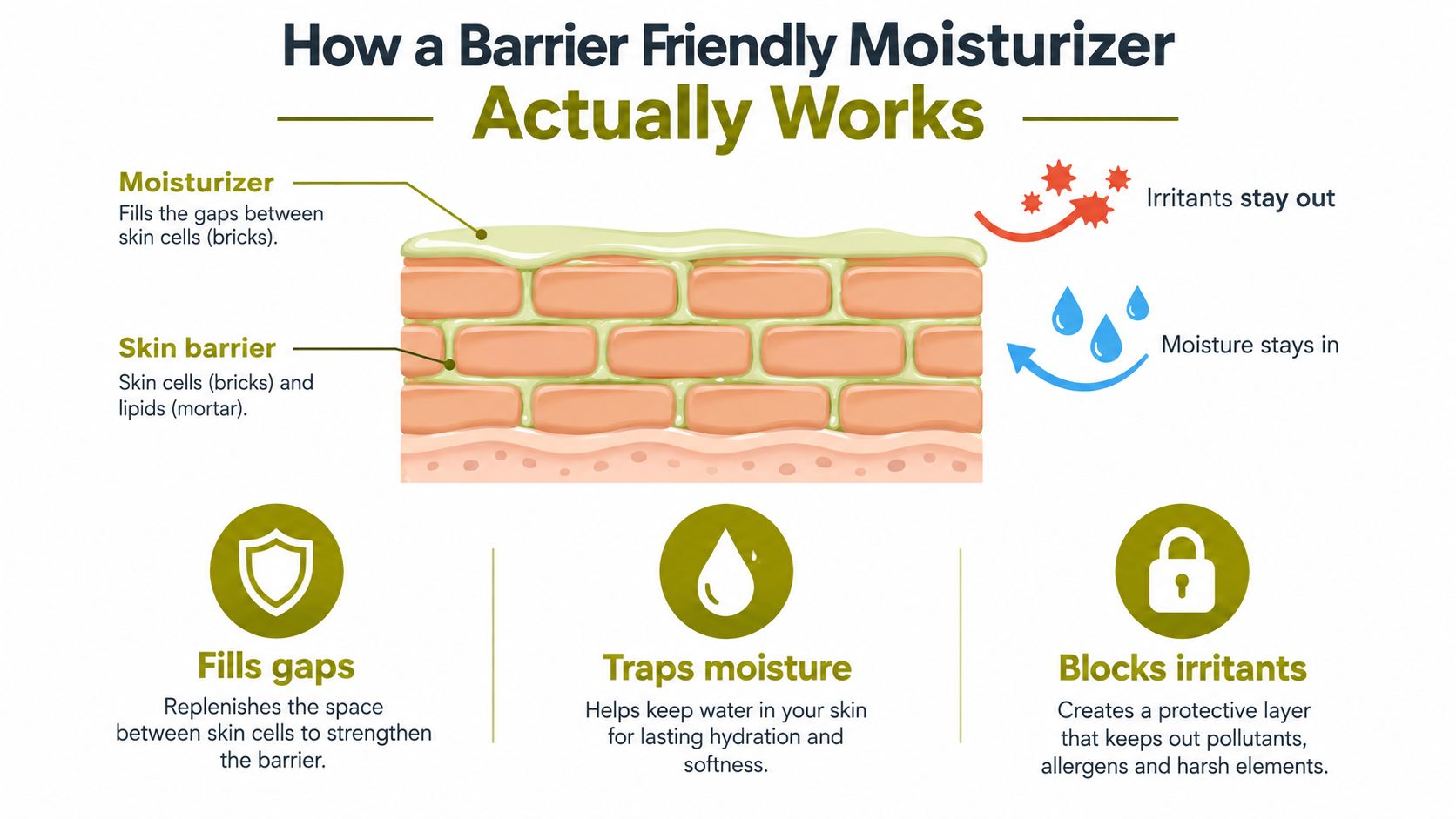
A simple way to picture the skin barrier is as a brick wall. Skin cells are the bricks, and the lipids between them act like mortar. This outer layer helps hold moisture in and keeps everyday irritants from getting through as easily.
When the barrier is comfortable, skin often feels smoother and less tight. When it's dry or irritated, water can escape more readily, and products that normally feel fine may start to sting. Acne routines can be part of the picture: treatments such as benzoyl peroxide and salicylic acid may leave skin feeling tight, flaky, or sensitive.
What moisturizer contributes
Moisturizers can combine ingredients that attract water with ingredients that soften and smooth the skin's surface. Humectants, such as glycerin, help draw water into the outer layers of skin. Emollients help soften the surface, while other ingredients can help reduce moisture loss. The formula as a whole determines how the product feels and how well it fits into your routine.
Ceramides are part of the skin's natural barrier lipids. Consensus literature reports that ceramide-containing cleansers and moisturizers can improve barrier function and reduce irritation when used alongside acne treatment. Ceramides help organize barrier lipids and reduce water loss (consensus literature on ceramides and acne-treatment support).
The aim isn't to pile on as many ingredients as possible. It's to find a formula that hydrates without feeling uncomfortable and works alongside the rest of your routine. For a deeper explanation of this protective outer layer, see ArtNaturals' guide to skin barrier repair.
Ingredients to Look For and Habits That Often Backfire
Ingredient lists can look complicated, but it helps to sort ingredients by their role. Some draw in water, others help soften the surface, and some are included to support a comfortable feel. No single ingredient guarantees a good match. The finished formula and your own response matter more.
| Category | Examples | Role in a Moisturizer |
|---|---|---|
| Humectants | Glycerin, hyaluronic acid | Help attract water to the outer skin |
| Barrier-supporting ingredients | Ceramides | Support the skin's moisture barrier |
| Soothing ingredients | Niacinamide, centella | Included in formulas designed for a calm, comfortable feel |
| Emollients | Squalane, plant oils | Help soften the skin's surface |
Read the whole formula, not one ingredient
A familiar ingredient can be useful in one formula and feel uncomfortable in another. A plant oil isn't automatically unsuitable just because your skin is acne-prone, and a “natural” label doesn't guarantee that a product will suit you. Consider the full ingredient list, the texture, and how the moisturizer sits under sunscreen or makeup. ArtNaturals has a guide to face oils and acne for readers considering oil-based products.
Fragrance is another point to weigh according to your preferences and skin's comfort. The U.S. Food and Drug Administration explains that fragrance ingredients must meet the same general safety requirement as other cosmetic ingredients when used as directed, but some components may trigger sensitivity or allergic reactions in certain people. A fragrance formula may also appear collectively on a U.S. cosmetic label as “Fragrance,” without each component listed separately (FDA guidance on fragrance in cosmetics).
“Fragrance-free” and “unscented” don't necessarily mean the same thing. An unscented product may use ingredients to mask an odor, so checking the label can help if you prefer to keep your routine simple and easy to interpret.
Habits that can make a formula harder to assess
A rich balm isn't automatically wrong for every person, but it may feel too occlusive if you prefer a lighter finish. Strong fragrance may also be uncomfortable for some users. Rather than banning whole categories, notice how your skin feels after application and whether the product leaves persistent residue, burning, or a sense of congestion.
Keep the comparison fair: Change one product at a time so you can more easily tell what your skin is responding to.
Matching Texture to Your Acne Prone Skin Profile
Texture is a practical place to start when a moisturizer feels too heavy or doesn't provide enough comfort. Acne-prone skin isn't one uniform type. Skin can be oily and tight at the same time, combination, dry, or easily irritated, and those differences can change which product feels comfortable.
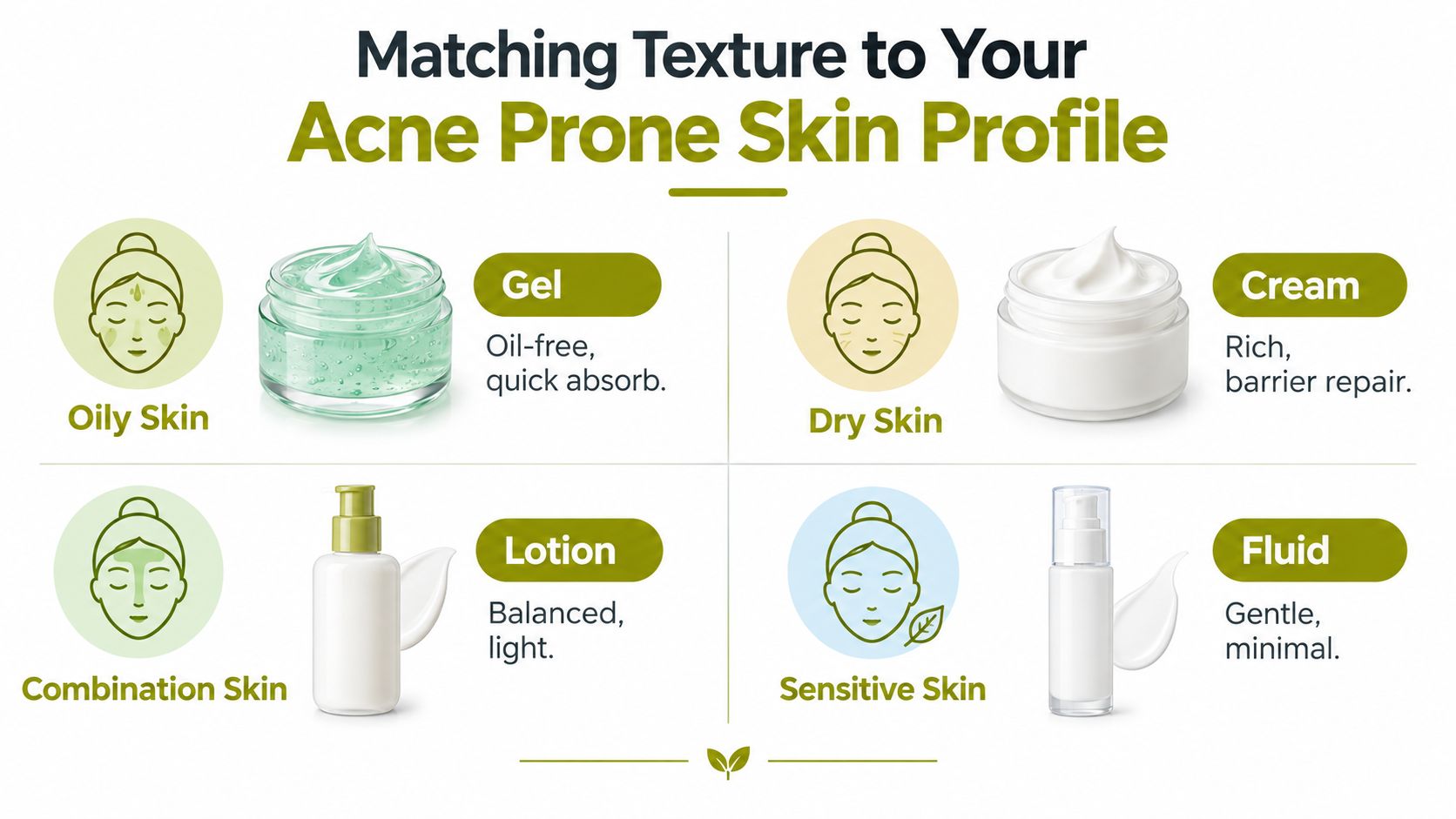
NHS-aligned guidance recommends a gentle, mild, fragrance-free cleanser and a moisturizer suited to your skin's texture. It lists gels as an option for acne-prone or oily skin, lighter lotions for normal or combination skin, and greasier formulations for dry to very dry skin (NHS-aligned guidance on acne-friendly skincare).
A quick texture guide
- Oily or shiny skin: A gel may feel light and absorb quickly, especially if creams leave a film.
- Combination skin: A light lotion can offer a middle ground when some areas feel comfortable but others become dry.
- Dry skin: A richer cream may provide more cushioning if lighter textures don't ease tightness.
- Sensitive-feeling skin: A simple, lightweight fluid may be easier to incorporate, particularly when you're trying to keep the routine gentle.
These are starting points, not strict rules. Skin can feel different with weather, cleansing habits, and the products already in your routine. If a gel feels comfortable but leaves your face tight, a lotion may be a better fit. If a cream feels soothing in dry weather but too heavy at another time, you can adjust the texture rather than forcing one product to work year-round.
Use the video below as another visual reference while thinking about texture and routine choices.
Where a Moisturizer Fits in Your Daily Routine
A moisturizer can fit into a simple routine without adding many steps. In the morning, cleanse gently, apply a treatment or serum if you use one, follow with moisturizer, then finish with sunscreen. In the evening, cleanse and apply your treatment as directed, then use moisturizer if your skin needs it.
The order gives each layer a clear place, but comfort matters more than a complicated schedule. If your treatment leaves your skin feeling dry, applying moisturizer afterward can help it feel more comfortable. In the morning, let your moisturizer settle before applying sunscreen so the layers feel less likely to mix or pill.
Keep the routine flexible
On a day when you're not using an active treatment, you can cleanse and apply moisturizer directly. If you already use a hydrating serum, apply it before your moisturizer and keep an eye on whether the combined layers feel comfortable. When your skin feels unusually sensitized, avoid adding several new products at once; simplify the routine and consider getting advice from a qualified professional if discomfort persists.
For a different kind of aftercare context, microneedling recovery tips UK offers guidance on caring for skin following a professional procedure. That's a separate situation from everyday acne-prone skincare, but it's a useful reminder that product choices may need to change when skin has special aftercare needs.
The American Academy of Dermatology notes that, in studies of acne-friendly moisturizers used alongside an acne medication and cleanser, most patients saw less acne after 4 to 8 weeks of consistent use. That's a realistic window for assessing a routine addition, not a promise that moisturizer alone will clear acne (AAD guidance on moisturizer and acne care). For a routine overview, see ArtNaturals' guide to a skincare routine for acne-prone skin.
A Simple Patch Test Plan You Can Actually Use
A label such as “non-comedogenic” can be a helpful first filter, but it isn't a guarantee that a moisturizer will suit your skin. A 2025 clinical review found that the term lacks standardized regulatory guidelines and may have limited clinical significance. It also noted that common comedogenicity tests, including rabbit-ear models, don't accurately reproduce how ingredients behave on human skin (clinical review of non-comedogenic labeling and testing).
That doesn't make label claims useless. It means you're better off treating them as clues and observing how the finished product behaves on your skin.
Try one product at a time
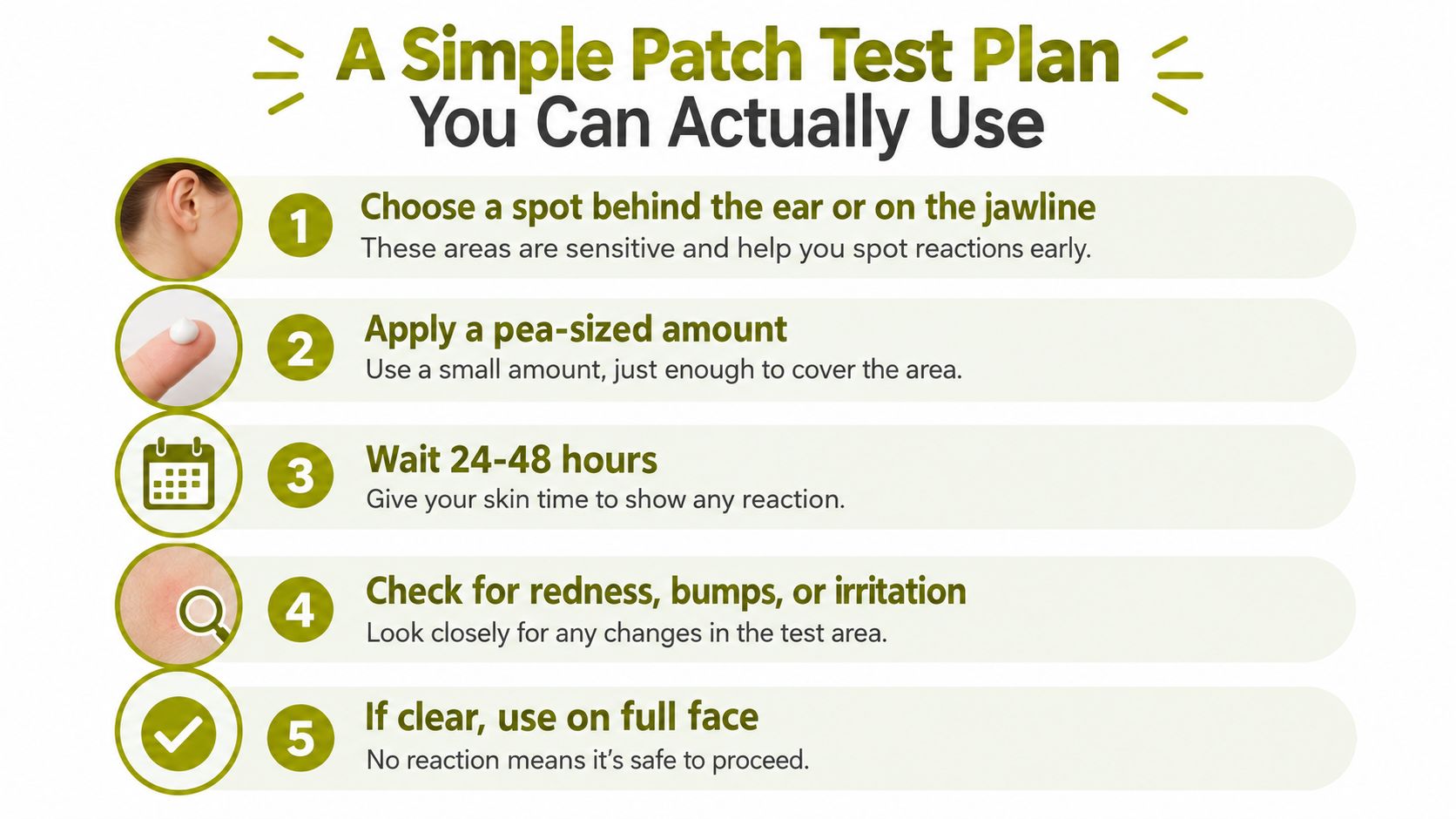
- Choose a test spot: Apply the product to a small area, such as along your jawline or behind your ear.
- Use a small amount: A pea-sized dab is enough to see how the texture feels on the test area.
- Repeat and observe: Use it once a day for several days, watching for both bumps and signs of irritation such as redness, burning, or persistent stinging.
- Keep other changes steady: If you're using an acne treatment, don't introduce multiple new products at once. That makes it easier to tell whether discomfort may be related to the moisturizer or another part of your routine.
- Decide based on your response: If the test area stays comfortable, you can consider using the product more broadly. If irritation appears or you notice a clear pattern of congestion, stop and reassess rather than assuming the label guarantees a match.
A patch test can help you assess early signs of irritation, but it can't predict every possible response across the whole face. If you're unsure whether a change is irritation or a breakout, give your skin's overall pattern more weight than a single bump, and avoid layering on new products to compensate.
Natural or botanical ingredients deserve the same thoughtful evaluation as any others. A plant-derived ingredient isn't automatically gentle or acne-friendly, just as a familiar synthetic ingredient isn't automatically unsuitable. The whole formula, how you apply it, and your skin's response are the more useful guides.
Putting It All Together for Your Next Purchase
Before choosing a moisturizer, notice how your skin feels after cleansing and treatment. Tightness or flaking may point toward a need for more comfortable hydration, while a heavy, lingering finish may suggest trying a lighter texture. Skin can need moisture even when it looks shiny, so judge by how it feels as well as how it looks.
Next, choose by texture and ingredient role rather than relying on a single label. A gel, lotion, or cream can each make sense depending on your skin's comfort and the rest of your routine. Look at the formula as a whole, then test a new product carefully instead of introducing several changes together.
Finally, give your routine time to settle before drawing conclusions. A moisturizer is one supportive part of everyday self-care, not a one-product solution or a replacement for treatment. Keeping your routine simple and paying attention to your own skin makes it easier to decide what belongs in it.
ArtNaturals offers skincare alongside haircare, bath and body, and wellness essentials, including its Hyaluronic Face Moisturizer for facial hydration. Explore ArtNaturals to browse skincare by concern and ingredient, and choose a moisturizer that fits your routine and the way your skin feels.