

You've washed your hair, followed with conditioner, and still ended up with dry ends, tangles, or curls that feel rougher than they did before the shower. Shampoo removes buildup, but the washing process can also leave vulnerable lengths feeling stripped. Pre-pooing hair adds a protective step before cleansing, yet it isn't a universal solution for growth, scalp concerns, or every texture.
Pre-pooing means applying an oil or conditioning treatment before shampooing. Used thoughtfully, it can help protect the hair fiber, reduce some washing-related stress, and make detangling feel gentler. The best routine depends on your hair's texture, porosity, processing history, and scalp condition.
What Pre Pooing Hair Actually Is
The name sounds more complicated than the practice. Pre-pooing is a pre-shampoo treatment, usually an oil applied to dry or lightly damp hair before cleansing. You work it through the lengths, allow it to sit, and then shampoo the scalp. The treatment doesn't replace washing. It prepares the hair for it.
This sequence has deep roots. A 2022 review of hair-oiling traditions describes oiling as an indigenous practice used in India and other parts of the world, often involving combing, applying oil from roots to tips, braiding, and washing afterward. Traditional routines associated oiling with shine, volume, and protection, but those cultural claims shouldn't be confused with proof that oil reverses hair loss, changes graying, or accelerates follicle growth.

Why the pre-wash step can help
Water and cleansing agents make the hair fiber swell during washing. Repeated swelling and drying can contribute to wear sometimes described as hygral fatigue. A suitable oil can reduce how readily water and surfactants move into the fiber, while also helping preserve some of the hair's lipid protection.
The clearest evidence concerns coconut oil and protein loss. In a Journal of Cosmetic Science experiment, coconut oil was the only tested oil that consistently reduced protein loss in both undamaged and damaged hair, performing better than mineral and sunflower oils in that test. In one comparison, normal hair measured approximately 13.1 micrograms per gram with coconut oil versus 203.02 micrograms per gram without it, while bleached hair measured approximately 304.8 versus 466.0 micrograms per gram (study details).
That finding supports a modest, useful conclusion: pre-pooing may help manage breakage associated with washing and grooming. It doesn't show that oil makes hair grow faster, treats a scalp disorder, or works identically for every hair type.
Practical rule: Think of pre-pooing as protection for the hair fiber, not treatment for the scalp or follicles.
If you're building a broader personal-care routine and want general educational resources about hair and skin care, you can explore LMI patient guides from Longevity Medical Institute.
Step-by-Step Guide to Applying Oil Before Shampoo
A successful pre-poo uses less product and more control. Saturating the hair or scalp doesn't create extra protection. It usually creates more residue to remove.
Start with sections
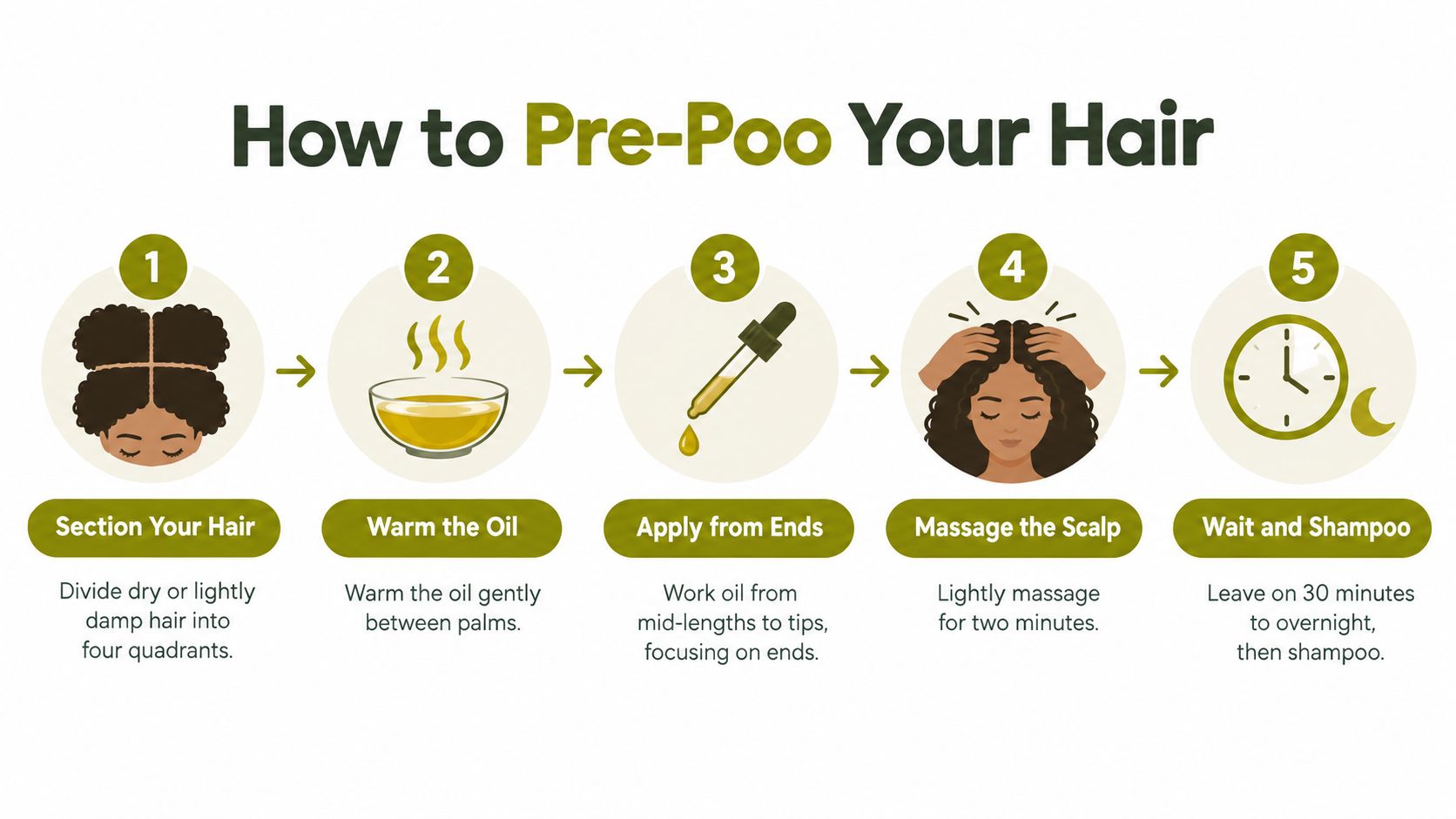
Begin with dry or lightly damp hair. Divide it into manageable sections so you can reach the underside and ends without pulling through a large mass of hair. Sectioning also makes it easier to notice which areas are especially dry, porous, or prone to tangling.
Warm a small amount of oil between your palms. Don't heat it until it's hot. Gentle warmth from your hands is enough to spread the oil more evenly and helps you avoid applying one heavy patch.
Apply where the hair needs support
Smooth the oil from the mid-lengths to the ends, giving the oldest, driest tips the most attention. Use your fingers to glide down each section rather than rubbing briskly. If your scalp is oily, flaky, acne-prone, or easily irritated, keep the application off the scalp.
Coconut oil is the most directly studied starting point for reducing protein loss during washing. Research using secondary-ion mass spectrometry found that coconut oil penetrated the hair shaft and cortex, while mineral oil did not. The same research reported that coconut oil reduced hair-fiber swelling by 48%, compared with 33% for mineral oil (hair penetration research).
Use gentle finger detangling after application. Begin at the ends and move upward only as the section loosens. Oil can add slip, but it doesn't make forceful brushing safe. If a knot resists, separate it with your fingers instead of dragging a brush through it.
Cleanse the scalp first
Allow the oil to sit before washing, then apply shampoo mainly to the scalp. Massage the cleanser over the roots and let the rinse carry it through the lengths. This follows dermatology guidance on scalp-focused shampooing, which emphasizes removing oil, dead skin, and buildup where they accumulate while limiting unnecessary drying along the hair shaft.
Rinse thoroughly. Repeat shampoo only if residue remains. The lengths don't need repeated scrubbing just because they received oil.
For more routine ideas, see ArtNaturals' hair oiling routine. Keep the central principle in mind: apply lightly, handle gently, and judge the result after the hair is clean and dry.
Choosing the Right Oil for Your Hair Type
The same spoonful of oil can feel protective on dense curls and coating on fine, straight hair. Hair density, strand diameter, porosity, chemical processing, and wash products all change the experience. Choosing an oil is less about finding a universal favorite and more about observing how your own hair responds.
Fine and low-porosity hair
Fine hair often becomes limp when a product forms a heavy film. Low-porosity hair may also resist absorbing richer oils, leaving the surface slick while the interior still feels unchanged. Start with a very small amount and consider a lighter-feeling option such as jojoba or grapeseed oil.
Keep the application concentrated on the ends. If the hair looks stringy after washing, feels coated once dry, or needs unusually forceful cleansing, the oil is probably too heavy, the amount is too large, or the treatment is too frequent.
Thick, coarse, or porous hair
Dense curls, tightly coiled hair, and highly porous or chemically treated lengths may tolerate a richer texture more comfortably. Olive oil and castor oil can feel more substantial, but “heavier” doesn't automatically mean “better.” A rich oil may support softness in one routine and create difficult buildup in another.
Coconut oil has the strongest directly relevant evidence among the options discussed here, but the research doesn't establish that every plant oil behaves the same way. Analytical work indicates that penetration varies with triglyceride structure. Some oils penetrate aspects of the hair's lipid-rich cell-membrane complex, while others remain more surface-focused.
| Hair situation | Starting approach | Watch for |
|---|---|---|
| Fine or low-porosity hair | Use a light application on the tips | Limpness, coating, difficult rinsing |
| Dense curls or coils | Work carefully through sectioned lengths | Uneven coverage and residue |
| Bleached or porous hair | Prioritize fragile lengths and ends | Excessive softness, brittleness, or buildup |
| Oily or irritated scalp | Keep oil away from the scalp | Itching, scaling, odor, or follicle bumps |
A strand test helps prevent a full wash-day disappointment. Apply a small amount to one hidden section, wash as usual, and assess softness, movement, residue, and manageability after drying.
For additional ingredient comparisons, you can read ArtNaturals' guide to the best oils for hair growth, while keeping your expectations grounded. Pre-pooing may support the condition of existing hair. It isn't an established way to speed follicle growth.
Timing, Frequency, and Heat Variations
Pre-pooing works best when its timing matches your hair's condition. A brief application can coat the fiber before cleansing, helping reduce friction and washing-related stress. Very dry or chemically treated lengths may tolerate longer contact, but extra hours do not guarantee extra benefit.
The 2003 coconut-oil experiment described in the definition section used roughly 3 milliliters of oil and about eight hours of contact before washing. That protocol helps explain the research design, not a universal home routine. Your hair may need far less oil and time.
A sensible starting rhythm
Try the routine approximately once weekly, then assess how your hair responds over several wash days. No single frequency suits everyone. Treat your hair and scalp like feedback gauges:
- Keep the routine: Hair feels soft, flexible, and clean without a film.
- Reduce the amount: Hair feels heavy, flat, or difficult to style.
- Reduce the frequency: Residue returns before the next wash.
- Stop applying oil to the scalp: Itching, burning, scaling, odor, bumps, or increased shedding appear.
Oil that remains on the hair can lead to stronger cleansing, which may undermine the protective purpose of pre-pooing. A scalp that is already irritated may worsen with added oil, so apply it to the lengths instead or pause the practice.
Heat is optional
Heat is not required. Mild warmth may help oil spread, while high temperatures can add thermal stress. Some lab work suggests heat may reduce capillary adhesion for coconut and sunflower oils, so it should not be treated as a shortcut to deeper care.
Use warm hands, a comfortably warm room, or a gentle towel wrap instead of a hot tool. Never place heated oil directly on the scalp. Remove the wrap if your scalp feels hot, itchy, or uncomfortable.
For practical timing ideas, read this guide on when to apply oil on hair. Choose the shortest contact period that leaves your hair comfortable and easy to cleanse.
Building a Sustainable Pre Poo Routine
A routine becomes sustainable when it fits your real wash day. You don't need a complicated oil blend, a long waiting period, or a strict schedule. You need a repeatable sequence that protects the lengths without creating a new scalp or buildup problem.
Start by writing down three observations after each treatment:
- How did the hair feel while applying the oil? Did it spread easily, or did you need too much?
- How did it wash out? Did one scalp-focused shampoo remove the residue?
- How did it behave when dry? Was it soft and flexible, or limp, coated, brittle, or unusually tangled?
Those observations are more useful than a label promising universal results. If your hair changes with the seasons, adjust the amount and placement rather than automatically adding more product. A dry-feeling winter routine may not suit a humid period, and a style that keeps the hair tucked away may require a different cleansing approach than loose, frequently manipulated hair.

Let the scalp set the boundaries
Hair-fiber protection and scalp care are separate decisions. Coconut-based oils have shown promise for reducing surfactant-related porosity and improving measured break stress and toughness in hair-fiber testing, but that doesn't make scalp oil a treatment for dandruff or seborrheic dermatitis.
The Canadian Dermatology Association cautions that scalp oil can accumulate and may attract yeast. That matters if you have an oily scalp, dandruff, acne-prone hairline, protective styles, or a history of irritation. Applying oil only to the lengths may preserve the protective part of the routine while reducing scalp residue.
Stop the scalp application if you notice itching, burning, scaling, odor, follicle-like bumps, or increased shedding.
If thinning is one of your concerns, consider broader lifestyle and scalp-care information such as diet and scalp care for thinning hair from ProMD Health Ashburn Med Spa. Pre-pooing can support the feel and resilience of existing lengths, but it shouldn't be presented as a solution for hair loss.
Keep the ritual simple
A practical routine might look like this:
- Before washing: Section dry or lightly damp hair.
- During application: Use a small amount from mid-lengths to ends, then detangle with low tension.
- Before cleansing: Allow the oil to sit comfortably without aggressive heat.
- In the shower: Shampoo the scalp and repeat only if residue remains.
- After washing: Assess softness, movement, washability, and scalp comfort.
Clean, plant-based oils can fit a complete approach when you choose transparent ingredients and use them sparingly. The mindful part isn't the promise of a dramatic transformation. It's taking a pause to handle your hair according to its actual needs.
ArtNaturals offers plant-oil haircare options, including pre-shampoo treatments and oils that can fit into a length-focused pre-poo routine. Visit ArtNaturals to explore ingredient-focused haircare and choose a simple product to test on a small section before making it part of your wash day.