

You unwrap a bar of soap, notice its warm colour and faint nutty scent, and expect a softer wash because it contains shea butter. That expectation makes sense, but it leaves out the most important part of the story. A raw shea butter bar may feel rich and creamy, yet its comfort depends on the finished formula, including its alkalinity, superfat level, fragrance, and how you use it.
Raw shea butter soap sits at the meeting point of traditional plant processing and straightforward soap chemistry. Understanding that distinction helps you choose a bar for the right routine, interpret “natural” claims more carefully, and recognise when a gentler-feeling cleanser may suit you better.
What Raw Shea Butter Soap Actually Is
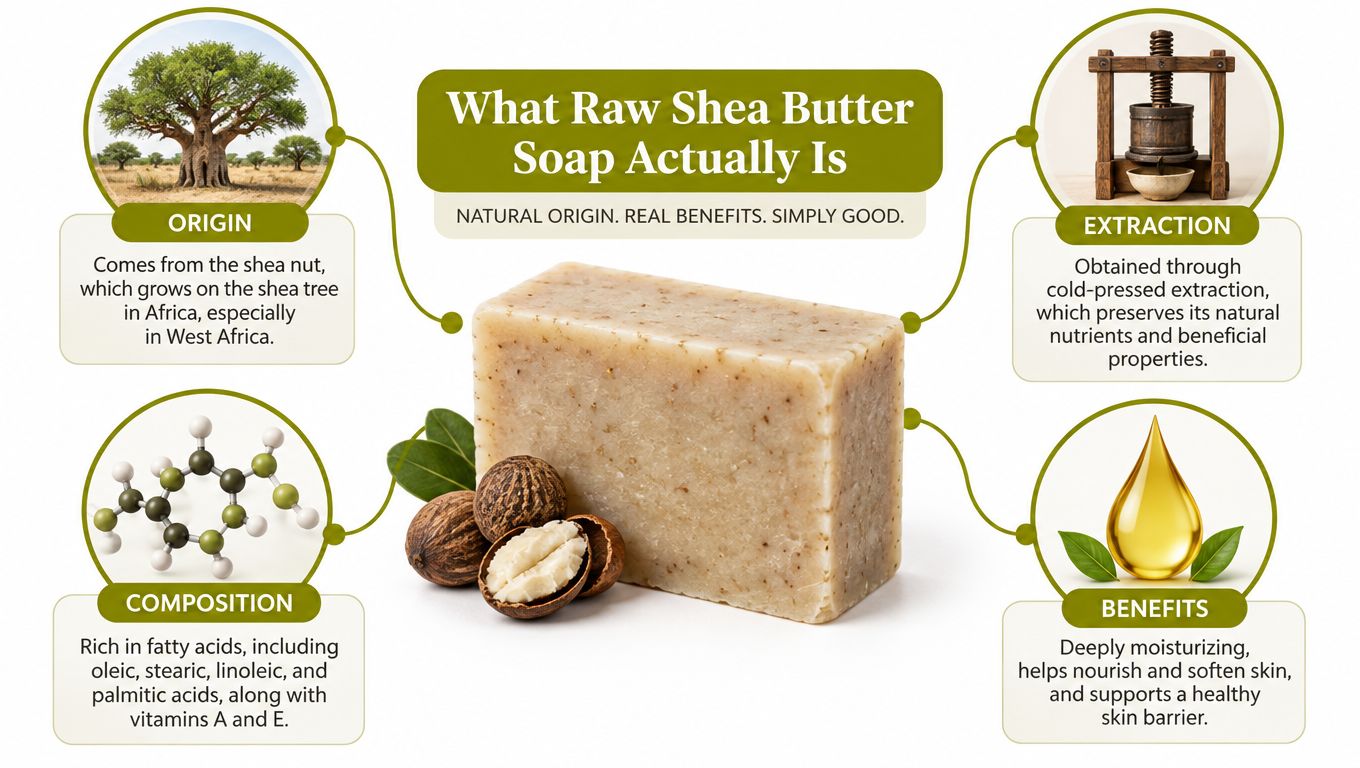
You reach for a bar labelled “raw shea butter soap” expecting a softer, more nourishing wash. Its warm colour and faint earthy scent may support that impression, but the label does not reveal the whole formula. Shea identifies one ingredient. Soap describes a chemical process and the cleansing salts it produces.
Raw shea butter is the fat extracted from shea seed kernels. Those kernels contain approximately 55% fat, according to the Food and Agriculture Organization's history of shea use. “Raw” generally indicates limited processing, so the butter may retain more of its original colour, aroma, and unsaponifiable components than a highly refined version.
Raw butter by itself is not soap. A soapmaker combines fats with water and an alkali, usually sodium hydroxide for a firm bar. During saponification, the alkali changes the fats into fatty-acid salts. Those salts are the cleansing agents that surround oily residue, lift it from the skin, and carry it away when you rinse.
The ingredient's origin and processing still matter, but they do not determine the finished bar on their own. A soap's pH, superfat level, fragrance, and complete blend of oils influence how it feels in daily use. Raw shea is therefore better understood as one part of a formulation, not as a guarantee of gentleness.
A tradition older than modern beauty labels
Shea has a long history in West Africa. Evidence cited by the FAO indicates that the shea tree and its products were used in ancient Egypt approximately 4,000 years ago. The Moroccan traveller Ibn Battuta documented shea as a valuable commodity in West African regional trade in 1354, while explorer Mungo Park described it again in 1799. These historical details appear in the FAO reference on shea's history and uses.
Traditional uses included food preparation, soap manufacture, medical care, illumination, and cosmetic care for women and infants. Around the 2000 harvest, approximately 610,000 tonnes of sheanuts were collected across Africa's shea zone. About 10% was exported, mainly to Europe and Japan, while roughly 545,000 tonnes were processed locally into an estimated 131,000 tonnes of shea butter, according to the same FAO source.
Raw shea butter soap is a modern bar shaped by an older, multifunctional shea tradition. Its marketing story begins with the plant, but its washing experience begins with chemistry.
Raw vs Refined Shea Butter
Raw and refined shea butter come from the same plant, yet processing gives them different sensory and formulation qualities. Raw butter is closer to the original ingredient, much like whole fruit compared with filtered juice. It usually keeps more of its natural colour, aroma, and texture. Refining creates a cleaner, more predictable material, while reducing some of that rustic character.
Raw, also called unrefined, shea butter is made with limited heat and filtering. Its colour may range from ivory to pale yellow, and its aroma can be mild, nutty, or earthy. Refined shea butter is commonly bleached, deodorised, and clarified, producing a more neutral colour and scent. A soap maker may choose it for a white bar or for fragrance work that requires a controlled base.
Neither option automatically makes a soap gentler. The finished bar's pH, superfat level, cleansing oils, and complete formula have more direct influence on how it feels in use.
What processing changes
Raw processing may preserve more of the butter's naturally occurring unsaponifiable fraction. These components do not convert into soap during alkali saponification, so they remain separate from the soap salts formed from the fats. The fatty-acid and processing study reports approximately 5–7% unsaponifiable matter in raw shea samples, with variation related to processing method.
Choose labels such as raw, unrefined, or traditionally processed if the original scent and colour matter to you. “Refined shea butter” indicates a more neutral ingredient, although the label may not describe every processing step. The ingredient list shows what the maker used, while sourcing details can clarify how that butter was produced.
Texture also affects product choice. A richer body product feels different from a lighter lotion, and this comparison of body butter versus lotion explains how those formats fit different routines.
| Trait | Raw Shea Butter | Refined Shea Butter |
|---|---|---|
| Appearance | Ivory to pale yellow, with natural variation | More uniform, often pale or white |
| Aroma | Mild, nutty, and earthy | Neutral or nearly scent-free |
| Processing | Limited heat and filtering | More extensive deodorising and clarification |
| Unsaponifiables | May retain more, depending on processing | Can vary after further processing |
| Best fit | Rustic, unscented, or lightly scented bars | Neutral bases and precise fragrance work |
How Raw Shea Butter Becomes Soap
The chemistry becomes easier to understand if you follow the ingredients in sequence.
First, the maker measures fats and oils, including raw shea butter. Shea may be combined with other plant oils because each fat affects the finished bar differently. Some contribute structure, while others influence lather, glide, or the bar's afterfeel.
Next comes the alkali. Sodium hydroxide is common for solid soap, while potassium hydroxide is used for softer or liquid products. The alkali is handled carefully and combined with water before it meets the fats.
Saponification in plain language
During saponification, the alkali breaks apart the triglycerides in the fats. The fatty acids then combine with sodium or potassium to create soap salts. Each soap molecule has a water-attracting end and an oil-attracting end. That two-sided structure lets the molecules surround oily residue so water can carry it away during rinsing.
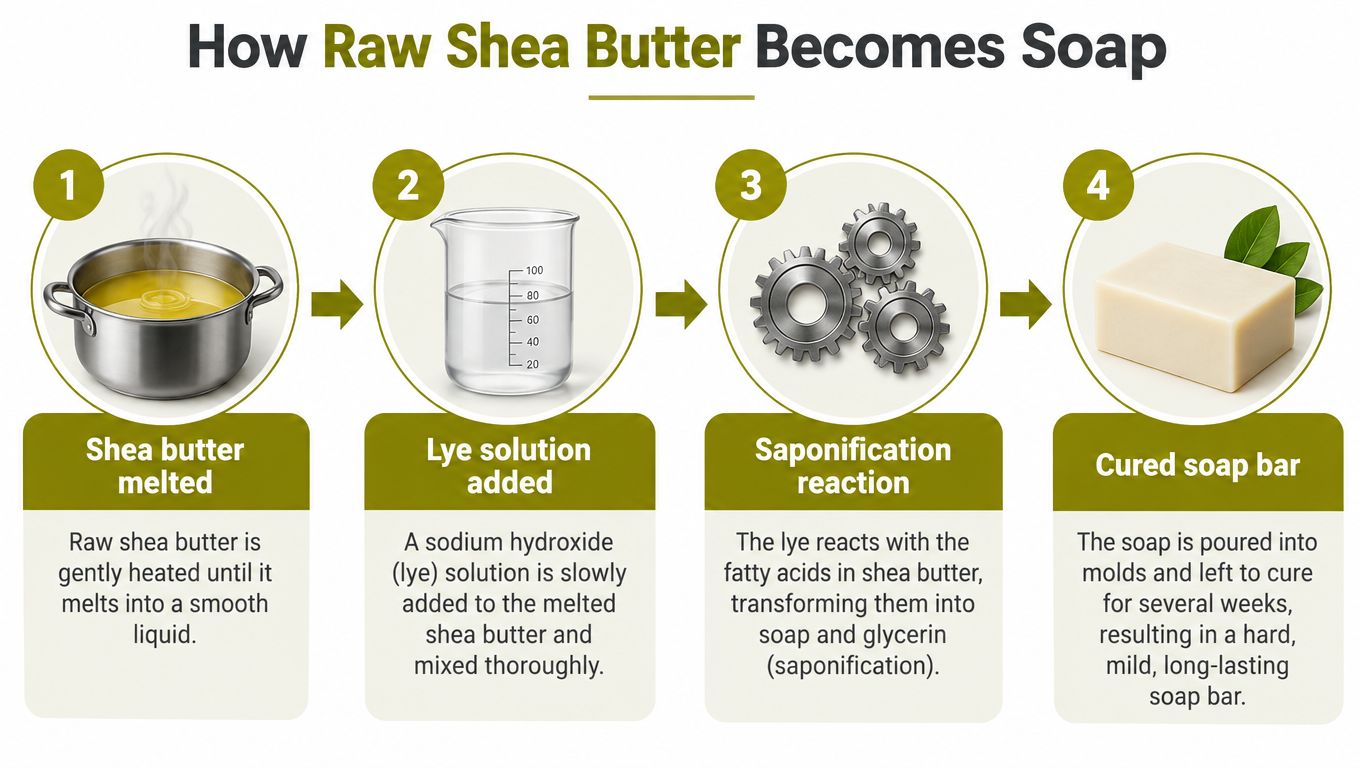
A product fits the traditional soap category under U.S. Food and Drug Administration guidance on soap when its nonvolatile portion consists principally of alkali salts of fatty acids, its cleansing action comes from those salts, and it's labelled and represented only for cleansing.
That definition explains why the word “soap” can be confusing. A bar may contain shea butter but rely mainly on synthetic detergents for cleansing. Such a product is chemically different from a traditional soap, even if its packaging uses familiar soap language.
Read the formula, not just the front label: Shea butter tells you about one ingredient. The cleansing mechanism tells you what kind of product you're actually using.
What Shea Brings to a Finished Bar
A bar can feel creamy at the sink while behaving like any other alkaline soap on the skin. Raw shea butter helps shape that experience, but its presence does not determine the finished product by itself.
Traditionally processed shea samples contain substantial amounts of oleic acid and stearic acid. Oleic acid generally contributes a softer, more conditioning-feeling quality, while stearic acid adds structure. Together, they can help a bar feel firm and produce a dense, creamy lather. The fatty-acid profile describes the butter before saponification, not the final bar in your hand.
During soapmaking, most triglycerides become sodium or potassium fatty-acid salts. The result is a cleanser, not raw butter spread over the skin. Its character depends on the original fats, the alkali, the water content, curing, and the portions of oil or butter the recipe leaves unsaponified.
Texture, hardness, and lather
Raw shea butter also contains unsaponifiable components. They do not become soap during the reaction, and processing can change how much remains. Consistent sourcing and production therefore matter when a maker wants similar texture and performance from batch to batch.
Superfatting adds another variable. A superfatted formula leaves some oils or butter unreacted, which may create a softer, less stripped rinse. The amount affects firmness, scent, and how the bar behaves between uses. A high shea content alone cannot predict those results.
The practical lesson is simple: judge the formula, not the marketing adjective. Check whether the product is traditional soap or a detergent cleanser, then consider its surface pH, superfat level, and full ingredient list. A bar made with raw shea can still feel drying if its overall formulation does not suit your skin.
Raw shea butter is an ingredient, not a guarantee: the finished bar's chemistry determines how it cleans and feels.
For families selecting products for younger skin, bathing habits matter alongside ingredients. These baby skin tips from Little Venture Co. offer routine-focused guidance without reducing comfort to one component.
Raw Shea Bar vs Refined Shea Product vs Syndet
Three products can sit beside one another on a clean-beauty shelf and feel deceptively similar: a traditional raw shea bar, a refined-shea product, and a syndet cleanser. Their labels may all mention softness, moisture, or gentle care, but the base formula determines how each one behaves at the sink or in the shower.
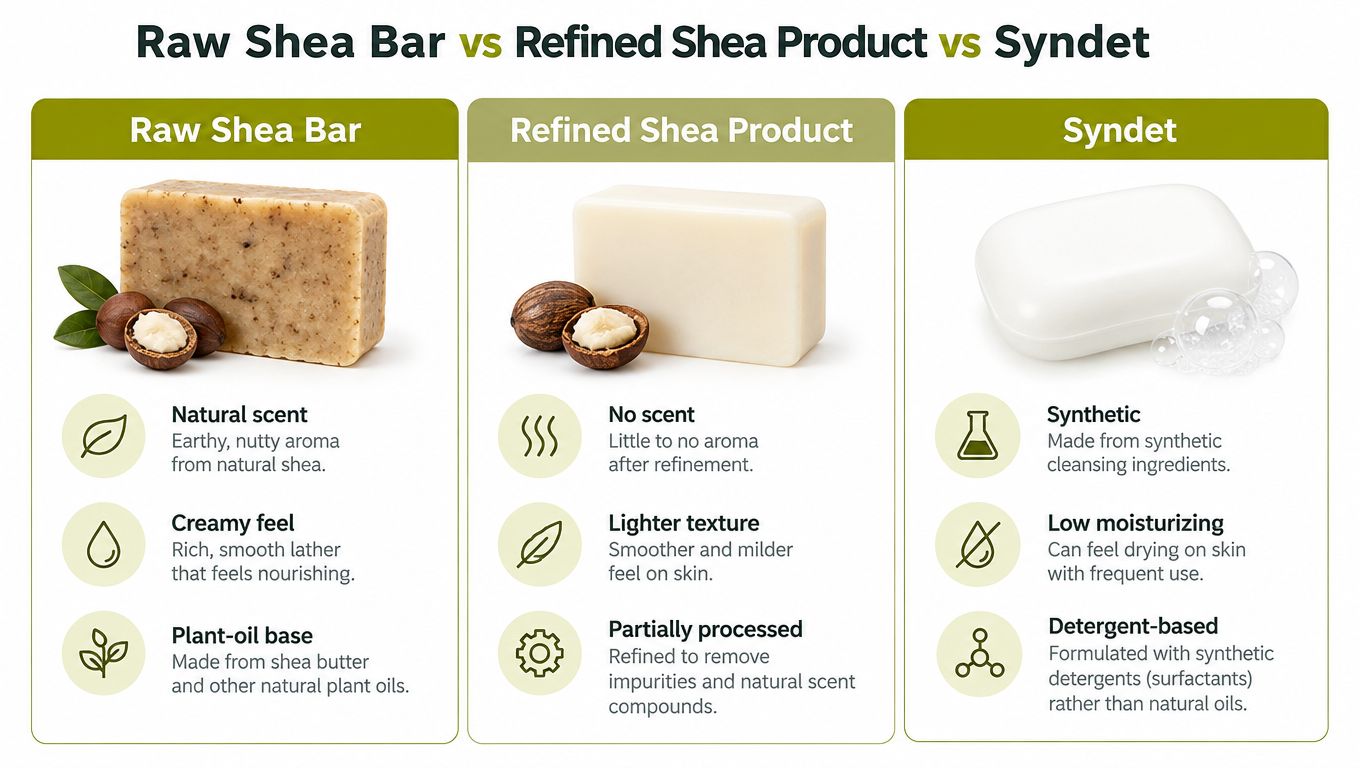
A raw shea bar is usually a traditional alkaline soap made with unrefined shea butter and other plant fats. It may have a natural scent, visible colour variation, and a creamy, substantial lather. The shea contributes to the bar's character, but the product remains an alkaline soap unless the formula has been changed substantially.
A refined shea product may use refined butter in a soap, body cleanser, cream, or balm. Its aroma and colour are more neutral, so it can suit someone who doesn't want a nutty scent competing with fragrance. Its texture still depends on the product type, since refined shea in a balm behaves differently from refined shea in a wash-off bar.
A syndet uses synthetic detergents rather than relying principally on alkali salts of fatty acids. Syndet formulations are often designed around a mildly acidic or skin-compatible surface pH, which can make them a more comfortable choice for facial cleansing or skin that feels easily tight after washing.
| Option | Typical feel | What drives cleansing | Useful routine |
|---|---|---|---|
| Raw shea bar | Creamy, earthy, and substantial | Alkali salts of fatty acids | Hands, body, or an evening shower |
| Refined shea product | More neutral in scent and appearance | Depends on the full formula | Fragrance-sensitive routines or neutral-feeling care |
| Syndet cleanser | Often milder and less soap-like | Synthetic detergents | Face washing or a low-tightness rinse |
The choice doesn't need to become a verdict on natural versus synthetic. A traditional bar may be exactly what you enjoy for hand washing, while a syndet may work better for facial cleansing. Ingredient education on related traditional formulas, such as African black soap benefits, can also help you look beyond colour and marketing language when evaluating cleansing bars.
Matching a Raw Shea Bar to Your Skin Type
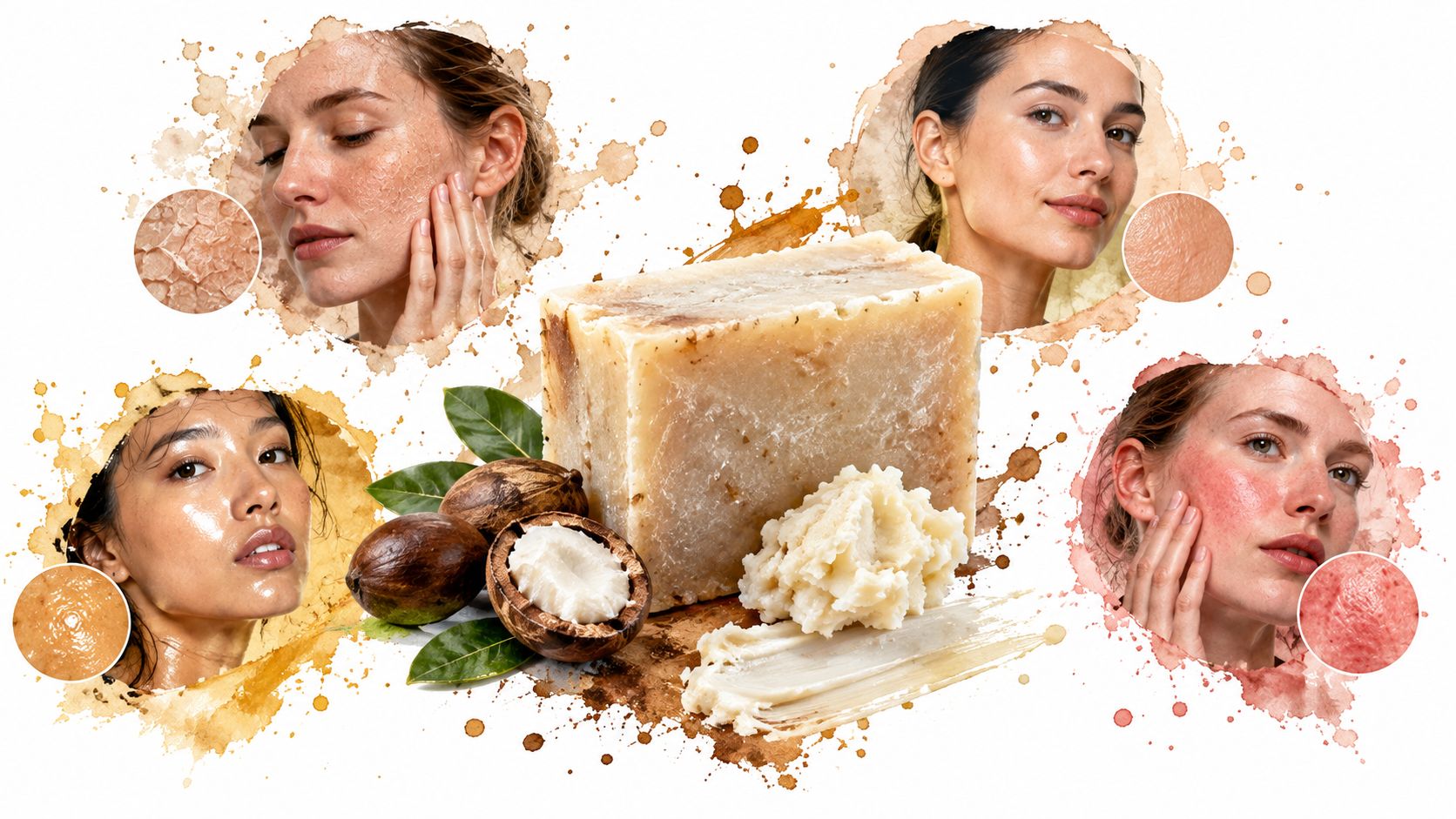
The phrase “sensitive skin” doesn't tell you whether a traditional soap will feel comfortable. The finished bar's pH, fragrance level, superfat, and your washing routine matter more than the raw ingredient's reputation.
Conventional soaps commonly have a pH around 9–10, while normal skin has an acidic surface pH roughly between 4 and 6, with an average near 5.4–5.9, according to the comparative skin-cleansing research. That difference can make an alkaline bar feel tight or drying, especially after hot water, frequent washing, or prolonged lathering.
A separate analysis of 250 cleansers found that all 37 tested soaps were highly alkaline, while the full cleanser range ran from 3.59 to 10.83. Only 12.8% of products disclosed pH, as reported in the cleanser pH analysis. Those findings don't make every traditional bar unsuitable, but they do show why marketing language can't replace formulation information.
A practical comfort check
- Body skin that tolerates soap: An unscented or lightly scented raw shea bar may feel satisfying, especially when the formula is well balanced and superfatted.
- Face or easily tight-feeling skin: A syndet or creamy cleanser may provide a more comfortable everyday rinse than a traditional alkaline bar.
- After a long hot shower: Use less lather, shorten contact time, and notice whether your skin feels tight, rough, or unusually dry afterward.
- When trying a new formula: Patch-test it on a small area first, then stop using it if you experience persistent redness, scaling, or discomfort.
A useful routine is to reserve a raw shea bar for hands or body while choosing a milder cleanser for the face. That approach respects the bar's traditional chemistry without assuming one product must serve every part of your routine.
Choosing and Storing a Quality Bar
Start with the ingredient list, then look for information the list cannot provide. A quality raw shea butter soap should make it reasonably clear whether the butter is raw or refined, whether the bar is traditional soap or a syndet, and what other oils, clays, botanicals, or fragrances shape the formula.
If raw shea butter appears near the beginning of the ingredient list, it may play a meaningful role, although ingredient order alone doesn't reveal the exact percentage. Added oils can change the bar's hardness, lather, and afterfeel. Essential oils and fragrance blends may add a pleasant scent, but a heavily scented bar won't suit everyone.
Questions worth asking before buying
- What kind of cleanser is it? Look for fatty-acid salts in a traditional soap, or detergent ingredients in a syndet. The word “soap” by itself isn't enough.
- Is the butter raw or refined? Raw butter usually brings more natural colour and aroma. Refined butter creates a more neutral base.
- Does the maker disclose testing? Finished-bar pH, free alkalinity, and irritation testing can offer more useful information than broad “moisturising” language.
- Can you trace the shea? Named origin, producer partnerships, cooperative relationships, and details about processing are stronger signals than “natural” alone.
- Does the scent fit your routine? An unscented bar may be a simpler choice if you already use fragranced lotions, oils, or laundry products.
For readers interested in how an additional botanical ingredient can change a bar's positioning, this overview of turmeric soap offers a useful example of why the complete formula matters.
Give the bar airflow
Handmade soap softens when it sits in water. Store it on a draining dish or slatted tray, away from the direct shower stream. Letting air circulate around the bar helps it dry between uses and keeps the surface from becoming unnecessarily mushy.
Don't leave a bar in a sealed container while it's still damp. If you travel with it, allow it to dry before closing the case. These small habits protect the bar's structure and make the cleansing experience more pleasant from one wash to the next.
Sustainability and the Shea Story
“Plant-based” doesn't automatically mean sustainable. Shea grows within environments that support people, trees, agriculture, and local trade, so the ingredient's future depends on how those relationships are managed.
The FAO reports more than 500 million fruiting shea trees across the production belt and estimates annual shea-nut production at approximately 600,000 tonnes. Around 4–5 million women participate in collecting, processing, and marketing shea nuts and butter, and shea-related activity provides roughly 80% of their income, according to FAO-linked shea supply-chain analysis.
The trade is also concentrated in West Africa. Other FAO-linked estimates place West African shea exports between 265,000 and 445,000 tonnes annually, while one assessment describes approximately 600,000 tonnes harvested, with 350,000 tonnes exported, mostly as raw nuts, and 250,000 tonnes processed and consumed locally. Industrial cocoa-butter-equivalent industries account for approximately 90% of West African shea exports, with cosmetics and pharmaceuticals taking much of the remainder, as described in the same FAO-linked source.
Look at the landscape, not just the label
The FAO notes that less frequent rainfall and rising temperatures have negatively affected shea-nut harvesting in Burkina Faso. It also reports that agricultural land can have very low shea-tree density, while old fallows may contain more mature trees and new fallows may contain many saplings, as explained in the FAO overview of shea-tree management.
That makes sourcing questions meaningful. Ask where the butter comes from, whether the maker can describe its traceability, how producers are involved, and whether harvesting and land-management practices support continued tree regeneration. A thoughtful raw shea butter soap purchase connects everyday cleansing with a much larger rural economy, but the strength of that connection depends on what the brand can document.
ArtNaturals offers plant-focused skincare, bath and body products, essential oils, and soaps designed for simple everyday self-care. If you're looking for a raw shea butter soap and want to explore ingredient-led options from the same clean-care range, visit ArtNaturals and compare products by formula, routine, and skin comfort.