

Have you ever wondered whether rosemary castor oil helps hair grow, or whether castor oil makes existing hair look shinier and feel softer? That distinction matters. A rich, glossy blend can support a thoughtful hair-care routine, but its appearance on the bathroom shelf doesn't prove that every ingredient contributes to new growth.
Rosemary and castor oil are often paired because they serve different practical roles. Rosemary oil has limited but relevant human research for a specific pattern of hair loss, while castor oil is better understood as a dense conditioning ingredient that can improve slip, shine, and manageability. This guide focuses on everyday beauty and self-care, with realistic expectations, careful application, and attention to how your scalp and hair respond.
Introduction to Rosemary Castor Oil
Rosemary castor oil usually refers to a blend of castor oil with rosemary essential oil or rosemary-infused oil. The combination appeals to natural beauty enthusiasts because it brings together a lightweight aromatic botanical with a thick, protective oil. Used thoughtfully, the blend can become part of a pre-wash routine, a scalp massage, or a small amount of conditioning care for dry lengths.
The two ingredients shouldn't be treated as interchangeable. Rosemary is the ingredient with the more direct, though still narrow, hair-related research, while castor oil mainly supports the feel and appearance of the hair fiber. That means a softer texture, more shine, and less friction are different outcomes from producing new hair.
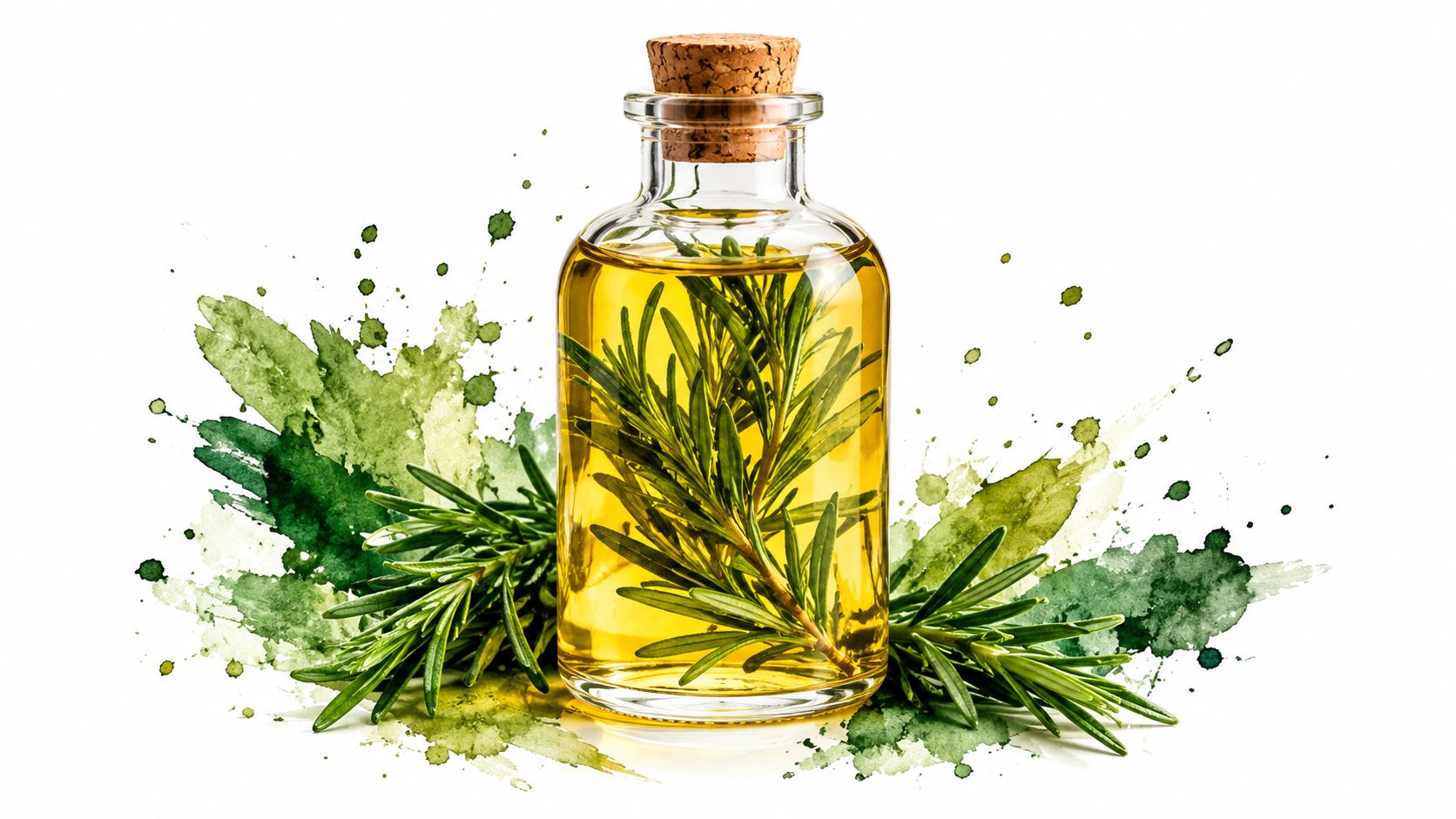
Practical expectation: Think of the blend as a conditioning hair ritual with limited evidence for a specific rosemary preparation, not as a guaranteed solution for shedding or thinning.
Your routine also needs to match the product. A ready-to-use hair oil isn't the same as concentrated rosemary essential oil, and a heavy castor-based formula may behave very differently on fine, straight hair than on tightly coiled or chemically treated hair. Starting with a small amount makes it easier to judge comfort, buildup, and washability.
Understanding Rosemary and Castor Oil History
Why do these two oils so often get grouped together when their histories point to different strengths?
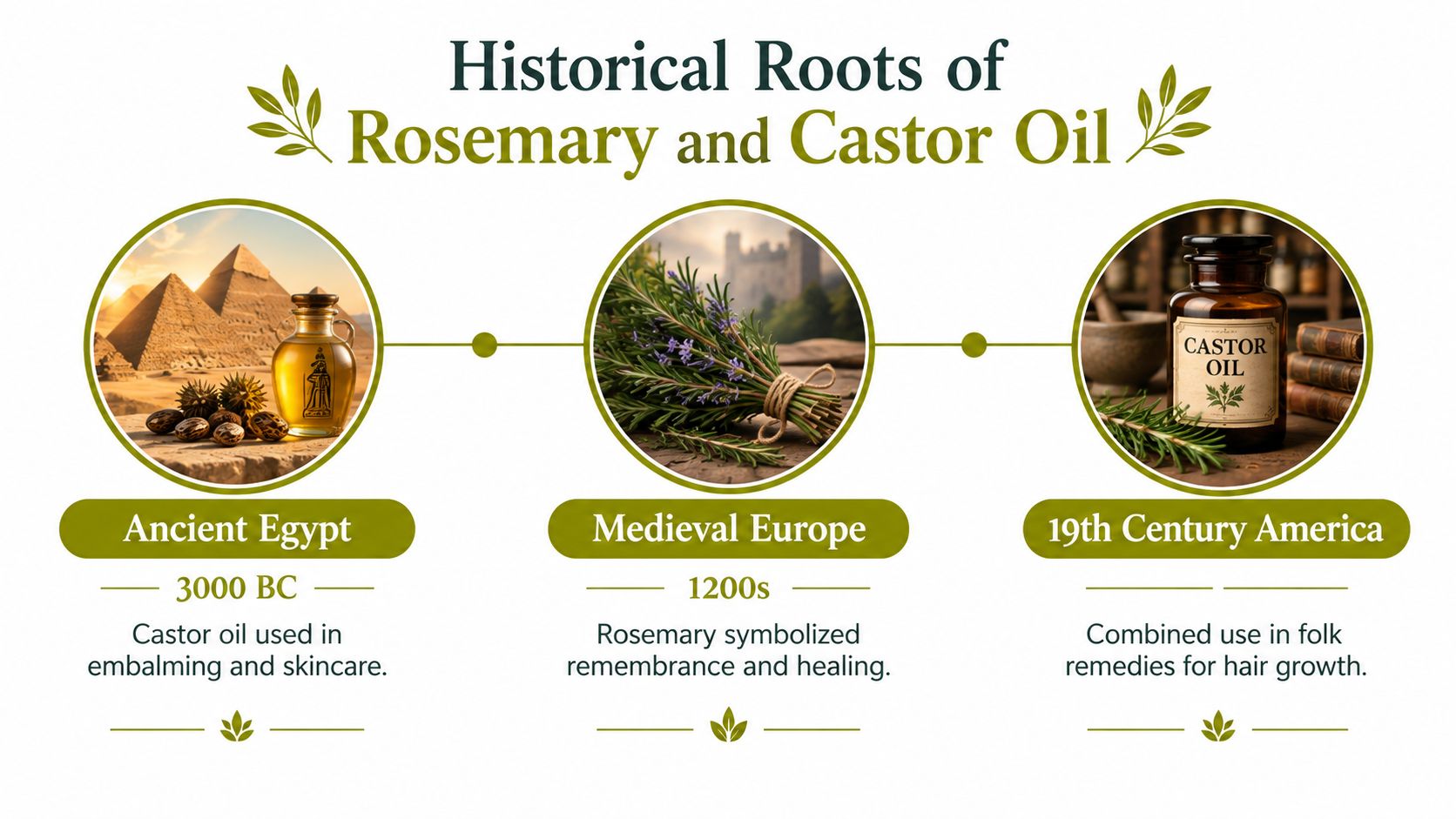
Rosemary entered beauty and healing traditions as an aromatic herb with many uses. A 2020 bibliographical review of rosemary describes ancient Egyptian use of rosemary in creams and oils alongside myrrh, thyme, marjoram, chamomile, and cedar. The same review traces rosemary use in China to approximately 220 BC and notes that physicians such as Hippocrates, Avicenna, and Galen used rosemary flowers and leaves macerated in olive oil for joint pain and wound care.
That background helps explain rosemary's reputation. It does not, by itself, show a modern hair benefit.
Its story continued across later periods. During the 1665 London plague, people inhaled rosemary vapors while passing through infected areas. French hospitals also burned rosemary leaves with juniper berries during World War II in attempts to reduce germs. These examples show how strongly people associated rosemary with cleansing and care, which is different from proving that rosemary supports hair growth in the way current marketing sometimes suggests.
Castor oil as a traded botanical material
Castor oil followed a different path. Instead of building its identity mainly through aroma and herbal tradition, it became widely known as an industrial and commercial plant oil. A technical review of castor oil states that the plant was domesticated in Eastern Africa and introduced from India to China approximately 1,400 years ago. India later became the dominant exporter, accounting for more than 90% of global castor-oil exports, while the United States, European Union, and China together represented 84% of global castor-oil imports.
The same review cites a 2005 industry analysis estimating world castor-seed production at about 1 million metric tonnes, yielding approximately 500,000 tonnes of oil. That scale matters because castor oil has long been used in coatings, lubricants, plastics, pharmaceuticals, and personal care. In other words, castor oil's history says more about supply, texture, and formulation than about hair regrowth.
Rosemary and castor oil meet in modern beauty routines, but their older records do not point to the same function. Earlier rosemary research often focused on anticancer, antioxidant, anti-infectious, central-nervous-system, anti-inflammatory, or analgesic activity. Those research categories do not prove that a rosemary and castor oil blend promotes hair growth. For a modern, hair-focused overview of rosemary, see this guide to rosemary oil for hair growth.
How Rosemary Castor Oil Works for Hair and Skin
What is this blend doing once it touches your scalp and hair? The clearest way to answer that is to separate the ingredient studied for scalp-related hair changes from the ingredient better known for coating and conditioning the hair fiber.
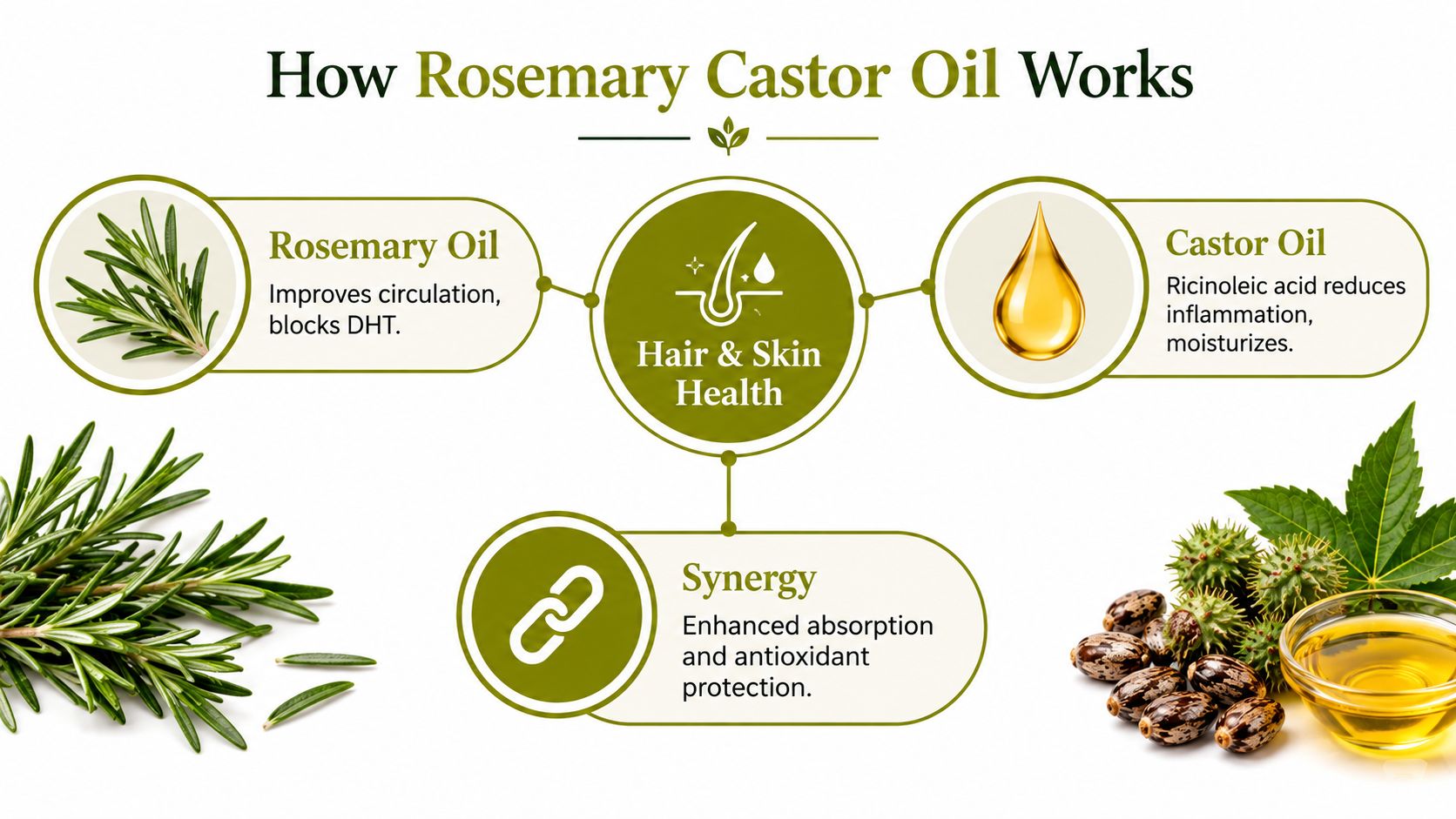
Rosemary oil has been studied in a randomized comparative trial involving 100 adults with androgenetic alopecia, where a lotion containing approximately 1% rosemary essential oil was compared with 2% minoxidil. Both were applied twice daily for six months. Neither group showed a statistically significant hair-count change at three months, but both showed significant increases by month six, and the between-group hair counts did not differ significantly, according to the PubMed trial report.
That result has clear limits. It reflects one rosemary lotion, one type of hair loss, and one schedule of use. It does not show that castor oil adds to the effect, and it does not automatically apply to postpartum shedding, traction-related changes, scarring conditions, or everyday breakage.
What castor oil contributes
Castor oil plays a different role. It is unusually thick because ricinoleic acid makes up approximately 88% to 90% of its fatty-acid profile, as described in the JECFA castor-oil monograph. Linoleic acid contributes about 4% to 5%, oleic acid 2% to 3%, and palmitic and stearic acids about 1% each.
The high ricinoleic acid content helps explain why castor oil feels dense and tacky on contact. That viscosity lets it coat the hair shaft, reduce friction during handling, and increase light reflection, which can make hair seem smoother and glossier. A systematic dermatology review of castor oil found limited evidence for improved hair quality or luster, but not strong evidence for treating hair loss or increasing growth. For a closer look at the conditioning side, see this overview of castor oil benefits for hair.
The same distinction helps on skin. Rosemary is usually discussed for its biologically active plant compounds, while castor oil behaves more like a heavy, occlusive oil that sits on the surface and softens rough areas.
For readers comparing broader treatment options, the Chernoff Cosmetic Surgery hair guide can add context. Used together, rosemary and castor oil may feel complementary, but the evidence points to different jobs rather than a proven special synergy.
DIY Rosemary Castor Oil Infusion Methods
A homemade infusion is different from adding rosemary essential oil to castor oil. An infusion transfers some plant compounds into a carrier oil over time, while an essential oil is concentrated and requires careful dilution. For a first attempt, dried rosemary is easier to manage because fresh plant material introduces moisture into the jar.
Cold infusion
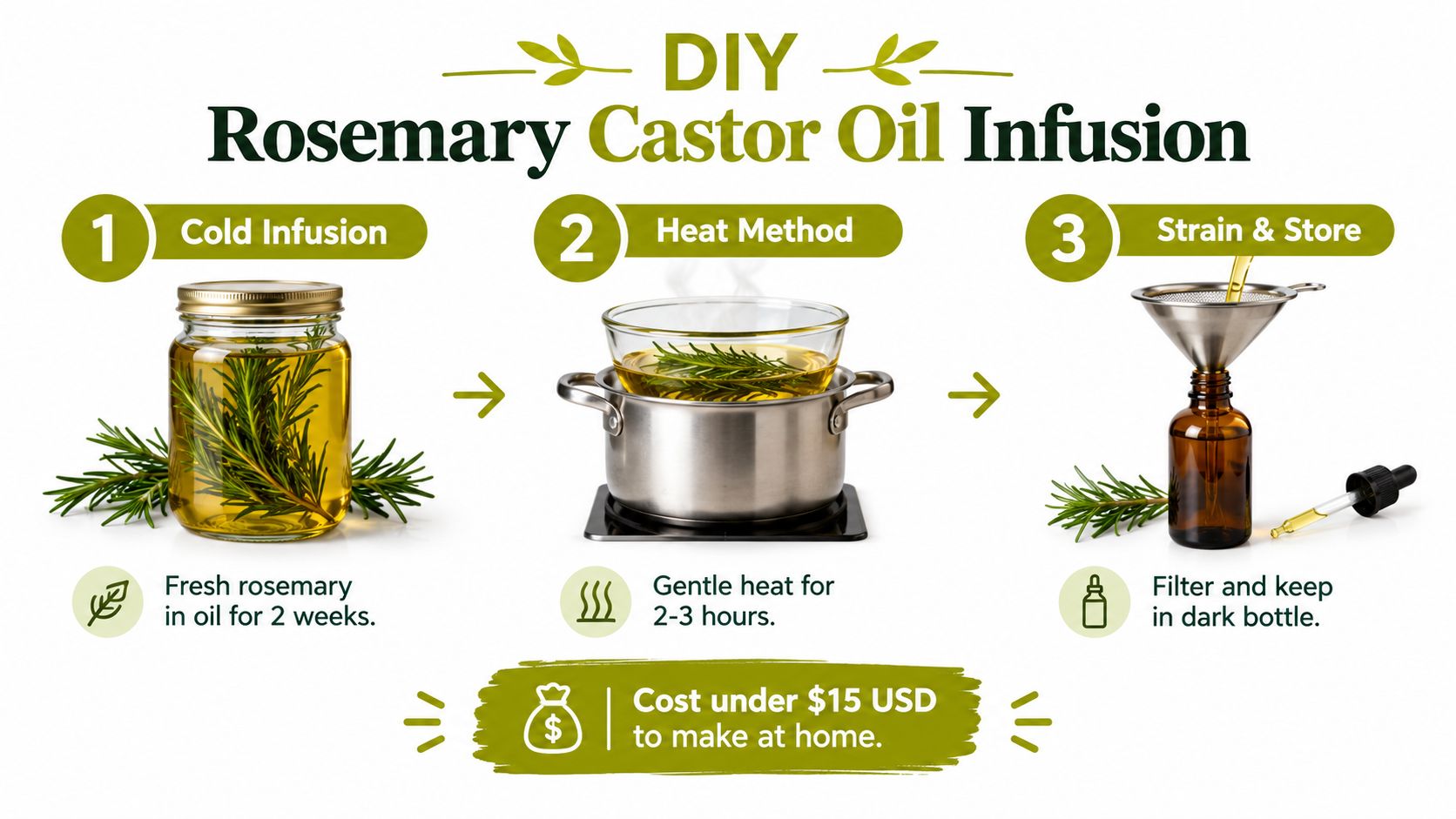
Use a clean, completely dry jar, dried rosemary, and castor oil from a supplier that clearly identifies the ingredient. Fill the jar loosely with the herb, cover it with oil, and keep the container closed in a cool, dark place. Gently turn the jar from time to time, then strain the oil through a clean filter before transferring it to a dark bottle.
The supplied visual describes a cold method using fresh rosemary for 2 weeks, but fresh herbs require extra care because residual water can affect stability. For a simple home routine, dried rosemary is the more cautious choice. Don't use an infusion if it develops an unusual smell, cloudiness, or visible contamination.
Gentle heat method
Place the oil and dried rosemary in a heat-safe container over a water bath or double boiler. Keep the heat gentle and steady, avoiding frying, smoking, or direct high heat. The supplied process visual presents gentle heating for 2 to 3 hours, followed by filtering and storage in a dark bottle.
Label the bottle with the ingredients and preparation date. Store it away from heat and sunlight, and make a small batch rather than keeping a homemade oil indefinitely. Before applying it to your scalp, test a small area and wait to see how your skin responds.
Homemade infusions don't provide a standardized rosemary concentration, so you can't assume they reproduce the preparation used in a hair study. Use them for gentle conditioning and botanical enjoyment, not as a measured active treatment.
Applying Rosemary Castor Oil Safely
Start with the smallest practical amount. Warm a few drops between your fingertips, part the hair, and touch the blend lightly to selected areas of the scalp. If your goal is shaft conditioning, smooth a very small amount through the lengths instead of saturating the roots.
Concentrated rosemary essential oil shouldn't go directly onto the scalp. Cleveland Clinic's guidance on rosemary oil for hair recommends dilution with a carrier oil such as coconut or jojoba oil, applying it to the scalp rather than only coating the hair, and beginning with a small area. The guidance also describes leaving an application on for several hours, often overnight, before washing, while warning that excessive use may contribute to irritation, redness, burning, inflammation, or follicle damage.
Make the routine easier to tolerate
A patch test is a small-area application before broader use. It can't guarantee that irritation won't occur later, but it gives you a sensible first checkpoint. Avoid the eyes, lips, broken skin, and any scalp that already feels sore, inflamed, or unusually sensitive.
Rosemary preparations have documented reports of dermatitis, allergy, and photosensitivity. Topical essential oils may also pose additional risks for susceptible people, including people with epilepsy, as summarized in a review of essential-oil safety.
For dilution guidance, use a clear essential-oil dilution reference rather than guessing. Stop using the blend if you notice persistent burning, swelling, rash, scalp pain, or sudden shedding, and seek medical advice when those symptoms continue.
Castor oil's weight also matters. Fine or oily hair may need less product and a shorter pre-wash session, while textured or chemically treated hair may appreciate a tiny amount on the lengths for slip. If repeated shampooing is needed to remove buildup, the routine may be creating more dryness than comfort.
Choosing Quality Rosemary Castor Oil Products
A product label should tell you what you're applying. Look for the full ingredient list, the form of rosemary used, and whether the formula contains rosemary essential oil, rosemary extract, or rosemary-infused carrier oil. Those terms describe different preparations and shouldn't be treated as identical.
Packaging offers another useful clue. Dark or opaque containers can help limit light exposure, while a secure cap reduces contamination from repeated handling. Transparent sourcing information is helpful too, especially for castor oil, which has applications across personal care and industrial manufacturing.
A practical label check
| Factor | What to Look For |
|---|---|
| Ingredient identity | Clear names for castor oil, rosemary essential oil, rosemary extract, or infused oil |
| Concentration | A stated rosemary concentration when essential oil is included |
| Directions | External-use instructions, application guidance, and dilution information |
| Packaging | A clean, secure container that limits unnecessary light exposure |
| Sourcing | Information about origin, processing, and supplier standards |
| Testing | Third-party testing or quality documentation when available |
| Marketing language | Specific cosmetic benefits rather than promises of guaranteed growth |
Be cautious with vague phrases such as “maximum growth” or “miracle density.” A responsible label separates scalp care, softness, shine, and breakage support from claims about new-fiber production. It should also state that the product is for external use and explain what to do if irritation develops.
If you need clarification, ask the brand about the rosemary form, the complete ingredient list, testing, and storage expectations. ArtNaturals offers a Rosemary & Castor Hair Growth Oil among its hair-oil products, so shoppers can compare its label and directions with other ready-to-use formulations rather than assuming that every rosemary castor oil product has the same composition.
Common Questions About Rosemary Castor Oil
How long does it take to notice a difference?
Cosmetic changes can be easier to notice than growth-related changes. Hair may feel more slippery or look shinier after an application, especially when castor oil smooths the surface. A change in hair count is a different question, and the rosemary trial described earlier found no statistically significant change at three months, with significant increases reported by month six in both comparison groups. Those findings shouldn't be converted into a promise for a homemade blend.
Does it suit every hair type?
The ingredients can be used across different hair textures, but the amount and placement should change. Castor oil is dense, so fine hair may look weighed down quickly, while dry, coarse, tightly coiled, or chemically treated hair may value the added slip on the lengths. A scalp that feels oily or prone to buildup may do better with a lighter formula and careful washing.
Can it be combined with other hair products?
Use the oil as a pre-wash treatment rather than layering it under every styling product. Heavy buildup can make hair feel coated and may lead to more aggressive cleansing. Keep concentrated essential oils out of leave-in products unless the finished formula has been designed and tested for that use.
What if my scalp becomes itchy?
Wash the product out and stop applying it. Don't try to mask burning or redness with another oil, and don't continue just because a product feels “active.” Persistent rash, swelling, pain, or sudden shedding deserves professional attention rather than more experimentation.
Does castor oil make hair grow faster?
There isn't strong evidence that castor oil treats hair loss or increases growth. A recent 90-day randomized trial reported improvements in growth rate, thickness, density, length, and hair fall for a rosemary castor formulation compared with coconut oil, as reported in the PubMed trial record. Because the researchers tested the finished combination rather than rosemary and castor oil separately, the result can't show which ingredient caused the reported changes or whether it applies to every type of hair loss.
Is an infused oil the same as rosemary essential oil?
No. An infused oil contains plant material steeped in a carrier oil, while an essential oil is concentrated. Their strength, composition, and dilution needs differ, so follow the directions for the exact product in your hands.
Final Thoughts on Rosemary Castor Oil Use
Rosemary castor oil makes the most sense when you assign each ingredient a realistic role. Rosemary has more direct, though limited, research support for a specific hair-related outcome, while castor oil mainly contributes conditioning, shine, slip, and surface comfort. The blend may help hair feel more manageable, but that cosmetic effect isn't the same as proven follicle stimulation.
A careful routine starts with a diluted, clearly labeled product or a cautiously prepared infusion. Patch-test first, keep the amount small, avoid broken skin and the eyes, and wash out excess castor oil before buildup becomes a problem. Your hair type, scalp sensitivity, and tolerance should guide the schedule more than an aggressive online routine.
Consistency also means observing, not forcing. Note whether your hair feels softer, whether your scalp stays comfortable, and whether cleansing becomes more difficult. If you develop persistent irritation, scalp pain, swelling, a rash, or sudden shedding, stop using the oil and seek appropriate advice.
ArtNaturals offers plant-oil haircare, including rosemary and castor oil-focused options, alongside shampoos, conditioners, serums, and other self-care products. Visit ArtNaturals to compare ingredient-led choices and build a simple routine that fits your hair's texture, your scalp's comfort, and your everyday care preferences.