

You wake up ready to start the day, cleanse your face, and notice the familiar shine across your forehead and nose. By lunchtime, your T-zone looks even oilier, and the small bumps or visible pores around your nose make you wonder whether a salicylic acid serum for oily skin would bring balance or just leave your face feeling tight.
That question deserves a more thoughtful answer than “choose the strongest formula.” Oily skin can still be sensitive, dehydrated, or easily overwhelmed by too many active products. The right serum depends on more than its percentage. Texture, supporting ingredients, pH, layering, and how consistently you can use it all shape whether a product feels comfortable in your routine.
This guide will help you understand why salicylic acid suits shine-prone skin, compare serum styles, read concentration and pH information, and build a simple ritual that supports both a fresher-looking surface and a comfortable skin barrier. For broader everyday beauty and skin-care ideas, the Vitamin Planet beauty guide offers useful routine context alongside ingredient-focused care.
Introduction to Salicylic Acid Serum for Oily Skin
Salicylic acid has a long-standing place in acne-care guidance. The American Academy of Dermatology acne guideline continues to list it among recommended topical options, with a conditional recommendation and low certainty of evidence. That doesn't make every serum suitable for every person, but it does explain why the ingredient remains familiar in everyday skin care rather than being a passing trend.
For oily and combination skin, the appeal is easy to understand. Shine often gathers where sebum is more noticeable, especially around the nose, forehead, and chin. Salicylic acid is oil-soluble, so it can mingle with oil inside pores and help loosen the buildup associated with blackheads and uneven-looking texture.
A calmer way to set expectations
Think of a serum as one part of a routine, not a quick reset button. A lightweight formula may suit someone who wants a barely-there layer beneath moisturizer and sunscreen. Someone whose skin feels tight after cleansing may prefer a slightly cushioned gel with humectants or ceramides, even if both products contain a similar amount of salicylic acid.
The most useful question isn't “What's the strongest serum?” It's “What can I use comfortably and consistently?” A formula that feels harsh may lead to skipped applications, while a supportive formula can make a simple routine easier to maintain.
A helpful mindset: Oily skin needs balance, not punishment. Reducing surface shine matters, but comfort helps you stay consistent.
What this guide can help you decide
You'll be able to compare watery, gel, and multi-ingredient serum styles, understand the commonly used leave-on range, and choose an introduction plan that respects your skin's response. You'll also see why moisturizer and morning sunscreen still matter when your main concern is oiliness.
Salicylic acid can be a practical, accessible ingredient for congestion-prone routines. The best experience usually comes from pairing it with gentle cleansing, lightweight hydration, and realistic expectations rather than adding several strong products at once.
How Salicylic Acid Supports Oily and Congestion-Prone Skin
Salicylic acid fits oily-skin routines because it works with the kind of buildup that makes pores look congested. Unlike ingredients that mainly sit on the surface, this oil-soluble exfoliant can mingle with sebum in the pore environment. In plain terms, it helps loosen the mixture of oil and dead skin that can make blackheads and rough texture more noticeable.
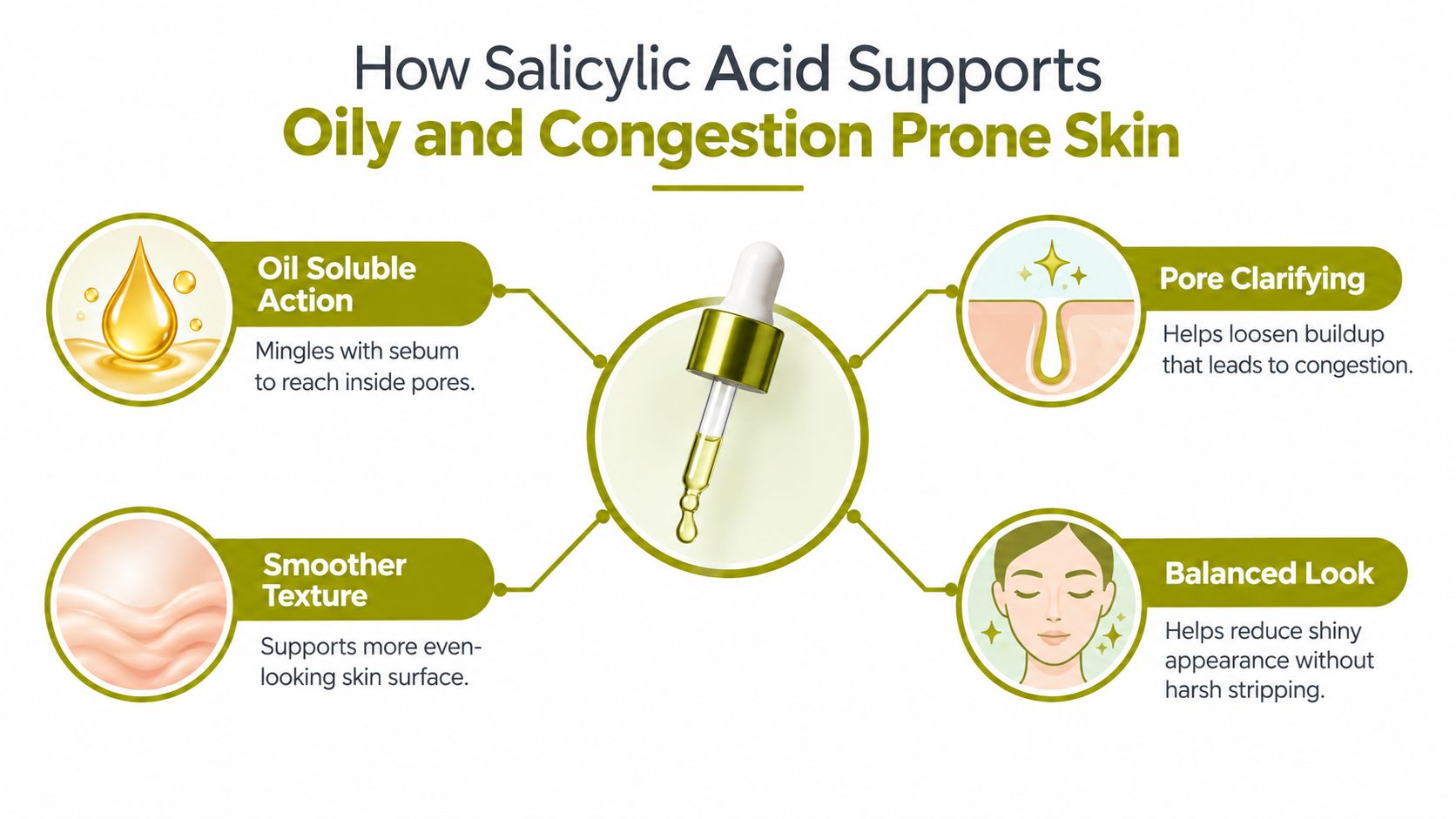
Four ways to understand the ingredient
Oil-soluble action is the starting point. Because salicylic acid is attracted to oil, it makes sense in a routine designed for shine and pore congestion. This doesn't mean it removes every trace of natural oil, and it shouldn't be treated as a way to make skin completely matte.
Pore clarifying describes the everyday cosmetic aim. As buildup loosens, the skin may look less uneven and feel smoother to the touch. Results vary with the formula, the rest of the routine, and how regularly you apply it.
Texture support is another reason people choose a serum. Gentle exfoliation can help the surface feel less rough, particularly when congestion and excess oil appear together. A serum won't replace a complete routine, but it can complement a mild cleanser and a comfortable moisturizer.
A balanced look matters more than a stripped finish. If a product leaves skin tight, hot, or visibly irritated, it may be too much for your current routine, even if your skin becomes shiny during the day.
Why it remains a familiar choice
Salicylic acid has been included in major acne-treatment guidance for years, and its continued presence in Beverly Hills dermatology acne information reflects how commonly it appears in conversations about pore congestion and oily-looking skin. For consumers, it's also accessible in many cleanser, pad, gel, and serum formats.
The ingredient's role is best understood as clarifying and balancing, not aggressively drying. Oily skin still needs water and barrier-supportive ingredients. A routine that removes excess surface oil while preserving comfort is more sustainable than one that chases an instantly powdery finish.
Start by viewing your skin as a changing system. Weather, cleansing habits, stress, makeup, and other active ingredients can all affect how a serum feels. Your routine should respond to that feedback instead of forcing the same intensity every day.
Comparing Salicylic Acid Serum Textures and Formulations
Percentage alone doesn't tell you how a serum will behave on your face. Two products can contain salicylic acid yet feel completely different because of their base, viscosity, humectants, soothing ingredients, and finish. For oily skin, those details influence whether the serum layers neatly or leaves you wanting to rinse it away.
| Serum Style | Texture and Finish | Best Fit Scenario | Consideration for Oily Skin |
|---|---|---|---|
| Watery serum | Thin, fast-spreading, often low-residue | You prefer minimal layers and a quick morning or evening routine | It may absorb quickly, but can feel less cushioned if your skin is easily dried out |
| Gel serum | Slightly viscous, smooth, with more slip | You want a lightweight formula that feels more comfortable during application | It can offer a softer finish without feeling as heavy as a cream |
| Multi-ingredient blend | Varies from fluid to gel, often paired with hydrating or soothing ingredients | Your skin is oily but also prone to tightness or sensitivity | Supporting ingredients may improve comfort, but a longer ingredient list calls for careful introduction |
Watery formulas
A watery serum often suits people who dislike anything that feels rich. It can fit neatly after cleansing and before moisturizer, especially when you want a short routine with minimal waiting between layers. The trade-off is that a very fluid formula may provide less cushion for skin that already feels uncomfortable after washing.
This style can work well for a person who wears sunscreen or makeup during the day and wants a low-residue step. Apply it to clean, dry skin, allow it to settle, and follow with a lightweight moisturizer if your face feels tight.
Gel textures
A gel serum offers a little more body without necessarily feeling greasy. The added slip can make application gentler because you're less likely to drag your fingers across the skin. For oily skin that still needs hydration, this middle-ground texture is often easier to live with than an ultra-thin liquid or a heavy cream.
If you're comparing salicylic acid formats with other exfoliating products, the salicylic acid facial mask guide can help clarify why rinse-off and leave-on experiences feel different. A serum generally becomes part of the routine rather than an occasional mask ritual, so comfort and repeatability matter.
Blends with barrier support
A multi-ingredient formula may include humectants that help attract water or ceramides that support the feel of the skin barrier. These additions don't cancel out the need for gradual use, but they may make the formula more suitable for oily skin that also becomes dry or reactive.
Look for the overall experience. A good fit should spread easily, leave skin comfortable, and work with the moisturizer and sunscreen you already enjoy. If the serum pills, stings, or makes your face feel tight, the problem may be the base or the way it's layered, not just the salicylic acid percentage.
How to Choose Concentration and pH for Your Routine
Reading the label becomes easier when you separate strength from formula performance. Commonly cited leave-on salicylic acid concentrations for over-the-counter products range from 0.5% to 2%, according to the formulation reference from SBCT Labs. The U.S. over-the-counter acne-product ceiling under the FDA monograph is 2%, which makes that range especially relevant when you're comparing everyday serums and spot treatments.
A lower strength can make sense if you're new to exfoliating products, prefer a gentler maintenance step, or notice that your skin becomes tight easily. The 2% benchmark is widely used for mild comedonal acne and congestion-focused routines, but a higher number isn't automatically the better choice for your face.
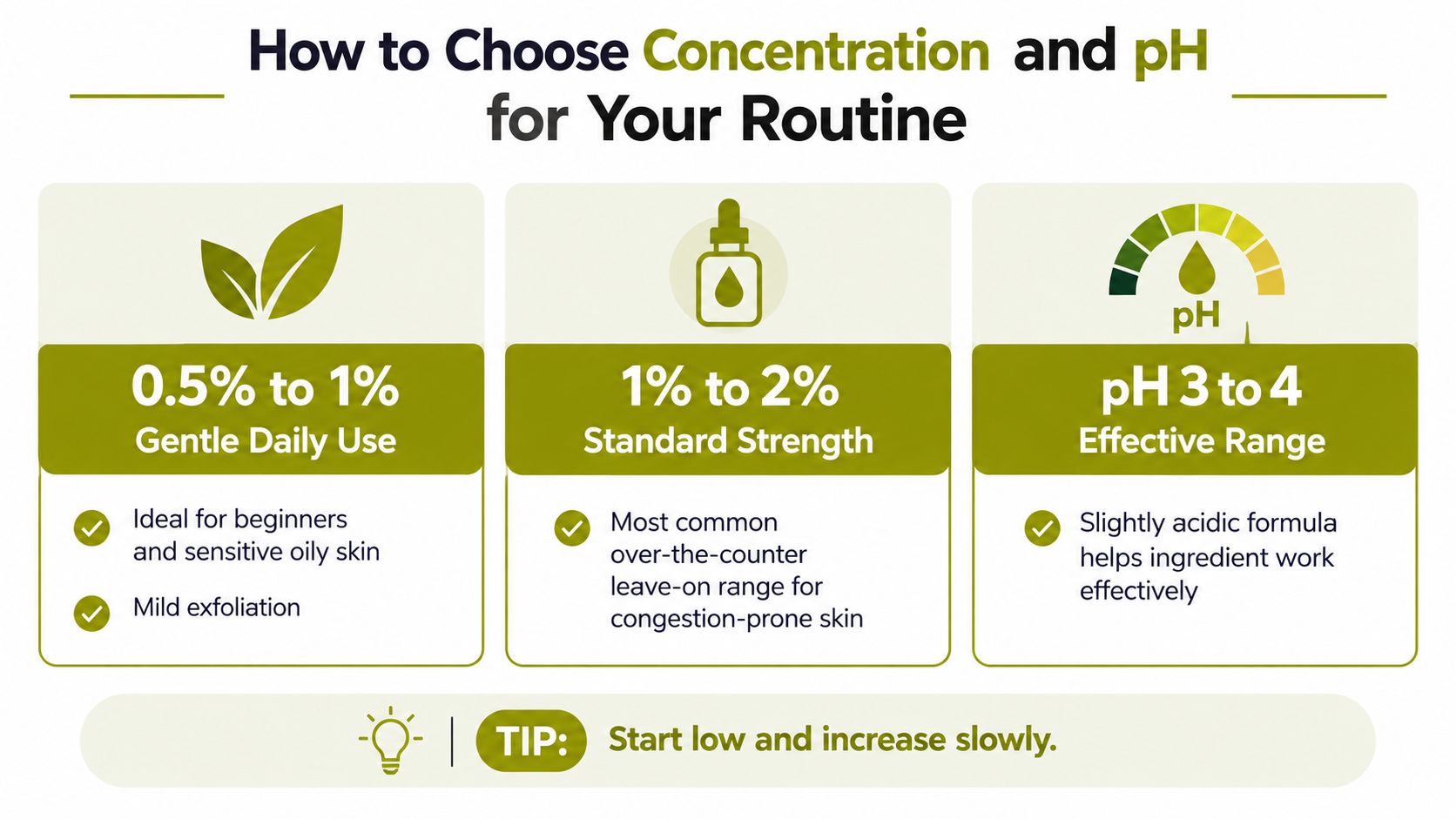
Use the label as a starting point
The following framework keeps the decision practical:
- 0.5% to 1%: A gentler entry point for people who want a lighter exfoliating experience or are concerned about dryness.
- 1% to 2%: The commonly seen leave-on range for oily, congestion-prone routines.
- 2%: A useful benchmark when blocked pores and uneven texture are the main concerns, provided your skin tolerates the formula.
The product's supporting base still matters. A 1% serum with a comfortable texture may be easier to use consistently than a stronger product that makes you pull back from your routine.
Why pH changes the experience
Salicylic acid has a pKa of about 2.97, and it tends to work most effectively in a formula pH window around 3.0 to 4.0, as described in this technical review of salicylic acid formulation. In that slightly acidic range, enough of the ingredient remains non-ionized to move into sebum-rich pores. Above roughly pH 4, exfoliating efficiency can drop materially.
You don't need to turn your bathroom into a laboratory. If a brand provides pH information, a formula around 3.0 to 4.0 is a useful technical reference. If it doesn't, judge the product through its ingredient disclosure, directions, texture, and your skin's comfort rather than assuming the percentage tells the whole story.
Label-reading rule: Choose a strength you can use steadily, then consider pH and the supporting formula before deciding whether you need more intensity.
Using Salicylic Acid Serum in a Balanced Oily Skin Routine
A simple routine gives your skin fewer variables to manage. Start with a gentle cleanser, apply your serum to dry skin, follow with a lightweight moisturizer, and use sunscreen in the morning. This order keeps the serum close to clean skin while preserving a comfort-focused final layer.
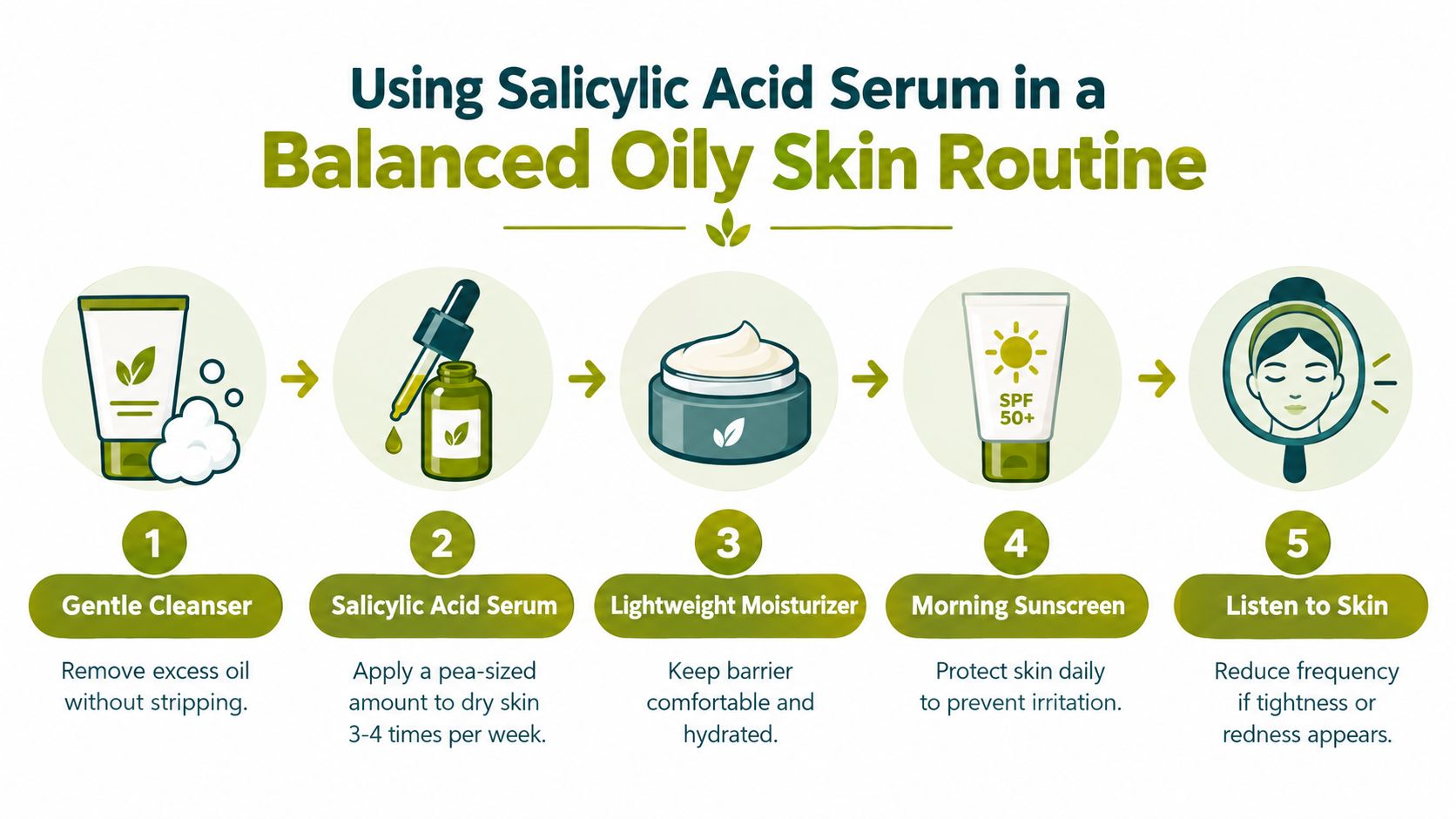
A manageable introduction
The routine shown in the visual uses serum 3 to 4 times per week. That cadence can be a practical starting point, particularly if you're introducing an active product or already use other exfoliating ingredients. Use a small amount on clean, dry skin, then apply moisturizer once the serum has settled.
A minimalist routine might look like this:
- Cleanse with a mild, non-stripping face wash.
- Apply the salicylic acid serum.
- Add a lightweight moisturizer.
- Finish with sunscreen in the morning.
If you already use a salicylic acid cleanser, avoid assuming that adding a leave-on serum is automatically necessary. A face wash with salicylic acid guide can help you think through the difference between a cleansing step and a leave-on step without turning your routine into a long list of actives.
Give the routine time to speak
Clinical evaluation of a facial serum containing salicylic acid and other acids recorded a 30.7% reduction in oiliness after 7 days, with the improvement remaining stable through 56 days, based on sebumetry measurements reported in the Journal of Cosmetic Dermatology evaluation. That finding offers useful context, but your own routine may feel different depending on the formula and the rest of your products.
Track comfort, shine, texture, and tightness over 4 to 8 weeks, a time window aligned with the clinical testing and routine guidance described in that source. Don't change several products at once, because you won't know which adjustment helped or caused discomfort.
A video can make the layering order easier to visualize:
If your skin feels dry, reduce how often you apply the serum and place more attention on moisturizer. Oily skin doesn't become less deserving of hydration just because it looks shiny.
Common Pitfalls and How to Keep Skin Comfortable
The most common mistake is treating shine as proof that your skin can tolerate anything. Oily skin may still have a compromised barrier, particularly after frequent cleansing, multiple exfoliants, strong masks, or a routine built around removing every trace of oil.
Overuse can show up as tightness, stinging, redness, flaking, or a rougher feel. Those signs don't mean the ingredient is permanently unsuitable. They mean your current combination of strength, frequency, texture, and supporting care may be asking too much.
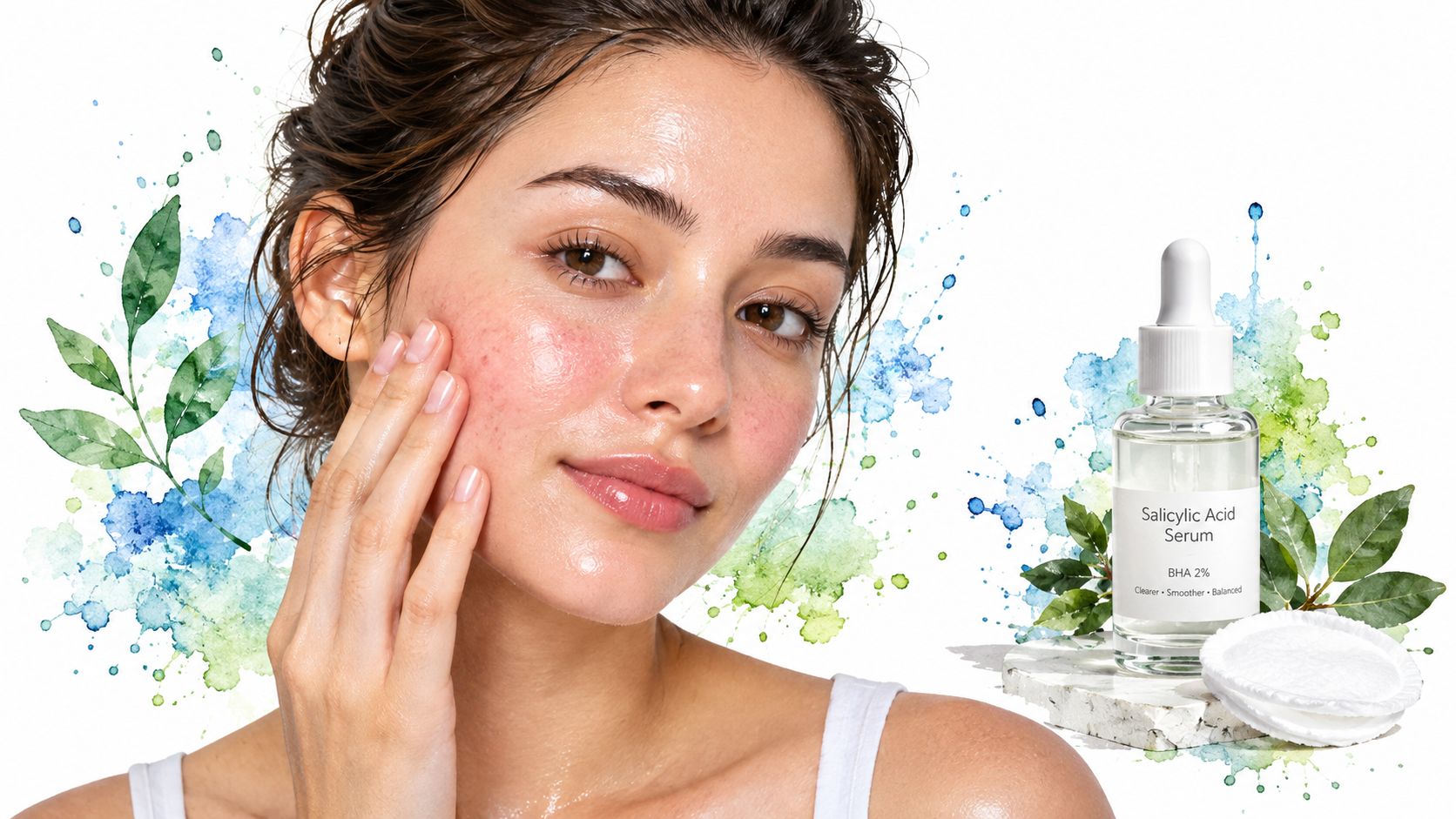
Break the over-stripping cycle
A harsh routine can create an uncomfortable loop. You notice shine, cleanse more aggressively, add more exfoliation, feel tight, and then stop using everything because your skin no longer feels settled. A gentler routine may look less dramatic, but it's easier to maintain.
Try these adjustments:
- Reduce frequency: Take a break or use the serum less often when tightness or redness appears.
- Add a cushion: Choose a moisturizer with humectants or ceramides if your face feels dry after application.
- Simplify layers: Avoid introducing several active products during the same adjustment period.
- Recheck texture: A gel or supportive blend may feel better than an ultra-light formula if your skin needs more comfort.
- Respect the area: Keep application away from the immediate eye area and avoid rubbing the serum into irritated skin.
Recent clinical data describe a salicylic-acid-containing gel improving acne lesions, sebum production, hydration, and skin-barrier function in acne-prone and sensitive skin over 4 weeks, while another serum evaluation connected reduced oiliness with improvement in post-inflammatory hyperchromia over 56 days. The PubMed summary on salicylic-acid-containing formulations supports a more nuanced view: the complete formula can matter alongside the active ingredient.
Comfort is useful feedback: If your face feels persistently tight or visibly irritated, more application isn't the answer. Adjust the routine before increasing intensity.
Salicylic acid and related salicylates are considered safe in cosmetics at current use levels when products are formulated to be non-irritating and non-sensitizing, according to the Cosmetic Ingredient Review safety assessment. Product directions still matter, and persistent or severe irritation calls for professional advice.
Finding the Right Salicylic Acid Serum for Your Oily Skin Needs
Choose by skin feel and daily behavior, not by percentage alone. A watery serum suits someone who wants fast absorption and a barely noticeable layer. A gel may be more comfortable if cleansing leaves your face tight. A blend with humectants or ceramides can make sense when oiliness appears alongside dryness or sensitivity.
If you want a simple way to explore supporting ingredients, this guide to niacinamide serum offers helpful ingredient context for building a broader routine. Keep the routine focused, though. You don't need every popular active in the same week.
For a practical decision path:
- Choose lower strength if you're starting out or your skin is easily unsettled.
- Choose the familiar leave-on range if congestion and shine are your main concerns.
- Choose a cushioned texture if watery formulas leave your skin uncomfortable.
- Choose simplicity if you're more likely to follow a short routine than a complicated one.
ArtNaturals offers a salicylic acid serum positioned for oily and acne-prone skin, with the product page describing salicylic acid as an ingredient that penetrates pores and dissolves trapped oil and dead skin cells. Treat it as one option to evaluate alongside the texture, concentration, pH information, and supporting ingredients that suit your own routine.
Patch test before applying a new serum more broadly, introduce it gradually, and keep a lightweight moisturizer nearby. The right product is the one that helps your routine feel clear, calm, and easy to repeat.
ArtNaturals offers skincare serums and ingredient-focused beauty products that can complement a simple oily-skin routine, including salicylic acid, hyaluronic acid, vitamin C, and niacinamide options. Visit ArtNaturals to explore formulas by concern and build a comfortable, consistent self-care ritual.