

You can do everything right on paper, then one serum leaves your cheeks hot, tight, and pink by dinner. That moment is frustrating because it feels small and specific, yet it can make every bottle on the shelf seem suspicious.
A calmer way forward is to treat sensitive-skin care like a series of small decisions, not a gamble. A good serum for sensitive skin isn't about chasing the loudest active, it's about choosing a formula that respects your barrier, reading the label with a clear eye, and testing it in a way that gives your skin time to answer back. For a broader baseline on gentle routines, this guide to natural skincare for sensitive skin is a useful companion.
What This Guide Is Really About
Sensitive skin isn't rare, and it isn't one single thing. A large review covering 26 studies and 51,783 people across 18 countries estimated that 71% of adults reported at least some degree of sensitivity, while 40% described their skin as moderately or very sensitive, and 64% reported facial sensitivity (source). That doesn't mean every person needs the same routine. It means the category is broad, messy, and personal.
A calmer way to think about the label
Some people feel stinging first. Others notice redness, tightness, or a low-level “this just doesn't sit right” feeling. That's why a serum for sensitive skin should be chosen like a made-to-measure layer, not a universal fix.
Practical rule: start with what your skin can tolerate, then build slowly. A serum should feel like support, not a challenge.
The smartest path is to learn three things at once. First, what a serum does. Second, which ingredients are more likely to feel kind. Third, how to test them without turning your bathroom mirror into a stress test.
That matters because “sensitive” is a spectrum, not a diagnosis. The same formula can feel soothing on one face and irritating on another, especially if the barrier is already strained or if the routine has too many moving parts. If you've ever blamed yourself for not “handling” a product, that's the wrong frame. The product and the context both matter.
A helpful way to stay grounded is to think in layers. Cleanser removes the day. Serum brings targeted support. Moisturizer seals in comfort. If you're unsure how a serum fits into that order, the basics are laid out clearly in this explanation of serum and moisturizer.
One more thing, because reactive skin is often affected by the water you wash with too. If your area has hard water, find a shower filter for hard water can be a practical resource to compare options and reduce one more possible source of irritation.
Understanding Sensitive Skin and What a Serum Does
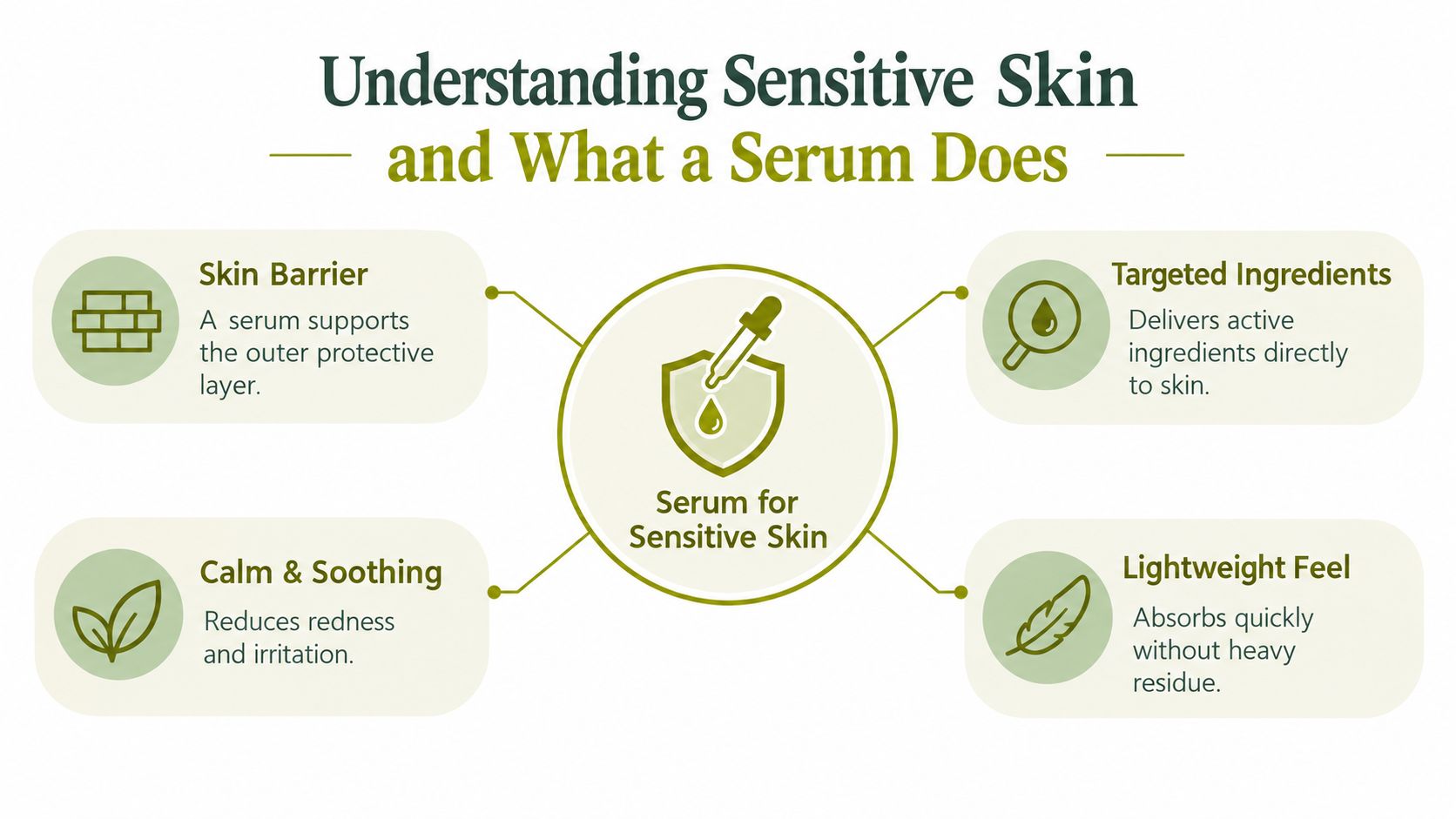
A serum is a lightweight treatment layer. Think of it as a thin topcoat that delivers a focused set of ingredients without feeling heavy. For sensitive skin, that usually means the formula should help the surface feel calmer, softer, and less exposed, rather than busy or aggressive.
Why the barrier matters so much
The skin barrier is easier to understand if you picture a brick wall. The “bricks” are skin cells, and the “mortar” is the lipids that help hold everything together. When that wall is steady, moisture stays in better and everyday irritants have a harder time getting through.
That's why barrier-supportive serums are so often a better starting point than trend-driven actives. They're meant to work with the skin's outer layer, not push it. In a 2023 study, 60 volunteers, including participants with sensitive skin, used an SPF 30 ceramide-containing sunscreen every morning for four weeks, and the non-invasive measurements showed that TEWL fell by 22.96%, stratum-corneum moisture rose by 21.96%, facial redness fell by 11.89%, and the erythema index dropped by 5.68% (source). That doesn't mean every serum should behave like that sunscreen, but it does show the kinds of outcomes barrier-supportive routines often aim for.
What “sensitive” can feel like in real life
Sensitive skin can show up as heat, flushing, stinging, tightness, or a prickly feeling after application. The same bottle can be a non-event for one person and a problem for another, especially when environmental factors, cleansing habits, or layering choices change. A gentle routine usually starts by stripping away friction, not by adding more.
That's also where cleansing habits, climate, and even water quality can matter. If your skin tends to react after showers or after washing more often than usual, it can help to treat those variables as part of the routine rather than as background noise. A serum can only do so much if the rest of the day keeps stressing the barrier.
The best takeaway is simple. A serum for sensitive skin should support the barrier, add targeted hydration, and avoid creating a new problem while trying to solve another one. Once you see it that way, ingredient labels become much easier to read.
Ingredients That Often Feel Soothing
A good serum for sensitive skin usually starts with restraint. The ingredients that earn a place in these formulas are often the ones that help the barrier hold water, feel less reactive, and avoid extra friction.
The names that usually signal comfort
Hyaluronic acid is the classic water magnet. It draws moisture toward the skin's surface, which is why it often feels like a tall drink of water for thirsty skin. If you want a closer look at how it behaves in formulas, this look at hyaluronic acid for sensitive skin is a helpful read.
Niacinamide often works better at moderate levels than at aggressive ones. In a small five-week pilot study, a serum with 5% niacinamide, hyaluronic acid, cranberry extract, a peptide, and a postbiotic ferment was used by 25 healthy adults, and the group saw increased hydration and reduced facial erythema after about one month, with 5% flagged as a potentially suitable level for sensitive skin (source). The practical lesson is simple, more is not automatically better.
Ceramides replenish the lipids that reactive skin tends to run low on. Panthenol is a comfort ingredient many people like because it supports a softer feel. Squalane is a lightweight emollient that can help ease that dry, squeaky sensation without making the face feel coated. Centella asiatica and oat-derived extracts often show up in soothing-style formulas because they are associated with a calmer finish, especially when the rest of the product stays minimal.
Reading a label with more confidence
Ask whether the formula looks built for low drama, not whether the ingredient is trendy. A serum with humectants, a few barrier-minded support ingredients, and a restrained base is usually easier to live with than one that tries to do everything at once.
Good habit: if a formula sounds gentle but contains a long list of extras, treat the ingredient deck as a conversation, not a promise.
A useful comparison is simple hydration versus a richer barrier blend. The first may feel light and fast-absorbing. The second may leave a more cushioned finish. Both can work, but your skin's mood, climate, and the rest of your routine should decide which one makes sense.
For a more lifestyle-friendly hydration perspective, holy hydration for intimate skin offers a useful example of how hydration language can stay gentle without overcomplicating the idea.
The key is still personal tolerance. Even gentle ingredients can bother reactive skin, so patch testing still matters. Try a small amount first, watch for heat, stinging, or tightness, and give the skin time to answer before you commit to full-face use.
Ingredients That Often Irritate Reactive Skin
Some formulas upset sensitive skin because of what they contain, and some because of how they're built. The common troublemakers are usually less about a single villain ingredient and more about a formula asking too much from a fragile barrier.
The usual suspects and why they matter
Denatured alcohol near the top of a list can make a formula feel fast and thin, but it can also leave skin feeling stripped. Strong fragrance can be a problem even when the scent is pleasant. Essential oils sound plant-based and gentle, yet they're concentrated compounds, and concentrated doesn't mean calming. Certain plant extracts can be fine for some faces and irritating for others, especially when the skin is already reactive.
High-strength retinoids and direct acids can also be too much if the goal is comfort rather than correction. They're not off-limits for everyone, but they're rarely the first choice when the barrier is already unhappy. In that situation, a simpler formula is easier to interpret and easier to tolerate.
Quick distinction: irritation often shows up fast, while allergic contact dermatitis can build more slowly and linger. If a product keeps getting more uncomfortable over days, that's a sign to pay attention.
A simple side-by-side way to think about formulas
| Formula type | How it usually feels | What it tends to suit |
|---|---|---|
| Humectant-light serum | Thin, quick, low residue | Oilier skin, warmer climates, layered routines |
| Barrier-supportive serum | Soft, cushiony, calmer finish | Dryness, tightness, frequent reactivity |
| Richer emollient blend | More sealed-in, more comforting | Dry air, compromised barrier, nighttime use |
That table matters because not every reactive face wants the same texture. Some people do better with a lighter serum that disappears fast. Others need a more buffered blend that feels like a soft blanket on the skin.
The preservative question is worth handling carefully too. A 2025 review notes that contact allergy to parabens, formaldehyde-releasers, and methylisothiazolinone has declined after regulation, while a 2014 to 2023 patch-test study of 6,435 patients found benzisothiazolinone sensitization rose from under 0.3% to 5.0% (source). The takeaway is not to fear all preservatives. It's to understand that water-based serums still need microbial control, and that a well-chosen preservative system is part of a responsible formula.
That's also why “natural” isn't the same thing as hypoallergenic. A botanical-heavy serum can be lovely, or it can be the thing that sets off a flare. The label can't answer that for you by itself.
Choosing Concentrations and Packaging That Matter
With sensitive skin, the strength of a serum can shape the experience as much as the ingredient name. A formula that looks impressive on paper may feel too sharp on reactive skin, while a more moderate one can be easier to live with.
What to look for on the front and back of the bottle
If niacinamide is part of the formula, a moderate level often makes more sense than an ultra-high one. As the niacinamide pilot study covered earlier showed, 5% niacinamide can sit in a more comfortable middle zone for some reactive users. That does not guarantee comfort, but it gives you a practical starting point.
Label reading matters here. If a brand lists a percentage, you can judge the claim more clearly. If the panel hides the concentration, treat the formula as less transparent for sensitive-skin testing. A serum that names its actives and their levels gives you more to work with than one that relies on vague front-of-pack language.
Texture matters too. A watery serum can feel almost invisible, while a more layered or multi-lamellar one can feel cushioned and more protective. In a randomized controlled trial with 60 women aged 22 to 40 with sensitive skin, a multi-lamellar-emulsion formulation significantly lowered transepidermal water loss at two and four weeks, while the comparator initially increased TEWL at two weeks before improving, showing that the vehicle changes how a formula behaves (source).
A packaging checklist that protects the formula
Packaging can support comfort too. Airless pumps help limit repeated exposure to air. Opaque bottles reduce light exposure. Smaller sizes are useful when you are trying a new serum and do not want a reactive formula sitting around for too long.
| Skin moment | Formula lean | Comfortable ingredients to look for | Packaging cue |
|---|---|---|---|
| First-time testing | Light and short ingredient list | Hyaluronic acid, panthenol | Airless pump or small bottle |
| Dry, tight days | More cushioned and barrier-supportive | Ceramides, squalane | Opaque container |
| Easily flushed skin | Low-fragrance, restrained base | Niacinamide at a moderate level | Pump dispenser |
| Climate change or seasonal dry air | Slightly richer texture | Emollients plus humectants | Travel-friendly size |
For label reading in the U.S., the FDA notes that terms like “hypoallergenic,” “fragrance-free,” and “for sensitive skin” do not have standardized federal definitions, and fragrance compounds may appear under the broader terms “fragrance” or “perfume” rather than itemized one by one (source). The ingredient panel matters more than the marketing phrase.
A practical habit helps here. Read the full list, look for ingredients you already know can bother you, and treat the front label as a clue, not proof.
How to Patch Test a New Serum
A patch test is the unglamorous part of skincare that saves a lot of guesswork. It's also the easiest way to introduce a serum for sensitive skin without demanding too much from your face on day one.
A steady at-home routine
The American Academy of Dermatology recommends testing a new product by applying it twice a day to a quarter-sized area such as the underside of the arm or elbow crease for 7 to 10 days, then washing it off and stopping use if redness, itching, or swelling develops (source). That turns patch testing into a repeatable habit rather than a guess.
Use the same amount and the same thickness you'd use on your face. Don't under-apply if your goal is to understand how the product really behaves. A tiny dab on clean skin is fine, but it should still be a real test, not a symbolic one.
Simple rule: if a product bothers the test spot, it doesn't get face time.
What counts as a pass, a pause, or a stop
A brief tingle that fades quickly can happen with some formulas, especially if your skin has been dry or freshly cleansed. Persistent redness, itching, swelling, or bumps are different. Those are signs to stop and step back.
If the test goes well, move to the face with restraint. Start with one area, not every active at once. If the test doesn't go well, don't try to “push through” because the label sounds gentle. Sensitive skin usually rewards patience more than optimism.
A patch test won't predict every reaction, but it does give you a quiet, controlled first conversation with the product. That's a much better starting point than learning in the middle of the day when your cheeks have already turned red.
Layering a Serum Into a Gentle Routine
A serum works best when the rest of the routine stops competing with it. The easiest way to remember order is thinnest to thickest, then finish with sun protection in the morning.
A simple rhythm that stays easy to follow
Start with a mild cleanser that doesn't leave your face squeaky. Apply serum to slightly damp skin if the formula is hydration-focused, then follow with a plain moisturizer to seal things in. In the daytime, finish with SPF.
If your skin starts acting up, simplify fast. A temporary reset of just cleanser and moisturizer can be enough to help you figure out whether the serum, another product, or the layering order is the actual problem.
For people who want a branded example of this style of routine, ArtNaturals offers a Hyaluronic Acid Serum for hydration and a Squalane Oil Serum that's positioned for all skin types, including sensitive skin. Those kinds of formulas fit the same simple logic, a hydrating layer first, then a sealing layer on top.
When to introduce a new serum
Use it every other evening at first if your skin is prone to surprise reactions. If that goes smoothly, move toward regular use. If you're using more than one serum, don't stack two strong actives at the same time just because both sound beneficial.
A more practical pairing is a hydrating serum plus a moderate niacinamide formula, as long as the rest of the routine stays quiet. The goal is to learn which layer your skin likes, not to force it through a challenge course.
If you're looking for a practical shopping lens that doesn't require a big splurge, this guide to gentle skincare dupes can help you think about budget-friendly options without abandoning the same basic rules.
Sensitive skin tends to like consistency more than novelty. Once you find a serum that feels steady, keep the rest of the routine simple enough that you can tell what's helping.
Troubleshooting and Frequently Asked Questions
Stinging on application usually means the formula is too active, too fragranced, or too soon for your skin. Pilling often comes from layering too much product or not giving each step time to settle. Breakouts can mean the texture is too rich for your skin right now, while “nothing happened” may just mean the formula is mild and needs more consistent use.
Common questions, answered plainly
How long should I wait before expecting visible changes?
Give a gentle serum time to settle into your routine. If the formula is working, you'll usually notice comfort before you notice a dramatic change.
Does fragrance-free always mean safer?
No. It only means fragrance hasn't been added in the usual sense, and the label still doesn't guarantee that every ingredient will suit your skin.
Can a sensitive-skin serum go near the eyes?
Only if the product is specifically meant for that area. The eye zone is less forgiving, so it's better to keep the first test away from it.
What if the same type of product keeps reacting?
Write down the ingredient list, stop using it, and bring that record to a dermatologist if the pattern repeats. The goal is to spot the trigger pattern, not to keep retesting the same mistake.
Sensitive-skin care works best as a conversation with your skin, not a one-bottle fix. The calmer you keep the routine, the easier it is to tell what your face is asking for.
ArtNaturals offers simple skincare options that fit a barrier-first routine, including hydration-focused serums and plant-powered formulas that can be introduced slowly and tested with care. If you want to build a gentler shelf with that same steady approach, visit ArtNaturals and look for formulas that match your skin's tolerance, not just your wishlist.