

You buy the breakout serum. Your skin stings. You switch to a foaming cleanser. Now it feels tight by lunch. You add a scrub because the flakes bother you, then wake up with fresh bumps and a red, hot face that seems angry at everything.
That loop is common when you're trying to build a skincare routine for sensitive acne prone skin. The confusing part is that acne advice often tells you to clear, dry, and exfoliate, while sensitive skin usually asks for the opposite. If your skin reacts easily, the answer usually isn't more force. It's better sequencing, fewer variables, and a routine that treats your moisture barrier like the main event.
A calm routine can still address congestion and breakouts. It just does it in an order your skin can live with.
Why Sensitive Acne Prone Skin Needs a Different Approach
Acne is often treated like a problem you should attack fast. Sensitive skin rarely responds well to that kind of pressure.
A lot of people end up in the same pattern. They use a strong cleanser, layer two or three treatment products, skip moisturizer because they're afraid of clogged pores, then wonder why every blemish looks redder and every new product burns. The skin isn't being stubborn. It's overwhelmed.
When acne care and sensitivity pull in opposite directions
Sensitive, breakout-prone skin has a built-in tension. Acne products are often drying or intense at first. Sensitive skin tends to flare when you move too quickly. That matters because acne isn't limited to teenagers. A 2024 global study reported 20.5% overall acne prevalence, including 28.3% among ages 16 to 24 and 19.3% among adults ages 25 to 39 according to this global dermatological care summary.
That wider picture helps explain why so many adults feel caught off guard by reactive breakouts. You're not unusual if your skin is both easily irritated and acne prone.
If your skin barrier is worn down, even a small blemish can feel bigger. Redness lingers longer. Dry patches sit next to oily areas. A perfectly fine product on paper can suddenly feel like too much.
Practical rule: If your skin burns, peels, or stays tight for hours after cleansing, barrier support usually needs attention before you add more treatment.
What keeps reactive skin stuck
Three habits tend to keep sensitive acne prone skin in a flare cycle:
- Over-cleansing: Washing too often or using a harsh face wash can leave skin dry and reactive.
- Stacking actives: Salicylic acid, retinoids, exfoliating pads, benzoyl peroxide, and vitamin C all in one routine can be too much at once.
- Chasing speed: Switching products every few days makes it impossible to know what your skin likes.
For many people, the most helpful shift is simple. Stop treating moisturizer like an optional finishing step. Start treating it like a support product that helps everything else become more tolerable.
If your skin tends to react to almost everything, a softer approach to natural skincare for sensitive skin often creates more consistency than a shelf full of strong formulas.
The Simple Four-Step Framework That Anchors Every Day
You wash your face, dab on an acne product, and by lunch your skin feels hot, tight, and somehow oilier at the same time. That is usually a sign that the routine is asking more from your skin than your barrier can handle.
A steadier structure helps. For sensitive, acne-prone skin, the simplest daily rhythm is cleanse, treat, moisturize, protect. The order stays the same so your skin does not have to adjust to a new experiment every few days, and your moisturizer is not a side note. It is the step that makes the rest of the routine easier to tolerate.
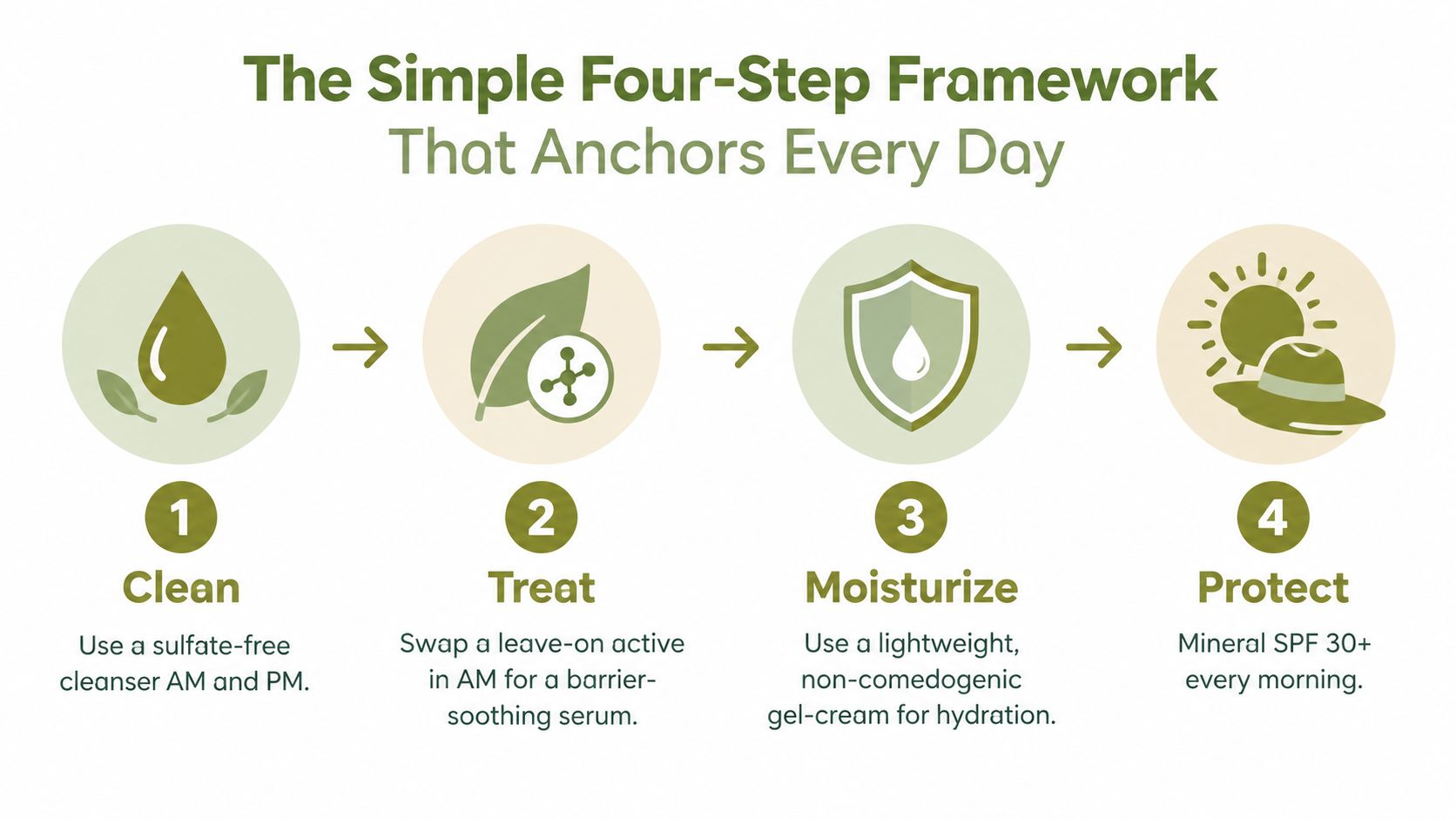
What each step is doing for your skin
-
Cleanse
Start by removing what needs to come off. Sweat, sunscreen, excess oil, and makeup should lift away without leaving that squeaky, stretched feeling. A good sensitive-skin cleanse feels more like rinsing dust off silk than scrubbing a pan. If your face feels dry for hours after washing, the cleanser is probably too strong. -
Treat
Acne care fits, but only one treatment step at a time. Your skin usually handles a single clear job better than a crowded lineup of acids, retinoids, and spot treatments layered together. If your barrier is touchy, morning can stay simple and treatment can wait until night. -
Moisturize
Many breakout-prone people treat moisturizer like an optional extra. With reactive skin, it often does the opposite job. It acts like a cushion between your skin and everything else in the routine, helping reduce the dry, stingy spiral that makes people give up on treatment too soon. -
Protect
In the morning, finish with broad-spectrum SPF 30 or higher. Sunscreen matters even more when your skin is irritated, because a stressed barrier tends to show redness and post-breakout marks more easily. If sunscreen pills, the fix is often simpler than it seems. Use fewer layers underneath, let each one settle, and keep the total amount of product light.
How morning and evening can differ
Morning should feel quiet and supportive:
- Gentle cleanse: or a water rinse if your skin is dry and you did not use a heavy product overnight
- Optional light hydration: glycerin, panthenol, or hyaluronic acid if skin feels dehydrated
- Moisturizer: lotion or gel-cream texture if you get shiny easily, cream if you feel tight
- SPF 30 or higher: whichever texture you will wear every day
Evening is usually the better place for your acne step:
- Cleanse: remove sunscreen, makeup, and the day's buildup
- One treatment: one active on most nights is enough
- Moisturizer: apply enough to leave skin comfortable, not coated
Consistency matters more than intensity.
If you want another way to compare order and layering, a clinical skincare routine for sensitive skin offers a useful reference for how a simpler structure can reduce product confusion.
Why moisturizer sits at the center
For reactive skin, moisturizer often behaves like the active ingredient people overlook. It supports the barrier, improves comfort, and makes it more realistic to stay consistent long enough to see whether a treatment is helping. The American Academy of Dermatology includes gentle cleansing, moisturizer, and daily sun protection among the basics that support acne care, especially when skin is prone to irritation, in its patient guidance on how to treat acne.
When your skin is flaring, strip the routine back to the frame that still feels safe. Cleanse. Moisturize. Protect in the morning. Then add one treatment back only after your skin has settled.
Active Ingredients That Play Well With Reactive Skin
Because barrier-first matters more than potency for reactive skin, choose actives that ease congestion without asking your moisture barrier to work overtime. For skin that breaks out and flares easily, moisturizer still does much of the heavy lifting. It helps your skin stay calm enough to tolerate a treatment long enough for that treatment to show you what it can do.
A good way to approach actives is to picture them as guests in a small room. One calm, well-mannered guest is manageable. Three loud ones at once can turn a minor breakout into a full irritation spiral. Sensitive acne-prone skin usually does best with one treatment category at a time, layered over a routine that already feels steady.
The small group worth knowing
Niacinamide is often a comfortable starting point because it supports barrier function while also helping skin look less oily and less flushed. Lower-strength formulas are usually easier to live with than high-percentage serums, especially if your skin already stings after cleansing or feels hot by evening. In practice, a simple serum or moisturizer with niacinamide is often enough.
Azelaic acid is one of the most useful options for reactive skin because it can help with clogged pores, lingering post-breakout marks, and uneven-looking redness without the sharp feel some stronger acids cause. If you want more context on where it fits in a barrier-first routine, this guide to azelaic acid products gives a helpful overview.
Salicylic acid can still have a place here, but the format matters. A wash-off cleanser or a low-strength leave-on used a few nights a week is often easier for reactive skin than stacking multiple exfoliating products. The goal is to loosen congestion gently, not to chase a squeaky-clean feeling.
Bakuchiol can suit someone who wants help with texture but has not done well with retinoids. It still counts as an active. Slow use matters here too.
Sensitive-Skin Friendly Actives at a Glance
| Active Ingredient | What It Helps With | Best Starting Point | How Often to Begin |
|---|---|---|---|
| Niacinamide | Supports the barrier and helps reduce the look of oiliness and redness | Lower-strength serum or moisturizer | Once daily or every other day |
| Azelaic acid | Helps with visible redness, post-breakout marks, and congested skin | Gentle cream or serum | Every other night |
| Bakuchiol | Helps with uneven texture for people avoiding stronger retinoids | Gentle serum or cream | A few nights per week |
| Salicylic acid | Helps clear clogged pores | Wash-off formula or low-strength leave-on | A few times per week |
What to save for later
Stronger retinoids and very acidic vitamin C formulas often ask more of the skin than a reactive barrier can comfortably give at first. If your skin is already sending warning signs like stinging, tightness, patchy flaking, or redness that lingers into the next day, adding a stronger active usually makes the routine harder to stick with.
The order matters more than people expect. Start with the routine that keeps your skin feeling ordinary. Then add one active. Then give it time.
A treatment is usually fitting in well if your skin still feels comfortable the next morning, your moisturizer no longer burns when applied, and new dryness does not keep spreading. Those are often better signs than whether a product tingled on night one.
A few guardrails help:
- Add one active at a time: this makes reactions easier to trace
- Choose cream, lotion, or wash-off formats first: they are often easier on reactive skin than sharp liquid exfoliants
- Let moisturizer buffer the process: applying enough moisturizer before or after your treatment can make the routine far more tolerable
- Judge by the next day: delayed irritation is common with sensitive skin
If you are curious about plant-based options, this guide on using tea tree oil topically is worth reading carefully, especially since essential oils can suit some people and irritate others.
One active used consistently alongside a reliable moisturizer usually gets better results than a crowded routine your skin keeps rejecting.
Choosing Cleansers and Moisturizers That Calm Instead of Strip
The products you use most often matter the most. That usually means your cleanser and moisturizer deserve more thought than your treatment serum.
How to pick a cleanser by skin state
If your skin feels dry when you wake up, a cream or milky cleanser often makes more sense than a foaming one. If you live somewhere humid or get sweaty during the day, a low-pH gel cleanser can feel cleaner without crossing into stripped.
Guidance for sensitive, acne-prone skin often points toward soap-free cleansers with skin-like pH around 5.5, and oil-in-water emulsions or hydrogels are often preferred over greasy textures, as noted in this NIH acne care overview.
A gentle wash technique matters too. Use lukewarm water, a light touch, and skip rough brushes or scrubbing tools. Some guides also note that washing once or twice daily can be enough, with once often being plenty if stronger treatments are in the picture, based on this minimalist acne routine guide.
Cleanser and Moisturizer Texture Guide
| Texture | Best For | Key Cues | Avoid If |
|---|---|---|---|
| Milky cleanser | Dry, tight, or easily stinging skin | Soft rinse, no squeaky finish, low-lather feel | You strongly dislike any soft residue |
| Cream-to-foam cleanser | Combination skin that wants comfort and a clean rinse | Cushiony texture, light foam, non-stripping finish | Very sensitized skin that reacts to most foaming products |
| Gel cleanser | Humid weather, sweat, oilier T-zone | Low-pH feel, fresh rinse, minimal residue | Skin is flaky or already irritated |
| Gel-cream moisturizer | Oily but dehydrated skin | Lightweight hydration, quick absorb, non-greasy finish | Skin is wind-chapped or very dry |
| Ceramide cream | Barrier support while using actives | Creamy but not heavy, comforting finish | You only tolerate very sheer textures |
| Balm | Cold weather or temporarily compromised skin | Seals in moisture, protective feel | You clog easily with rich occlusives |
What to look for in a moisturizer
For reactive skin, the most useful moisturizers often combine water-binding and barrier-supportive ingredients. Think glycerin, hyaluronic acid, ceramides, cholesterol, squalane, panthenol, or allantoin.
Ceramide- and niacinamide-containing moisturizers are getting more attention because they can support acne-prone skin while also reducing irritation. If hydration layers confuse you, this article on hyaluronic acid for sensitive skin gives a good feel for when a humectant step helps most.
One practical example is the ArtNaturals Niacinamide Serum, which fits the role of a simple support step in a barrier-first routine when you want one calming active rather than a crowded stack.
Texture cue: If your moisturizer disappears instantly and your skin still feels tight, you probably need more barrier support, not less.
How to Introduce New Products Without Triggering a Flare
You finally find a new acne product that sounds promising. By Sunday night, you have added a serum, a spot treatment, and a new cleanser. By Tuesday, your skin is hot, bumpy, and impossible to read. Is it purging, irritation, or just too much at once?
Reactive, acne-prone skin usually does best with clear, boring sequencing. One change at a time gives your skin a fair chance to respond well, and it gives you a clean read on what is helping, what is too strong, and what needs more time.
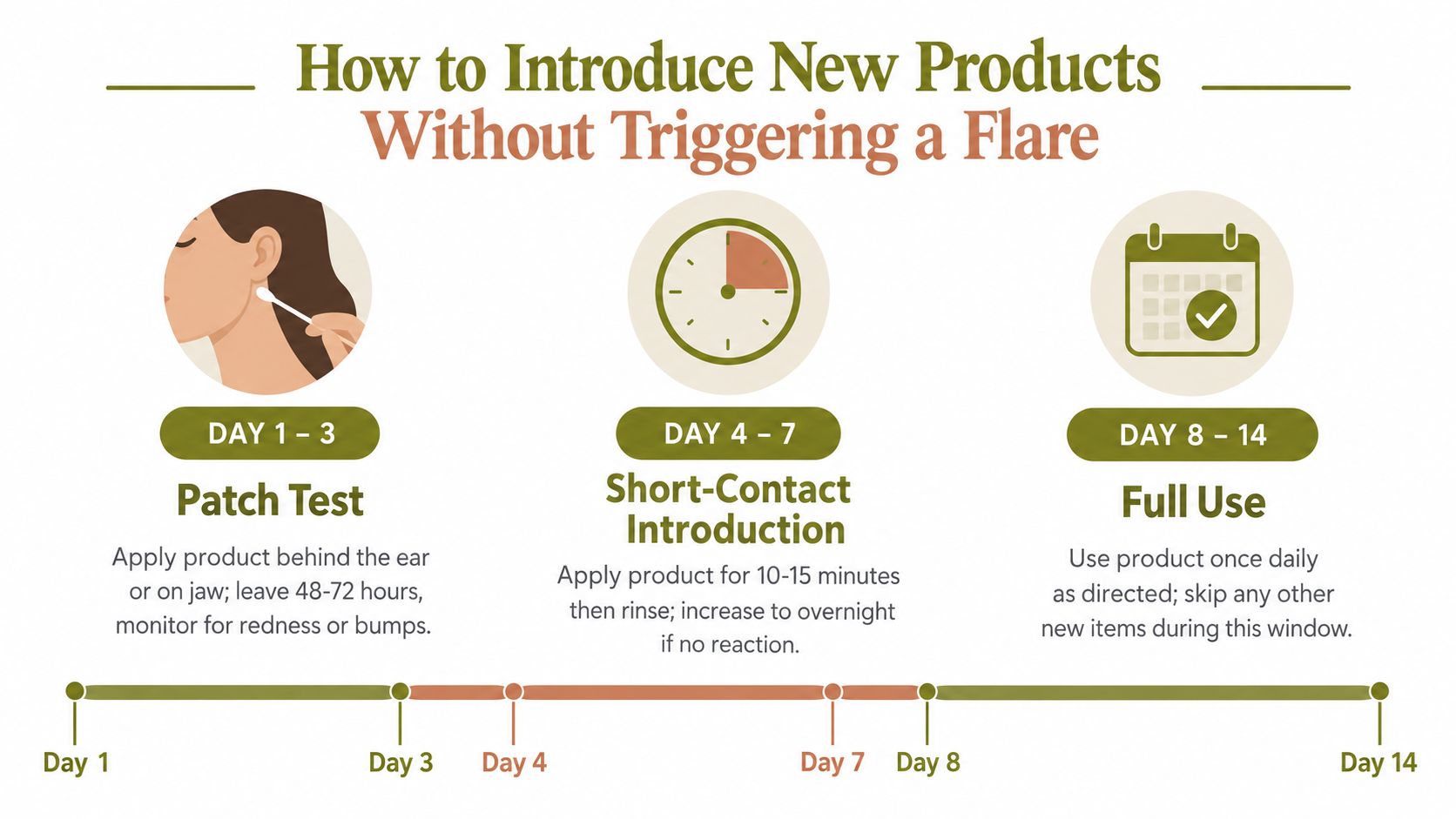
A two-week plan that keeps things traceable
Start with a calm base routine first. If your skin already feels tight, stingy, or flaky, hold off on the new active and spend several days just cleansing gently and moisturizing consistently. For sensitive acne-prone skin, moisturizer often does more of the heavy lifting than people expect. It helps create the cushion that lets a treatment be tolerated at all.
Then add the new product in stages:
-
Days 1 to 3
Patch test on the jawline or behind the ear for 48 to 72 hours. Watch for lingering burning, swelling, itchy rash, or a crop of tiny bumps. -
Days 4 to 7
Try a short-contact application if the product is known to be irritating. Apply it to dry skin, leave it on briefly, then rinse and follow with moisturizer. -
Days 8 to 14
If your skin stays settled, increase to fuller use on a spaced schedule. Keep the rest of your routine exactly the same during this window.
That spacing matters. Sensitive skin often reacts like an overloaded inbox. If too many messages come in at once, you cannot tell which one caused the problem.
Later in the section, this video gives a helpful visual way to think about adding products slowly:
A sample order for adding actives
If your routine is already stable, add products from most supportive to most demanding.
- First addition: niacinamide serum
- Second addition: a gentle salicylic acid cleanser or low-strength exfoliating step
- Third addition: a stronger nighttime treatment, if needed
Leave 7 to 14 days between new products so delayed irritation stays easy to spot. Redness and clogged-looking texture do not always show up on day one.
A practical review of acne regimens described a stepwise pattern that begins with the basics and builds only as tolerated, which matches what estheticians often see in real life. The steadier approach tends to be easier for reactive skin to stick with over time, as discussed in this review of acne skincare regimens and tolerability.
One more tip helps a lot. Do not start a retinoid, an acid, and a benzoyl peroxide product in the same week, even if each one is mild on its own. Layering treatment over treatment on sensitive skin is a bit like raising the volume on three speakers at once. The noise builds fast.
Slow progress is often the fastest way to reach a routine you can actually keep.
Common Routine Mistakes and How to Fix Them Gently
Most skin setbacks don't come from one terrible product. They come from a handful of well-meaning habits repeated every day.
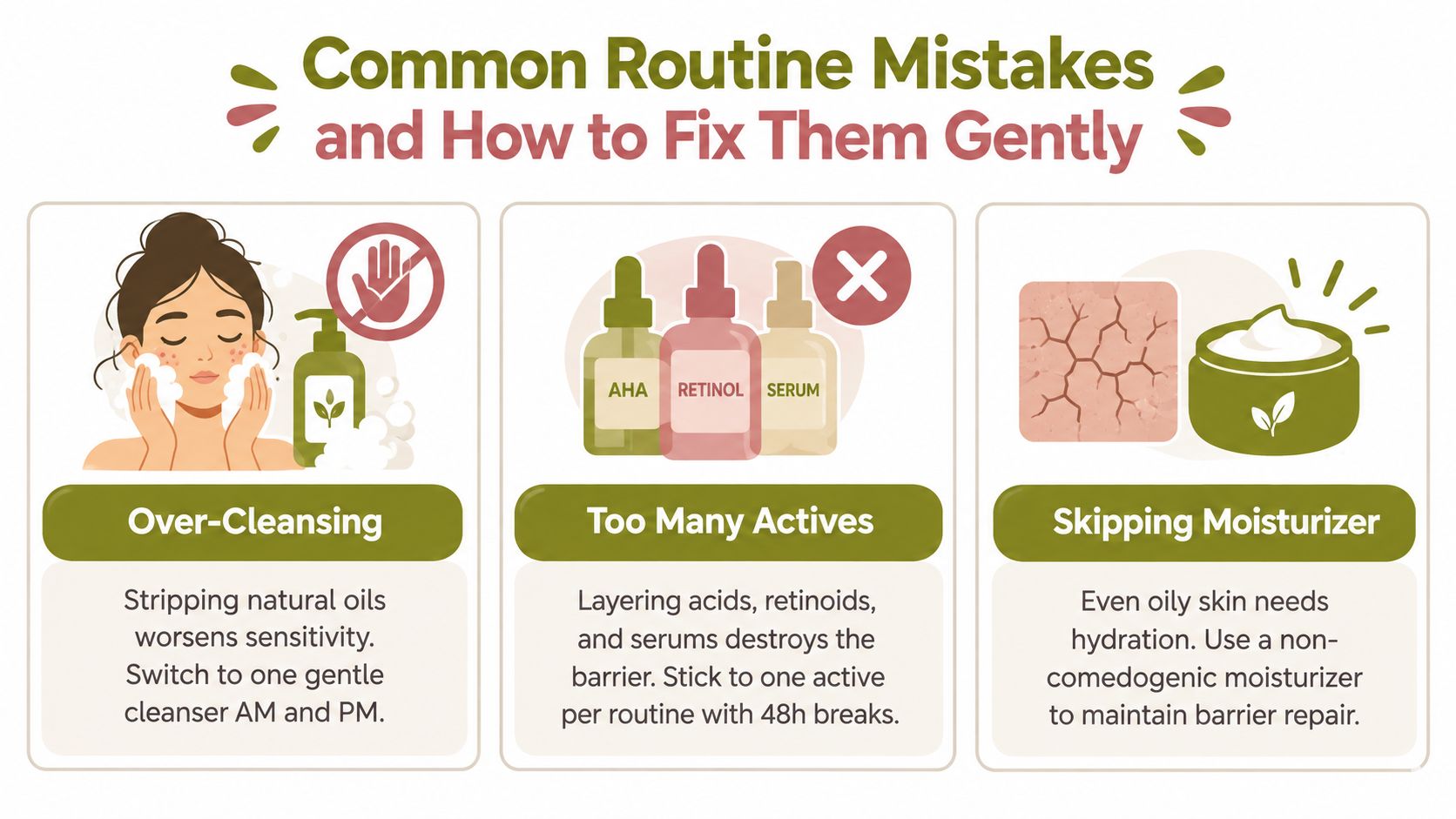
Mistake one: trying to scrub acne away
Harsh scrubs, stiff brushes, and very aggressive foaming cleansers can leave skin feeling clean for an hour and irritated for the rest of the day. Expert guidance has long noted that over-cleansing and abrasive exfoliants can worsen dryness and irritation, and synthetic detergents with less than 10% soap are described as less irritating and more suitable for sensitive skin in this regimen-focused review.
A softer fix is usually enough. Use your fingertips, lukewarm water, and a cleanser that rinses without that squeaky finish.
Mistake two: treating moisturizer like the enemy
This one is common. People see shine or clogged pores and assume hydration is making things worse. Often, the opposite is happening.
A barrier-repair-first approach, especially with ceramide- and niacinamide-containing moisturizers, can help reduce irritation and make acne care easier to stick with. That matters because irritation and poor adherence are stubborn barriers in acne routines, and NIH guidance also notes that antibacterial washes can irritate more sensitive skin and over-washing can worsen dryness, as discussed in this moisturizer and tolerability summary.
Mistake three: using every active in the same week
If your shelf includes salicylic acid, benzoyl peroxide, retinoids, exfoliating toner, and spot treatments, the temptation is to rotate all of them quickly. Reactive skin usually reads that as stress.
Try these swaps instead:
- Instead of cleansing repeatedly: wash gently and stop once your skin feels clean
- Instead of layering multiple actives: pick one treatment lane for now
- Instead of skipping moisturizer on breakout days: use a lighter gel-cream or lotion
- Instead of grainy scrubs: choose a milder exfoliating format, or skip exfoliation during a flare
Sensitive skin does better when corrections feel boring. That's a compliment.
If you have a rough week and your skin gets hot, flaky, or suddenly shiny and irritated at once, return to the four-step base. A short reset with cleanser, moisturizer, and morning SPF is often more useful than pushing harder.
Your Sensitive Skin Questions Answered
Is it purging, or is my skin reacting badly?
A true reaction usually feels uncomfortable. Think burning, itching, persistent redness, swelling, or lots of tiny irritated bumps in places you don't usually break out. Purging is harder to call at home, so when in doubt, go by how your skin feels. If it looks worse and feels worse, pause the new product.
A calm next step is to strip your routine back to cleanser, moisturizer, and sunscreen in the morning. Once your skin settles, reintroduce only one product.
How do I layer sunscreen without pilling?
Keep the layers thin. Let each one settle before the next goes on. If you use a richer moisturizer, you may need less sunscreen rubbing, not more.
Mineral sunscreens often do better when applied over a fully set moisturizer. If pilling keeps happening, try fewer layers underneath or switch either your moisturizer or sunscreen texture, not both at once.
Do I need to panic about dairy or sugar?
No. Food talk around breakouts gets intense very quickly, and that stress rarely helps. It's more useful to notice your own patterns than to eliminate half your kitchen overnight.
If you suspect a food connection, keep notes and look for consistency rather than one-off flare days. Big diet overhauls tend to create more confusion than clarity.
How can I tell over-exfoliation from normal adjustment?
Over-exfoliation usually shows up as shiny tightness, stinging when water hits your face, sudden sensitivity to products you normally tolerate, and flakes that don't feel like normal dryness. Normal adjustment is milder and tends to settle as your skin gets used to a product.
When that line feels blurry, reduce frequency first. You don't always need to quit a product forever. You may just need more space between uses.
If your skin starts reacting to everything, that's often a sign to simplify, not shop faster.
When should I stop self-treating and get professional help?
If breakouts are painful, deep, cyst-like, or leaving marks that concern you, it's worth checking in with a dermatologist. The same goes for acne that persists even when your routine is gentle and consistent.
You should also get help if your skin becomes so reactive that even basic products sting. A good routine supports your life. It shouldn't leave you guessing every day.
Progress with sensitive acne prone skin usually shows up in quieter ways first. Less burning. Fewer surprise flares. More days when your skin feels steady. That steadiness is worth building around.
ArtNaturals offers plant-focused self-care products across skincare, serums, and wellness staples, including options that fit a barrier-first approach like niacinamide, hyaluronic acid, and acne-focused formulas. If you're building a calmer routine and want simple products organized by skin concern, visit ArtNaturals to explore options for sensitive and acne-prone skin.