

You're standing in the shower with a conditioner that worked beautifully last month, and your curls still feel dry, flat, or tangled before they're even dry. It's frustrating, and it's also common. Curls change with weather, cut, color, and how much product is already on them.
The best conditioner for curly hair isn't a universal winner. It's the formula that fits your curl pattern, your porosity, and the condition your hair is in today. When you learn to read those three things, you can stop guessing and start testing with purpose.
Quick Picks for Curly Hair Conditioners
No single conditioner suits every curl. Loose waves need light slip so they don't fall flat, while tight coils often need richer conditioning and help with detangling. Porous or color-treated hair typically needs stronger friction control than fine, low-porosity hair.
That's why this starting point pairs each hair profile with a conditioner type, the traits to look for on the label, and the simplest way to apply it. Our haircare subcategories are Shampoos, Conditioners, Hair mask, Hair oil, Styling products, and Nutrition, and products are tagged for uses including curly hair and blonde and bleached hair, which can help you narrow a shelf quickly.
Quick picks by curl pattern and hair condition
| Your Curls | Best Conditioner Type | Key Traits to Look For | How to Apply |
|---|---|---|---|
| Loose waves, fine strands, low porosity | Lightweight rinse-out | Light slip, no heavy butters | Mid-lengths to ends, small amount |
| Defined curls, normal porosity | Rinse-out plus light leave-in | Cationic conditioner, moderate slip | Full length, then leave-in on damp hair |
| Tight coils, dry or thirsty ends | Rich rinse-out plus leave-in | Fatty alcohols, humectants, strong slip | Full length, detangle while wet |
| Bleached, dyed or high porosity | Rich rinse-out with film-forming polymers | Cationic agents, strong wet slip | Full length, allow the label time before rinsing |
| Dry, tangled wash days | Co-wash | Mild cleansing base with conditioning agents | Scalp gently, then rinse and condition |
| Weekly dryness or stiffness | Deep treatment or hair mask | Richer emollients and longer contact | Once a week, rinse after the label time |
Start with the first row. Fine, low-porosity waves usually do better with a small amount of lightweight rinse-out on mid-lengths and ends, because heavy butters can weigh them down.
Defined curls with normal porosity often balance well with a rinse-out through the full length, then a light leave-in on damp hair for day-to-day softness. Tight coils with dry ends generally need more. A rich rinse-out with strong slip, plus a leave-in afterward, makes wet detangling calmer and helps lengths feel less thirsty.
Where condition changes the answer
Bleached, dyed, or high-porosity hair is its own category, whatever your curl pattern. Look for cationic agents and film-forming polymers, apply through the full length, and let the product sit for the time on the label.
Two rows are about your week, not your curl type. A co-wash can suit dry, tangled wash days when you want gentle cleansing and conditioning together. A deep treatment or mask fits weekly dryness or stiffness, when a richer formula and longer contact time feel helpful.
Find the row that matches your hair today. Then check your pattern and porosity before you buy anything, because the right row is a starting point, not a verdict.
Reading Your Curl Pattern and Porosity
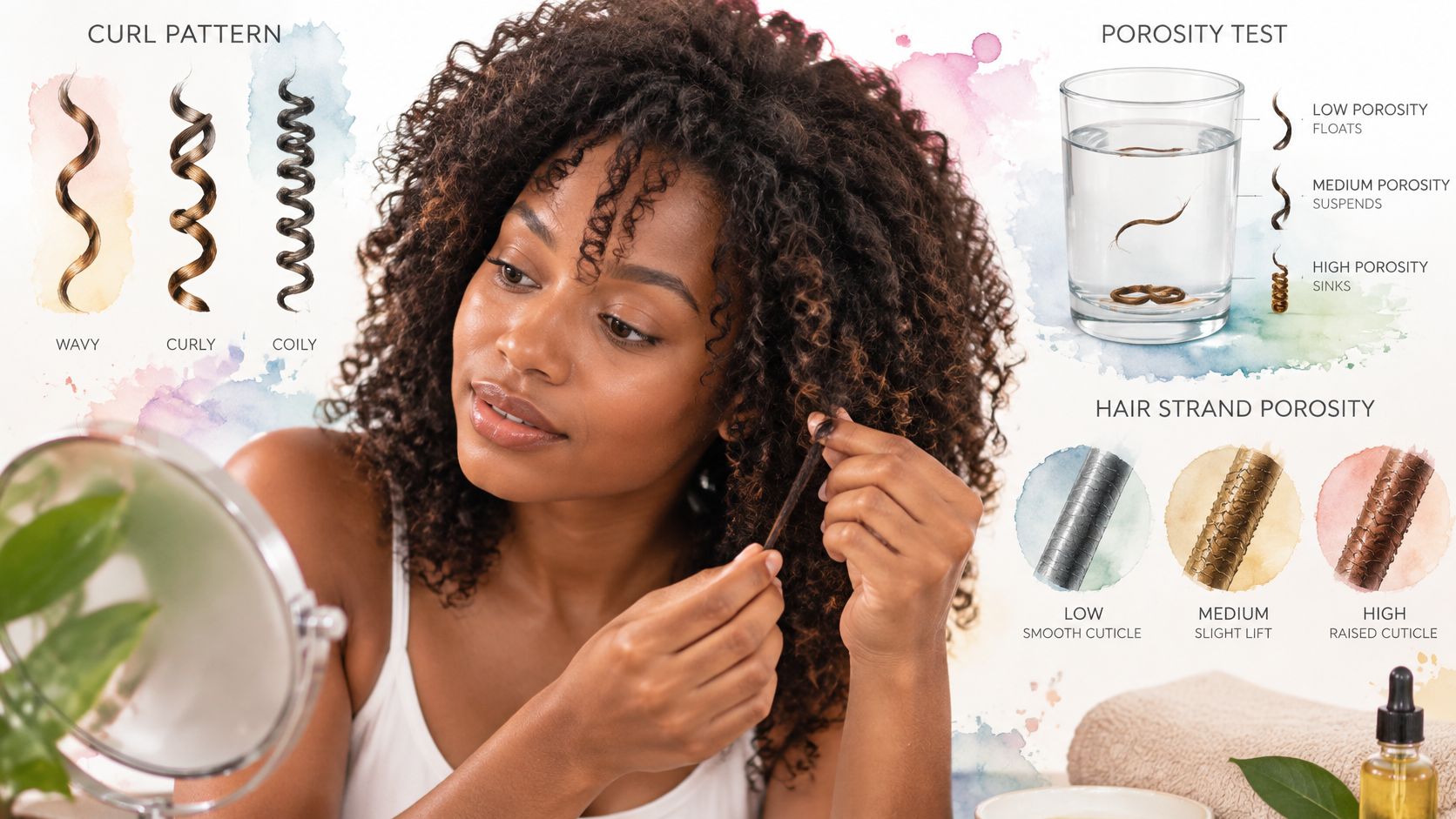
Labels like wavy, curly, and coily, or ranges like 2A to 4C, are a rough starting point. They're helpful shorthand, but they don't tell you how your hair absorbs water, holds product, or responds to weight. Porosity often matters more than the label when you're choosing a conditioner.
Look at your hair in two states. When it's wet, does it fall into loose S-shaped waves, springy ringlets, or tight coils? When it's dry without much product, does that shape stay, loosen, or puff out? Many heads have more than one pattern, so note the loosest and tightest areas rather than forcing everything into one code.
What porosity means in plain language
Porosity is how easily your hair takes in and releases water and product. Low-porosity hair tends to absorb slowly, so water beads and product can sit on the surface. High-porosity hair tends to absorb quickly and lose moisture quickly too, so it may feel dry again soon after conditioning.
Try the float test with a clean, shed strand in a glass of water. If it stays on the surface for a long time, that points toward lower porosity. If it sinks quickly, that points toward higher porosity.
A single strand test isn't a diagnosis. Use it alongside how your hair behaves on a normal wash day.
The product test adds useful context. After applying conditioner, notice whether it seems to sit on top of the hair or sink in fast. Sitting on top matches low porosity, while soaking in quickly matches high porosity.
Signs you can spot without any test
- Fast drying after washing: Often fits higher porosity, especially if ends feel dry again the same day.
- Frizz that grows in humidity: Can fit higher porosity, as hair takes in moisture from the air unevenly.
- Product that feels coated or heavy: Often fits lower porosity or fine strands that need less product.
- Slow wetting under the shower: A common low-porosity sign, where hair takes time to feel fully saturated.
If low porosity sounds familiar, our guide on how to moisturize low porosity hair walks through lighter layering that won't just sit on the surface.
Two checks people often miss
Density is how much hair you have, not how thick each strand is. Dense curls may need conditioner worked through in sections, while less dense hair may need far less product than you expect. Fine strands, even in large amounts, can still go flat with rich formulas.
Recent chemical processing changes things too. Bleach, dye, and frequent heat can make hair behave as if it's more porous, rougher, and quicker to tangle. Record your pattern, porosity signs, density, and recent processing over one week. That small record makes the next choices much clearer.
Conditioner Types and When Each One Works
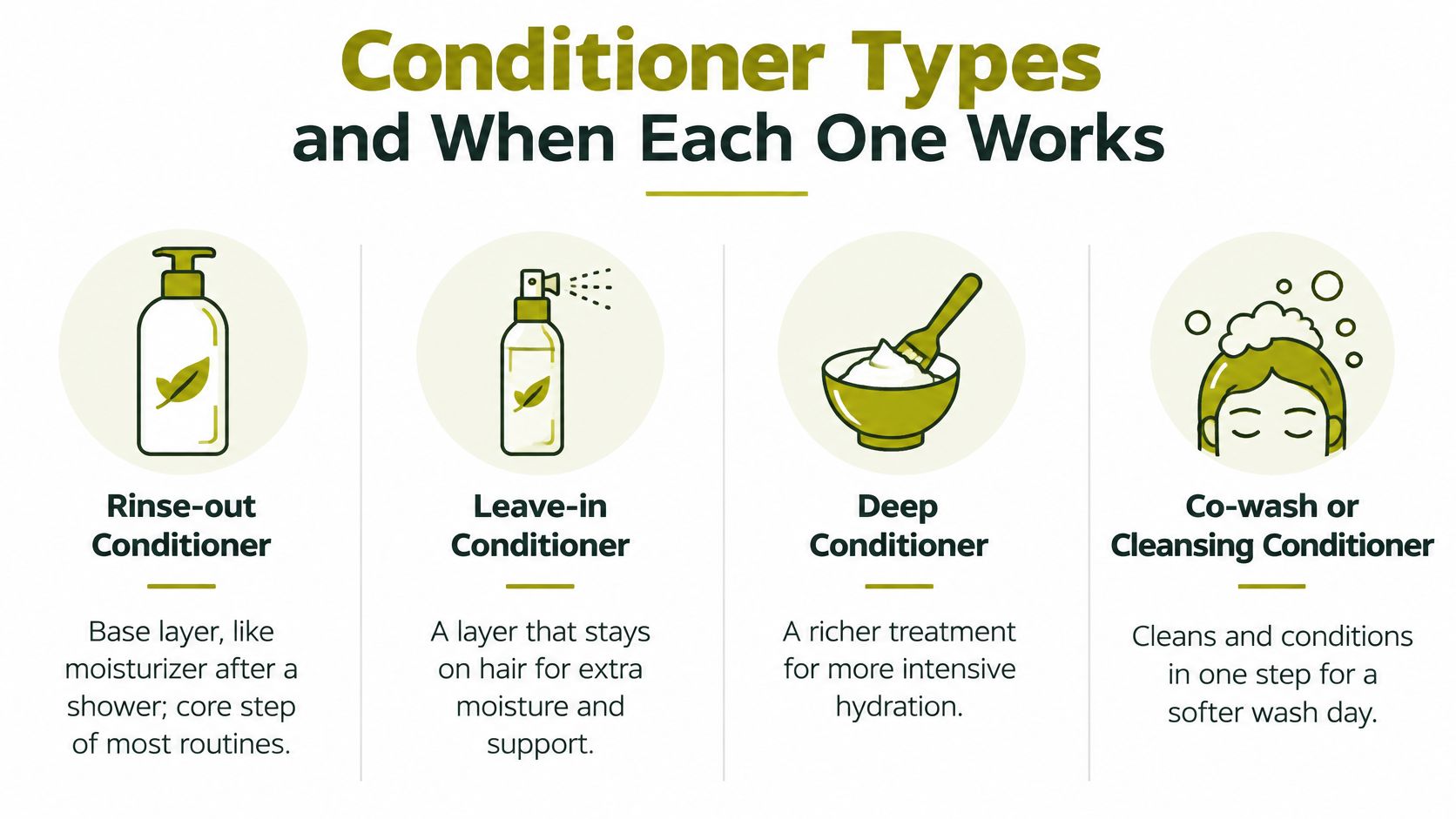
Conditioner formats differ by contact time, weight, and where they sit in a wash day. Marketing names blur those roles. A leave-in may be a spray or a cream, and a mask may be labeled a deep conditioner. Judge each format by the job it does for your curls, not by the word on the front of the bottle.
The four formats and their roles
Rinse-out conditioner is the base layer. You apply it after shampoo, let it sit briefly, detangle while it is in, and rinse. For most curls, this is the core step on each wash day because it supplies the slip that limits breakage during wet detangling.
Leave-in conditioner stays in the hair. Apply a small amount to damp hair after rinsing, focusing on mid-lengths and ends. It supports softness and definition between washes. Our overview of how leave-in conditioner fits a routine explains when that extra layer helps and when it becomes too much for fine hair.
A co-wash, or cleansing conditioner, replaces shampoo on some days. It suits hair that feels dry and tangled while the scalp is not heavily coated with product. Massage gently, rinse well, and follow with rinse-out conditioner if your lengths still need slip. A co-wash is not a shampoo plus conditioner in one step. It is a milder cleanse with conditioning ingredients.
Deep treatment or hair mask is the richer, longer step. It stays on for the time on the label, often once a week, when hair feels stiff, rough, or thirsty. A deep treatment is a timed at-home step, not the same service as private head spa care in Sherman Oaks, which is an in-person scalp and hair reset. Keep the at-home mask to the label time and use it when stiffness returns, not as a daily substitute for detangling slip.
A side by side view
| Format | When You Use It | How Often to Start | Rinsed Out |
|---|---|---|---|
| Rinse-out | Every wash, after shampoo | Each wash day | Yes |
| Leave-in | After rinsing, on damp hair | Each wash, small amount | No |
| Co-wash | In place of shampoo on gentle days | Between shampoo washes | Yes |
| Deep treatment | When hair feels stiff or very dry | Once a week | Yes |
The table also shows where routines go wrong. Stacking a rich rinse-out, a heavy leave-in, and a mask in one wash can leave fine curls limp. Using only a co-wash for weeks can leave a coated feeling if your scalp and lengths need a fuller cleanse.
Common mistakes to avoid
- Heavy leave-in on fine hair: Start with a pea-sized amount per section and add only where ends still feel dry.
- Co-wash every day on a coated scalp: Alternate with shampoo when your scalp feels heavy or your roots look dull.
- Mask instead of daily conditioning: A weekly mask does not replace the slip you need for detangling on regular wash days.
Starting rule: Begin with a rinse-out alone. Add a leave-in only if ends feel dry after drying, and add a deep treatment only when stiffness keeps coming back.
That rule keeps your routine simple enough to judge. You can add a step later, but you cannot learn what a product does if four things change at once. Decide over two washes whether the new format earns its place.
Ingredients That Help and Labels Worth Reading
A calm label read beats a long avoid list. You're looking for a few ingredient groups that do clear jobs, then checking whether the complete formula suits your scalp and preferences. The best conditioner for curly hair for you will balance slip, softness, and comfort, not just chase one hero ingredient.
Cationic conditioning agents, such as behentrimonium methosulfate and cationic polymers, help condition the surface of the hair and reduce the friction you feel when strands rub and tangle. They are especially useful during wet detangling, when curls have many contact points.
Fatty alcohols such as cetyl alcohol and stearyl alcohol add slip and a creamy feel. Despite the word alcohol, these are conditioning ingredients, not the drying type people worry about. They help a comb move more gently through coated hair.
Moisture, softness, and slip
Humectants such as glycerin help hair hold moisture from water and the product itself. Plant oils, including argan oil, add softness and shine to the feel of the lengths. Neither replaces conditioning agents for detangling, but both can make hair feel more comfortable after drying.
Silicones are common in leave-ins because they add smooth slip and help hair feel less rough. Some people prefer silicone-free routines because they like lighter layering or simpler wash days. That's a preference you can test, not a rule you must follow.
Reading the ingredient list by order
For retail cosmetics sold in the United States, the FDA summary of cosmetics labeling requirements says ingredients are listed using common or usual names and generally in descending order of predominance, while ingredients present at 1% or less may be listed in any order after those above that threshold. That means the top of the list is the most informative part. Farther down, order tells you less about strength.
Fragrance can appear as a single term that covers several fragrance ingredients, so you won't always see every component named. Fragrance and essential oils can be enjoyable for many people and irritating for some. Natural or plant-powered describes sourcing or positioning, and it doesn't automatically mean low irritation.
Try a patch test on a small area before full use when you're trying a new leave-in or a strongly fragranced product, especially if you know you're sensitive.
If itching or scalp discomfort keeps returning, stop guessing with new products and see a dermatologist. Ongoing discomfort deserves personal guidance rather than another round of label detective work.
A balanced note on protein
Protein-rich conditioners can make already stiff, porous, or previously processed hair feel harder when used too often. Fine, low-porosity hair may instead feel flat if protein formulas are layered heavily. Alternate a protein-light, moisture-focused conditioner with a more protein-focused one, and judge the change over two washes rather than after one.
How to Apply Conditioner to Curly Hair
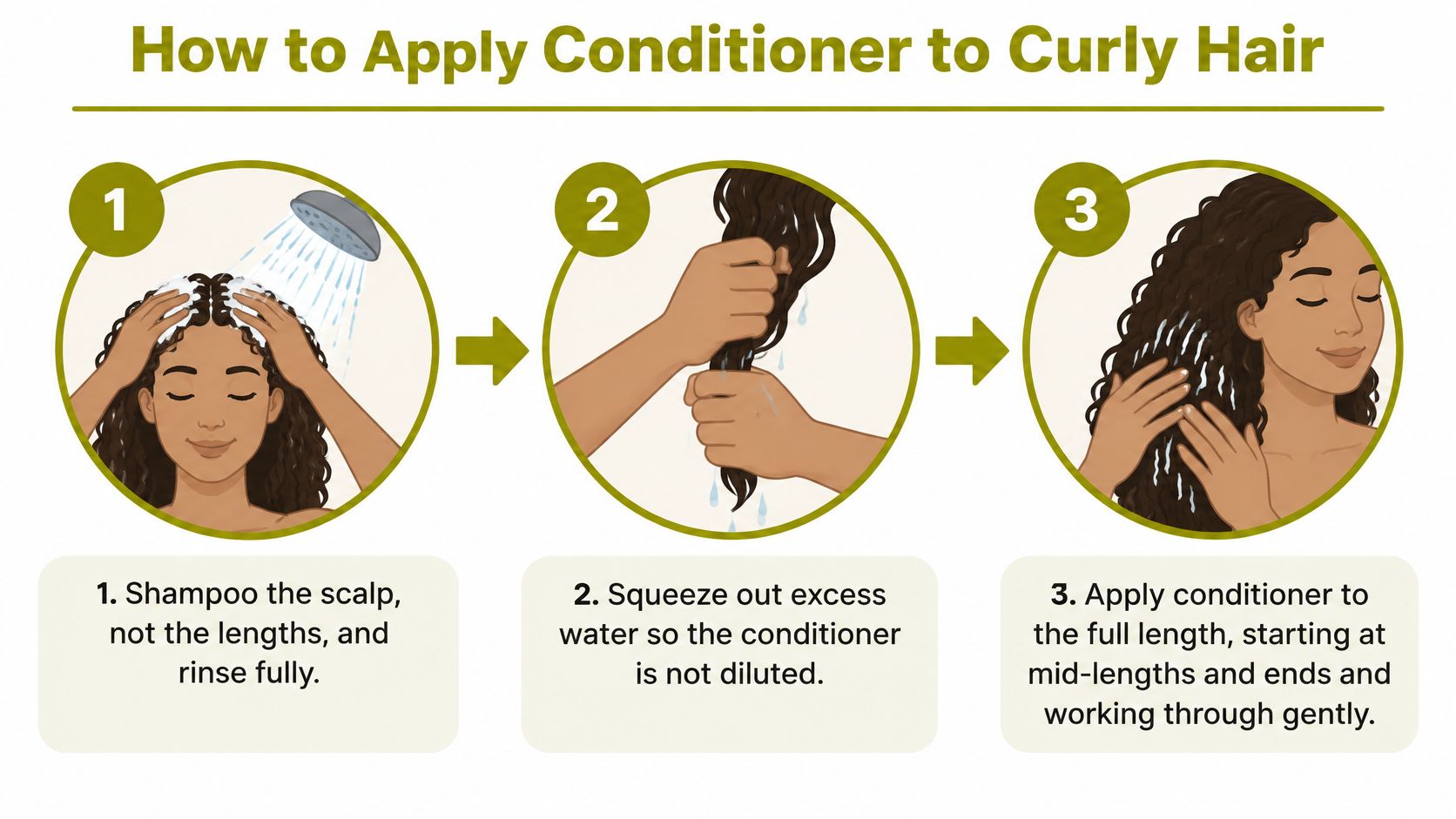
Application changes results as much as formula does. The same conditioner can feel too light if it's diluted, too heavy if it reaches your scalp, or ineffective if you detangle after rinsing it out. These steps give the product a fair chance.
Wash day steps in order
- Shampoo the scalp, not the lengths: Massage shampoo at the roots where oil and product build up, then let the rinse run through the lengths. Rinse fully so conditioner isn't sitting over leftover shampoo.
- Squeeze out excess water: Gently press water out with your hands so the conditioner isn't diluted straight down the drain. Hair should be wet, not dripping heavily.
- Apply through the length: The American Academy of Dermatology curly hair care guidance recommends applying conditioner to the entire length of dry or curly hair rather than limiting it to the ends. In practice, start at mid-lengths and ends, then work upward only as needed so roots don't look oily.
- Let it sit for the label time: Give a rinse-out a few minutes, and give deep treatments the longer time stated on the pack. Use that pause to work conditioner through in sections.
That third step confuses many people. Full length doesn't have to mean heavy at the scalp. It means your lengths shouldn't be skipped just because advice for straighter hair says ends only.
Detangle while the slip is still there
- Detangle before rinsing: While hair is still coated, use fingers or a wide-tooth comb, starting at the ends and working upward in sections. Ends first loosens knots gradually instead of dragging them into a bigger tangle.
- Rinse with lukewarm or cool water: Rinse until hair feels clean but still smooth. Many people find cooler water leaves the surface feeling smoother than very hot water.
For thick curls, sectioning matters. Two to four sections help you coat every layer, including the underside that often tangles first. Take your time here, because rushing with force is what turns a small knot into breakage and frizz.
After you step out
- Apply leave-in to damp hair: Smooth or scrunch a small amount through mid-lengths and ends rather than brushing it through dry curls. Between washes, thoroughly wet hair first, then apply leave-in and use fingers or a wide-toothed comb.
- Dry gently and keep hands off: Use a diffuser on low heat and low airflow, or let hair air dry. Avoid touching, separating, or brushing curls while they dry, since dry brushing can add frizz and stress the strands.
Smooth, defined results usually look like curls that clump together, feel flexible rather than coated, and stay manageable the next day without a full rewash.
If your hair looks good wet but rough dry, don't blame the rinse-out immediately. Check your leave-in amount, drying method, and whether you're touching it too early. Small technique changes often solve what looks like a product problem.
Fixing Frizz, Buildup and Dryness
When curls misbehave, the cause is usually one of three things. You may have too little conditioning, too much product, or too little slip for detangling. Naming the cause keeps you from buying a heavier product when you need less.
Curly hair symptoms, likely causes and fixes
| Symptom | Likely Cause | What to Adjust |
|---|---|---|
| Frizz by midday | Low moisture or rough cuticle after drying | Apply leave-in to damp hair and use a lighter oil or cream to seal |
| Dry, brittle ends | Lengths not conditioned enough | Apply conditioner to the full length and add a weekly deep treatment |
| Limp curls or flat roots | Rich product on fine or low-porosity hair | Switch to a lighter rinse-out, use less and keep roots light |
| Stiff, straw-like feel | Residue or buildup | Use a gentle clarifying cleanse as needed and reduce leave-in |
| Tangles and snags while wet | Insufficient slip | Add conditioner before detangling and use a wide-tooth comb |
| Greasy-looking roots | Conditioner reaching the scalp | Apply from mid-lengths to ends only |
Frizz by midday often means hair dried a little rough or thirsty, so a leave-in on damp hair followed by a light oil or cream can help it feel smoother. Our guide on how to reduce frizzy hair naturally covers everyday habits that support that step. Dry, brittle ends usually point the other way, toward fuller-length conditioning and a weekly deep treatment.
Limp curls or flat roots are a classic sign that a rich formula is sitting on fine or low-porosity hair. Use less, choose a lighter rinse-out, and keep conditioner away from the roots. Stiff, straw-like hair can also come from residue, so a gentle clarifying cleanse every few weeks as needed, plus less leave-in, is a sensible reset.
When wet detangling still catches
Bleached or dyed curls need stronger friction control because processing can leave the surface rougher. The Society of Cosmetic Chemists library entry on damaged hair and combing force reports dyed hair generated roughly three to four times the combing force of untreated reference hair before conditioning, and polyquaternium-11 reduced that force to approximately the untreated-hair level. Use that as practical context, not a promise. Richer cationic conditioning can matter more on processed hair.
Try the wet-slip check. Saturate hair fully with conditioner, emulsify for several seconds, then pass a wide-tooth comb through the ends. If it still catches and snags, the conditioner isn't lubricating enough for that damage level.
Greasy-looking roots are simplest. Move application back to mid-lengths and ends, rinse well, and save scalp contact for shampoo or a co-wash designed for gentle cleansing. Dryness can also grow with heat styling, low humidity, or very hot water, so adjust one habit at a time.
Persistent scalp itching, flaking, or soreness isn't a reason to keep switching conditioners. See a dermatologist so you can get guidance for your scalp rather than layering more products over discomfort.
Run a Two-Wash Trial Before You Commit
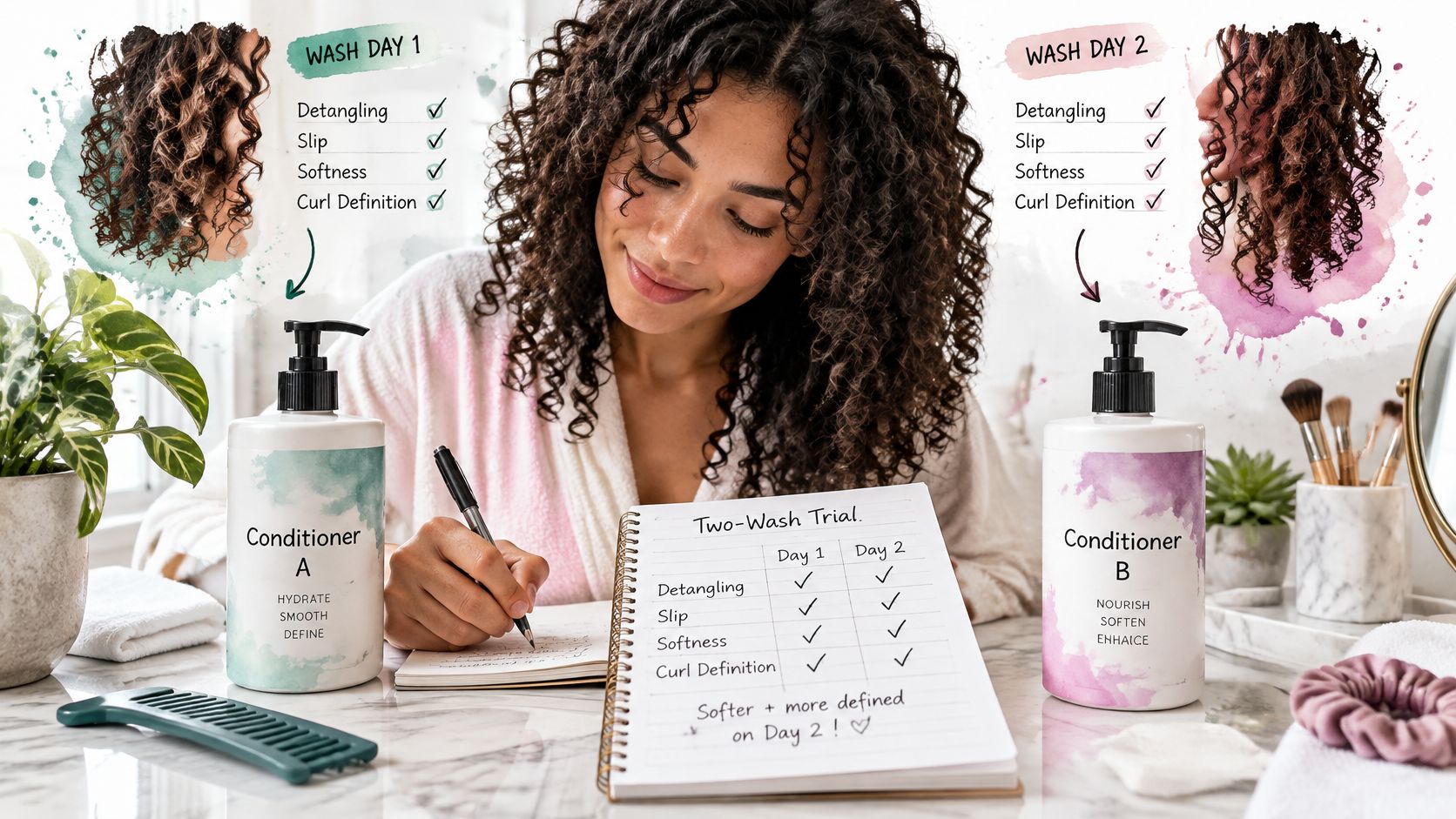
Judge a conditioner by how it performs on your hair over two washes, not by a label claim or a single good hair day. One wash can be swayed by leftover product, weather, or a rushed detangle. Two washes give you a fairer pattern without wasting months.
Change one product at a time and keep the rest of your routine steady. Use the same shampoo, drying method, and styling amounts for both washes. Then write down what you notice while it's fresh.
What to record each wash
- Detangling time: Did knots loosen easily while hair was coated, or did the comb keep catching?
- Curl clumping: Did curls form smooth groups as they dried, or separate into fluff?
- Drying time: Did hair take much longer to dry, which can signal too much heavy product?
- Breakage and shedding in the comb: Note any clear change, without trying to count every strand.
- Buildup signs: Look for coated roots, dull lengths, or a stiff surface feel by day two.
- Next-day manageability: Could you refresh with water and a little leave-in, or did hair feel unworkable?
Before you switch, adjust amount or frequency. Use a third less, keep it off your roots, leave it on longer, or rinse more thoroughly. Many good matches are found by tuning the dose, not by abandoning the bottle.
Keep, adjust, or switch
Decision rule: Keep it if most measures improve. Adjust if only one measure lags. Switch if two or more measures get worse across both washes.
Start your trial with a single rinse-out from the quick-pick row that matched your hair. Add a deep treatment for weekly care only if stiffness or dryness persists after those two washes. When you shop with us, prices are shown in USD with tax included, and shipping and discounts are calculated at checkout, so you can check the final total before you commit.
Pick one conditioner this week and run the trial. You'll learn more from two careful washes than from another month of guessing.
Ready to put your two-wash trial into practice with calm, plant-powered haircare made for everyday routines? Explore conditioners, masks, and oils that fit your curl pattern and porosity at ArtNaturals, and choose one simple starting point for your next wash day.