

Is a mask just conditioner left on longer, or does it do a different job? Most routines treat the two as a ladder, with the mask always on the higher rung. That picture misses how both products behave on the hair.
A conditioner and a hair mask draw on the same conditioning ingredient families. What changes is concentration and how long the formula stays on the hair. Conditioner is the regular coat that adds slip after shampoo. A mask is a thicker coat you leave on for several minutes when lengths feel dry, tangled, or heavily styled. Neither product rebuilds the hair from the inside. Both change how the surface feels, combs, and shines, and the useful routine is the one that matches that limit.
Conditioner vs Hair Mask at a Glance
Conditioner is the everyday step that softens lengths, adds slip, and makes wet hair easier to comb. A hair mask is a richer, less frequent treatment for lengths that feel dry, tangled, or heavily styled.
In 2025, 86% of U.S. adults reported using shampoo or conditioner, while 18% used serums, masks, or leave-in products, according to YouGov's nationally representative survey of 1,236 adults. The daily coat is already a habit for many. A mask is the smaller, occasional step.
Side by side
| Feature | Conditioner | Hair Mask |
|---|---|---|
| Main purpose | Everyday detangling, slip and softness after shampoo | Periodic, more concentrated treatment for dry or heavily styled lengths |
| Contact time | Rinsed out shortly after application | Left on for the time stated on the label, often several minutes |
| Texture | Lighter, quick-rinse formula | Thicker, with more oils, waxes or conditioning polymers |
| Best fit | Most hair types on regular washing days | Dry, porous, bleached or heat-styled lengths |
Both products rely on conditioning agents that coat the hair surface. The difference in a conditioner vs hair mask choice is mostly intensity and contact time, not a separate mechanism.
Simple rule: Conditioner after every wash, and a mask added when lengths feel dry or tangled, typically about once a week at first.
A mask can add softness and manageability. It does not guarantee a specific change in the hair. Match the starting week to your texture using the frequency guide below, then keep or cut the mask based on how the lengths feel.
What Each Product Does on the Hair Surface
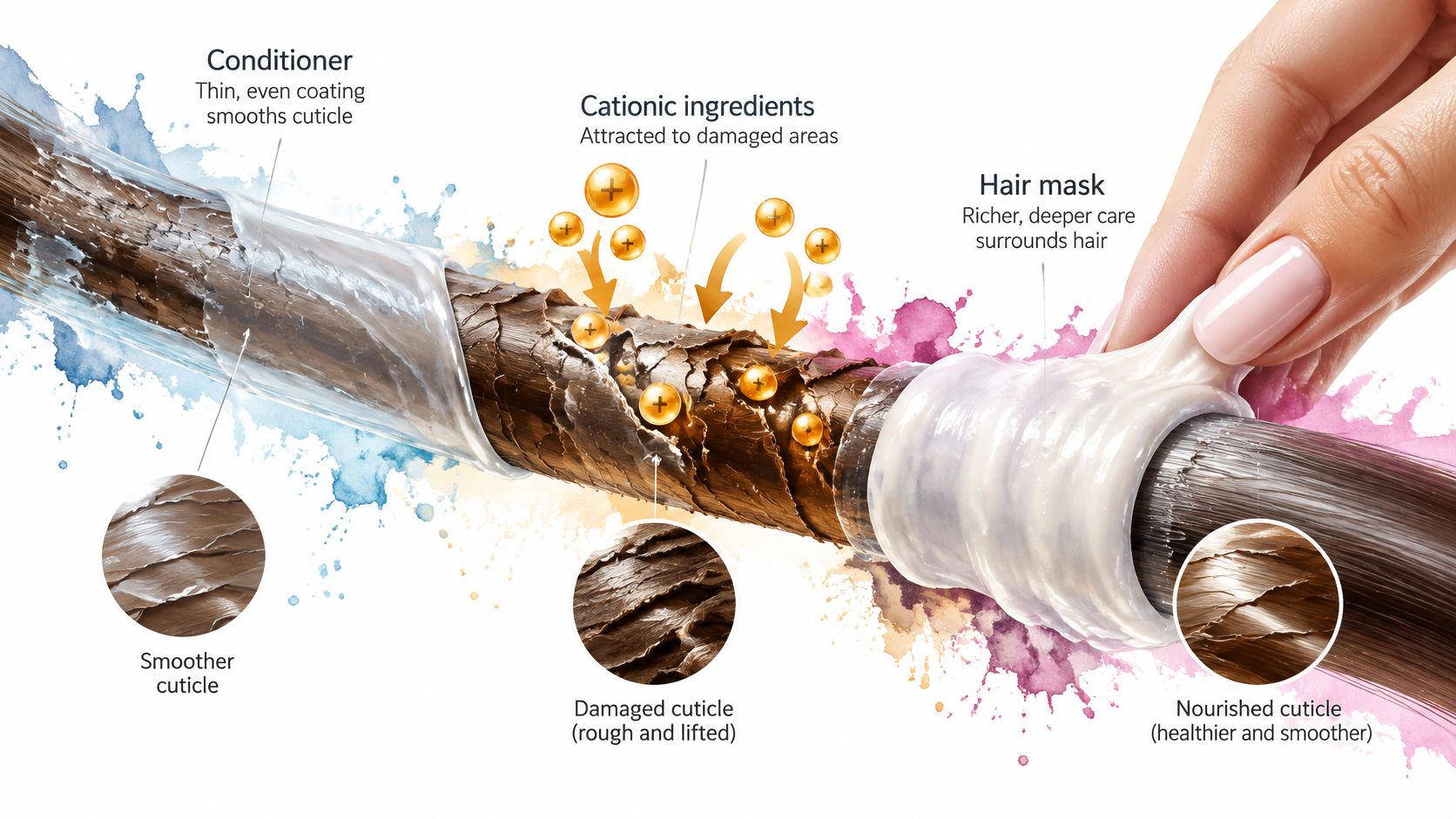
A conditioner's first job is to reduce friction. On damp hair, positively charged conditioning ingredients attach to the surface, particularly in weathered areas. The resulting coating helps fibers slide past one another, so detangling takes less effort. It improves handling rather than rebuilding the strand.
A thicker coat on the same surface
A mask usually leaves a richer coating on the lengths. It may contain oils, waxes, humectants, or film-forming ingredients, and its label will specify how long to leave it on. Conditioner is generally rinsed out sooner. That difference in formula and contact time is what gives a mask its more intensive feel.
Conditioners and masks can use the same ingredient families: cationic materials aid deposition and detangling, oils and waxes provide lubrication, humectants help attract or hold water, and film-forming ingredients smooth the fiber surface. A mask is a more intensive conditioning treatment, but it does not have to replace conditioner at every wash.
Use masks less often than conditioner, from a few times a week to occasionally. Let the product label and your hair's response set the pace. If lengths start to feel coated or weighed down, reduce use.
One wash day, two feels
For shoulder-length hair that snags at the ends, conditioner can make the damp lengths easier to comb after shampooing. On a mask day, apply the product to the driest lengths and leave it on for the label's stated time. A comb may then pass through with less pulling. Keep the richer coating away from roots that do not need it.
What the surface can and cannot do
Neither product reverses structural changes from bleach, heat, or rough handling. Both can change how hair feels, moves, and combs by conditioning its surface. Judge the routine by softness, combing ease, and shine across several washes, then adjust if hair feels heavy or still catches.
Ingredients That Set Each Product Apart
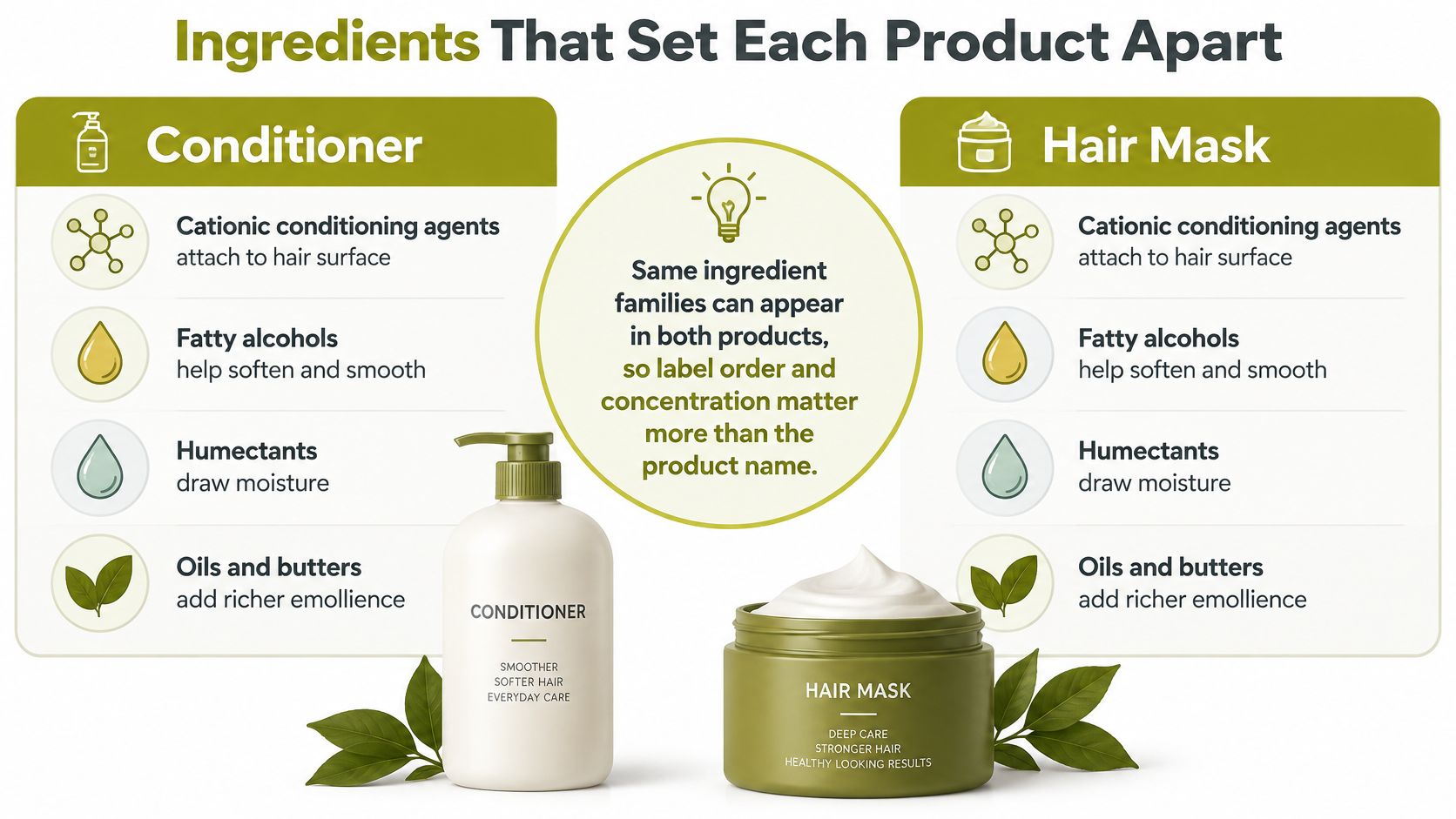
The product name is a weak guide. The same ingredient families show up in both bottles, so label order and concentration tell you more than the word on the front.
A label lookup
| Ingredient family | Role on the hair | Where it appears most |
|---|---|---|
| Cationic surfactants | Attach to the hair surface, reduce static and friction | Both, central to conditioners |
| Fatty alcohols | Add slip and a smooth feel | Both |
| Plant oils such as argan and jojoba | Lubricate the surface and add shine | Richer masks and leave-ins |
| Butters and waxes | Add cushion and body to the formula | Masks |
| Silicones | Smooth the surface and add slip, can build up | Both, more often in masks |
| Humectants such as glycerin | Help hair attract and hold water | Masks and some conditioners |
| Hydrolyzed proteins | Give a firmer, more structured feel | Masks and some conditioners |
Cationic surfactants are the grip of the formula. They are drawn to the hair surface, calm static, and cut the friction that makes wet hair grab the comb. They sit at the center of conditioners and also show up in masks.
Fatty alcohols are the quiet slip agents in both. They are not drying alcohols. They give the cream its smooth glide.
Plant oils such as argan and jojoba lubricate and add shine. You will see them more often once the formula gets richer, in masks and in leave-ins. Butters and waxes add cushion and body, and they belong mainly in masks. Silicones smooth and add slip in both, more often in masks, and they can build up when rinsing is brief.
Humectants such as glycerin help hair attract and hold water. They are common in masks and in some conditioners. Hydrolyzed proteins give a firmer, more structured feel, again mostly in masks and in some conditioners. A protein-rich mask can feel helpful on porous lengths and stiff on hair that is already coated, so the next wash is part of the test.
If oils, waxes, or silicones sit near the top of the list, expect a heavier texture and plan to rinse thoroughly.
A plant-based label does not automatically mean lighter or buildup-free. Texture depends on concentration, the rest of the formula, and how well you rinse. Skin Perfection's notes on ingredients for a DIY conditioner base show how fatty materials and conditioning agents are combined before a formula takes on its final weight. For a wash-day bottle built around plant oils, a plant-based hair conditioner is a useful contrast with a richer mask, because the same oil can feel light or heavy depending on where it sits in the list.
How Often to Use Each by Hair Type
Conditioner belongs after every wash for every hair type below. The mask column is the part you change.
| Hair type | Conditioner | Mask | Placement tip |
|---|---|---|---|
| Fine or low-density | After every wash | Once or twice a month, lightweight formula | Keep off the roots |
| Low-porosity | After every wash | Lightweight mask, less often than the general range | Mid-lengths and ends, rinse well |
| Curly or coily | After every wash | About once a week | Focus on the driest lengths |
| Dry or coarse | After every wash | About once a week | Mid-lengths and ends |
| Bleached or heat-styled | After every wash | Once a week, or every two weeks | Prioritize porous ends |
| Oily roots with dry ends | Mid-lengths and ends only | Ends only, once a week or less | Keep mask off the scalp |
In 2025, 21% of U.S. adults reported never using hair conditioner, while 24% used conditioner two to three times per week, according to YouGov. Skipping the rinse-out step is common. A mask on Sunday does not replace the slip you skipped on the washes in between.
Finding your row
Fine or low-density hair flattens quickly. Use a lightweight mask once or twice a month, and keep it off the roots. A pea-to-nickel amount on the ends is plenty for a short cut.
Low-porosity hair often lets product sit on the surface instead of feeling absorbed. Choose a lightweight mask less often than you would for very dry hair, keep it on mid-lengths and ends, and rinse until the slip is gone.
Curly or coily hair usually wants more emollience on the driest lengths, about once a week. A conditioner for curly hair can stay in the routine on the other wash days so the pattern does not lose its slip between mask days.
Dry or coarse hair generally handles a weekly mask on mid-lengths and ends. Bleached or heat-styled hair often does well with a mask once a week, or every two weeks, with the focus on porous ends rather than a heavy coat from root to tip.
Oily roots with dry ends are a placement problem more than a product problem. Use conditioner on mid-lengths and ends only, and put the mask on the ends only, once a week or less.
Products are tagged for uses including all skin types, all hair types, beards, blonde and bleached hair, curly hair, and dandruff, dry scalp, psoriasis symptoms and eczema. Those tags help you match a bottle to a row. They are not a substitute for personal care advice when the scalp is uncomfortable. If you are caring for added hair, Conde Professional's notes on at-home hair masks for extensions are a practical extra, because extensions and your own lengths do not always want the same amount of product.
Start once a week, watch how the hair feels, then adjust.
How to Layer Conditioner and Mask Without Overdoing It
Layering fails when both products try to do the richest job on the same day. Keep the daily coat light, and let the mask carry the heavier formula only where the lengths are dry.
The wash-day order
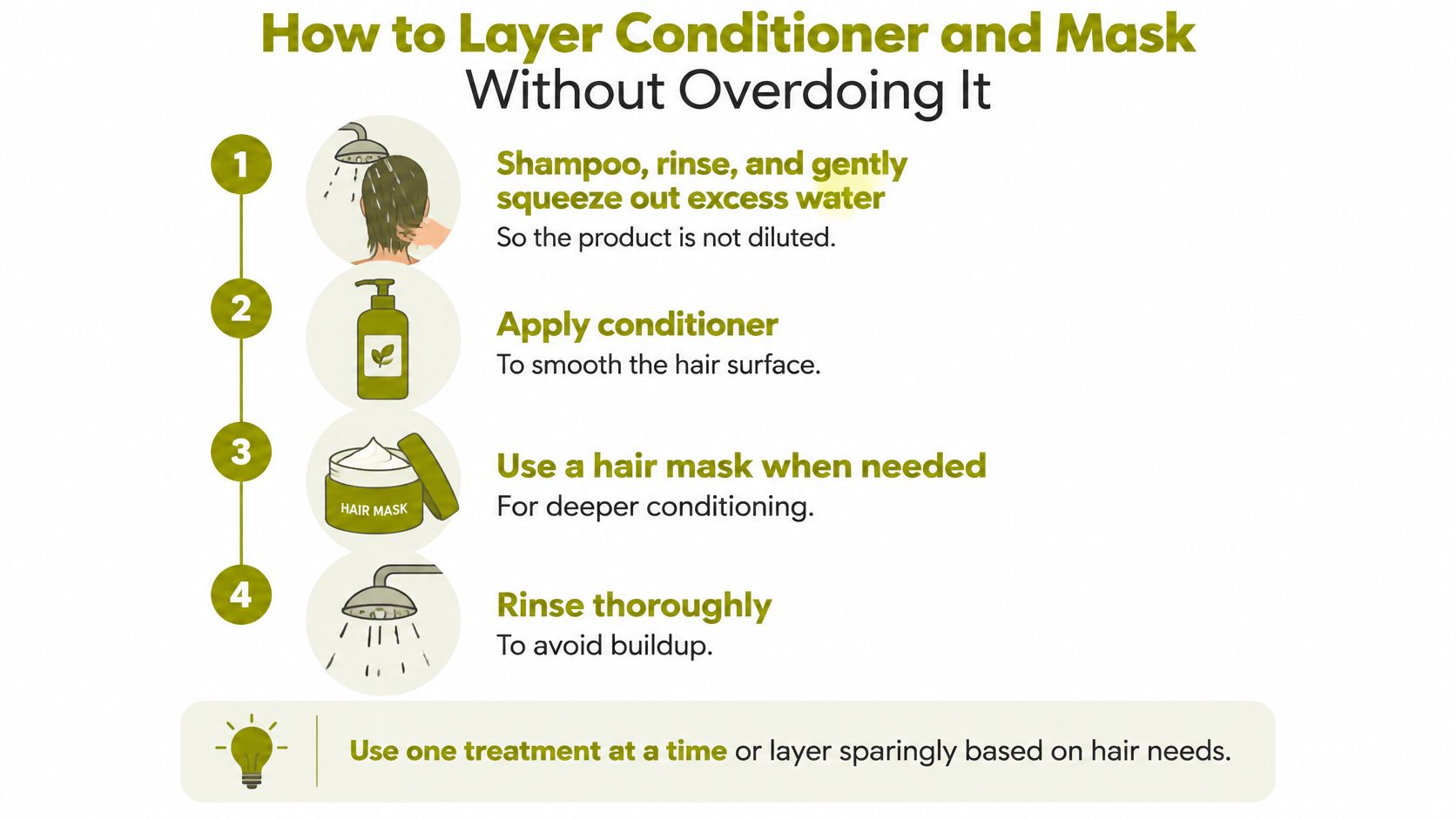
- Shampoo, then remove the extra water. Rinse the cleanser fully and gently squeeze the lengths. Dripping hair dilutes the next product, so you end up using more than the hair can hold.
- Apply conditioner from mid-lengths to ends. Comb through with a wide-tooth comb. Keep the cream off the scalp and off fine roots, where a coat you cannot see still shows up tomorrow as flatness.
- On a mask day, switch the richest product to the driest lengths. Spread the mask from mid-lengths to ends only. Rich formulas near the roots weigh them down, and the scalp rarely needs that cushion.
- Leave the mask for the time on the label. That is usually several minutes, not an open-ended sit. Longer than the label is not a better treatment. It is just more residue to rinse.
- Rinse with lukewarm water until the hair no longer feels slick. Cool water is fine at the end if you like the feel. The goal is a clean slip, not a film you can still pinch between two fingers.
- Skip the mask on any wash where the hair already feels coated. Save it for very dry or heavily styled lengths. On mask days, keep the conditioner light so only one product carries the richest formula.
Why one rich step is enough
Oils, cationic conditioners, and silicones all work by depositing on the surface. Stacking a heavy conditioner and a heavy mask in the same shower raises the dose without raising the benefit. Fine, low-porosity, or oily-rooted hair shows that extra dose first, as dullness or a coated feel at the roots.
Curly and coarse lengths can still use both products in one week. They just should not wear both at full strength on the same inches of hair. Conditioner covers the areas that tangle every wash. The mask visits the inches that still feel dry after that coat.
If you are unsure, pick the lighter conditioner on mask day and the usual conditioner on every other wash. You can always add a little more next time. Taking buildup out takes several washes.
Signs Your Routine Needs Adjusting
Routines usually go wrong by overdoing one product, not by picking the “wrong” category. Change one variable, give it a few wash cycles, and read the feel before you buy something new.
| Sign | Likely cause | Adjustment to try |
|---|---|---|
| Limp, heavy or dull look | Too much product or residue build-up | Use less, rinse longer and cut mask use to about once a month |
| Tangles after washing | Conditioner alone may be too light for the texture | Add a weekly mask to mid-lengths and ends |
| Frizz and flyaways | Dryness in the lengths | Focus the mask on ends and consider a leave-in |
| Greasy roots within a day | Rich product applied near the scalp | Keep products to mid-lengths and ends |
| Stiff or straw-like feel | Frequent rich treatment | Use conditioner only for one week, then reassess |
Read the feel, then change one thing
A limp, heavy, or dull look is the most common sign after a new mask. Too much product, or residue that never fully rinsed, is the usual cause. Use less, rinse longer, and cut mask use to about once a month until the hair looks lighter.
Tangles after washing often mean the daily conditioner is too light for that texture. Add a weekly mask to mid-lengths and ends rather than piling more conditioner on the roots. A hair mask for damaged-feeling lengths can be the richer step in that spot, still rinsed on the schedule your hair tolerates.
Frizz and flyaways usually point to dryness in the lengths, not a missing root treatment. Focus the mask on the ends, and consider a light leave-in only on the inches that still puff after they dry.
Greasy roots within a day almost always trace back to a rich product applied near the scalp. Keep both products on mid-lengths and ends.
A stiff or straw-like feel often follows frequent rich treatment, especially when proteins or heavy butters stack up. Step back to conditioner only for one week, then reassess.
These are styling and routine adjustments, not medical advice. Scalp soreness, flaking that will not settle, or sudden shedding belongs with a qualified professional. Hair feel after a wash is something you can test at home. Skin on the scalp is not a formula experiment.
Pick Your Routine and Test It for Two Weeks
Start with a standard conditioner after every wash and add a mask once a week to dry or porous lengths. Adjust from the signs above instead of adding a third product in the first fortnight.
The two-week test
- Week one, conditioner only. Use it after every wash, from mid-lengths to ends, and rinse until the hair feels clean rather than filmed. This week shows you the baseline slip.
- Week two, one mask. Add a single mask on the driest lengths, from mid-lengths to ends. Keep the same conditioner, the same amount, and the same rinse so you can tell what the mask changed.
- Note three things at the end of each week. How the hair combs when wet, how it feels once dry, and how it moves the next day. A photo in the same light helps more than a vague memory of “better.”
Before you buy more, write down hair type, washing frequency, the current routine, and how the hair felt each week. Those details decide which texture fits. A fine, twice-weekly wash does not need the same cream as coarse hair that is heat-styled often.
Haircare on our shelves is grouped into Shampoos, Conditioners, Hair mask, Hair oil, Styling products, and Nutrition. Once the two-week notes are clear, compare conditioners and masks in the ArtNaturals haircare range by texture, not by how rich the jar looks. A lighter daily conditioner plus a occasional mask is a complete test. Hair oil and styling products can wait until the wash-day pair feels settled.
Choose one product to test for two weeks, then decide whether to keep it, change the mask, or adjust the frequency. Your own notes on combing, feel, and movement are the final judge, not a promise printed on a bottle.
ArtNaturals offers plant-oil haircare across shampoos, conditioners, hair masks, and hair oils for everyday wash days and the occasional richer treatment. If you are choosing how to pair a light conditioner with a mask, start with the textures that match your lengths and keep the test simple. Visit ArtNaturals to compare those options and set your two-week routine.