

You notice more strands than usual on your brush, then spot a few more circling the shower drain. Before changing your entire routine, you wonder, does rosemary help your hair growth, or has a familiar kitchen herb become the latest beauty trend?
The most accurate answer is encouraging but measured. Rosemary may support a healthier scalp environment and hair-growth-related outcomes for some people, yet it isn't a magic fix, and the available evidence remains limited. A thoughtful routine depends less on using a large amount and more on choosing a suitable formula, diluting it properly, applying it consistently, and paying attention to how your scalp responds.
Why Rosemary Has Become a Hair Care Favorite
Someone noticing extra shedding often starts with a simple search for a gentler option. Rosemary appears everywhere, from scalp oils and shampoos to short videos showing fingertip massages at the roots. The appeal makes sense. It's familiar, plant-based, fragrant, and easier to understand than a long list of synthetic-sounding ingredients.
Rosemary has also carried cultural staying power. The herb has long been associated with Mediterranean herbal traditions and everyday cooking, so its move from the kitchen into the bathroom feels natural rather than mysterious. In the kitchen, a single sprig still lifts roast potatoes or a weeknight chicken, and home-cooking cookbooks from Just Cook It are an easy place to find dishes that put it to work. As clean beauty has made plant oils and botanical extracts more visible, rosemary has become a familiar part of scalp-care rituals.
Why the ritual matters
The popularity isn't only about the oil itself. A rosemary routine often includes a gentle scalp massage, a slower wash day, and a deliberate pause before rinsing. Those habits can make hair care feel less like an emergency response and more like regular self-care.
Social media has amplified the idea that rosemary can create fuller-looking hair, but visual fullness and new hair growth aren't identical. Hair can look more polished because of conditioning, reduced breakage, styling, or better scalp comfort. A botanical oil may support the scalp without producing the dramatic transformation promised by a viral clip.
A useful expectation: Rosemary is better viewed as a supportive scalp-care habit than as a guaranteed answer to thinning.
That distinction keeps the routine grounded. Rosemary may be worth exploring if you enjoy plant-led care and can use it comfortably, but changes in shedding can have many possible contributors, including stress, nutrition, hormones, genetics, and general scalp health. No single ingredient can override all of them.
How Rosemary Is Thought to Support the Scalp
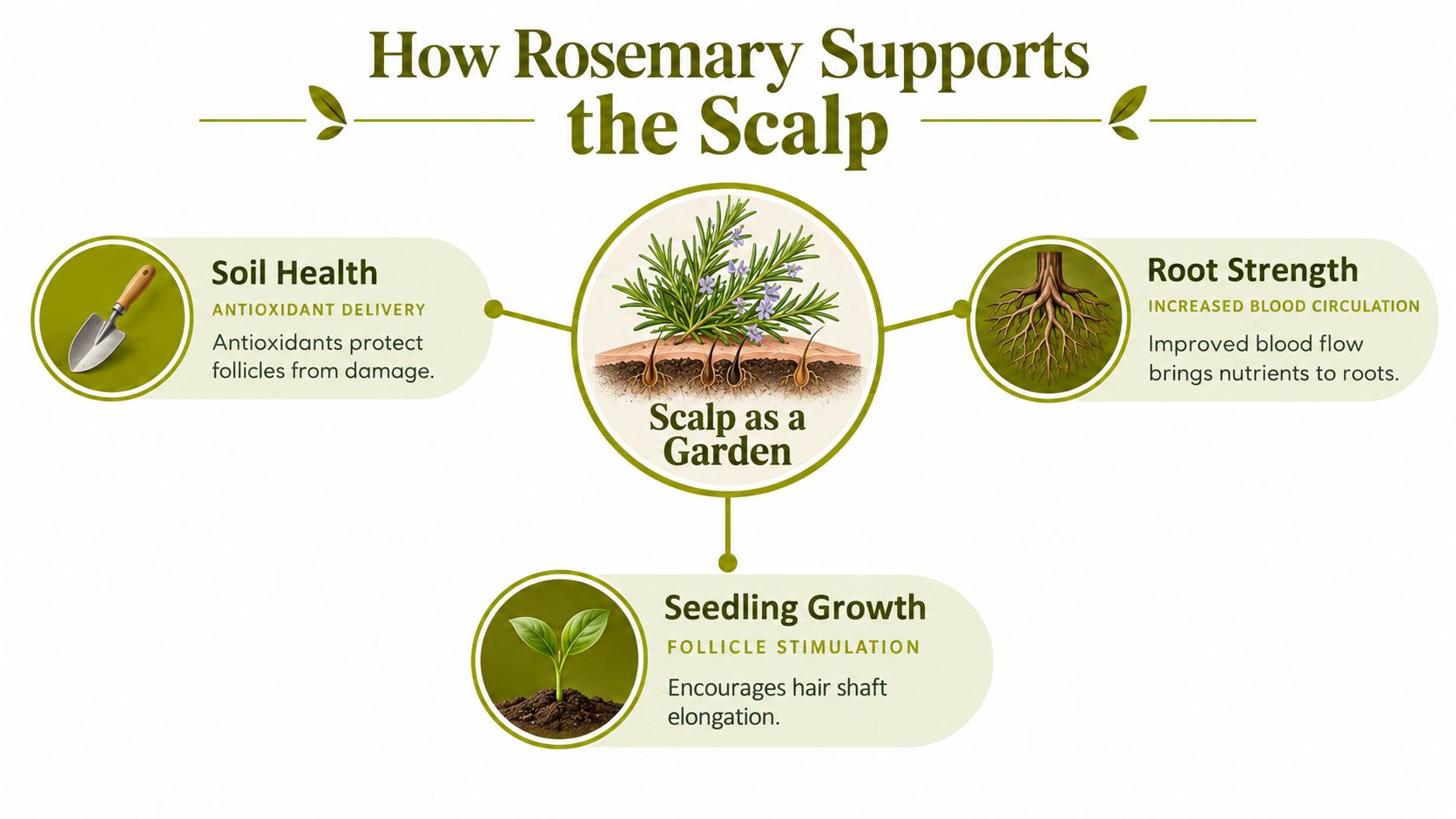
Think of the scalp as a small garden. Hair follicles are the roots, the surrounding skin is the soil, and regular care helps maintain the conditions those roots need. Rosemary oil isn't a seed that creates a new plant in empty soil. It's more like a concentrated botanical added to a broader care routine.
Rosemary contains plant compounds, including carnosic acid, that are associated with antioxidant activity. Antioxidants are often described as protective helpers. In plain language, they may help the scalp handle everyday oxidative stress, although that doesn't mean rosemary can rebuild follicles that are no longer active.
Circulation is another commonly discussed pathway. A gentle massage may encourage local blood flow, similar to watering dry soil so nutrients can reach the roots more easily. That analogy describes a possible supportive role, not a promise that more massage or more oil will force hair to grow.
What rosemary may support
A well-formulated, diluted product may help you care for the scalp in three connected ways:
- A more comfortable surface: A gentle routine can reduce the temptation to scratch, pick, or scrub aggressively.
- A nourished environment: Botanical antioxidants may help support the skin around the follicle.
- A consistent care habit: Repeated, careful application encourages attention to the scalp rather than only the visible hair lengths.
What rosemary can't do is equally important. It can't promise to reactivate every dormant follicle, reverse every type of hair loss, or replace an evaluation when shedding is sudden, severe, or unusual. The scalp garden analogy works best when it reminds you to improve the soil, not when it suggests that one ingredient controls the entire harvest.
What the Research Actually Shows
The most frequently cited human trial was published in 2015 and enrolled 100 men aged 18 to 49 with mild-to-moderate androgenetic alopecia. Participants used either topical rosemary oil or 2% minoxidil for 6 months. Hair count didn't differ significantly between the groups at 3 months or 6 months, while both groups showed a significant increase in hair count by month six. Read the original randomized comparative trial on PubMed for the study details.
A 2024 review summarized the same trial, noting that 50 participants received rosemary oil and 50 received 2% minoxidil. It also described less scalp itching with rosemary in that trial. The review characterized rosemary as promising rather than definitive because the evidence base remains small and product formulations vary. You can read the 2024 review of natural hair-growth alternatives for its broader discussion.
Key Rosemary Hair Growth Studies at a Glance
| Study | Type | Duration | Key Finding |
|---|---|---|---|
| 2015 randomized comparative trial | Human trial | 6 months | Hair count increased in both groups, with no significant difference between rosemary oil and 2% minoxidil |
| 2024 natural-alternatives review | Literature review | Not a new treatment period | Reiterated the trial findings and described rosemary as promising but limited |
| Newer rosemary-blend study | Randomized, placebo-controlled clinical study | 90 days | Rosemary-lavender and rosemary-castor blends showed stronger reported growth, thickness, and shedding outcomes than coconut-oil placebo |
The newer 90-day study reported a 57.7% increase in hair growth rate with rosemary-lavender oil and 47.6% with rosemary-castor oil, compared with 21.1% for coconut-oil placebo. Hair thickness rose by about 68% in both rosemary groups versus 24% in placebo, while hair fall dropped by about 45% versus about 16% in placebo, according to the published clinical study. These results are interesting, but small studies and specific blends don't establish a universal consumer regimen.
Hair count, thickness, density, and personal perception measure different things. A hair-count increase may not look like dramatic fullness, especially when hair texture, styling, lighting, and breakage influence appearance. For broader context on hair-loss concerns and possible evaluation pathways, hair loss info from Georgia Plastic can be a useful educational resource.
How to Dilute and Apply Rosemary Oil Safely
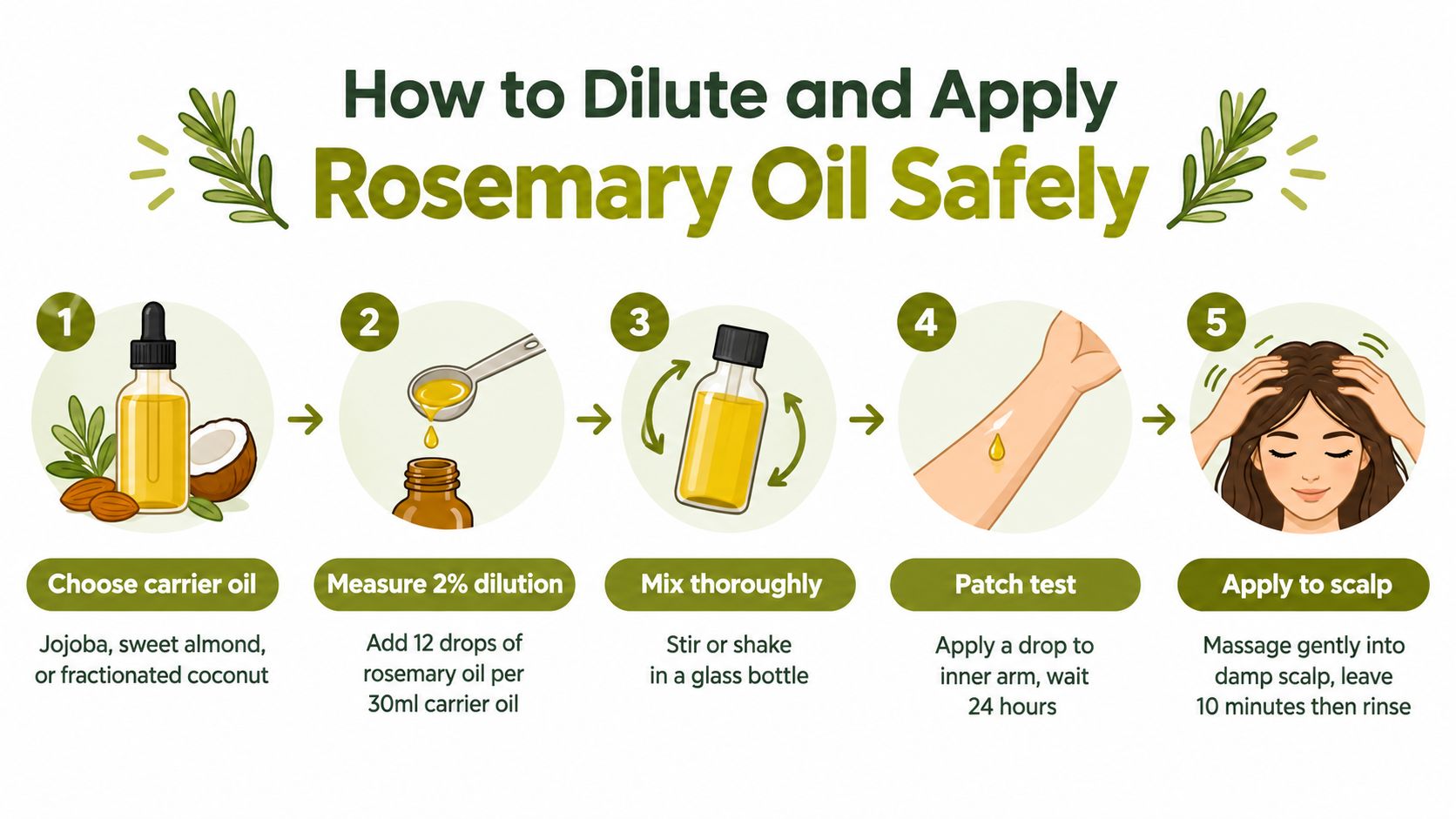
Rosemary essential oil is concentrated, so applying it straight from the bottle isn't a shortcut. It can cause redness, itching, burning, or dryness, especially on a sensitive scalp. Consumer guidance commonly describes a leave-on dilution of about 1% to 2%, which works out to roughly 3 to 6 drops per tablespoon, or 15 mL, of carrier oil (dilution guidance for rosemary oil).
A simple starting formula uses jojoba, sweet almond, or fractionated coconut oil as the carrier. For a 2% dilution, the provided formulation example uses 12 drops of rosemary oil per 30 mL of carrier oil. Mix it in a clean glass bottle, label it, and avoid adding extra drops because stronger isn't automatically more effective.
Three ways to use it
- Pre-shower massage: Apply a small amount to the scalp and use your fingertips in gentle circles for 5 to 10 minutes. Keep your pressure light. Fingertips are safer than fingernails, which can create unnecessary friction.
- Longer leave-on treatment: If your scalp tolerates the formula, leave it on for a few hours or overnight before shampooing. Covering the hair with a silk cap can protect bedding, but overnight use isn't suitable for everyone.
- Short rinse-off treatment: Apply before washing, leave it for around 10 minutes, then cleanse thoroughly. This format may suit fine hair or an oily scalp better than a heavy leave-in.
A practical starting cadence is 2 to 4 times per week for a diluted scalp application, while some guidance describes daily or as-needed use depending on the product and tolerance (rosemary oil safety and frequency guidance). Start conservatively and adjust downward if your scalp feels tight, itchy, or greasy. The essential-oil dilution ratio guide offers additional formulation context.
Massage the scalp rather than coating the lengths. Guidance from the Cleveland Clinic on rosemary oil for hair also emphasizes targeting the scalp and choosing a contact time that fits the product format.
For a visual demonstration of application technique, watch this routine:
Side Effects and Who Should Use Extra Care
“Natural” doesn't mean risk-free. Essential oils contain concentrated aromatic compounds, and a scalp that tolerates a botanical shampoo may still react to a leave-on oil. Mild tingling can happen, but persistent burning, redness, itching, dryness, flaking, or swelling means the formula or frequency isn't working for you.
Stop at the first clear warning
A patch test is a sensible first step. Apply a small amount of the diluted formula to the inner forearm and wait 24 hours before using it on the scalp. A reaction may show up as irritation or contact dermatitis, and continuing through discomfort can make the skin barrier more unsettled.
Extra care is sensible for people who are pregnant or breastfeeding, those with epilepsy or hormone-sensitive conditions, young children, and anyone using medicated scalp treatments such as minoxidil or steroid creams. Combining active products can increase irritation, so professional guidance is appropriate before layering them.
Safety principle: A reaction doesn't mean rosemary has failed. It means that particular product, concentration, or routine isn't suitable for your skin right now.
Choose a pure, properly labeled essential oil or a transparent pre-diluted product. Store essential oils away from sunlight and heat, and keep them out of reach of children. If your scalp becomes uncomfortable, rinse the product away and pause rather than trying to balance irritation with more oil.
Choosing the Right Rosemary Product for You
The best format is the one you can use carefully and consistently. Pure rosemary essential oil offers flexibility, but you must dilute it every time. A pre-diluted blend removes that measuring step and may feel simpler for a first routine, provided the label clearly states how it's intended to be used.
Rosemary shampoos and conditioners are lower-commitment choices. They fit into an existing wash day, although shorter contact time and rinsing make them different from a scalp oil. Mists and scalp serums suit people who dislike a greasy finish, while infused oils can feel more comforting for dry or textured hair.
Comparing Rosemary Hair Product Formats
| Product Type | Best For | Effort Level | Key Consideration |
|---|---|---|---|
| Pure essential oil | Experienced DIY users | Higher | Requires accurate dilution and patch testing |
| Pre-diluted scalp oil | Simple leave-on routines | Moderate | Check the carrier oils and intended use |
| Rosemary shampoo or conditioner | Low-commitment wash days | Low | Rinse-off contact may feel lighter |
| Scalp mist or serum | Fine hair or non-greasy preferences | Low to moderate | Check whether rosemary is present as an actual ingredient, not only fragrance |
| Rosemary powder or tea rinse | DIY enthusiasts | Higher | Requires preparation and careful storage |
Match the base to your hair
Fine or oily hair often feels better with a lightweight carrier and a rinse-off application. Thick, curly, or dry hair may tolerate a richer base, especially when you apply the oil mainly to the scalp and protect the lengths from excess handling.
Read the ingredient list rather than relying on the front label. Look for rosemary leaf oil or extract, identify the carrier oils, and avoid assuming that a rosemary fragrance provides the same experience as a formulated scalp treatment. Pure essential oils are best kept in dark glass packaging. For a broader look at carrier oils and hair routines, explore oils commonly used for hair care.
Common Myths About Rosemary for Hair Growth
Rosemary became popular partly because simple routines are easy to share. The problem starts when a supportive ingredient gets presented as if it controls every stage of hair growth.
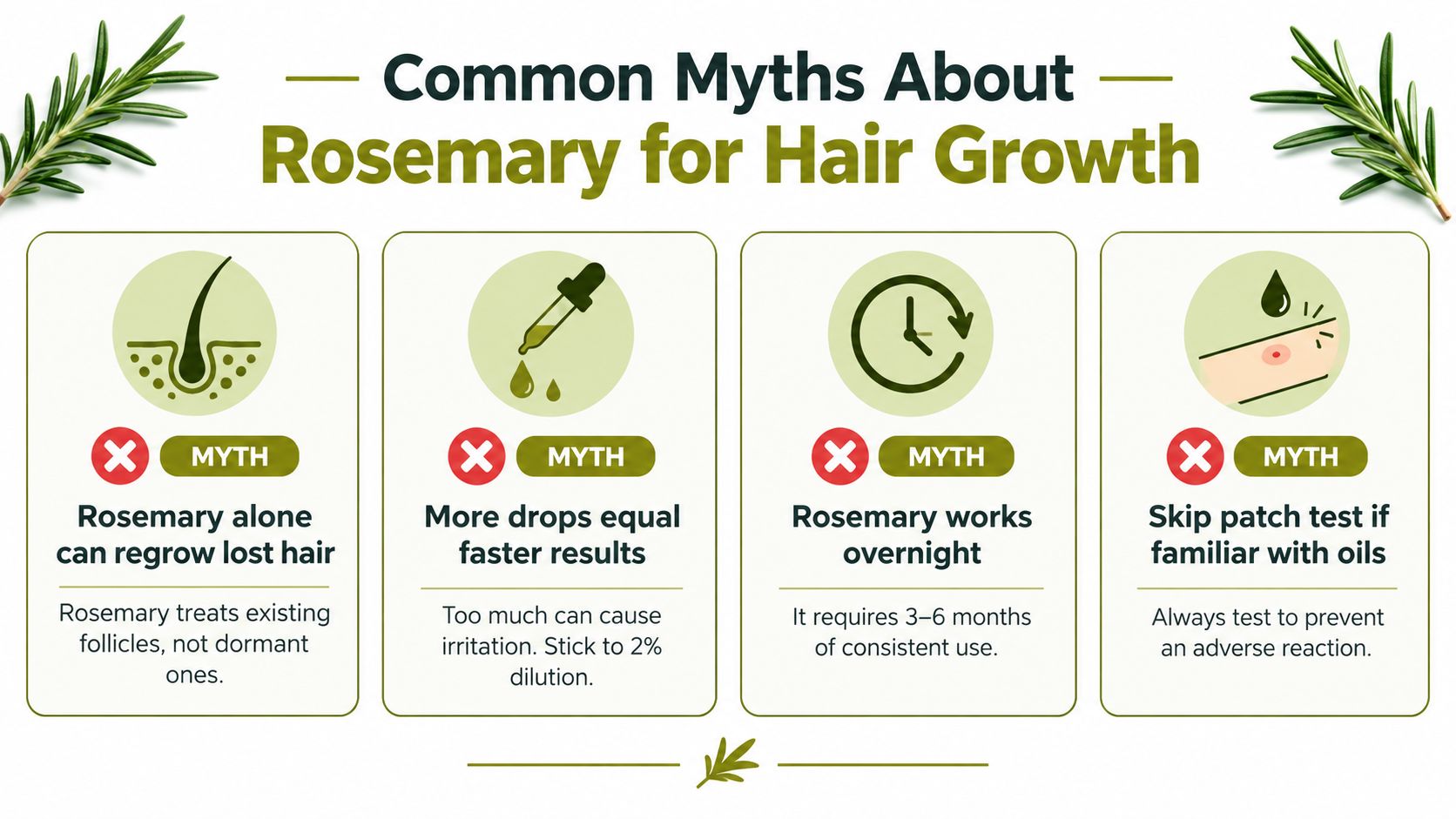
Myth one, rosemary alone can regrow lost hair
Rosemary may support the environment around existing follicles, but it can't promise to recreate hair where follicles are no longer active. Hair changes can also relate to genetics, hormones, stress, nutrition, or scalp conditions. A sudden or marked change deserves more attention than a social-media remedy can provide.
Myth two, more drops produce faster results
Increasing the amount raises the chance of irritation, not necessarily the chance of visible growth. A diluted formula used repeatedly is more sensible than a heavy application that leaves the scalp burning or greasy.
Myth three, overnight soaking works for everyone
Some people like a longer leave-on treatment, while others develop itching, redness, or buildup. Contact time should match your scalp and product format. A short pre-shampoo treatment can be a better choice for fine hair or sensitive skin.
Myth four, a patch test is optional
Familiarity with oils doesn't guarantee that a new concentration or carrier blend will suit you. A patch test gives you a chance to notice a reaction before covering the scalp.
The better framing is modest but useful. Rosemary can be part of a supportive routine, not a substitute for understanding what may be driving a hair change. Consistency, dilution, and scalp comfort matter more than dosage extremes.
Building a Simple Rosemary Hair Care Routine
Start with a routine you can repeat without making wash day complicated. Patch test the diluted formula first, then choose a small amount for the scalp rather than saturating the entire head. A scalp massage should feel gentle and calming, not aggressively stimulating.
A weekly rhythm
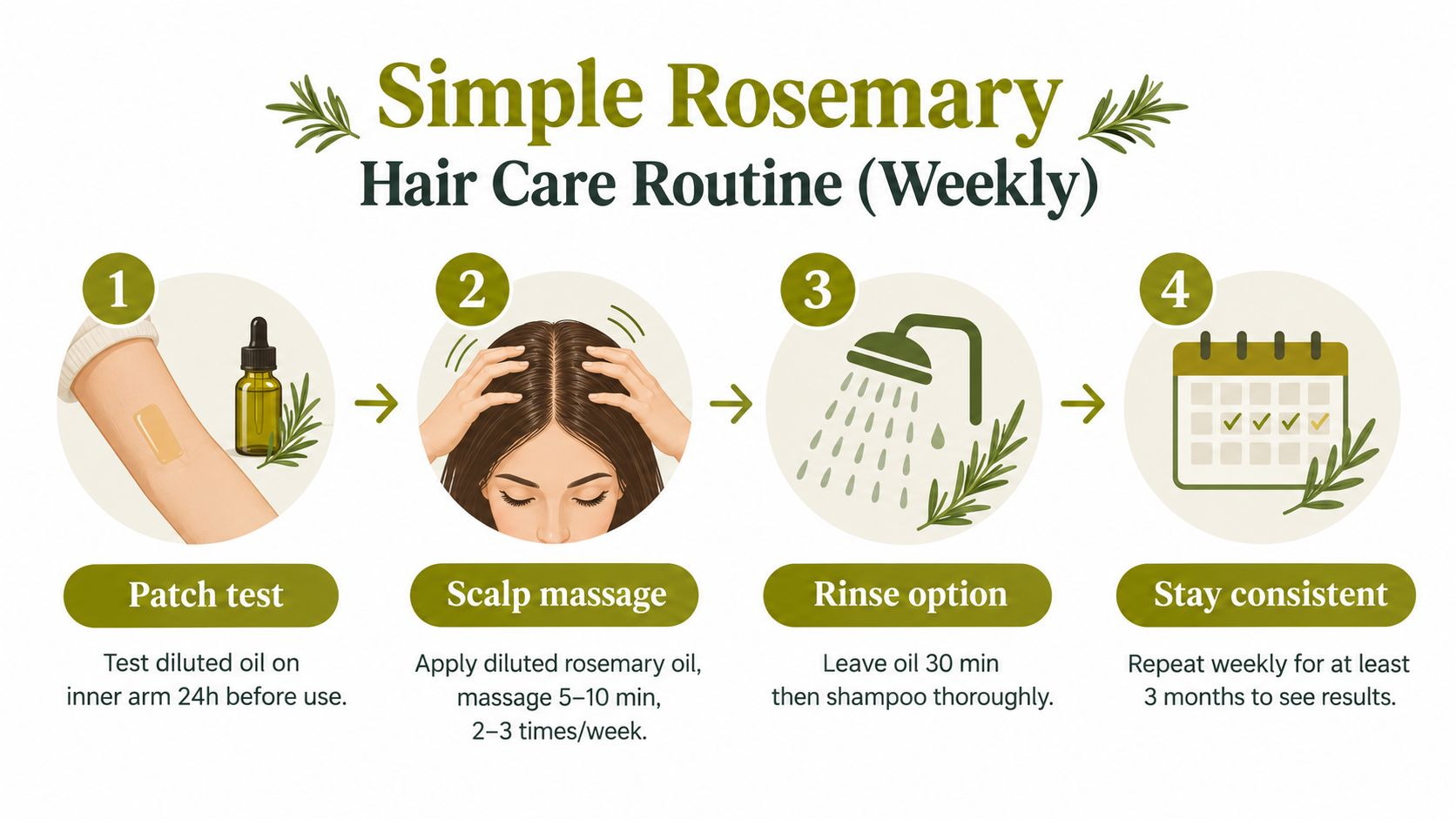
- Before the first full application: Test the diluted oil on the inner arm and wait 24 hours.
- On selected wash days: Apply the diluted oil to the scalp, massage for 5 to 10 minutes, and leave it on for a short period before shampooing.
- For a lighter option: Use a rosemary mist or rinse-off format when you don't want an oily finish.
- After washing: Choose a mild shampoo, detangle with a wide-tooth comb, and avoid pulling through wet hair.
A starting cadence of 2 to 3 applications per week keeps the habit realistic. The scalp massage guide for hair growth can help you think about massage as a gentle technique rather than a forceful one.
Track the experience, not just the mirror
Keep brief notes about scalp comfort, flaking, oiliness, breakage, and the amount of shedding you notice. Compare your experience over 6 to 8 weeks rather than judging the routine after one application. Hair responds slowly, so patience, adequate nutrition, stress management, and gentle styling all belong beside the oil.
Rosemary may be a worthwhile addition if your scalp enjoys it and your expectations stay realistic. If discomfort appears, stop and reassess. If shedding feels sudden, severe, or persistent, seek qualified guidance instead of adding more products.
ArtNaturals offers plant-based haircare options, including a Rosemary & Castor Hair Growth Oil and a hair growth kit that pairs rosemary and castor oil with a scalp massager. Visit ArtNaturals to explore these formulas alongside essential oils and other everyday self-care products, then choose the format that fits your scalp and routine.