

If your face feels squeaky-clean after washing but tight and shiny later, did your cleanser do a good job? That question matters more than how much a product foams or how quickly it removes visible oil.
A good face cleanser for oily skin fits into everyday life without making your skin feel uncomfortable. Choose a texture you enjoy, understand the ingredients, and watch how your skin feels over two to four weeks, rather than judging the moment you rinse. Oil control and gentleness belong together.
Cleanser Types Compared for Oily Skin
A gel or light foam is a practical starting point for daily cleansing when your skin feels oily. These textures lift surface oil, sweat, and debris without necessarily leaving a heavy film.
Gel cleansers are especially familiar to shoppers. Global Market Insights' facial-cleanser market analysis reports that gels held a 39% market share in 2024, making them the leading format identified in that analysis. Popularity doesn't establish suitability, but a lightweight, easy-rinsing gel can be a straightforward place to start.
Cleanser formats for oily skin
| Format | Typical texture | Why it suits oily skin | Watch for |
|---|---|---|---|
| Gel | Clear, lightweight, water-like | Removes surface oil with a light, residue-free feel | Can feel squeaky if strongly formulated |
| Foam | Airy, bubbly lather | Rinses cleanly and is easy to work into the T-zone | Some formulas have a strong surfactant system; check comfort after use |
| Clay or mask-style | Thick, slightly matte paste | Absorbs excess surface oil | Can over-dry; use one to two times a week at most, if comfortable and permitted by the label |
| Micellar water | Liquid, no lather needed | A gentle first pass for makeup and sunscreen | May leave a film; often followed by a second cleanse |
| Cream or milk | Soft, low-foam, cushiony | Suits combination skin that also feels dry | Can feel heavy on very oily skin |
Match the texture to your whole face
Consider your cheeks as well as your forehead. If your nose looks shiny but your cheeks feel dry, a cleanser selected only for maximum oil removal may leave part of your face uncomfortable.
Clay is better treated as an occasional option than an automatic daily step. Micellar water can help loosen makeup before washing, while a cream or milk may feel welcome when your skin needs a softer cleansing experience.
For readers balancing sensitivity with oiliness, ALODERMA's guide to a cleansing routine for sensitive, oily skin offers another resource for thinking through routine choices.
Practical rule: Pick a format for its rinse-off feel and ongoing comfort, not for the strongest immediate degreasing sensation.
During your trial, notice whether your cheeks remain comfortable, your moisturizer applies without stinging, and washing feels pleasant rather than something your skin has to recover from. A dramatic squeak isn't the standard to aim for.
Why Oily Skin Happens and What Cleansing Can Change
Washing more often doesn't remove oil for good. Think of dish soap cutting grease from a pan: a little helps lift what's on the surface, but scrubbing harder doesn't stop grease from appearing again. Skin is much more delicate than cookware, so the analogy ends well before vigorous scrubbing.
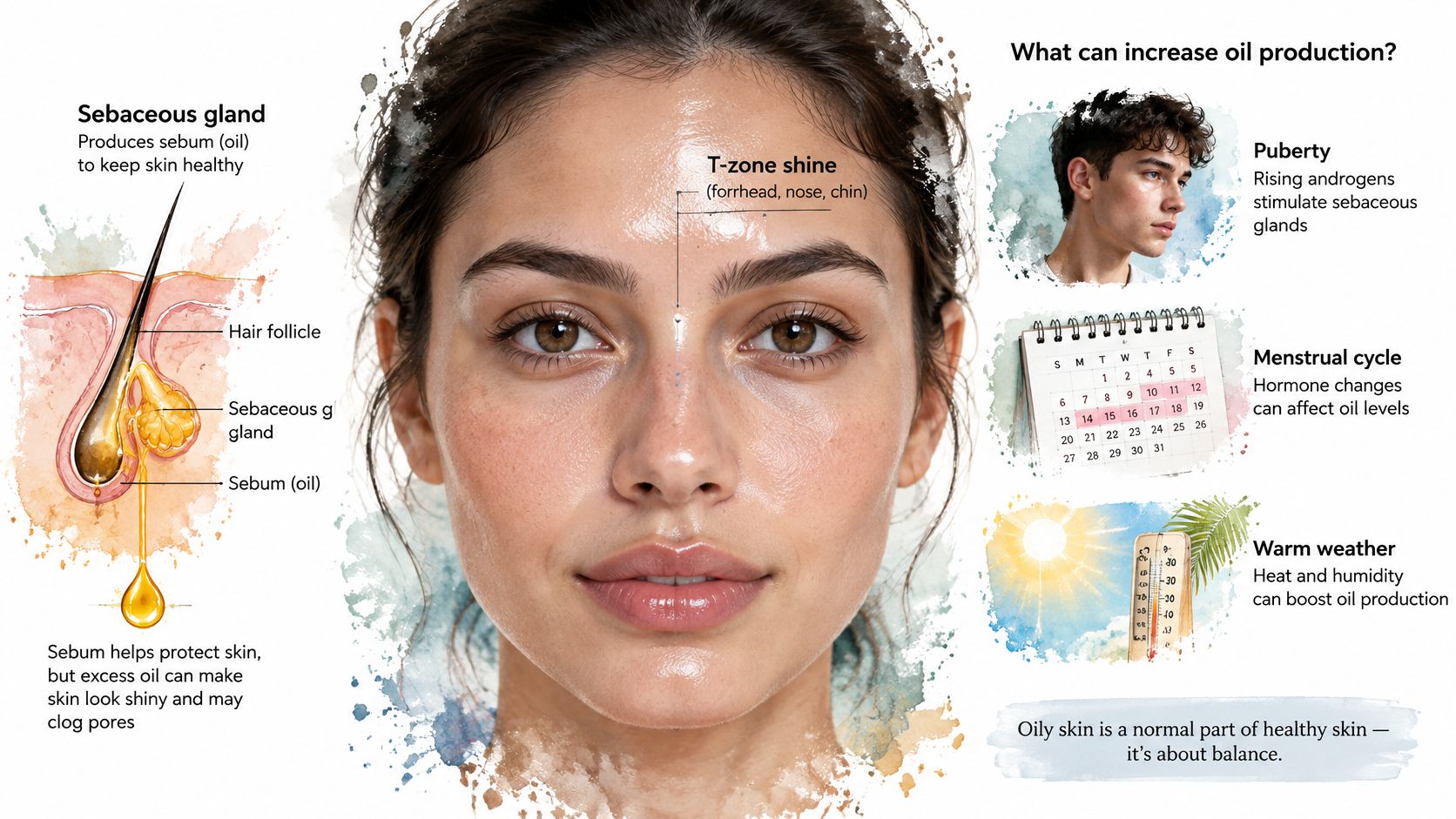
Your sebaceous glands make sebum, the natural oil that reaches the skin's surface. Sebum helps keep skin supple and supports its protective surface. The aim isn't to eliminate it.
Genetics influence your usual oiliness, while hormonal changes, including puberty and menstrual cycles, can affect how oily your face feels. Heat and humidity can make shine more noticeable, and heavy skincare layers may add a greasy feel without necessarily changing gland activity.
Surface cleaning isn't an off switch
A cleanser removes material sitting on your skin: surface oil, sweat, makeup, sunscreen, and everyday debris. It doesn't switch off the glands underneath.
That distinction explains why a clean face can become shiny again. Oil returning doesn't automatically mean your cleanser failed, and oily skin doesn't mean dirty skin.
This visual shows where skin oil comes from and why daily conditions can affect its appearance.
Why extra washing can disappoint
Repeated washing can leave you with an uncomfortable mix of surface shine and dryness. Don't assume that this proves your skin is compensating by producing extra oil. The more useful observation is that your current routine isn't keeping you comfortable.
DermNet's guide to soaps and cleansers explains that harsh cleansing can disturb protective skin lipids and barrier function, while mild synthetic-detergent cleansers are generally better tolerated.
- Oiliness: Describes how much oil you notice on your skin.
- Hydration: Describes its water content, which a shiny appearance can't tell you.
- Breakouts: Are a separate concern, not merely evidence that you haven't washed enough.
Cleansing is everyday care, not a stand-alone answer to every skin concern. A useful cleanser leaves room for moisturizer, sun protection, and other carefully chosen steps to do their own jobs.
Ingredients That Help and Ingredients to Use With Care
Salicylic acid, niacinamide, clay, and ceramides often appear on oily-skin labels, but they serve different purposes. Some help lift oil or exfoliate, while others support moisture and comfort.
The complete formula matters more than a single highlighted ingredient. A cleanser with an appealing botanical can still contain fragrance your skin dislikes, and an acid cleanser can feel unnecessarily drying alongside an exfoliating serum.
Oily-skin cleanser ingredients: role and caution
| Ingredient | Role in cleansing | Use with care |
|---|---|---|
| Salicylic acid | Oil-soluble exfoliant that helps loosen buildup within pores | Can dry skin; introduce gradually and avoid stacking several acids |
| Glycolic or lactic acid | Water-soluble surface exfoliants | Can increase sun sensitivity; start with a few uses a week |
| Niacinamide | Supports a smoother, more balanced look | Often well tolerated; watch for flushing or discomfort |
| Kaolin or bentonite clay | Absorbs surface oil | Can over-dry; avoid on very dry or reactive areas |
| Ceramides | Replenish lipids associated with the skin barrier | Support rather than degrease; assess the full formula |
| Hyaluronic acid | Humectant that helps skin hold water | Think of it mainly as a hydration ingredient, not an oil-removing ingredient |
| Tea tree extract | Botanical commonly included in oil-focused formulas | Can irritate; patch test before regular use |
| Sodium cocoyl glycinate | Mild amino-acid-derived surfactant | A gentle cleansing option; still check the overall formula |
| Sodium lauryl sulfate (SLS) | Strong degreasing surfactant | Can leave skin feeling stripped at high levels |
| Denatured alcohol | Fast-drying solvent | Can leave skin feeling dehydrated |
| Fragrance and essential oils | Scent and sensory appeal | Can irritate reactive skin; plant origin isn't a guarantee |
| Large-grit scrubs | Physical exfoliation | Can cause friction-related irritation; avoid forceful rubbing |
Choose support as well as oil removal
Surfactants help water lift away oil and debris. Sodium cocoyl glycinate is an amino-acid-derived option worth recognizing, although no ingredient name can guarantee how the finished cleanser will feel.
Ceramides deserve attention, too. They replenish skin lipids rather than adding grease, so their presence isn't a reason for oily-skin users to reject a cleanser.
If you're considering exfoliation beyond your wash, our guide to salicylic acid serum for oily skin can help you think about where a leave-on product belongs. You don't need an exfoliating ingredient in every step.
Plant-powered still calls for discernment
Our plant-powered approach values plant oils, botanical extracts, and plant-derived actives. That preference doesn't make every botanical suitable for every face.
The FDA's cosmetic-ingredients guidance explains that natural origin doesn't establish safety and that cosmetic products generally don't require FDA premarket approval, apart from certain color additives. Legal sale shouldn't be mistaken for an approval claim.
When narrowing your choices, prioritize:
- A comfortable cleansing base: Look beyond the featured extract.
- Moisture support: Consider ceramides or humectants alongside oil-focused ingredients.
- A manageable active load: Choose fragrance and exfoliation according to your skin's tolerance and the rest of your routine.
Reading a Cleanser Label Before You Buy
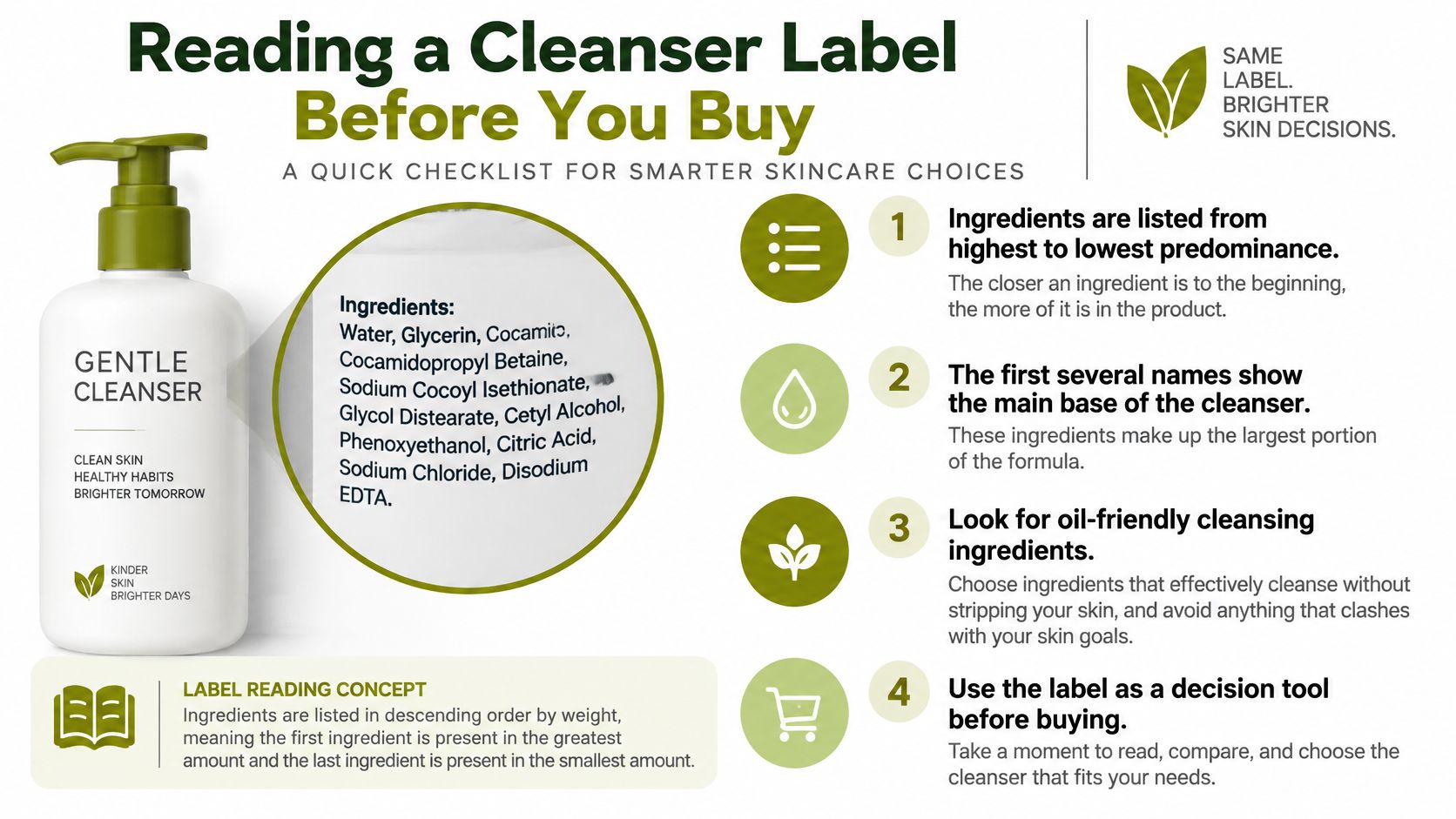
Start with the first five ingredients as a shopping habit, not a scientific cutoff. They can help you identify whether the cleanser's base is mainly water, cleansing agents, oils, or moisturizing ingredients.
Under FDA cosmetic-labeling regulations, ingredients are generally listed in descending order of predominance, but ingredients present at 1% or less may appear without strict concentration ordering. That exception means you can't reliably rank low-level botanical extracts or fragrance ingredients by their position alone.
You also can't calculate an exact ingredient percentage from the list. A prominently advertised extract might appear late in the formula without telling you much about the cleanser's overall performance.
Use a repeatable shopping checklist
- Read the first five names. Use them to understand the main base, then continue through the complete list.
- Check scent ingredients. Look for fragrance and essential oils, especially if scented products have bothered you before.
- Confirm the intended use and directions. Check whether the product is a daily wash, occasional mask, makeup remover, or another format.
- Read the warnings. Pay attention to eye-contact precautions and instructions about sensitivity or frequency.
The label-reading visual below gives you a quick reminder to keep alongside that checklist.
Read beyond the front of the bottle
The label should also identify what the product is and its net quantity. Check those details so you know what you're buying and how it's meant to fit into your routine.
Words such as natural, clean, and oil-control don't replace that information. Neither does an attractive ingredient story.
Say you prefer an unscented daily gel but pick up a fragranced clay mask because its packaging emphasizes oily skin. Reading the directions and complete ingredients would reveal the mismatch before you bring it home.
Label reading helps you make a more informed choice. It doesn't guarantee that your skin will enjoy the finished formula.
How to Cleanse Oily Skin Step by Step
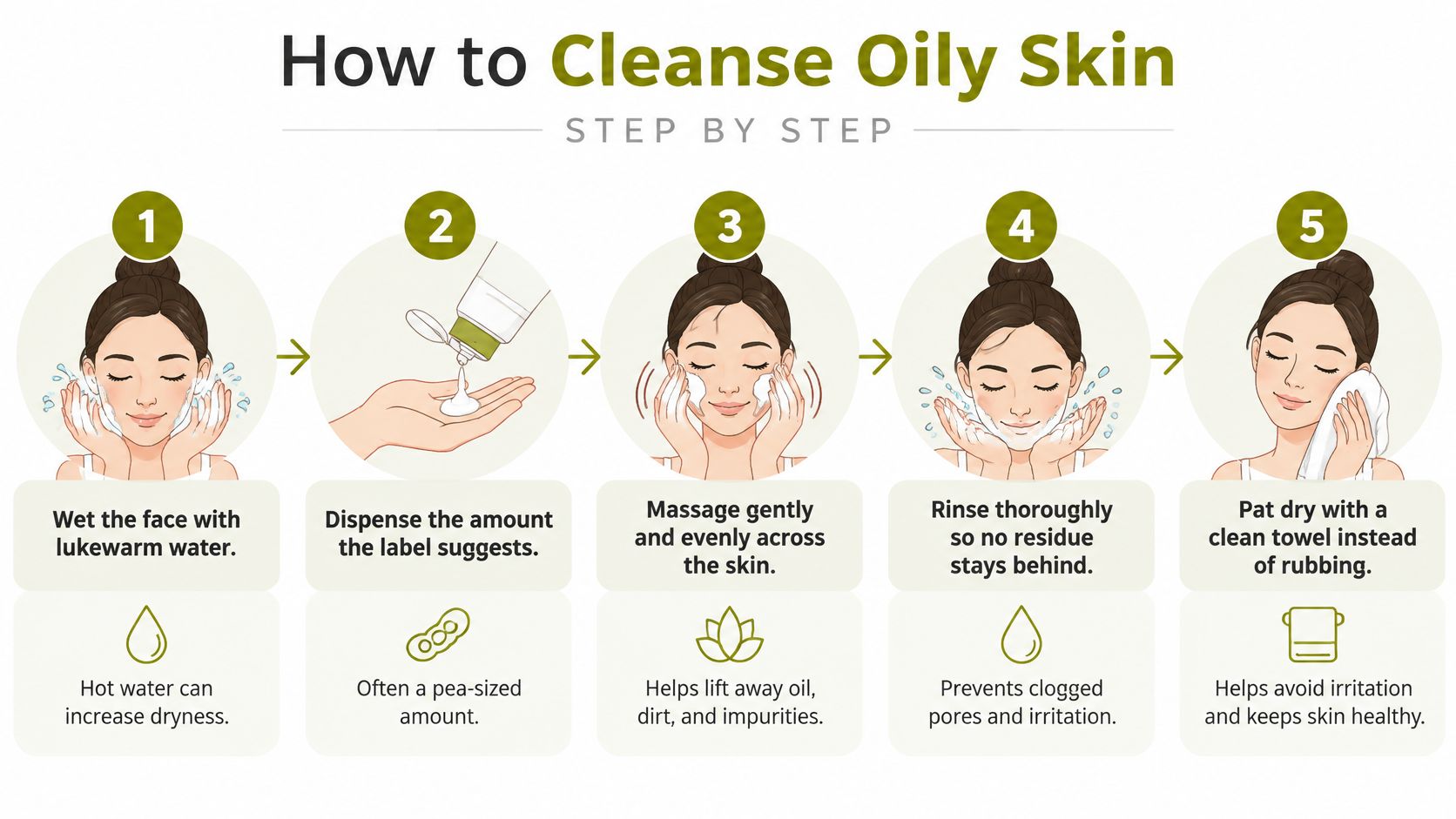
- Wet your face with lukewarm water. Hot water can make washing feel more drying. Aim for comfortably warm, not steaming.
- Dispense the amount directed on the label. A pea-sized to coin-sized portion may be enough for some gels, but concentrated formulas differ. More product doesn't necessarily mean a better wash.
- Add a little water and massage gently. Use your fingertips across the nose, chin, forehead, and cheeks for about 30 to 60 seconds, unless the label specifies otherwise. Gentle, even contact is more useful than forceful scrubbing.
- Rinse thoroughly with lukewarm water. Check around your nostrils, hairline, and jaw, where residue is easy to miss. Leaving cleanser behind can make the next skincare step uncomfortable.
- Pat with a clean towel. Avoid rubbing, especially around flaky areas. Leave skin slightly damp if you're following with a hydrating product.
- Apply your next product appropriately. Moisturizer or a hydrating serum can go onto slightly damp skin. If an exfoliant or another active calls for dry skin, follow that product's directions instead.
Use this visual as a reminder of the gentle washing technique.
Let your day guide frequency
Morning and evening cleansing is a common routine, not an obligation to wash through discomfort. The evening wash usually has more to remove, including sunscreen, makeup, sweat, and the day's buildup.
If your face feels comfortable in the morning without a full cleanse, consider whether a gentler morning approach suits you. Don't add washes just because you notice shine.
Double cleanse only when useful
For heavy makeup or persistent sunscreen, start with an oil-based cleanser or micellar water used according to its directions. Follow with your regular gel if needed to remove the remaining residue.
A light sunscreen day doesn't automatically require an elaborate cleansing ritual. Avoid turning an optional first pass into extra rubbing with cotton pads or repeated washing.
Clean and soft is a more useful endpoint than tight and polished.
If tightness continues after two weeks, reduce cleansing frequency or try a milder formula. Don't wait through worsening stinging or redness just to complete a trial period.
Pairing Your Cleanser With Serums and Moisturizers
- Cleanse in the morning with your chosen wash, if your skin is comfortable with morning cleansing.
- Add optional hydration, such as a hyaluronic acid or niacinamide serum, following its directions.
- Apply a light gel or lotion moisturizer that feels comfortable beneath sunscreen.
- Finish with broad-spectrum sunscreen used according to its label.
Keep the evening routine equally straightforward: cleanse, use an optional targeted serum, and moisturize. Your cleanser handles surface cleaning; a leave-on product has a different place in the routine.
That division helps prevent overloading the washing step. You don't have to choose the most active cleanser just because you have oily skin.
Make exfoliation a deliberate choice
Glycolic, lactic, and salicylic acid serums are leave-on exfoliants. Introduce them a few nights a week, or less often if directed, rather than adding several at once.
Keep strong exfoliating acids separate from retinoids unless a qualified professional has advised otherwise. Layering products that each feel tolerable alone can still lead to discomfort when used together.
For example, if you're introducing a salicylic serum, don't also begin an acid cleanser and a gritty scrub. A simpler wash makes it easier to understand how the serum fits your skin.
- Use damp skin selectively: Hydrating products may suit it, while some active products call for dry skin.
- Let layers settle: Waiting about a minute can make application easier, but there's no universal stopwatch requirement.
- Introduce products separately: Allow about two weeks between additions when skin remains comfortable, so unexpected changes are easier to trace.
Choose a routine you can repeat
Moisturizer isn't reserved for dry-looking faces. A lightweight texture can provide comfortable hydration without the rich finish you may dislike.
Our guide to how to build a skincare routine offers a broader way to organize these steps. Start with a manageable foundation before deciding whether an extra serum serves a clear purpose.
Fixing Tightness, Shine and Breakouts
Tightness right after washing isn't proof that your cleanser worked harder. It's a reason to reconsider the formula, water temperature, or amount of friction involved.
Use the following table as a troubleshooting starting point, not a diagnosis. Similar-looking changes can have different causes, especially when you're using several products.
Oily skin symptoms, likely causes and adjustments
| Symptom | Likely cause | What to adjust |
|---|---|---|
| Tight feeling right after washing | Harsh surfactant or hot water | Try a milder gel and lukewarm water, changing one factor at a time |
| Shine returns within an hour | Normal sebum production | Use a lightweight moisturizer and blotting paper; don't automatically wash more often |
| Flaky dryness around the nose | Over-cleansing or scrubbing | Avoid repeated morning washes, use gentle hands, and drop scrubs |
| Stinging or redness | Fragrance, essential oils, or overlapping acids | Pause acids and consider a fragrance-free formula |
| Small bumps or clogged-looking pores | Congestion that cleansing alone may not address | Once skin is comfortable, consider a gentle leave-on exfoliant introduced slowly |
| Painful, spreading, or scarring breakouts | Beyond the scope of a cleanser | Speak with a dermatologist or healthcare professional |
Adjust the smallest useful thing
If the wash feels fine but your cheeks sting when you apply serum, inspect the serum routine too. The cleanser isn't always the only contributor.
If your nose is flaky, avoid scrubbing off the flakes. Reduce friction and simplify the surrounding routine instead. Our guide to skin barrier repair can help you consider comfort-focused changes without adding more exfoliation.
Week-to-week inconsistency can also reflect weather, makeup use, or changes in your schedule. A brief note about those circumstances is more useful than switching products after every shiny afternoon.
Test thoughtfully and stop when necessary
Before full-face use, try a new cleanser behind the ear or along the jawline over 24 to 48 hours, rinsing it off as directed. This small-area check can reveal discomfort, but it can't guarantee that a later reaction won't occur.
A useful distinction: Give a comfortable routine time to show a pattern. Don't give an irritating product extra time to prove itself.
Change one variable at a time and assess the pattern over two to four weeks if your skin remains comfortable. Pause a product sooner if it causes persistent irritation.
An everyday cosmetic cleanser isn't an acne treatment. Shine is normal, and repeated breakouts don't mean you've failed at cleansing or need to wash harder.
Choose Your Cleanser and Know When to See a Dermatologist
Choose a daily format you'll use consistently, usually a gel or light foam, then check whether its ingredients and directions match your preferences. Keep the decision narrow: comfortable cleansing first, optional extras later.
This guide brings the main shopping and care decisions together.

Turn your choice into an observable routine
Check the base ingredients, fragrance and essential oil content, and directions before buying. Then keep a short morning and evening note about comfort, dryness, and how the routine wears through the day.
Choose practical descriptions such as comfortable cheeks, stinging near the nose, or makeup sitting unevenly. These observations are easier to act on than a general judgment that your skin looks bad.
If you're gathering information about other facial-care formats, Plaine facial care at Fillaree provides another product page to assess with the same label-reading checklist. A product page is a place to gather details, not a substitute for assessing your own tolerance.
For an additional visual resource, you can watch the video below.
Our skincare navigation groups products by anti-aging, dry and dehydrated skin, dull skin, congested and oily skin, sensitive skin, and acne and pores. Our Salicylic Acid Serum is suited to oily, acne-prone skin, as are our Glycolic Acid Serum (1 oz) and Lactic Acid Serum (1 oz). These are optional leave-on choices, not a reason to introduce several acids together.
Know when to step away from trial and error
Seek advice from a dermatologist or healthcare professional if breakouts are painful, spreading, or leaving scars. Arrange an appointment if they haven't improved after several months of consistent care, rather than repeatedly replacing your cleanser.
Sudden redness, swelling, or irritation that keeps spreading also deserves prompt professional attention. Someone who can examine your skin in person can consider your history and help you choose appropriate care.
For everyday shopping, compare complete ingredient lists and directions rather than relying on front-label promises. Keep the comfortable parts of your routine steady, and remember that a useful pattern takes time to observe.
ArtNaturals offers plant-powered skincare and ingredient-focused serums to help you build a simple self-care routine around your needs. Visit ArtNaturals to explore options, review their ingredient lists, and choose a thoughtful next step to complement your daily cleanser.