

Choosing a mask labeled natural or for sensitive skin isn't enough. The more useful safeguard is a plan for what you'll do if your skin reacts: stop, observe, record what happened, and test unfamiliar products slowly.
Face masks for sensitive skin work best as an optional comfort step, not a challenge your skin needs to endure. A thoughtful choice starts with the format and ingredients, but it also leaves room for your skin to say no.
Gentlest Mask Formats at a Glance
Cream and gel masks applied in a thin layer are the gentlest default. Peel-off and strong acid-based masks are the least forgiving starting points because they add pulling, rubbing, or exfoliation to prolonged ingredient contact.
The format doesn't tell you everything about a formula, but it helps you judge how much handling and contact your skin will experience.
Mask formats ranked by gentleness for sensitive skin
| Format | How It Sits on Skin | Gentleness Notes | Starting Point |
|---|---|---|---|
| Cream or gel mask | Thin, water- and glycerin-based layer resting on the surface | Usually low friction; thicker layers keep more product against skin | Default starting point |
| Sheet mask | Pre-soaked fabric pressed flat for a set time | Even coverage can feel soothing; check the soaking solution for fragrance and wear time | Try after a patch test |
| Hydrogel mask | Water-rich gel that often feels cool on contact | Can feel comforting; check fragrance and preservative ingredients | Use within the label's time limit |
| Overnight sleeping mask | Heavier occlusive layer left on for hours | Holds moisture and any irritating ingredients against skin | Test carefully and use less often |
| Clay or mud mask | Dries on the skin and is rinsed off | May feel drying or tight on reactive skin | Occasional use only, if tolerated |
| Peel-off or exfoliating mask | Pulled or rubbed off, sometimes with acids or grit | Pulling plus exfoliation adds avoidable stress | Generally avoid while sensitive |
Friction, occlusion, and contact time matter more than natural wording on the package. Friction comes from handling and removal; occlusion means covering the skin so moisture and ingredients remain close to its surface. Longer contact isn't automatically more comfortable.
Match the format to today's skin
Say your cheeks feel calm, but your chin regularly becomes tight and itchy. You might tolerate a tested hydrogel mask on a comfortable day while deciding that your chin needs its familiar moisturizer instead. You don't have to cover every area because a mask is shaped for the whole face.
For more context on moisture-focused textures, this guide to hydrating face masks can help you distinguish hydration goals from exfoliation goals. If you're curious about pre-soaked formats, Buy Me Japan's Japanese daily sheet mask guide offers useful format context, but daily use isn't a requirement for sensitive skin.
Practical rule: Use the format ranking as a starting guide, not a promise of tolerance.
When skin is stinging, postpone masking rather than covering the discomfort. Once it settles, a simple cream or gel is a sensible starting choice; when skin is calm, a sheet or hydrogel mask can be considered after testing.
Why Sensitive Skin Reacts to Masks
Sensitive skin describes how skin feels and responds, not a diagnosis or proof of an allergy. Redness and discomfort are signals to pause, whether they follow skincare or another kind of facial covering.
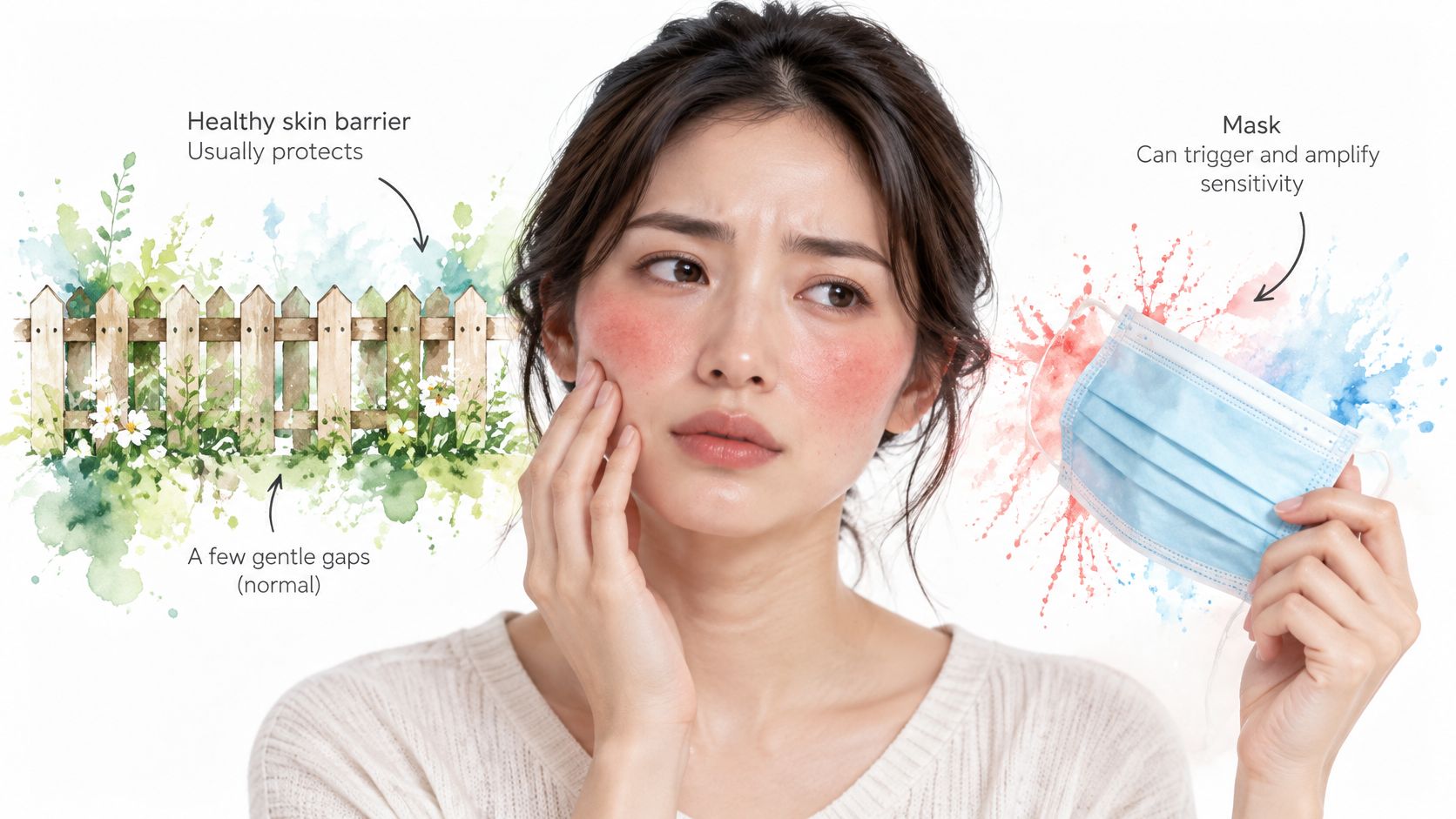
Think of your skin barrier as a garden fence. An intact fence helps keep unwanted visitors out and moisture inside; a stressed barrier is less effective at doing that job.
Masks can amplify discomfort through:
- Occlusion: Product stays pressed against the surface.
- Friction: Pressing, adjusting, and rubbing add physical stress.
- Heat: A long, covered soak can feel increasingly warm.
- Extended wear: Thick applications or extra time prolong exposure.
Irritation and allergy aren't interchangeable. Irritant contact dermatitis accounts for about 80% of contact-dermatitis cases, while allergic contact dermatitis involves an immune response to an ingredient, as described in this dermatology review of cosmetic contact dermatitis.
Timing offers clues, but it can't establish the cause by itself. Immediate tightness and delayed itching both deserve attention rather than another application.
For broader everyday context, explore natural skincare for sensitive skin. Keep the same thoughtful approach when watching skincare demonstrations.
Ingredients to Seek and Ingredients to Skip
| Ingredient | What It Does | Sensitive-Skin Note |
|---|---|---|
| Seek: Glycerin | Humectant that draws water into the skin | Common moisturizing base; individual tolerance still matters |
| Seek: Panthenol (vitamin B5) | Humectant that supports a comfortable feel | Often included in gentle formulas; test before use |
| Seek: Ceramides | Lipids that help replenish the skin barrier | Useful to look for in moisturizing formulas |
| Seek: Squalane | Lightweight emollient that softens skin | Can suit those who dislike heavy textures |
| Seek: Colloidal oat kernel extract | Botanical included for a soothing feel | Still a possible sensitizer for some people |
| Seek: Hyaluronic acid | Binds water at the skin's surface | Often found in lightweight hydration formulas |
| Skip when reactive: Fragrance or parfum | Adds scent | Frequent cause of cosmetic contact reactions |
| Skip when reactive: Lavender, rose, citrus, or peppermint essential oils | Add scent and botanical character | Can trigger reactions in susceptible users |
| Skip when reactive: Denatured alcohol or SD alcohol | Fast-drying solvent | May feel stripping, especially high in the ingredient list |
| Skip when reactive: Menthol or camphor | Creates a cooling sensation | Can sting uncomfortable skin |
| Skip when reactive: Strong AHA or BHA acids | Exfoliate chemically | Not a useful starting point for comfort-focused masking |
| Skip if sensitized: Methylisothiazolinone | Preserves the formula | Recognized sensitizer worth checking for |
| Skip when reactive: Physical scrub particles | Exfoliate through rubbing | Add friction during application and removal |
Choose ingredients that support hydration and barrier comfort, rather than chasing a strong sensation. A mask doesn't need to tingle, smell botanical, or leave skin feeling squeaky to earn a place in your routine.
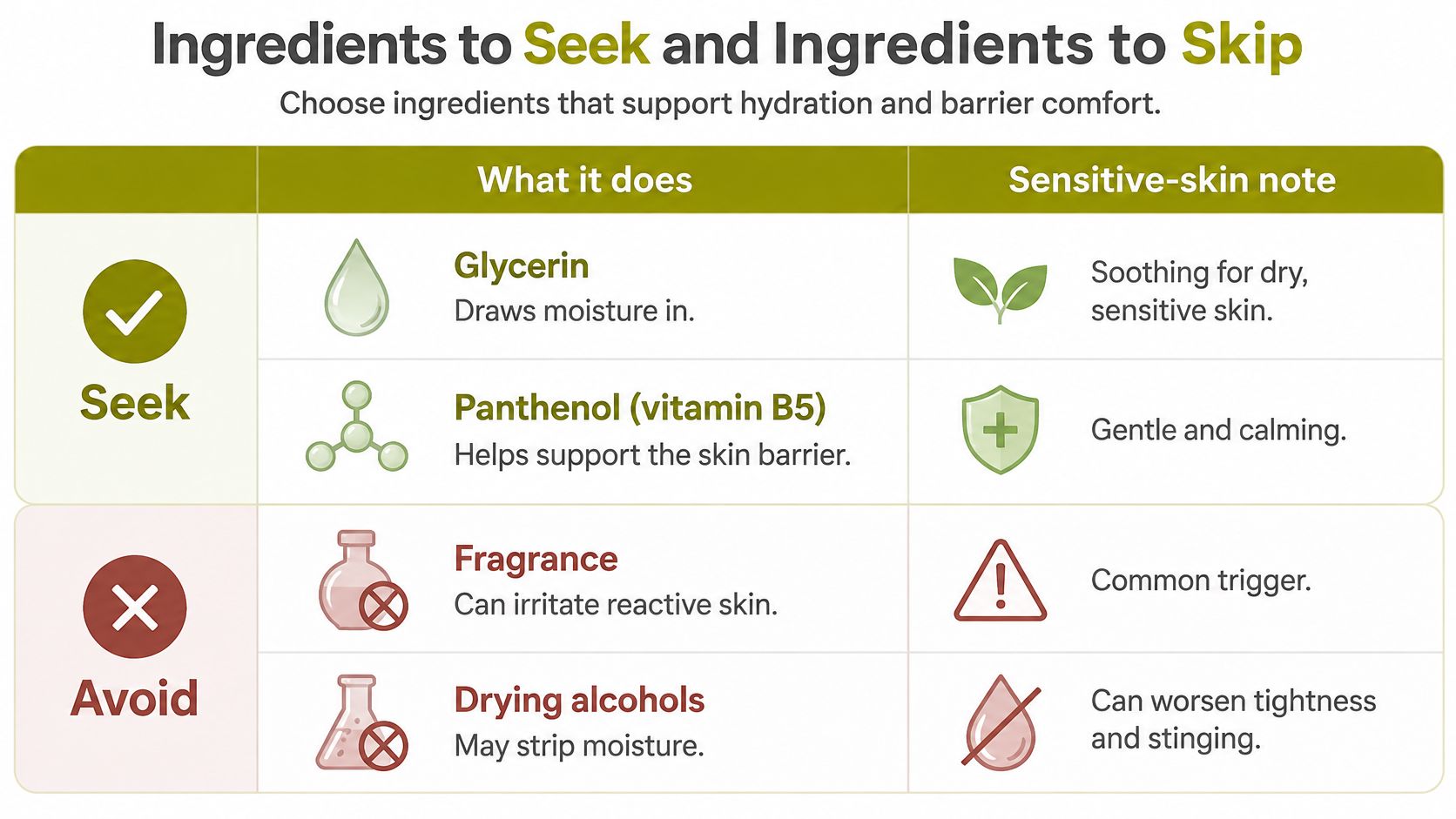
Understand the whole formula
Fragrances are the most frequent source of cosmetic contact reactions, and preservatives are another major allergen category, according to DermNet's guide to contact reactions to cosmetics. That doesn't mean every preserved product is unsuitable. Preservatives serve a practical purpose, and a known personal trigger is more useful information than a blanket rejection of an entire category.
The seek list isn't a guarantee, either. A mask containing glycerin can also contain fragrance, and an oat-based formula can include ingredients your skin dislikes. Judge the complete panel, not the ingredient featured most prominently on the front.
Natural isn't a shortcut
Plant extracts and essential oils can be pleasant parts of personal care without being suitable for every face. Lavender, rose, and other aromatic botanicals deserve the same attention you'd give any unfamiliar ingredient.
Likewise, unscented doesn't necessarily mean fragrance-free. A formula may contain ingredients used to mask the smell of its base.
A shorter, recognizable ingredient list can make your reaction log easier to interpret, but length alone doesn't determine gentleness. Keep photographs of labels so you can identify overlapping ingredients if different products cause discomfort.
If you're reviewing other products that touch your cheeks or hairline, Sphagnum Botanicals' guide to check your shampoo for harsh ingredients offers additional label-reading prompts. Use such lists to ask better questions, not to assume that every ingredient mentioned will trouble your skin.
Read Labels and Choose a Mask to Test
Front-label terms such as hypoallergenic, fragrance-free, and for sensitive skin don't have a single federal definition, so they shouldn't replace the ingredient panel, explains the FDA's guide to allergens in cosmetics. In the United States, retail cosmetic ingredients are generally listed in descending order of predominance, and fragrance components may appear collectively as fragrance or perfume.
Ingredients near the end are generally present in smaller amounts, but a low position doesn't establish personal tolerance. If you already know an ingredient bothers you, its location shouldn't persuade you to overlook it.
Use a shopping checklist
Consider a plant-based mask with leafy artwork and a fragrance listing halfway down the panel. The packaging communicates a botanical theme; the ingredient declaration tells you something more useful about what will touch your face.
Before choosing a mask:
- Scan the full panel: Read beyond the highlighted ingredients.
- Identify scent ingredients: Look for fragrance, perfume, parfum, and named essential oils.
- Check alcohol wording: Notice denatured alcohol or SD alcohol, especially near the beginning. Don't assume every ingredient containing the word alcohol performs the same function.
- Compare past reactions: Check against your own notes, including preservatives that have caused trouble.
- Match the texture: Favor a simple cream or gel when choosing for reactive-feeling skin, and postpone testing while skin is uncomfortable.
- Confirm removal directions: You should be able to identify whether the mask rinses off, lifts away, or stays on.
- Allow testing time: Leave room for a deliberate product test before planning a full-face application.
Choose information over reassurance
Clean beauty language can communicate a brand's approach, but it doesn't tell you how your face will respond. ArtNaturals emphasizes transparent, plant-based skincare; treat it as one option to assess by reviewing the complete ingredient panel on its website against the same checklist.
Plant-based isn't interchangeable with fragrance-free, and neither phrase replaces your personal reaction history. If the online listing doesn't show the full panel or clear directions, wait until you can review the package before using the product.
A good purchase is a mask you can evaluate clearly, not simply one whose front label sounds reassuring.
Pick a mask that passes your checklist, save its ingredient list, and test it before making it part of regular self-care.
How to Patch-Test a New Mask Before Use
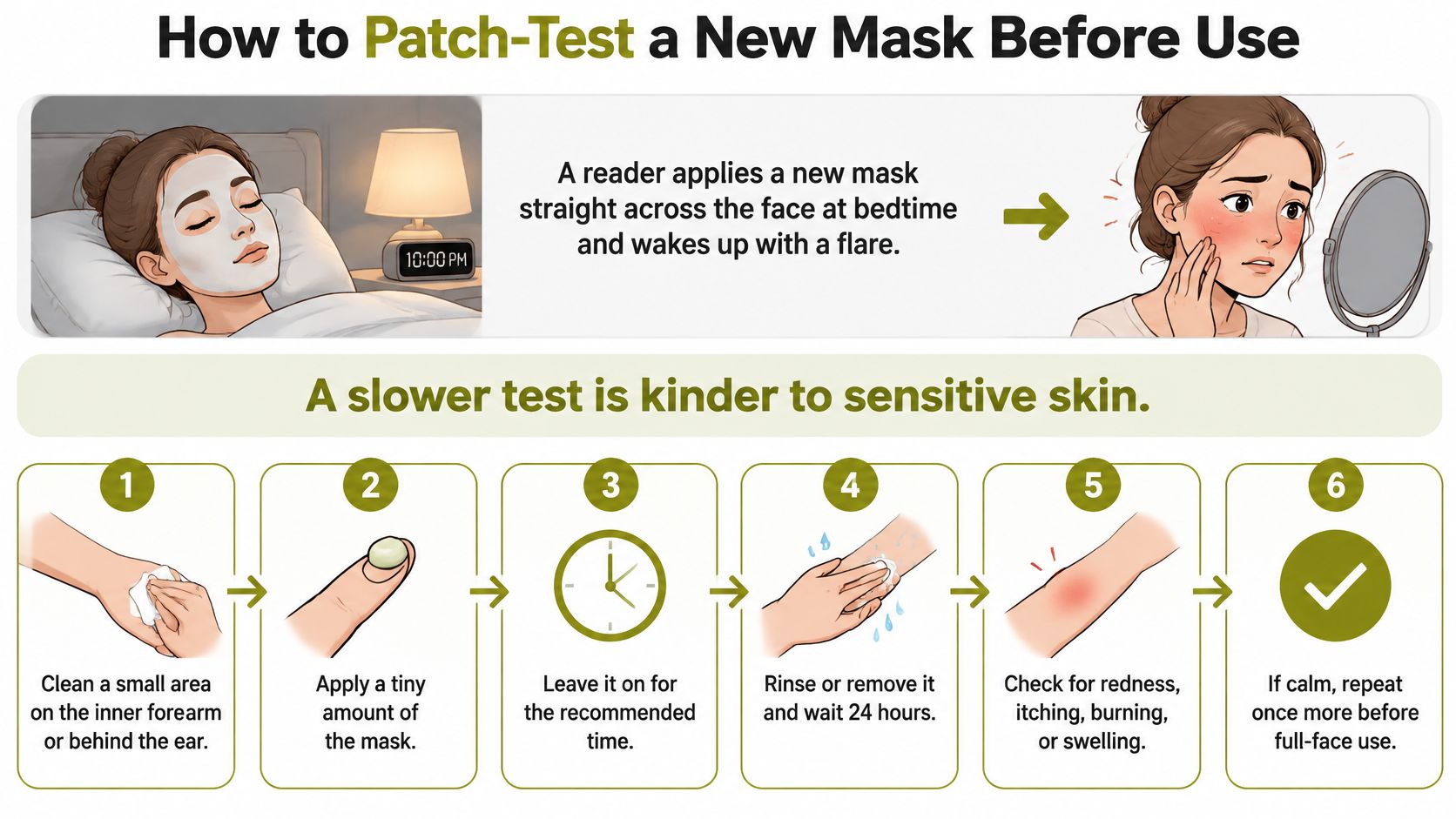
Say you spread a new mask across your face at bedtime and wake with an itchy flare. You've exposed a large area before learning whether your skin accepts the formula, and any other unfamiliar products used that evening make the cause harder to untangle.
A slower home product test is kinder to sensitive skin. The American Academy of Dermatology's product-testing guidance recommends a quarter-sized area, such as the underside of the arm or elbow bend, tested twice daily for seven to 10 days; rinse-off products stay on for five minutes or the time stated in their directions.
Follow a repeatable test
- Choose the area. Use the underside of your arm or inner elbow where you can check the skin easily.
- Apply the same amount and thickness you'd normally use. An unusually tiny smear won't represent a full application well.
- Respect removal instructions. For a wash-off mask, use the contact time described in the guidance above and the product directions. Don't leave a rinse-off product on overnight.
- Rinse gently when appropriate and repeat according to the testing schedule. Keep other new products off that area so the result is easier to interpret.
- Stop at a reaction. If redness, itching, swelling, or another change appears, wash the product off and discontinue it.
- If the area remains comfortable throughout testing, introduce the mask cautiously to your face without exceeding its intended wear time or frequency.
The visual below is a reminder to test before full-face use. Use the longer written schedule above rather than treating a brief observation or a couple of applications as a complete test.
Watch beyond the first application
Some reactions take repeated exposure or time to become visible. A comfortable first application is encouraging, but it isn't a final answer.
For example, you might begin testing a cream mask expecting to use it the following weekend, then notice itching partway through the test. Stop there and return to products you already tolerate rather than completing the schedule despite discomfort.
A home test can reduce uncertainty, but it can't predict every facial reaction. Your face may respond differently from your arm, especially when its surface is already uncomfortable.
Keep other additions separate, including a new serum. This guide to serum for sensitive skin can help you think through that choice without introducing everything together.
What to Do When a Mask Stings or Flares
Say a sheet mask starts stinging while you're wearing it, while another formula leaves you itchy well after removal. The first pattern may fit immediate irritation; the second raises the possibility of a delayed response. Neither pattern proves an allergy, and neither is a reason to push through another application.
Reaction timing and next steps
| Pattern | When It Shows Up | Common Signs | Next Step |
|---|---|---|---|
| Immediate irritation | During application or soon afterward | Stinging, burning, tightness, or warmth | Rinse, stop, and let skin rest |
| Delayed reaction | After a delay, sometimes after the skin initially seemed comfortable | Itching, swelling, or an eczema-like rash | Stop, log ingredients, and consider a dermatologist |
| Spreading or painful reaction | At any point | Redness beyond the application area, blistering, or pain | Seek professional care promptly |
Stop, observe, and log
- Remove the product. Rinse gently with lukewarm water. Don't scrub away residue or try to neutralize it with another skincare product.
- Stop using the mask. Repeatedly trying it on an irritated face won't provide a clearer answer.
- Make a useful record. Save the product name, full ingredient list, when you applied it, when symptoms began, and what seemed to help. A photograph can help you describe the change later.
- Give your skin a quiet period. Use a familiar, simple, fragrance-free moisturizer if it feels comfortable, and hold off on unfamiliar products and exfoliation.
- Arrange professional advice if a delayed reaction persists, spreads, or becomes painful. Don't wait for a home testing plan to resolve a worsening response.
Know what professional testing adds
Dermatologist-supervised patch testing is different from trying a cosmetic on your arm. A dermatologist can investigate delayed allergic reactions using selected ingredients and follow-up readings, since a response may not be visible immediately.
Bring your ingredient photographs and reaction log to the appointment. They're more informative than remembering only that a mask was natural, cooling, or intended for sensitive skin.
A reaction is useful information, not a failure of self-care.
If facial swelling affects breathing or swallowing, seek urgent medical help rather than continuing a skincare routine. For less urgent discomfort, keep the response simple and avoid replacing the mask immediately with another unfamiliar formula.
How Often to Use Masks and Safe Routines
Starting frequency and pause signals by mask format
| Format | Starting Frequency | Wear-Time Rule | Pause When |
|---|---|---|---|
| Cream or gel, rinse-off | Once or twice weekly as a cautious starting point | Follow the label and rinse gently | Stinging, warmth, or new redness |
| Sheet mask | Once weekly initially | Remove at the stated time; don't extend for more effect | Burning or tightness during wear |
| Hydrogel mask | Once or twice weekly, building slowly only if comfortable | Stay within the label's time | Dryness, itching, or flushing afterward |
| Overnight sleeping mask | Once or twice weekly initially | Apply thinly and remove as directed in the morning | Breakouts, itching, or swelling |
| Clay or mud mask | Occasional use, or skip while reactive | Rinse as directed without waiting through discomfort | Tightness, stinging, or flaking |
These are cautious routine suggestions, not dosing instructions or targets. Choose less frequent use when you're unsure, and treat the label's directions as a ceiling rather than a challenge.
Keep hydration expectations realistic
A 2026 hydrogel-mask evaluation published in the International Journal of Cosmetic Science included only 15 participants in an uncontrolled facial trial using the mask three times weekly for 20 minutes over six weeks; hydration and firmness improved, while barrier-related measurements, sebum, skin color, and pH stayed stable, and the authors described short-term effects as transient.
That distinction matters: a soft, hydrated feeling after removal doesn't establish lasting barrier repair. A small, uncontrolled evaluation also can't tell you the ideal schedule for your individual skin.
You don't need to copy a testing schedule to enjoy a mask. Comfort, simplicity, and a clear response afterward are more useful everyday guides.
Build a low-pressure routine
- Test first: Complete your home product test before regular facial use.
- Cleanse gently: Use clean hands and your familiar cleanser, without a scrub or cleansing brush.
- Apply evenly: Spread a thin layer where appropriate, keeping away from eyes and lips unless the product is specifically intended for those areas.
- Set a timer: Don't rely on how long the mask still feels wet.
- Remove gently: Rinse wash-off formulas with lukewarm water or lift away sheet formats as directed.
- Finish: Apply a lightweight, familiar moisturizer if tolerated.
Introduce new products separately. As a practical routine-building choice, leave roughly a couple of weeks before adding another unfamiliar product so you have time to notice changes.
Should you remove a mask when it dries? Follow its stated wear time, rather than waiting for a sheet to become papery or clay to crack. Remove it sooner if discomfort develops, and avoid masking on broken or actively inflamed skin.
ArtNaturals offers plant-based skincare, including moisturizing serums and everyday self-care products that you can assess ingredient by ingredient. Visit ArtNaturals to review full product panels, choose a simple hydration-focused option, and make time to test it before regular use.