

You're standing at the sink with a vitamin C serum, a freshly washed face, and a surprisingly unclear set of instructions. Should your skin still be damp? How many drops are enough, and should that tingling feeling reassure you or make you stop?
Learning how to apply vitamin C serum on face starts with a simple routine, but comfort depends on more than product order. How wet your skin is, how much serum you use, and how quickly you introduce it all deserve attention.
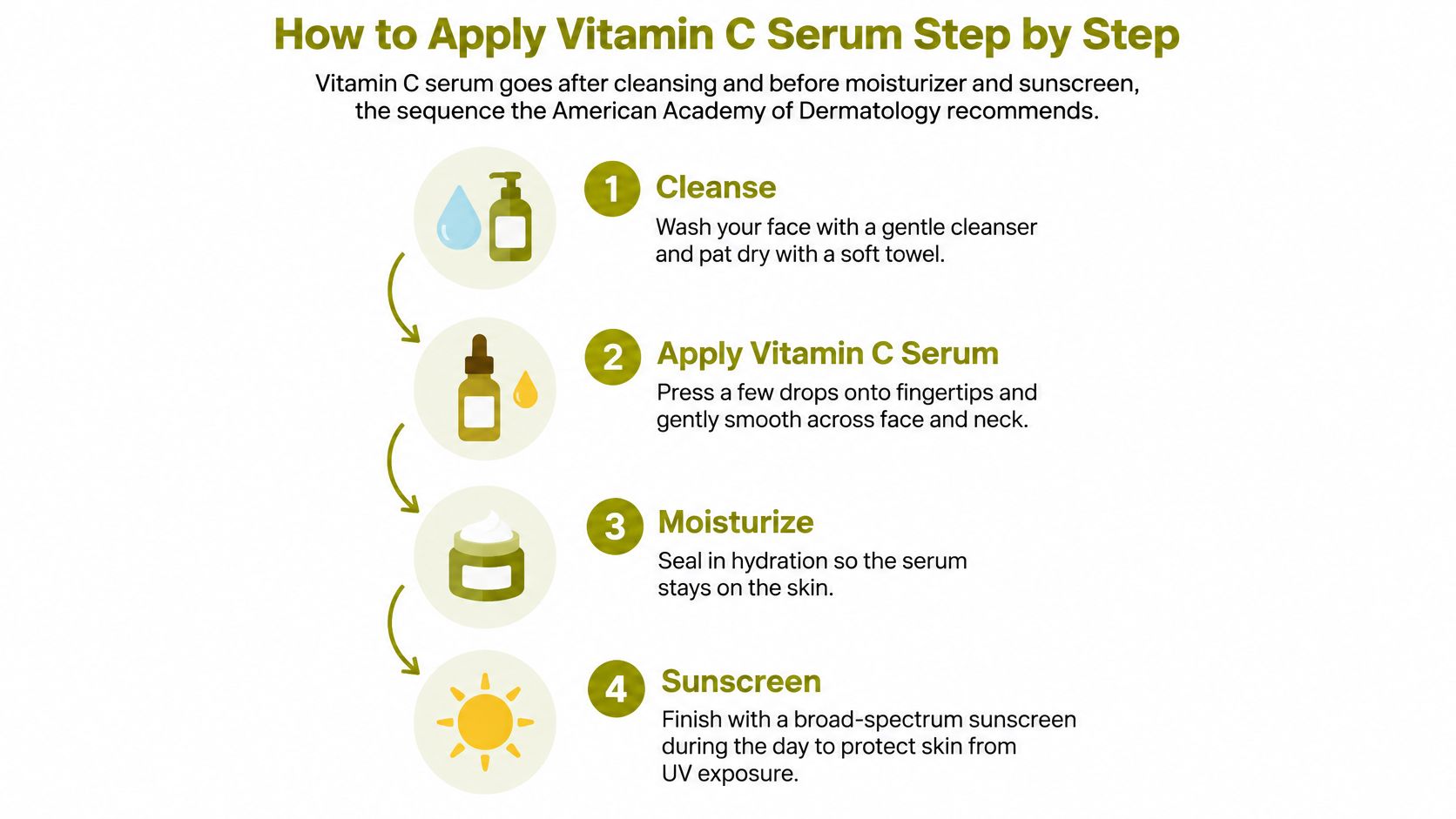
How to Apply Vitamin C Serum Step by Step
Vitamin C serum goes after cleansing and before moisturizer and sunscreen, following the sequence recommended by the American Academy of Dermatology. Start with clean, dry skin so you can apply a controlled, even layer.
A straightforward application routine
- Cleanse gently. Wash with a gentle cleanser and rinse with lukewarm water. You're removing surface residue, not trying to scrub your skin completely free of its natural oils.
- Pat dry with a soft towel. Wait until your face is no longer damp before applying the serum. Acidic formulas can spread more readily on wet skin and may feel sharper or sting more.
- Dispense a modest amount. A few drops, or roughly a pea-sized dab, is a practical starting point for the face unless the product directs otherwise. Bottle openings and serum textures differ, so aim for light coverage rather than a fixed drop count.
- Press and smooth gently. Use clean fingertips to distribute a thin, even film over your face and, if tolerated, your neck. Keep it away from eyelids, the immediate eye area, and irritated patches.
- Let the layer settle. Give it a short pause, about a minute as a practical starting point, before adding another product. The useful signal is that the surface no longer feels wet, not that you've completed a precise countdown.
- Finish according to the time of day. Add moisturizer if your skin feels dry, then apply broad-spectrum sunscreen in the morning. Don't mix the serum into your sunscreen to save a step.
The routine below shows the placement of each product.
Dry skin means a dry surface
Your face doesn't need to feel tight before you apply serum. Pat away water and wait until there's no visible or noticeable dampness; you don't need an extended drying ritual.
For example, if your cheeks are still wet after rinsing, finish drying them rather than adding serum directly over the droplets. That small adjustment makes the amount and placement easier to control.
The sequence stays broadly the same for normal, dry, and combination skin. Adjust the amount and frequency to your comfort rather than rearranging every product.
Sunscreen belongs last because the serum is intended to contact the skin directly, while sunscreen needs to form an even protective top layer. Let each product settle without vigorous rubbing.
Patch Testing and Calming Irritation
A small trial gives you a chance to notice discomfort before applying a new serum across your whole face. This is especially useful if your skin reacts easily, although a comfortable patch test can't guarantee that full-face use will feel identical.
Try a small area first
- Choose a discreet patch. Use a small area near the jaw or behind the ear.
- Apply sparingly. Put a small amount on clean, dry skin, without adding other new products there.
- Observe before expanding. Leave the area alone and check it through the following day for burning, itching, or redness.
- Begin gradually. If the area stays comfortable, introduce the serum on spaced-out mornings rather than immediately using it every day.
Low-pH formulas can tingle, but tingling isn't proof that vitamin C is working. The multidisciplinary consensus on topical vitamin C notes discomfort lasting over 30 minutes in 6% of participants in one cited assessment, alongside possible burning, redness, itching, dryness, and scaling.
Irritation signs, likely causes and what to do
These are possible explanations, not a way to diagnose a reaction.
| Symptom | Likely cause | What to do |
|---|---|---|
| Brief tingling that fades within minutes | Acidic, low-pH formula on the skin | Use a smaller amount and wait until skin is fully dry |
| Burning or redness lasting over 30 minutes | Too strong or too frequent for your skin | Rinse, pause, then restart two to three times a week with a gentler formula |
| Itching, dryness or scaling | Overuse or stacked actives | Reduce frequency and add a richer moisturizer |
| Flare-up with rosacea or reactive skin | Sensitivity to acidic formulas | Try a derivative such as magnesium ascorbyl phosphate and ask a dermatologist about persistent reactions |
Don't wait for a time threshold if something burns. Rinse it off and pause; only consider restarting once your skin feels settled.
The guide to vitamin C serum for sensitive skin offers additional routine considerations. For skin recovering from a procedure, follow your practitioner's directions first; Luxe Aesthetic Surgery & Medical Spa's resource on protecting your skin after laser resurfacing provides relevant aftercare context.
If you have rosacea or persistently reactive skin, derivatives such as magnesium ascorbyl phosphate or ascorbyl-6-palmitate may be milder options. Ask a dermatologist about recurring reactions rather than repeatedly testing the same uncomfortable formula.
How Much Serum and How Often to Use It
If you're new to vitamin C, start slowly, even when the label permits daily use. A schedule you can comfortably maintain is more useful than an ambitious routine you keep interrupting.
A pea-sized amount for the face is a practical starting point, not a requirement to use every last drop. You want a thin film, not a shiny coating that stays wet or collects around your nose.
Starting frequency and step-up plan by skin situation
Use this as a conservative application plan, keeping the product's directions in mind.
| Starting point | Frequency | Amount for the face | When to step up |
|---|---|---|---|
| New to vitamin C or sensitive skin | 2-3 times a week, morning | Pea-sized amount | After 2 weeks with no stinging or tightness, add one day |
| Normal skin, first month | Once daily, morning | Pea-sized amount | Keep daily and review at 8-12 weeks |
| Established routine, skin tolerates well | Once or twice daily | Pea-sized amount per use | Step back one row if irritation appears |
The beginner row deliberately leaves space between applications. That makes it easier to notice whether your skin feels comfortable later in the day and the following morning, rather than judging only the first moments after application.
You don't have to increase frequency just because the calendar says you can. If your current schedule fits your skin and your mornings, keeping it steady is reasonable.
Practical rule: Increase application days before increasing the amount. A thicker layer isn't a shortcut.
Choose consistency over a stronger label
Pure L-ascorbic acid and vitamin C derivatives aren't interchangeable formulas. Concentration alone doesn't tell you how a serum will feel; acidity, texture, and the rest of the formulation also matter.
Don't assume that a stronger percentage will suit you better. Start with a formula you can use comfortably, and avoid changing strength and frequency at the same time.
Allow roughly eight to twelve weeks of consistent use before assessing appearance changes, rather than expecting an immediate difference, a timeframe supported by the application periods discussed in this Wiley-published vitamin C article. That's an observation window, not a promise of results.
Choose your starting row based on experience and sensitivity. Then let comfort, rather than impatience, decide whether you move forward.
Morning or Evening and Where Sunscreen Fits
Morning is a practical default because vitamin C fits naturally before daytime moisturizer and sunscreen. Evening application is also an option if that's when you can maintain a calm, consistent routine.
The same careful application can fit either part of your day.

Morning, evening and twice-daily vitamin C routines
| Routine time | Best for | Sun protection | Watch for |
|---|---|---|---|
| Morning | Daily antioxidant step before sun exposure | Broad-spectrum SPF 15+, reapplied every 2 hours | Sunscreen is required, not optional |
| Evening | Readers who want fewer daytime layers | Not a sun-protection step; cleanse off sunscreen first | Avoid stacking with a retinoid on the same night when skin is sensitive |
| Twice daily | Consistent routines that tolerate the serum well | Sunscreen in the morning only | Return to once daily if stinging returns |
For evening use, remove makeup and sunscreen thoroughly before applying serum. Don't add an evening application merely because you missed the morning; there's no need to double up to compensate.
Twice-daily use is an option only when the label allows it and your skin remains comfortable. More frequent application isn't a requirement for a worthwhile routine.
Keep sunscreen as its own step
The U.S. Food and Drug Administration recommends broad-spectrum SPF 15 or higher, covering exposed skin adequately and reapplying at least every two hours, with more frequent reapplication after swimming or sweating. Broad-spectrum labeling indicates protection against both UVA and UVB radiation.
Vitamin C doesn't replace sunscreen. Evening serum use doesn't remove the need for daytime sun protection either; the table's morning sunscreen placement isn't a reason to skip protection during later daytime exposure.
For a visual companion to your application routine, you can watch the video below.
Keep the morning sequence straightforward: serum, a short wait, moisturizer, sunscreen. Let the final layer sit evenly rather than rubbing additional skincare over it.
What to Layer With Vitamin C and What to Keep Apart
Introduce one new active at a time, and avoid placing several acidic products back to back while you're still learning what your skin tolerates. A tidy layering order can't make an uncomfortable combination suitable for you.
Vitamin C can share a routine with sunscreen, other antioxidants, tretinoin, and glycolic acid, but compatibility doesn't guarantee personal comfort. The Cleveland Clinic's vitamin C serum guidance emphasizes attention to formulation and irritation, particularly for sensitive skin.
Where common products fit around vitamin C
| Product | Where it goes | Layering note |
|---|---|---|
| Moisturizer | After serum, once absorbed | Seals in hydration across the whole face |
| Broad-spectrum sunscreen | Last step, morning only | Full layer over all exposed skin |
| Hyaluronic acid serum | After vitamin C, before moisturizer | A light hydrating layer that pairs easily |
| Other antioxidant serums | After vitamin C | Generally compatible; add one at a time |
| Retinoid (tretinoin or retinol) | Separate night or alternate nights | Introduce after the vitamin C routine feels settled |
| Glycolic or other AHA exfoliant | Different day or separate routine | Using both in one session may increase irritation |
| Benzoyl peroxide | Separate routine, following the label | Keep apart at first and check label guidance |
For example, if you already use retinol at night, leave that routine unchanged while trying vitamin C on occasional mornings. You'll have a clearer sense of which addition caused discomfort than if you introduced both together.
If you use prescription tretinoin or acne-focused products, follow your prescriber's directions rather than rearranging them around a new cosmetic serum. Keep vitamin C away from the immediate eye area, even if another product in your routine is intended for that region.
A combination that looks compatible on an ingredient list still needs to feel comfortable on your skin.
Keep optional layers optional
You don't need a hydrating serum, another antioxidant, and an exfoliant just because they can fit somewhere. For ingredient-specific questions, the guide to vitamin C and niacinamide together offers further context.
If you're choosing a serum around changing appearance concerns, XO's anti ageing serum guidance for UK adults provides additional ingredient-selection context. Use those considerations to simplify your choices, not to justify adding every active at once.
For reactive skin, keep the strongest active on its own schedule and rebuild gradually. A useful rule of thumb is vitamin C on dry skin, compatible lightweight layers next, moisturizer afterward, and sunscreen last in the morning.
Storing Your Serum Between Uses
Application technique is only part of caring for a vitamin C serum. Light and air can break down L-ascorbic acid, so the bottle and its storage spot deserve attention too.
The packaging guidance in Prevention's vitamin C serum guide recommends an airtight container or darker-colored bottle and keeping the product properly closed between uses. These habits help protect the formula rather than leaving it exposed on the bathroom counter.
Build a simple storage habit
- Close it promptly. Replace the cap or secure the pump after dispensing, rather than leaving the bottle open while you finish your routine.
- Choose a cool, shaded spot. Use a cupboard away from sunny windows and the steamy shelf inside the shower.
- Consider protective packaging. An airtight pump or darker bottle is a useful feature when comparing products.
- Track opening and replacement. Note when you opened the serum and follow the maker's suggested use period and storage directions.
Notice changes without guessing
A shift toward yellow or amber, an unfamiliar smell, or a different texture can indicate that the formula has changed. Some serums have color from the outset, so compare the product with its original appearance rather than assuming every tint means oxidation.
The guide to vitamin C serum oxidation explains what to consider when a bottle changes. Follow the manufacturer's guidance instead of applying a changed product automatically.
A clear-looking serum isn't a guarantee of full potency. Keep good storage habits even when nothing looks different.
Start Your Vitamin C Routine This Week
Choose a starting schedule that matches your experience, then keep the rest of your routine familiar. Give yourself a consistent observation period without treating a particular date as a deadline for visible change.
For example, someone with normal skin who's never used vitamin C might start on Monday and Thursday mornings. They use a pea-sized amount on clean, dry skin, keep sunscreen in place every morning, and record any redness, tingling, or tightness in a simple phone note.
After two comfortable weeks, they could add another morning rather than applying a larger amount. This slower example is a choice for a beginner, not a rule that normal skin must follow.
Your ready-to-use checklist
- Read the label. Check the vitamin C form, concentration, any pH information, packaging, and application directions.
- Cleanse and rinse. Use your familiar gentle cleanser.
- Dry the surface. Wait until your face is no longer damp.
- Apply lightly. Smooth a thin, even layer without scrubbing.
- Add comfort. Moisturize if needed.
- Finish for daytime. Apply broad-spectrum sunscreen.
Keep the routine manageable enough to repeat. Your notes should help you decide whether to maintain, simplify, or pause it, not pressure you to use more.
ArtNaturals offers a Vitamin C Serum as one option for building this routine. Visit ArtNaturals to compare its current label, ingredients, and application directions with your checklist before deciding whether it fits your skincare habits.