

A natural body wash is a rinse-off cleanser built largely on plant-derived ingredients, and the word natural has no formal definition under U.S. federal cosmetics law.
You're standing in the shower aisle, holding a bottle decorated with leaves, wondering whether it'll feel comfortable on your skin. The front label looks reassuring, but it doesn't tell you everything about the cleanser inside.
A useful choice starts with the whole formula: its cleansing ingredients, pH, preservation, fragrance, and label transparency. What happens after you rinse deserves attention, too.
What Natural Body Wash Means in Everyday Terms
A shopper turns over a bottle labeled natural body wash and finds a long ingredient list. That isn't necessarily a contradiction. Plant-forward formulas still need ingredients that help them cleanse, stay mixed, smell pleasant if fragranced, and remain properly preserved.
Think of natural as a description of ingredient positioning, not a complete product specification. It doesn't tell you how the finished wash will feel or whether its fragrance suits your preferences.
What the category actually tells you
Under the FDA's framework for soap and cosmetics, ingredient origin doesn't create a separate set of legal requirements. Classification depends mainly on composition, labeling, and intended use.
The legal definition of soap is narrower than everyday language suggests. A qualifying soap consists mainly of alkali salts of fatty acids, gets its cleansing action exclusively from those salts, and is marketed solely as soap. Many liquid body washes instead contain synthetic detergents or make moisturizing, fragrance, or deodorizing claims, placing them within the cosmetics framework.
Disease-treatment claims can change that classification. That's why an ordinary cleansing promise and a claim to treat a skin condition aren't interchangeable.
The label relationships are easier to understand visually.
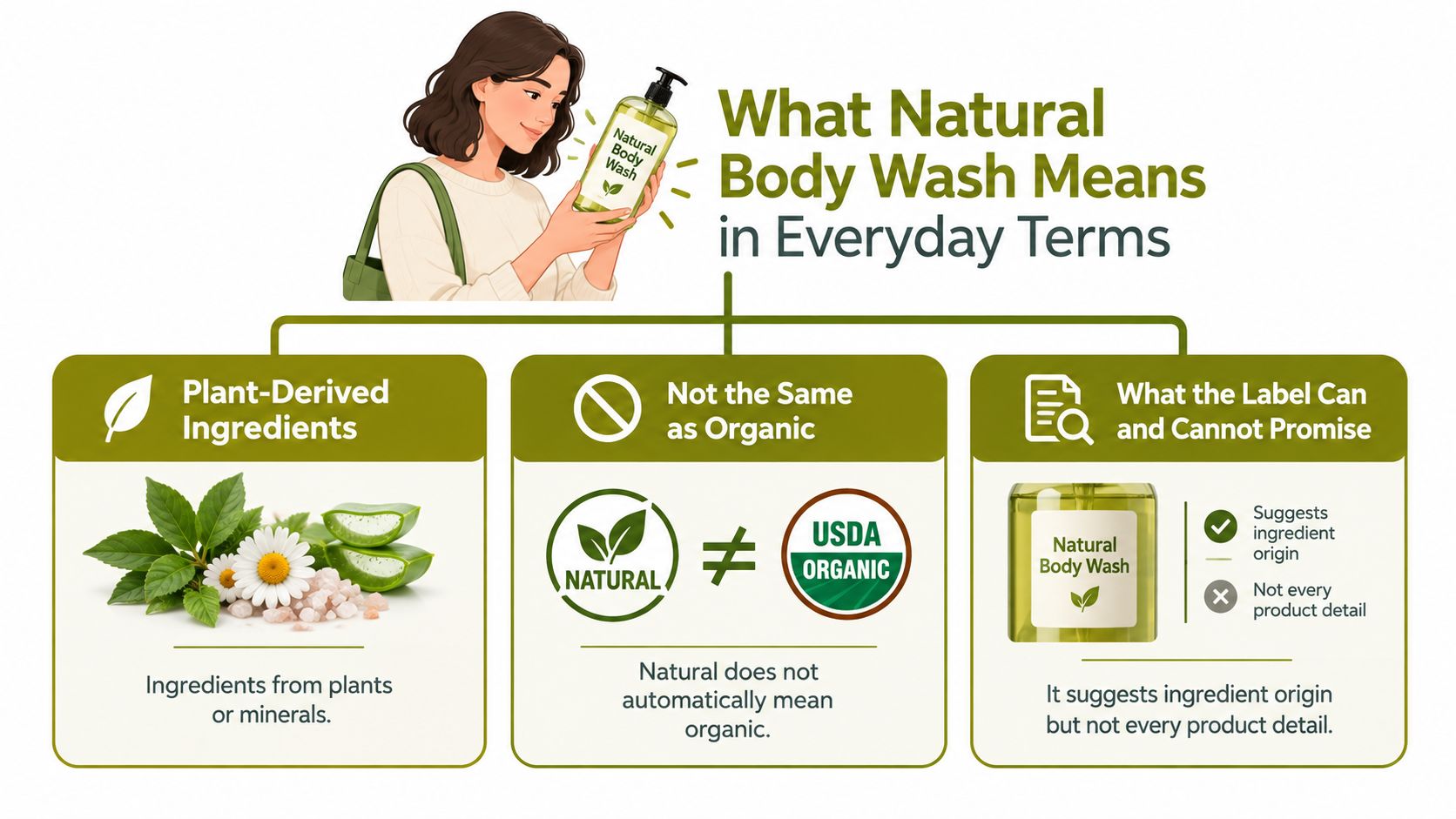
Read the description, then investigate the details
Natural doesn't automatically mean organic, safer, or more effective. Rather than asking a single marketing word to answer every question, separate your priorities:
- Ingredient preferences: Are plant-derived ingredients important to you?
- Everyday experience: Do you prefer a fragrance-free wash or a scented shower ritual?
- Product transparency: Can you find the full formula and straightforward use directions?
Practical rule: Treat the front label as an introduction, not the complete conversation.
This habit can extend across your bathroom shelf. If you're also reviewing oral-care routines, Mouthology's resource on gentle rinses for daily oral care offers a related topic to explore, while keeping each product's intended use separate.
The useful mental model is simple: body wash describes the product's role, cosmetic rules govern many formulations, and natural describes positioning within that space.
Ingredients and Benefits of a Gentle Cleanse
The cleansing ingredients deserve as much attention as the featured botanical on the bottle. A prominent plant oil might explain part of the formula, but it doesn't describe the entire wash.
Surfactants are the cleansing workhorses. For shopping purposes, think of the surfactant system as a recipe: knowing that bread contains flour doesn't tell you what the finished loaf will be like. The balance of ingredients matters.
Why the whole cleansing system matters
A useful ingredient review separates the formula into roles:
- Cleansing system: Look for information about the blend of surfactants rather than judging a single name in isolation.
- Moisturizing components: Notice which oils or other ingredients support the product's moisturizing positioning.
- Fragrance materials: Decide whether scent belongs in your routine at all.
- Preservation: Expect the manufacturer to explain how the finished product remains protected during use.
A long ingredient name isn't a shopping verdict. Neither is a familiar botanical name. Your strongest question is whether the manufacturer has evaluated the finished formula for mildness, not whether individual ingredients sound appealing.
For a routine-focused explanation, the guide to choosing a gentle body wash provides another way to organize these considerations.
Why pH needs context
The phrase pH-balanced can sound like a complete answer, but pH works alongside the cleansing system. In formulation evidence examining the relationship between pH and surfactant interaction, sodium laureth sulfate-based washes with identical surfactant composition were evaluated at approximately pH 4.7 and 6.7; the lower-pH, predominantly anionic systems showed greater dryness and barrier disruption under the conditions examined.
That finding isn't a universal ranking of body washes. It illustrates why a lower pH alone shouldn't serve as a shortcut for gentleness. A manufacturer needs to consider the blend and its finished-product performance together.
A reassuring pH claim is useful only when it belongs to a thoughtfully formulated, tested product.
Keep your expectations grounded in everyday experience. A wash can offer cleansing, a pleasant texture, an enjoyable scent, and a comfortable rinse without promising to transform your skin.
Consider the shower itself, too. If a formula feels pleasant while lathering but leaves you uncomfortable afterward, its botanical story doesn't have to outweigh your experience.
How to Choose a Formula for Your Skin and Concerns
Start with what you notice during your routine. Does your skin feel tight after rinsing? Do scented products tend to bother you? Are you looking for a straightforward wash after exercise rather than an elaborate self-care ritual?
These observations make a useful shopping list. They don't require you to diagnose a condition or assign yourself a permanent skin category.
Matching Skin Considerations to Label Cues
| Skin Consideration | What to Look For on the Label |
|---|---|
| Dry-feeling skin | Moisturizing positioning, clearly named supporting ingredients, and information about finished-formula mildness |
| Sensitive-feeling skin | Fragrance-free options, a complete ingredient declaration, and clear directions |
| Oily-feeling skin | Everyday cleansing claims and a formula that fits your preferred rinse feel |
| Normal-feeling skin | A texture and scent choice you enjoy, alongside transparent product information |
| Dull-looking skin | Realistic cleansing and moisturizing claims rather than promises of dramatic change |
| A feeling of congestion | Straightforward wash directions without assuming that a rinse-off cosmetic will address an underlying concern |
Use the table as a set of shopping cues, not outcome predictions. A bottle can check the right boxes and still feel wrong for you.
For example, someone who enjoys a fragrant evening shower may prioritize scent and texture. Someone who already knows particular aromatic ingredients bother them may choose to leave fragrance out entirely.
The guide to natural skincare for sensitive skin can help you think about that preference within a broader routine.
Evaluate the product page as carefully as the bottle
ArtNaturals is one option among plant-forward bath and body brands. Its bath, body, and soap offerings use plant oils and absolutes, while navigation by concern and ingredient helps shoppers narrow their choices; product pages also display pricing and reviews, and the brand emphasizes ingredient transparency and quality sourcing.
Use those features to investigate rather than to skip your own checks. A concern category can help you find products, but it doesn't establish that every formula within it will suit your skin.
Before adding a wash to your basket, look for:
- A complete ingredient list: Make sure you can review the actual formula, not just featured ingredients.
- Clear product purpose: Everyday cleansing and fragrance should be described plainly.
- Useful directions: Check how the manufacturer expects you to use the product.
- Accessible answers: If preservation, scent, or packaging details are unclear, ask before buying.
Reviews can add context about texture, packaging, and scent preferences. They shouldn't replace ingredient information or persuade you to overlook something you already know doesn't suit your routine.
Your shortlist should feel manageable. Choose according to your priorities, not the longest list of botanical names.
Reading Labels for Fragrance and Allergens
Turn the bottle around before deciding what belongs in your shower. The FDA's cosmetics labeling requirements call for retail ingredient declarations that are conspicuous and likely to be read when purchasing, alongside product identity and net quantity information.
That makes the ingredient declaration a practical starting point. Terms such as clean, gentle, and plant-based can't replace it.
Scan for the details that matter to you
Begin with the full list rather than the highlighted ingredients on the front.
- Find the fragrance description: Notice whether the product is presented as fragrance-free, fragranced, or scented with essential oils.
- Recognize aromatic ingredient names: Limonene, linalool, citral, geraniol, and eugenol are useful names to recognize when checking fragrance allergens.
- Apply your own history: If you already know a particular ingredient bothers you, don't let its natural origin persuade you to ignore that information.
Naturally derived fragrance doesn't automatically mean hypoallergenic. Essential oils and botanical mixtures can contribute aromatic allergens, so the relevant question is what you're exposed to, not merely where it came from.
Understand what allergen disclosure means
In the European Union, covered fragrance allergens must be declared separately above 0.01% in rinse-off products, equivalent to 100 parts per million, while the leave-on threshold is 0.001%, as explained in the Cosmetics Europe fragrance-allergen labeling guide.
These requirements concern concentration in the finished product. An allergen can come from a perfume blend, essential oil, natural complex substance, or another raw material.
Disclosure helps people who are sensitized identify specific ingredients. It doesn't mean the named material is universally dangerous, and a rinse-off product's exposure pattern shouldn't be treated as identical to a leave-on product's.
A useful distinction: Ingredient disclosure helps you make a personal choice. It isn't a universal danger label.
If fragrance complicates your routine, consider a fragrance-free option. When trying something unfamiliar, follow the manufacturer's directions for a small-area trial, and don't interpret a comfortable first use as a guarantee of future tolerance.
For a separate household perspective, Gmaids' resource on floor cleaner options for sensitive homes may help you review fragrance preferences beyond personal care. Keep household cleaners and body products strictly within their own intended uses.
Sustainability Beyond the Plant Label
A plant on the label doesn't answer what happens after a body wash leaves your shower. A useful environmental review includes the cleansing ingredients, fragrance materials, preservatives, packaging, and information the manufacturer can substantiate.
Renewable origin and environmental performance are different questions. A botanical ingredient can be renewable yet still present challenges if it breaks down poorly, requires substantial processing, or travels in heavy packaging.
Ask about breakdown and aquatic effects together
The EPA's Safer Choice surfactant criteria evaluate aquatic toxicity alongside biodegradation. For surfactants with acute aquatic toxicity greater than 1 and up to 10 parts per million, the criteria require biodegradation within a 10-day window without producing chemicals of concern; above 10 parts per million, the timeframe extends to 28 days, again without concerning breakdown products.
These are ingredient-evaluation criteria, not a household test you can perform on a bottle. They show why biodegradable shouldn't be treated as a complete environmental explanation by itself.
Ask what breaks down, how that conclusion was established, and what remains afterward. Don't assume that every product using an environmentally appealing ingredient has been evaluated as a complete formula.
Use this visual as a reminder of the different questions involved.
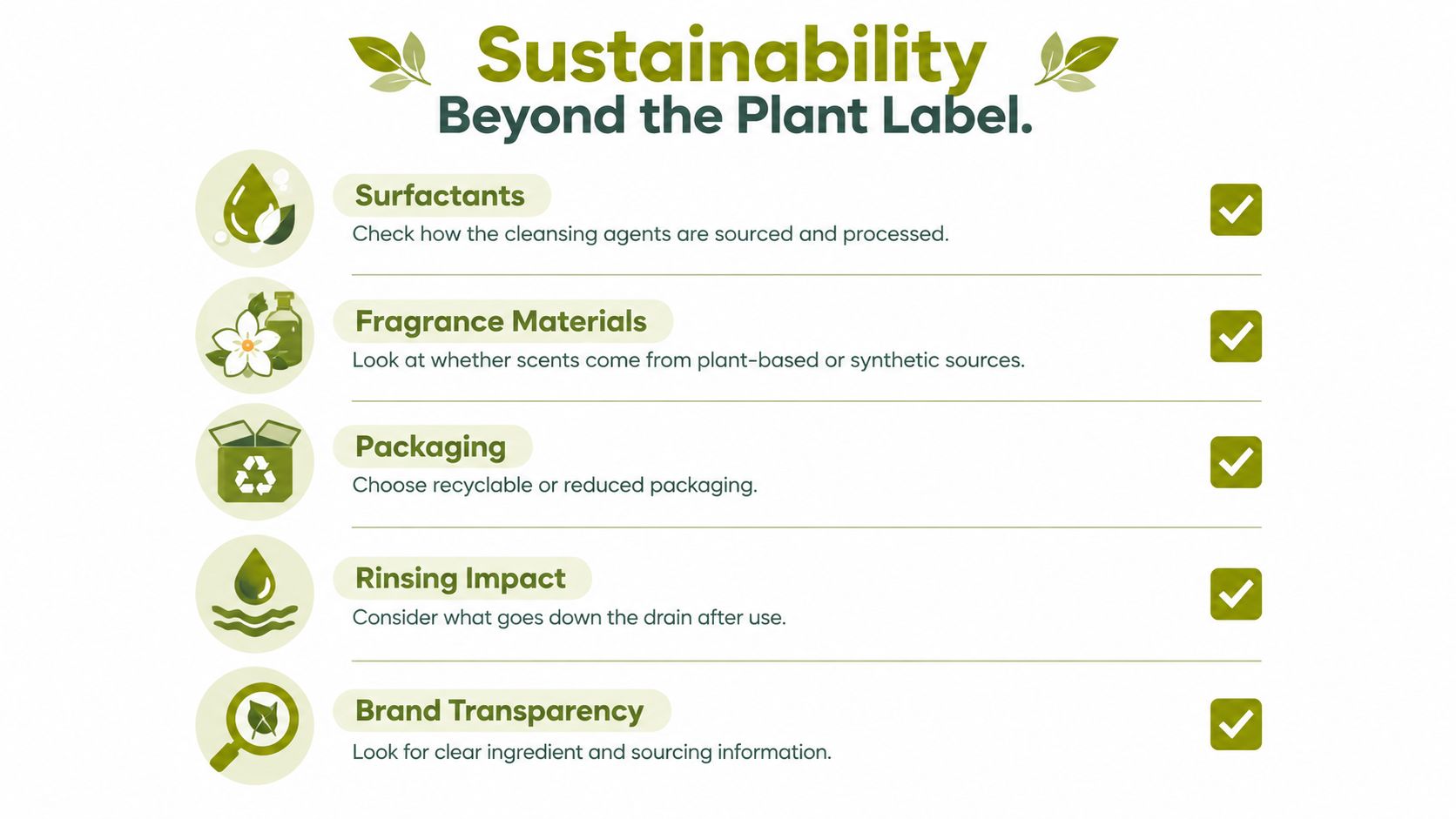
Build a verifiable shopping checklist
Rather than accepting broad eco-friendly language, ask manufacturers specific questions:
- Surfactant evidence: What information supports biodegradability and aquatic-impact claims?
- Formula context: Does the environmental statement cover a featured ingredient or the whole product?
- Concentrates and refills: Are these available, and what packaging do they require?
- Packaging weight: Is there unnecessary material around the cleanser?
- Fragrance load: Can the brand explain the role of scent within its environmental claims?
- Local recycling: Will your own collection service accept the bottle and its components?
- Sourcing details: Can the company explain where its botanical materials come from?
You don't need a perfect answer to every question before making a purchase. Prioritize claims the seller can explain and avoid treating a green color scheme as evidence.
The broader guide to sustainable beauty products offers additional context for reviewing your bathroom purchases. The practical goal is a decision you can explain using product information, not a promise of an impact-free shower.
Simple Routines and DIY Alternatives to Try
Keep your shower routine easy enough to repeat without much thought. Let comfort guide your choices rather than chasing a particular amount of foam or an elaborate sequence.
A simple setup can make the routine feel calmer.

Make everyday cleansing straightforward
Try these general habits, adapting them to the product's directions:
- Dispense modestly: Start with a small amount rather than automatically filling your palm.
- Choose a comfortable touch: Use your hands or a soft cloth without turning cleansing into vigorous scrubbing.
- Rinse comfortably: Choose lukewarm water and rinse away the wash.
- Finish: Follow with a moisturizer that suits your preferences and skin feel.
Notice how your skin feels during consistent use. If you're uncomfortable, you don't need to keep using a product just because its ingredients sound appealing.
For a visual pause in your routine planning, you can explore the video below.
Keep DIY experiments separate from stored body wash
An oil-based blend or freshly prepared oat-based mixture might appeal as a hands-on self-care experiment. Don't assume either will behave like a formulated rinse-off cleanser, and don't treat a kitchen recipe as a substitute for product testing.
The most important caution concerns water-based homemade mixtures. Botanical extracts and oils don't protect an aqueous formula from microbial growth.
FDA guidance on cosmetic preservation describes microbial challenge testing as a way to evaluate preservative effectiveness and identifies inadequately preserved high-water personal-care products as susceptible to contamination. Preservation also depends on the formula's pH and water activity, manufacturing hygiene, and packaging.
A homemade wash doesn't gain a validated preservation system just because you add an essential oil. Nor should a pleasant smell reassure you that a stored mixture has been adequately protected.
A DIY project can be enjoyable without becoming the product you rely on for everyday cleansing.
Avoid turning an improvised water-based mixture into a stored shower product. If you want something you can keep in a warm bathroom and use repeatedly, a properly formulated product with validated preservation and compatible packaging is the more practical choice.
Preservative-free isn't a useful goal by itself. The better question is whether the manufacturer has protected the formula appropriately for its intended use.
Frequently Asked Questions and Your Next Step
Is natural body wash automatically better for sensitive skin?
No. Use the fragrance and ingredient checks above to identify a formula that fits your own preferences and known sensitivities. Plant-focused positioning isn't a substitute for finished-product mildness information.
Does plant-based mean eco-friendly?
Not by itself. Ask for evidence about the cleansing ingredients, sourcing, and packaging rather than relying on a broad environmental description. A seller's ability to explain a claim is more useful than the claim's prominence on the bottle.
Do antibacterial washes outperform ordinary cleansing?
The FDA's consumer guidance on antibacterial soap explains that its 2016 rule removed 19 active ingredients, including triclosan and triclocarban, from eligibility in nonprescription consumer antiseptic washes because manufacturers hadn't supplied sufficient evidence of long-term daily-use safety or greater effectiveness than plain soap and water. That rule concerned consumer antibacterial washes used with water, not hand sanitizers, wipes, or healthcare products.
For an everyday shower, don't confuse an antimicrobial claim with a more thoughtful cleansing routine. Keep your choice focused on the product's intended purpose.
What should I do before buying?
Set a small shortlist beside the ingredient and packaging checklist. Note fragrance preferences, available information about the surfactant system, preservation questions, and what you can realistically recycle.
Then decide which unanswered details matter enough to ask the manufacturer about. You don't need to replace a comfortable routine just because another bottle has more botanical imagery.
When browsing bath and body products by concern and ingredient at the publisher's store, check delivery eligibility as well. The store currently ships within the USA and directs international customers to a partner retailer.
ArtNaturals offers plant-forward bath, body, and soap products, with browsing options organized by concern and ingredient. Visit ArtNaturals to review the ingredient information, pricing, and reviews, then choose a wash that fits your fragrance preferences and everyday routine.