

The advice to choose a natural oil, apply generously, and leave it overnight skips the most useful question: what do you want that oil to do? A glossy finish, easier detangling, and conditioning inside the strand aren't the same job. More oil and longer contact don't automatically make a routine more helpful.
Penetrating oils for hair work through molecular fit and contact time. Choosing one that suits your lengths, then keeping the application simple, is a more thoughtful starting point than layering several oils or treating the scalp and strands as interchangeable.
Oils That Enter Hair and Oils That Coat It
Start with purpose: the same bottle can act like a key for one hallway and a coat for another, depending on the oil's fatty acids and how long it stays in contact.
Common hair oils and where they tend to sit
| Oil | Fatty-acid character | Where it tends to sit | Everyday use |
|---|---|---|---|
| Coconut | Compact lauric-acid triglycerides | Can move past the cuticle toward the cortex | Small pre-wash on porous lengths |
| Olive | Mostly monounsaturated oleic acid | Can move into the fiber, with location shaped by hair condition | Light pre-wash or ends-only treatment |
| Avocado | Oleic-rich with some larger molecules | Partial entry plus a soft surface film | Dry, coarse lengths in a thin layer |
| Jojoba | Liquid wax esters close to skin sebum | Mostly a light surface film | Finish damp fine or low-porosity ends |
| Argan | Mix of oleic and linoleic acids | Mixed, often more surface comfort than deep entry | A drop for shine on mid-lengths |
| Mineral oil | Nonpolar hydrocarbon | Stays on the surface | Slip and gloss rather than inner-fiber care |
| Castor | Ricinoleic-acid-rich triglycerides with a substantial feel | Treat as a heavy surface coat in a simple routine | Small amounts on very dry spots, not fine lengths |
A compact triglyceride works like a slimmer key in a narrow lock, while heavier molecules behave more like a jacket left near the door. The clearer question is less “does it soak in?” and more “which job does this oil do well at the porosity I have?”
Treat the table as a practical starting map, not a measured penetration ranking. Mapping evidence is not equally available for every oil, and a bottled blend will not necessarily behave like one isolated ingredient.
Molecular fit matters more than plant origin
The Journal of Cosmetic Science discussion of oil structure connects coconut oil's movement into hair with its compact lauric-acid structure and affinity for hair proteins. Botanical origin alone does not tell you whether an oil will travel into a strand.
Texture can mislead. An oil that disappears from your fingertips has not necessarily reached the cortex, while a noticeable film is not automatically a failed application. Spreading, surface deposition, and internal uptake are different things, and contact time changes which one you notice.
Choose by purpose: A surface film can be useful when your main concern is snagging or dull-looking ends. Deeper travel is not automatically a better result.
Keep shine questions separate from loss questions
Argan oil often sits in conversations about softness and thinning, though those are different concerns. A page asking can argan oil prevent hair loss belongs to the follicle question; a smoother mid-length is a fiber question. Judge the strand result by feel, combing, and porosity, and judge scalp or shedding concerns on their own evidence.
For tonight's routine, choose one row and one purpose. Low-porosity lengths usually need a thinner layer and less time; more porous lengths may benefit from a small pre-wash. If you are testing a pre-wash, start modestly rather than combining several oils and losing track of what your hair likes.
How the Hair Fiber Lets Oil Through
Say your ends have been lightened, feel rough when wet, and catch as you detangle. Understanding where that roughness occurs makes oil selection less mysterious.
The cuticle is the strand's outer covering, made of overlapping cells arranged like roof shingles. Beneath and between the hair's cells sits the cell-membrane complex, a lipid-rich network. Farther inside is the cortex, the keratin-rich region responsible for much of the fiber's strength.
This outside-to-inside map helps explain the possible routes.
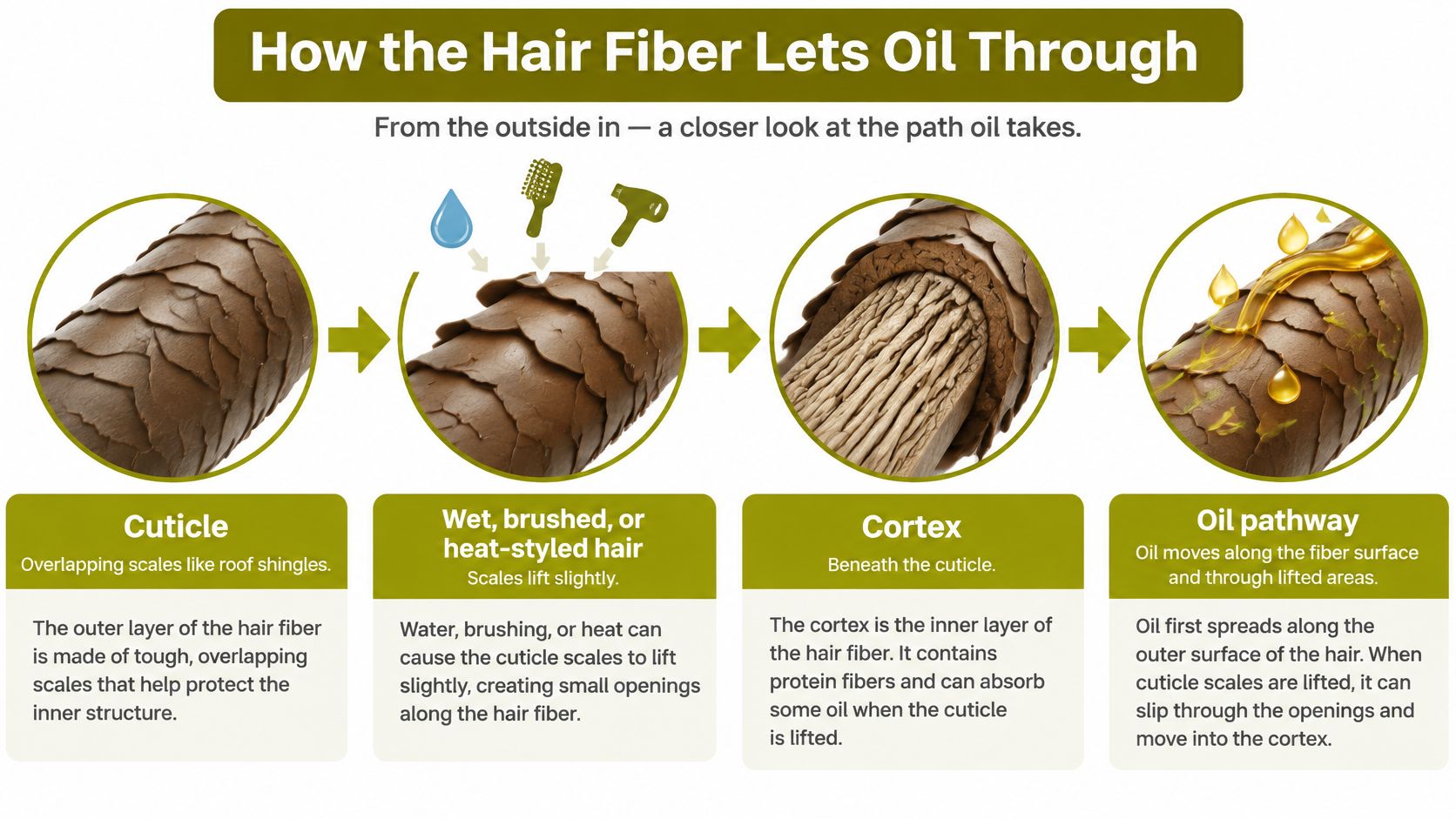
The route between the cells
The cell-membrane complex resembles the mortar between bricks rather than an empty tunnel. Oil molecules must be compatible with that environment to move through it; they don't pour through an open cuticle.
An International Journal of Cosmetic Science paper on plant-oil penetration describes triglycerides partitioning into this lipid-rich network and interacting with its fatty acids. That gives a more useful explanation than saying hair absorbs anything natural.
Hair condition changes access to these pathways. Chemical processing and mechanical wear can disrupt the outer structure, so weathered ends may behave differently from newer hair near the roots. Even on the same head, you may need a lighter touch through the upper lengths.
- Cuticle surface: A film changes how neighboring strands slide against each other.
- Lipid pathway: Compatible molecules can move into the spaces between cells.
- Cortex: Some oil can reach the inner, protein-rich region.
Water changes the setting
When hair takes up water, the fiber swells. Repeated wetting and drying can place mechanical stress on the structure, especially when you add brushing or rough towel handling.
A penetrating oil can influence water movement within the strand. It doesn't supply living nourishment to the cortex, and the hair shaft isn't a route for feeding the follicle.
For fine hair that wets slowly and quickly feels coated, the goal may be a manageable surface rather than extensive internal uptake. Our guide to how to moisturize low-porosity hair offers ways to organize that kind of routine without continually adding heavier layers.
Surface, lipid pathway, cortex: these are distinct destinations, not a ladder of product quality. Choose the destination that serves your grooming needs.
What Research Shows About Oil Penetration
Laboratory fiber measurements can answer a narrow but useful question: did an oil enter the strand, and did that change how the strand behaved? They don't automatically tell you how a finished product will feel in your bathroom.
In a 2001 analysis, time-of-flight secondary-ion mass spectrometry detected coconut oil within hair cross-sections, including movement toward the center, while mineral oil wasn't detected within the cross-section. The authors connected that behavior to molecular polarity and protein affinity. In the same work, coconut-oil-treated hair showed a 48% reduction in swelling relative to untreated controls.
That swelling measurement is relevant to wash-day handling. It describes how a fiber responds to water, not a promise that worn ends become new again.
Contact time changes uptake
A 2012 radiolabeling report summarized in Cosmetics & Toiletries reported approximately 15–20% coconut-oil penetration after one hour and 20–25% after six hours. Uptake continued with longer contact, but the additional increase was relatively modest.
Those measurements don't reveal what happened during every intervening hour. They support allowing contact before washing, but they don't establish that everyone needs an overnight treatment.
A longer treatment is a scheduling choice, not a reason to assume proportionally greater conditioning.
Protein loss and repeated handling
The Journal of Cosmetic Science paper on coconut oil and grooming-related protein loss reported reduced protein loss in both damaged and undamaged hair with coconut-oil treatment before or after washing. This is a more meaningful fiber-care outcome than shine alone, because it concerns material lost during handling.
Oil movement still isn't governed by a simple small-versus-large rule. Penetration-mapping work published through Wiley describes molecular structure and unsaturation as influences on where oils travel, including activity concentrated near the cuticle.
Newer work on plant oils and hair-fiber fatigue also connects entry into the lipid pathway with improved single-fiber fatigue strength. That offers a plausible basis for breakage protection during repeated handling, not a growth claim.
Keep the limits clear:
- Ingredient evidence isn't a product guarantee: A blend's composition and application affect its behavior.
- Fiber tests aren't scalp tests: These measurements concern strands, not living follicles.
- Measured uptake isn't a universal target: Your useful result may be easier grooming with very little residue.
Matching Amount, Timing, and a Simple Wash-Day Routine
Before opening a new bottle, check how your clean lengths behave. Gently slide your fingers along a shed strand from end toward root; catching or unevenness can offer a clue about surface wear, but it isn't a reliable porosity diagnosis.
You may also encounter the water-float test, where a clean shed strand is placed in water. Don't use sinking speed to assign a firm porosity category: surface residue, trapped air, and water tension can affect what happens. Your everyday observations, including wetting, tangling, drying, and product buildup, are more useful for choosing a starting routine.
Choose a starting amount
These are practical trial amounts, not measured doses. Length and density matter alongside strand thickness, so begin at the smaller end and distribute carefully before adding more.
Oil amount and wear time by hair type
| Hair pattern | Oil style | Amount | Wear time |
|---|---|---|---|
| Fine, low porosity | Jojoba or a drop of argan | A drop for argan; less than a pea-sized puddle for jojoba on ends | Damp leave-in or a brief pre-wash |
| Medium texture | Olive or avocado | About a dime-sized puddle on lengths | A convenient pre-wash window, then shampoo |
| Coarse or high porosity | Coconut or avocado | Nickel- to quarter-sized puddle across lengths, starting smaller | About an hour, then shampoo |
| Lightened or worn lengths | Coconut pre-wash | Small amount, mid-lengths to ends | About an hour, then a gentle cleanse |
| Oily scalp, any texture | Chosen oil kept off the roots | Ends only | Shorter contact, then shampoo |
For fine lengths, even the word pea can suggest too much. Spread a trace between your palms first, touch the ends, and stop before they clump into oily ribbons.
Medium-textured hair may tolerate an even coating without looking saturated. Coarse or densely packed hair needs careful distribution more than a large puddle in one place. Lightened ends deserve targeted application rather than automatically coating every strand from root to tip.
Follow a repeatable wash-day sequence
- Begin with dry or barely damp lengths. Detangle gently with your fingers, separating knots rather than pulling through them. This makes it easier to spread a small amount evenly.
- Warm your chosen amount between your palms. Smooth it from roughly ear level downward, concentrating on worn ends and leaving the scalp untouched. For curls and coils, work through sections so the outer layer doesn't receive all the oil.
- Allow a manageable pre-wash window. About an hour is a reasonable trial for coconut oil on porous lengths, not a requirement for every ingredient. Choose a time you can repeat without turning wash day into an obligation.
- Shampoo the scalp and let the cleansing process remove oil from the lengths. If they still feel heavily coated, cleanse again gently rather than scrubbing the ends. Follow with conditioner for detangling and your usual finish.
- For a surface-finishing routine, apply a trace of jojoba to damp, not dripping, ends after washing. Keep this separate from your pre-wash experiment initially, so you can tell which change helped.
Our guide to when to apply oil on hair can help you choose the application point that fits your existing wash routine.
Adjust the film, not just the ingredient
Too much oil can leave hair waxy or limp even when the ingredient suits it. If residue remains after a couple of wash days, halve your next application before buying something new.
Soaking-wet hair also makes controlled application awkward. Water can dilute the oil's distribution across your hands and strands, leaving some areas slick and others missed; blotting to damp gives you more control.
Your useful endpoint: Hair should move naturally after cleansing, not feel as though you're carrying the treatment into every hairstyle.
Try keeping the rest of your routine steady for a couple of weeks. Judge the trial by wet detangling, snagging, and how the finished style falls, rather than by the unusually glossy look of freshly oiled hair.
Stop or simplify if the process creates more washing, more tangles, or an uncomfortable scalp. A routine that needs constant correction isn't the right fit, even if the ingredient sounds appealing.
Keeping Oil Off a Sensitive Scalp
Lengths and scalp need separate decisions. A useful conditioning habit for the strand doesn't establish a benefit from spreading the same formula over your skin.
Keep the application area clear in your mind before you begin.
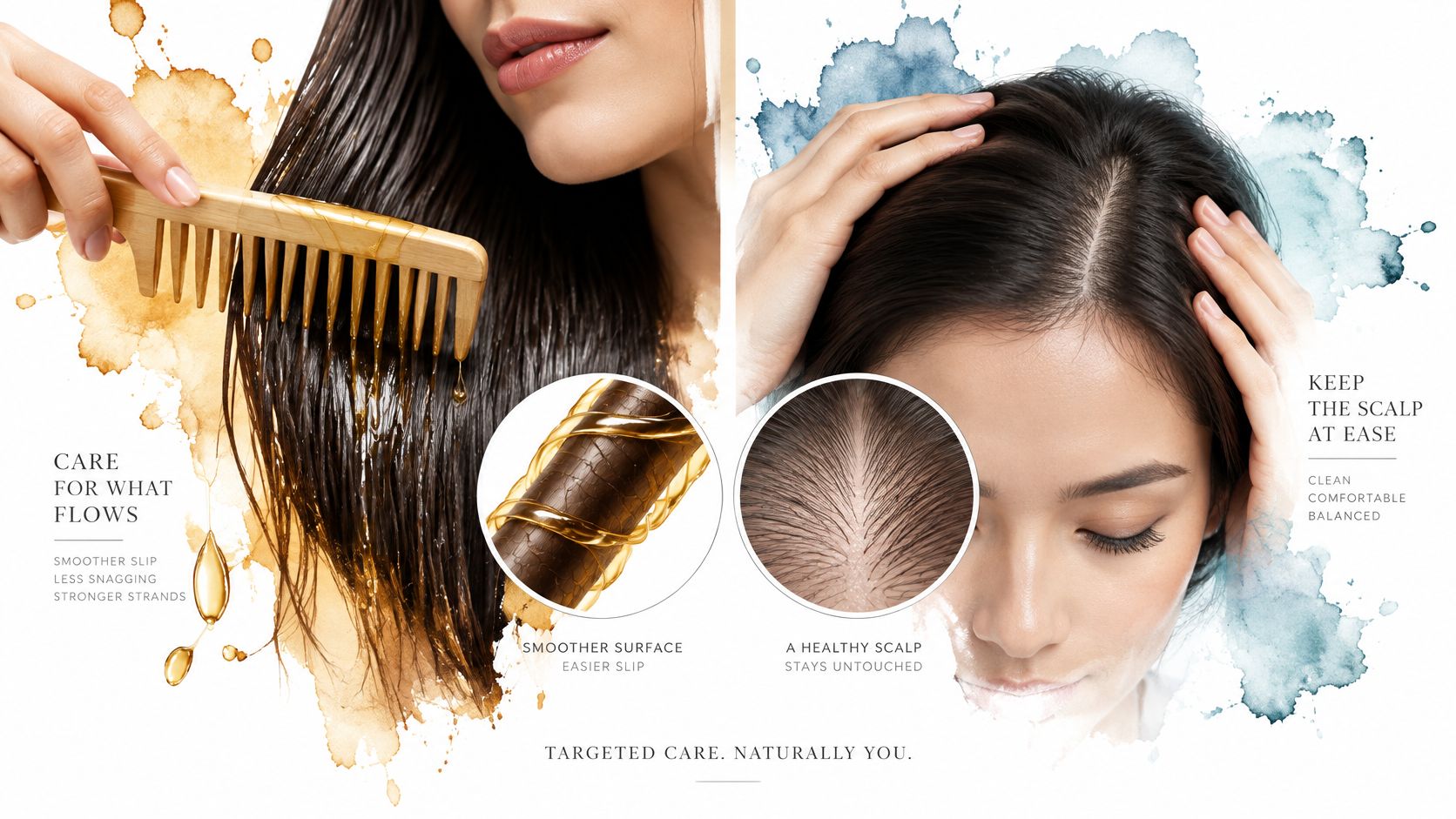
Make comfort the deciding factor
If your scalp is oily, itchy, acne-prone, or easily irritated, keep the experiment on the mid-lengths and ends. A heavy root application can leave an uncomfortable mixture of oil, sweat, and styling residue, even when the ends look polished.
Fragrance and essential oils add another variable. Rosemary, peppermint, and tea tree oils aren't interchangeable with plain carrier oils, and a pleasant scent or cooling sensation doesn't establish suitability.
- Test the finished formula: Try a rice-grain amount on intact skin behind the ear and watch for discomfort over the next day. A home patch check can't rule out every reaction.
- Skip broken or inflamed skin: Don't use an oil experiment to manage an already uncomfortable area.
- Keep essential oils diluted: Don't apply concentrated essential oils directly to the scalp.
- Ask before special-use situations: For children or during pregnancy, get qualified guidance before using essential oils; a simple unscented carrier is an easier starting consideration.
- Clean contact surfaces: Wash brushes and pillowcases when leave-on residue transfers to them.
Keep warmth optional
A comfortably warm towel can make the ritual pleasant, but hot oil and a hot scalp aren't goals. Warmth can change how freely oil spreads, so use less if it begins migrating toward the roots.
Use this video as an optional visual accompaniment to your routine, while keeping your own comfort limits in place.
For general self-care ideas, our guide to natural remedies for dry scalp provides additional context. Persistent irritation or unexplained shedding deserves individual advice rather than repeated oil changes.
An oil can support slip and how your lengths feel between washes. Don't ask it to treat dandruff, dermatitis, or hereditary thinning.
Choose One Oil and Start This Week
Use your wash-day observations as a decision fork. Rough, weathered lengths are a sensible place to test a modest coconut pre-wash; fine hair that wets slowly and becomes heavy easily may suit a trace of jojoba on damp ends.
You don't need to establish a perfect porosity label before starting. Choose the smallest useful experiment and keep it consistent.
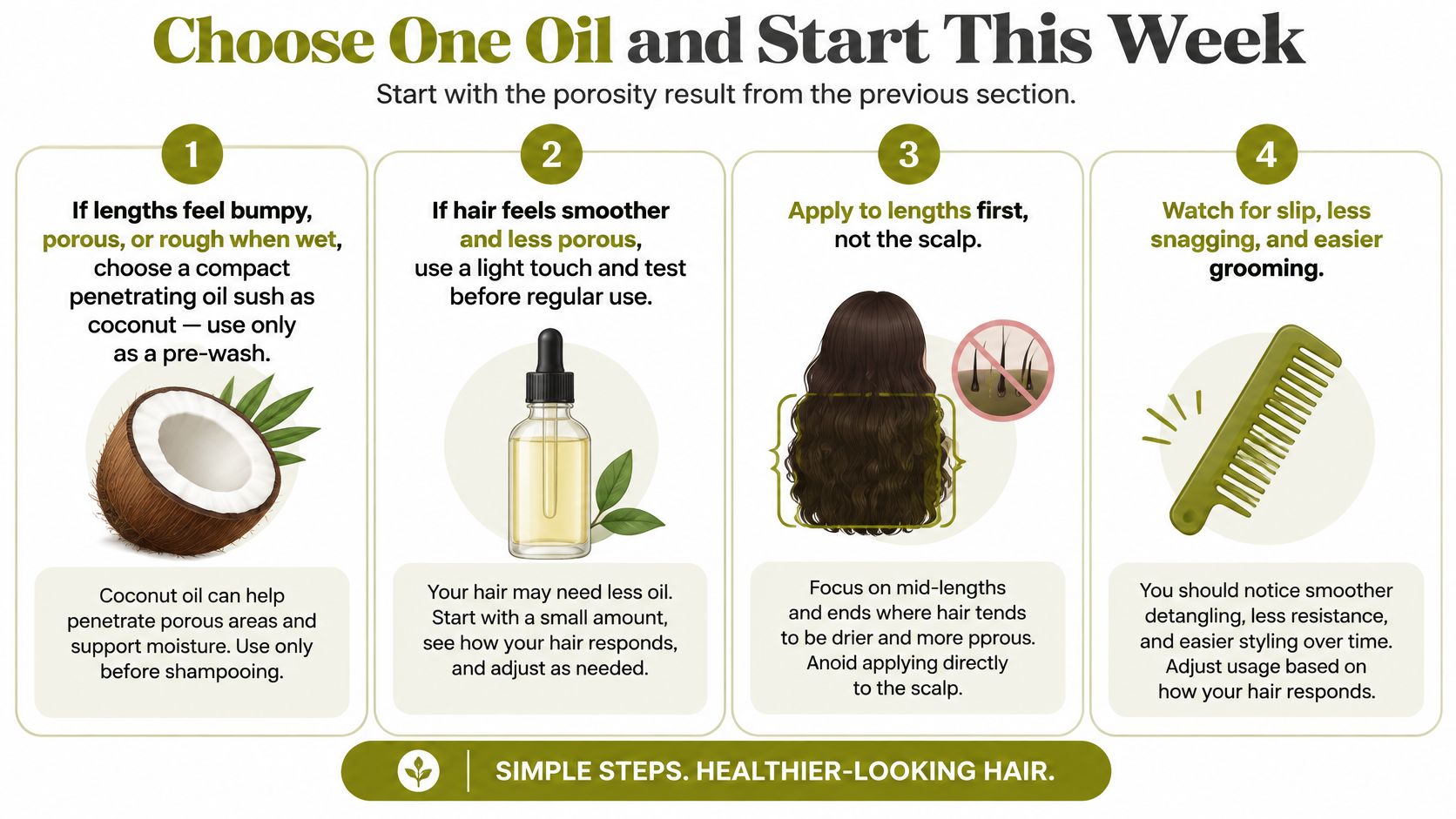
Pick a format you'll use carefully
Read the ingredient list, especially if you prefer an unscented formula. A shorter list can make an experiment easier to interpret, though simplicity alone doesn't guarantee that your skin or hair will like it.
Our ArtNaturals range separates Essential Oils, Hair Oils, and Skin Oils, with oil products in 4 oz, 16 oz, and rollerball formats. Starting options include:
- Keratin Strengthening Hair Oil: The 4 oz bottle costs $14.95, an option to consider for a conditioning-feel routine on dry-feeling lengths.
- Jojoba Essential Carrier Oil: The 4 oz (118 ml) bottle has a sale price of $16.95 and is listed for all hair types.
- Rosemary & Castor Hair Growth Oil Kit: The 4 oz kit has a sale price of $18.97 and is suited to all hair types. Its product name isn't a promise of growth.
- Rollerball oil formats: Consider these when controlled placement matters more than covering long sections.
Check current listings for details and pricing. Our store ships within the USA.
Keep a useful result
Keep one oil and one starting amount through your trial. Continue only if grooming feels easier, the lengths don't remain coated, and your scalp stays comfortable.
ArtNaturals offers carrier oils, hair oils, shampoos, and conditioners for building a straightforward wash-day routine. Visit ArtNaturals to review ingredient lists and choose one oil for your lengths, whether you want a pre-wash treatment or a light finishing touch.