

Many people assume the right hair growth oil for curly hair will make curls grow faster from the scalp. That sounds appealing, but it misses the part curly-haired readers often notice first: new growth can be hidden by shrinkage, while dryness and breakage can remove visible length before it has a chance to show.
A more useful question is, can an oil help your hair retain more of the length it naturally grows? Human scalp hair grows approximately 0.5 inches, or 1.25 centimeters, per month, and about 6 inches, or 15 centimeters, annually, although genetics, age, health, and environmental conditions affect the rate. This hair-growth baseline helps set realistic expectations. An oil may support scalp comfort, reduce friction, and make strands easier to manage, but it won't create several inches of new hair within a few weeks.
Rethinking Hair Growth Oil for Curly Hair
Oil doesn't usually override the biological growth cycle. The follicle determines how quickly new hair emerges, while the length you can see depends on what happens to each strand afterward. Curved strands contract as they dry, so a coil can grow without appearing much longer in its natural shape.
Breakage creates a second source of confusion. Repeated detangling, dry brushing, tight styling, heat, and the constant swelling and shrinking that occurs during wetting and drying can weaken the fiber. If new growth breaks near the ends at roughly the same pace that it appears at the scalp, your hair may seem stuck.
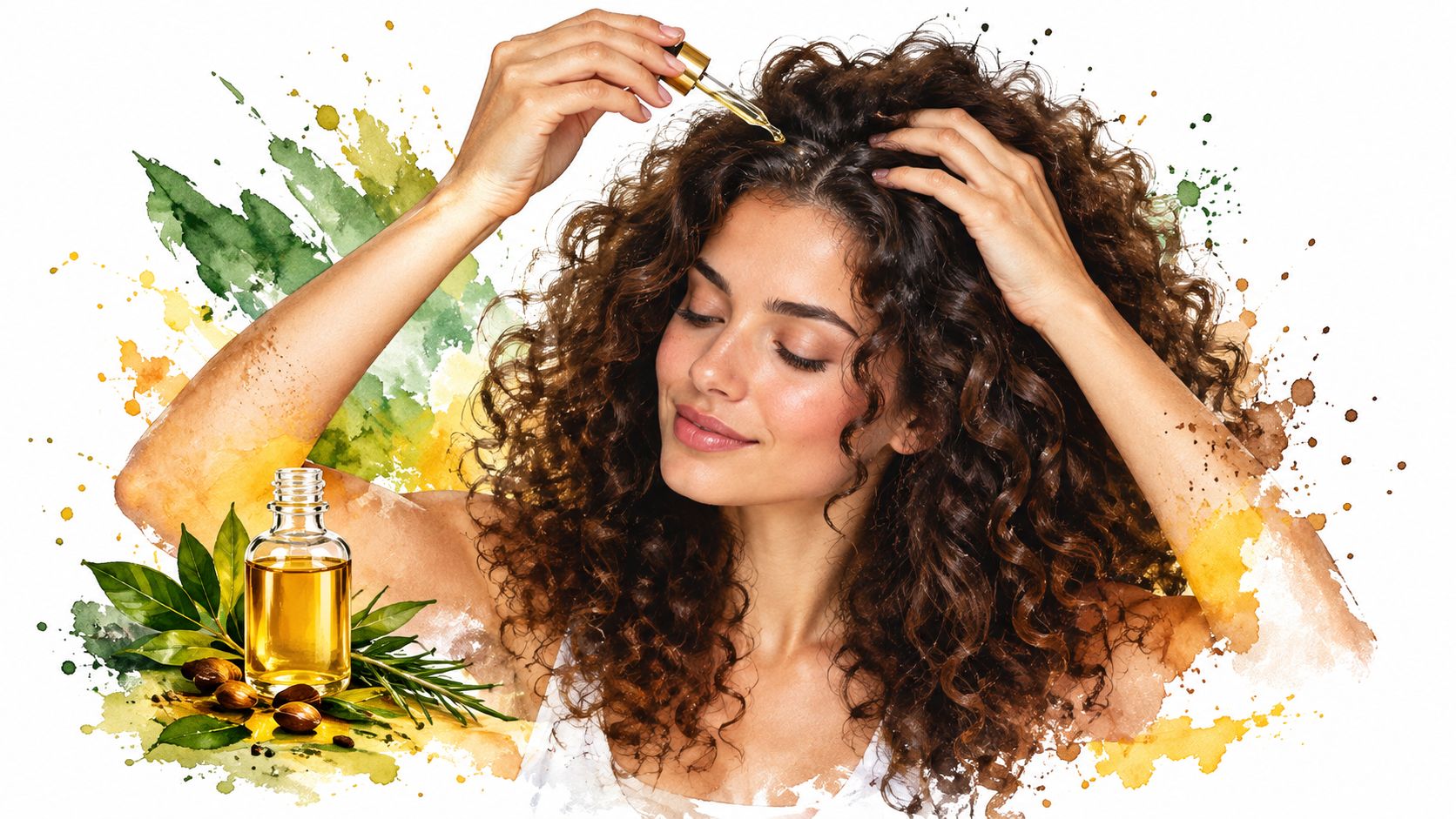
Two goals that shouldn't be confused
Think of curly-hair oiling as serving two different areas:
- Scalp support: A suitable oil can provide lubrication during massage and help the scalp feel less dry or tight.
- Fiber protection: A small amount on lengths and ends can reduce friction, improve slip, and help minimize the handling that leads to breakage.
- Length retention: When fewer ends snap, more of your natural growth remains attached to the hair.
These benefits can make hair look longer, softer, and more defined, but they aren't the same as producing new follicles or changing the underlying growth rate.
A practical rule: Measure growth on stretched hair, not only by looking at curls in their shrunken state.
Take a photograph of the same stretched section each month, using similar lighting and positioning. Track shedding separately from breakage. Shedding is hair released from the scalp, while breakage is a shorter piece that has snapped along the shaft. This simple distinction can show whether your routine is helping you keep length, even when your curl pattern looks much the same.
Choosing Oil Based on Curl Type and Porosity
Curl pattern tells you how the strand bends. Porosity describes how readily that strand takes in and loses moisture. A low-porosity strand behaves somewhat like a tightly closed straw, so heavier oils may remain on the surface and make the hair feel coated. A higher-porosity strand behaves more like a wider funnel, often accepting richer oils but losing moisture more readily.
Your hair doesn't need to fit a perfect category. Start with observation rather than a porosity test. Notice whether a product disappears quickly, whether your curls feel coated after a small application, and how long softness lasts after wash day.
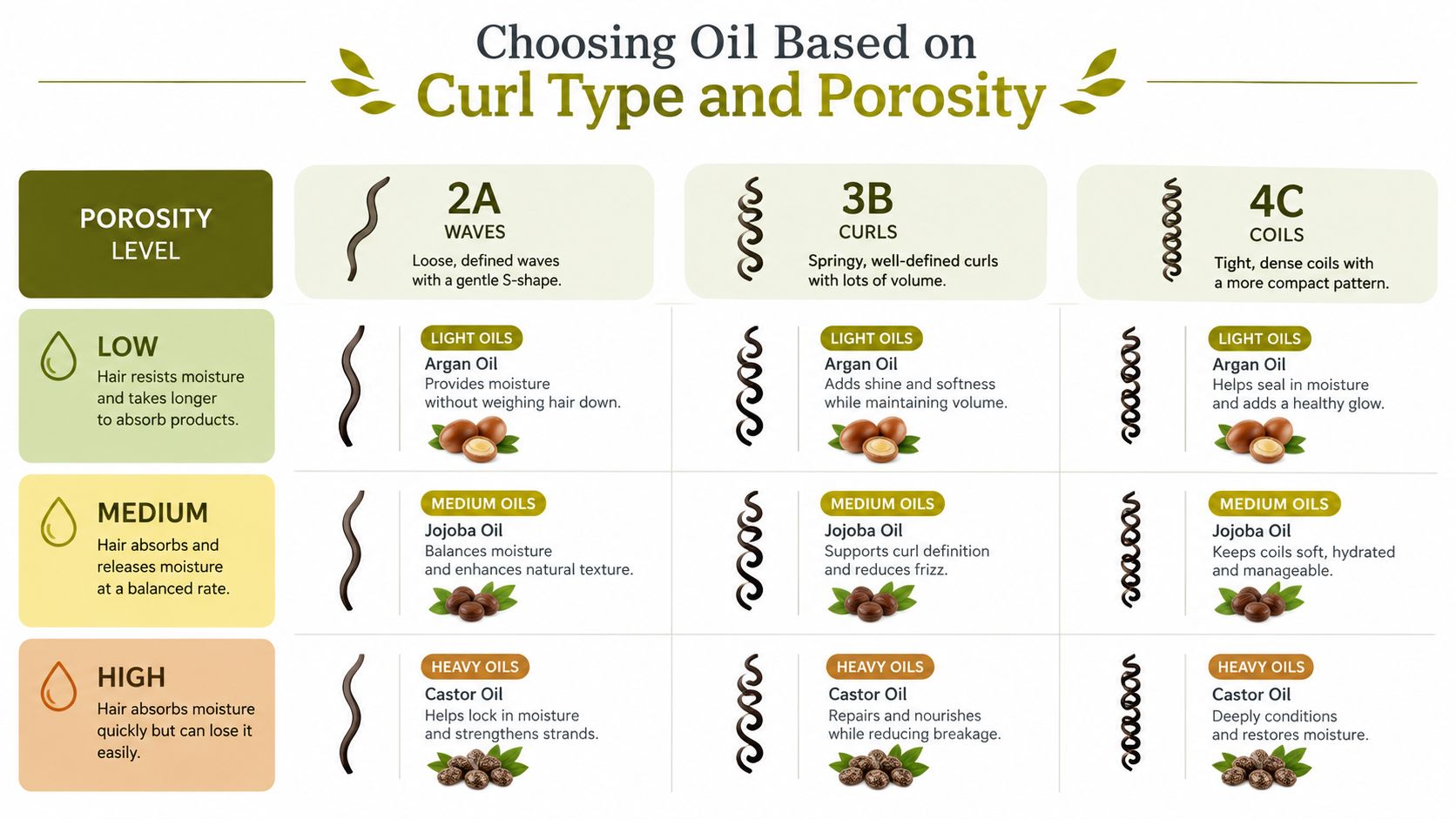
| Curl Porosity Type | Recommended Oil Characteristics | Best Carrier Oil Examples | Application Tip |
|---|---|---|---|
| Low porosity | Light, fluid oils that spread easily | Argan or jojoba | Begin with a very small amount on damp lengths |
| Medium porosity | Balanced oils with moderate slip | Jojoba or sweet almond | Apply after conditioning, concentrating on the ends |
| High porosity | Richer oils that smooth and coat the fiber | Castor blended with a lighter carrier | Use as a pre-wash treatment or on particularly dry ends |
Match the formula to the way your hair behaves
For fine waves or loose curls, a lightweight oil can add softness without flattening the pattern. Medium-density curls may respond well to jojoba or sweet almond oil, especially when the product is applied over a water-based leave-in. Coarse coils and dry, high-porosity hair may appreciate a richer blend, but castor oil is thick and often feels more comfortable when paired with a lighter carrier.
Porosity can also vary across one head. Older ends may feel drier and absorb more product than new growth near the scalp. Apply accordingly instead of covering every section with the same amount.
If you care for extensions or a curly weave, matching the shade and curl character matters alongside oil selection. This guide to color matching for curly weaves offers useful context for choosing a natural-looking match when texture and appearance need to work together. For a deeper look at oil routines, explore Moroccan oil for curly hair.
Best Oils for Curly Hair and What They Actually Do
Popular oils differ more in feel and use than many labels suggest. Argan oil is relatively light and can suit curls that need shine and softness without a heavy finish. Jojoba oil also spreads easily and works well when you want a smoother scalp-massage experience or a modest seal over conditioned hair.
Sweet almond oil sits between very light and very rich formulas. It can give lengths slip during styling, although the right amount depends on strand thickness and how quickly your hair becomes weighed down. Coconut oil has a distinct role in fiber protection. Experimental hair-fiber research found that its hydrophobic coating can limit water penetration, while its molecular structure allows some penetration into the strand. The resulting benefit relates to reduced water-driven swelling and protein loss, not direct stimulation of new follicles. The fiber research on coconut oil supports using a small amount mainly on lengths and ends before washing.
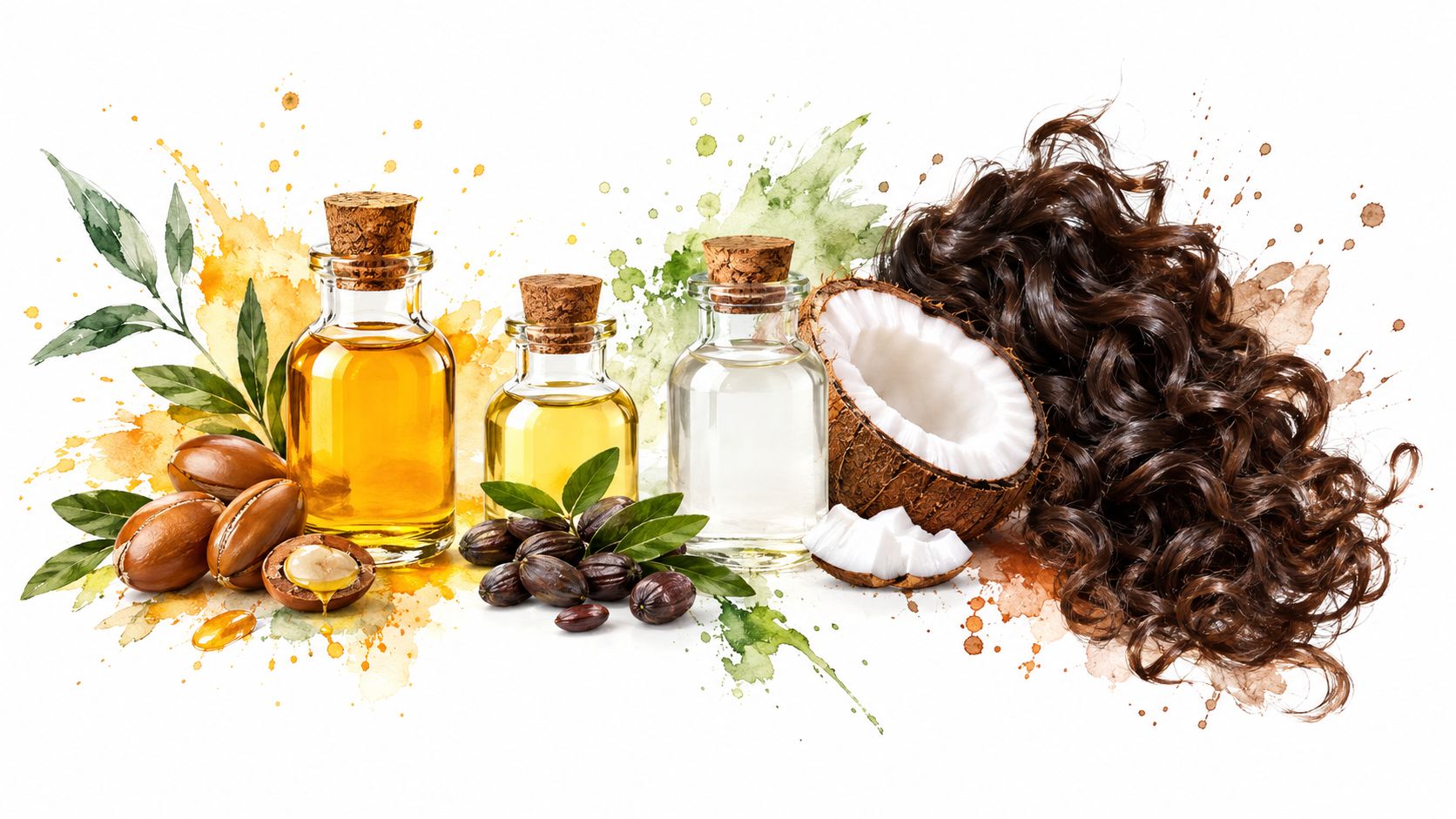
Compare texture before choosing promises
Castor oil is dense, tacky, and useful when you want a more substantial coating. It can support a protective pre-wash routine or add richness to a blend, but too much may leave buildup and make cleansing difficult. Rosemary oil is different. It is an essential oil, not a carrier oil, so it should be appropriately diluted before scalp use.
Read the ingredient list with that distinction in mind. Carrier oils make up the base and provide slip or conditioning. Essential oils are concentrated aromatic ingredients that need careful handling. A short ingredient list isn't automatically better, and a botanical name isn't automatically suitable for every scalp.
For product ideas and ingredient-focused routine planning, this guide to oils for hair growth can help you compare common options by purpose. You can also check Haydaly Curlango on Bornbir if you're exploring curl-focused styling inspiration and want to think about how an oil will fit into your wider routine.
The best choice is the one you can apply sparingly, cleanse comfortably, and use without disrupting your curl pattern. A glossy finish can be pleasant, but it isn't proof of faster growth. Look instead for easier detangling, less roughness, and ends that stay intact.
What the Evidence Says About Rosemary and Castor Oil
Rosemary is one of the more closely discussed botanicals in hair-oil research, but the findings need careful boundaries. A randomized trial enrolled 100 men aged 18 to 49 with androgenetic alopecia. Fifty participants used rosemary oil and 50 used 2% minoxidil, applying their treatments for 6 months. Both groups had a statistically significant increase in hair count at the six-month assessment, with results reported as significant at P < 0.05. The published trial record describes a specific male-pattern hair-loss population, not curly hair, ordinary breakage, or length retention.
The schedule also matters. Participants applied 1 milliliter twice daily to specified scalp areas, and the rosemary formulation contained 3.7 milligrams of 1,8-cineole per milliliter. Hair counts didn't show a significant change at the three-month checkpoint, while the rosemary group's reported average hair count rose from 122.8 ± 48.9 at baseline to 129.6 ± 51.2 at six months. Those details don't translate into a guaranteed result from any bottle used on any curl pattern.
Where castor oil fits
Castor oil is best understood as a thick carrier oil with a protective, conditioning feel. It can help reduce friction on dry lengths and may make a blend feel richer, but the available evidence here doesn't establish it as a direct accelerator of follicle growth for curly hair.
A separate randomized trial involving 90 healthy adults reported changes in measured growth rate, thickness, density, length, and hair fall for rosemary-lavender and rosemary-castor formulations compared with coconut oil over 90 days. The population, concentrations, and measurement methods limit how broadly those results can be applied, especially to textured hair. That study summary supports cautious interest, not a universal promise.
For a plain-language discussion of rosemary within a curl routine, see this rosemary hair-growth guide. Patch-test products containing rosemary or other fragrant botanicals, and stop using them if irritation or dermatitis develops.
Safe Application Methods for Scalp and Curls
A good oil routine is modest. Saturating the scalp or coating every strand can create buildup, weigh down low-porosity curls, and make it harder to notice changes in the scalp. Curly hair also benefits from moisture and gentle handling, so oil works best as one layer in a broader routine.
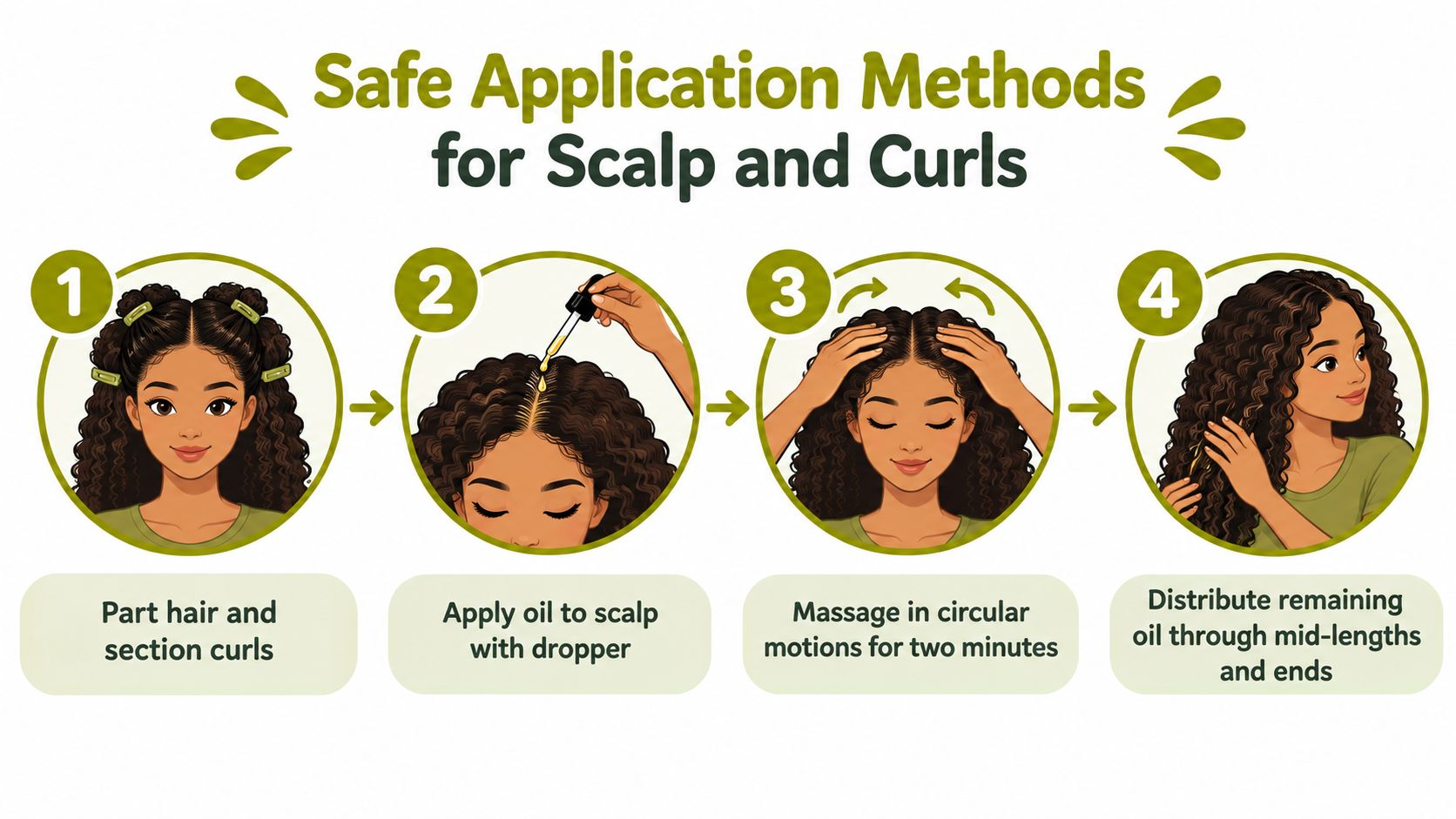
A simple scalp and length routine
- Section first: Part the hair so the dropper or fingertips reach the scalp without dragging through the curls.
- Use a small amount: Place oil along a few partings rather than flooding the whole head.
- Massage gently: Use the pads of your fingers in comfortable circular movements. Avoid scratching with your nails or pulling at the roots.
- Protect the ends: Smooth any remaining oil over mid-lengths and ends, especially where tangling and dryness are most noticeable.
Essential oils should be diluted in a suitable carrier oil according to the product's directions. Patch-test a new formula on a small area of skin before applying it broadly, particularly if it contains rosemary, fragrance, or other aromatic ingredients. Discontinue use if burning, persistent itching, redness, or a rash appears.
For a pre-wash treatment, apply coconut oil or another suitable carrier mainly to the lengths and ends, then cleanse the scalp thoroughly afterward. Research on curly-hair care indicates that curly and tightly coiled strands are especially vulnerable to dryness and breakage. The American Academy of Dermatology's curly-hair guidance recommends washing at least once every two to three weeks for scalp and hair health, adjusting for buildup, products, and personal needs. It also advises thick conditioner, sectioned detangling, and avoiding dry brushing.
Use oil after water-based conditioning when you want to seal softness, or before washing when your priority is reducing friction during cleansing and detangling. If your curls look limp or greasy, reduce the amount rather than adding more shampooing and manipulation.
DIY Blends vs Ready-Made Hair Growth Oils
DIY oiling gives you control over the texture, carrier, and scent. You can choose a light base for fine curls, a richer option for dry ends, or a simple coconut pre-wash treatment without adding several ingredients. The tradeoff is that you must manage dilution, storage, labeling, and consistency yourself.
Ready-made oils offer a prepared formula and a clearer repeatable routine. That can be useful when you don't want to calculate how much essential oil belongs in a carrier, or when you prefer a product with directions and a fixed ingredient list. Neither route guarantees faster growth. The better choice is the one you can use comfortably and consistently without irritating the scalp or creating difficult buildup.
A practical decision filter
Before buying or blending, ask four questions:
- What is the main goal? Choose scalp application when you want a botanical ingredient or massage step. Choose lengths and ends when breakage, roughness, or detangling is the bigger concern.
- How rich is the formula? Argan and jojoba may suit curls that become heavy quickly. Castor and coconut can feel more protective on coarse or porous hair, but they may require more thorough cleansing.
- Are the ingredients clear? Look for named carrier oils and clearly identified essential oils. A vague “growth blend” tells you less about texture, fragrance, or how your scalp may respond.
- Will the routine fit wash day? A pre-wash treatment is practical if you already section and cleanse your curls. A lightweight finishing oil may be easier if your schedule favors quick styling.
A DIY blend should start simply. Use one carrier oil first so you can observe how your hair responds. If you add rosemary essential oil, follow a reliable dilution approach rather than treating a few extra drops as harmless. Keep the blend away from the eyes, don't apply it to irritated skin, and wash it out if the scalp feels uncomfortable.
A ready-made option can make sense when you want less preparation. ArtNaturals Rosemary & Castor Hair Growth Oil is one example of a plant-oil hair product, while Moroccan Argan Oil Shampoo is another ArtNaturals haircare option intended for cleansing within a broader routine. ArtNaturals is a U.S.-based beauty and wellness brand offering essential oils, haircare, skincare, bath and body, and men's grooming, with plant oils and absolutes across its products. Its store also features serums, magnesium oil sprays, and curated gift sets, with clear pricing and reviews to guide shopping. The store currently ships within the USA, while international customers are directed to a partner retailer.
Let consistency reveal what works
Track one routine at a time. Photograph a stretched section monthly, note how much breakage appears during detangling, and record whether your scalp stays comfortable. Don't judge success by shine alone, because oil can make curls look smoother immediately without changing follicle activity.
Longer-looking curls usually come from several small choices working together: enough cleansing to prevent buildup, rich conditioning, wet and sectioned detangling, gentle styling, and an oil that supports the specific job you want it to perform. That approach is less dramatic than a quick-growth promise, but it gives you a clearer way to care for your texture.
ArtNaturals offers plant-oil haircare, including Rosemary & Castor Hair Growth Oil and Moroccan Argan Oil Shampoo, for routines focused on scalp care, softness, and manageable curls. Explore the available formulas and ingredient details at ArtNaturals, then choose one small routine to follow consistently while you track retained length over time.